Translate

Showing posts with label David Grudt. Show all posts

Monday, November 24, 2025

Bela Lugosi in The Midnight Girl; his 'Warren William'-type role


Review by Doug Gibson


Take a look at Bela Lugosi as sophisticated millionaire Nicholas Harmon (seen with co-star Dolores Cassinelli) in the 1925 silent drama, "The Midnight Girl." He's only 42; it's several years before Dracula and stardom. As Lugosi may have said in his later years, observing himself on film, "I was a handsome devil!"


Indeed he was. But he was not yet a star, although active on stage and screen by 1925. In 1924 and 1925, Lugosi had prominent roles in three films: "The Silent Command," "Daughters Who Pay," and "The Midnight Girl." Although his presence and acting ability dominates all three films, he was essentially an afterthought in studio promotions.


In "The Midnight Girl," (Chadwick Pictures Corporation) Lugosi's Harmon is a charming rogue, even amoral. He is a prominent patron of the arts, and sleeps with the singing opera diva of a top-notch production, Nina (Cassinelli). But he's likable, and fawned over by many. 


Lugosi is playing -- to perfection -- the kind of role that Warren William would hone within several years. If there had not been "Dracula" waiting, one can wonder if Lugosi would have done these "charming rogue" rich-man roles in the early sound features?


Back to the plot: There's an issue. Nina is aging gracefully and still occupies Harmon's bed. (This is a pre-pre-code film; there's a risque scene where Harmond views his nearly nude mistress through a filmy obstruction. He instructs her to go to his quarters after work.) But Nina is also losing her voice on stage. Harmon needs to find a new singer for his musical pleasures.


Harmon has a stepson, Don (Gareth Hughes). Don is a bit of a stick in the mud (but maybe that is due to Hughes' lackluster acting?) Hughes is morose, fending off a money-grubbing girlfriend, and her ambitious mother. One night, in Nina's presence, Don denounces his father and Nina. The father-and-son argument results in Don leaving in a huff, saying he no longer wants his father's money.


We are finally introduced to the film's star, Lila Lee. She plays Anna a Russian refugee, poor after fleeing communist Russia. Don, who has located a job as an orchestra director for a fancy restaurant, discovers Anna. (There's a scene in a street where Don protects Anna from a young thug who later attempts revenge but it's kinda drab.) What happens is that Don, recognizing Anna's talents, provides her top billing as "The Midnight Girl" who sings at the stroke of midnight. (See the newspaper clip above) Don and Anna also fall in love.


So arrives the conflict. Nicholas goes to the restaurant to see how his son is doing on his own. The father sees his son's discovery Anna and promptly falls in love, although falls in lust is probably more accurate. Nicholas is a man who feels he should get what he wants. He's fond of, as he puts it, new kisses. The father manages to coerce Anna into his quarters, and, as mentioned, he's a man accustomed to getting, not wanting. But Anna does not want Don's dad. That provides a climax that involves Nicholas, Don, Anna and Nina.


I will not give away the ending. I do urge readers to watch this film. It's easy to find and free (here). Lugosi is absolutely magnificent in the role. The camera loves him and, again, he shines.


NOTES: Flora Finch, an early silent comedy shorts star, has a small role as Don's landlady. Finch would do well in early sound films later. The film was directed by Wilfred Noy, maternal uncle to actor Leslie Howard ("Gone With the Wind," "Pygmalion"). The film was based on a story by Garrett Fort, who later wrote scripts for "Dracula," "Frankenstein," and "Dracula's Daughter." Contemporary reviews praised Lugosi's performance. Lila Lee was a major star in silents and very early sound films. She was out of films by 1937 but returned for a handful of performances starting in 1952. Some reviews criticized the nightclub and restaurant musical performances as handicapped by a small budget. However, this reviewer thought the dancing, singing, and overall pomp very impressive.


Below are more 1920s newspaper clips of this film. The clips are courtesy of the research of my friend, David Grudt, of Long Beach, Calif. One clip shows a lawsuit resulting from the film. Also, note the ad for the Charlie Chaplin film, "The Gold Rush," which was playing at the same theater.


Friday, May 9, 2025

Last of the American Hoboes: A review


Review by Doug Gibson


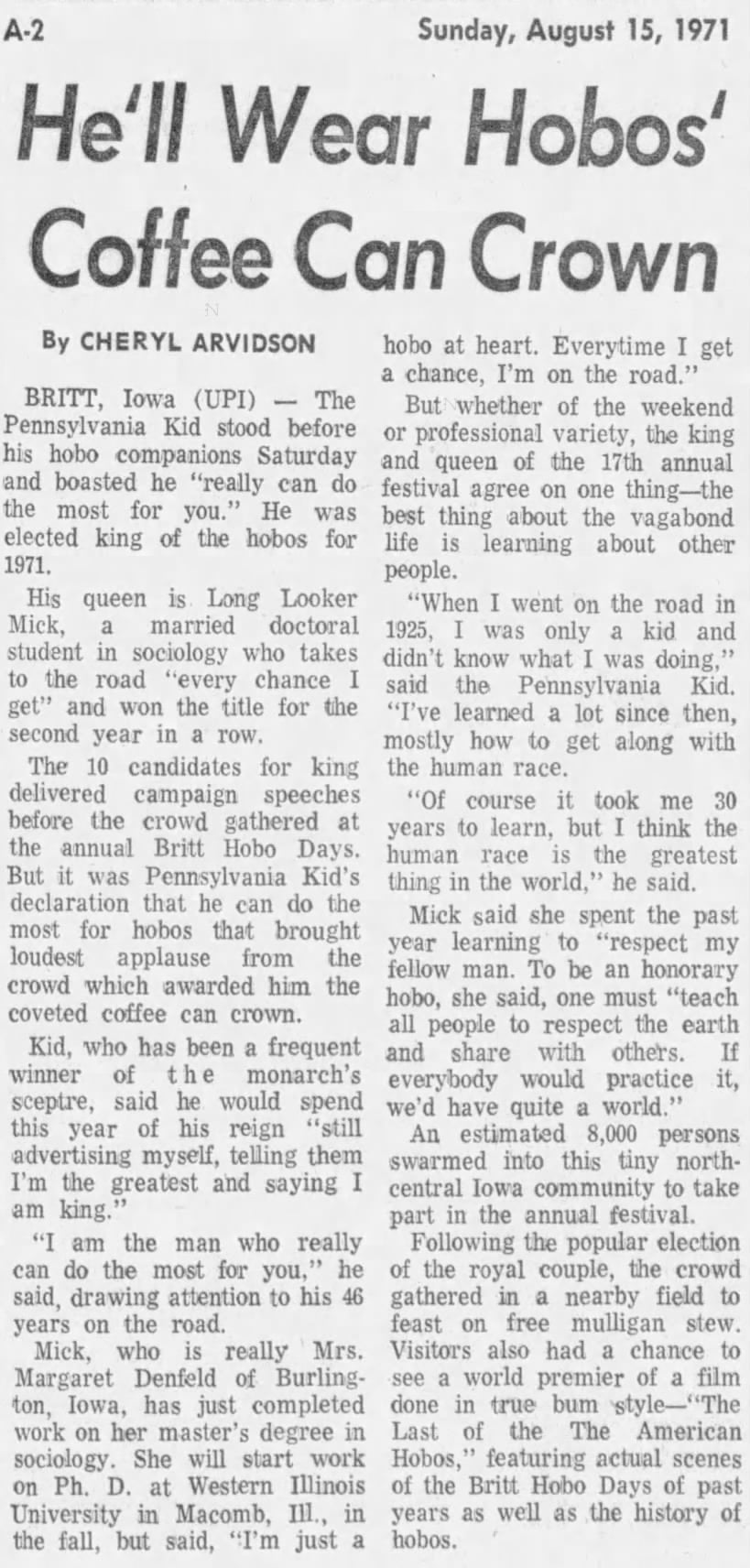
The actor above is the late Titus Moede (also known as Titus Moody). It's a still from the film "The Last American Hoboes," which has a date of 1967, but I don't believe it premiered until at least 1969.  View a trailer here.


I used to read about this film in the pages of Cult Movies Magazine. Moede occasionally contributed for the pub, either as interviewee or interviewer. He was active in the film industry for 40-plus years. Early in his career he was a TV actor. He moved toward low-budget cinema in the '60s, working for Coleman Francis and Ray Dennis Steckler. My favorite Moede film is "Rat Pfink a Boo Boo." 


Like some of his peers, Moede gravitated to adult cinema. His tasks included directing and photography. But "Last of the American Hoboes" was a passion project of his. Over the course of several years, Moede, along with script writer/actor Gordon Barclay, gathered film for this pseudo documentary that included a healthy dose of filmed dramatic inserts. Moede and Barclay moved from skid row streets to railroads, to "hobo jungles," to flophouses, cheap late-night diners, skid row, country homes, old trees, and many roads of middle America and the American West. The film has a lot of atmosphere with the relaxed outdoor hobo camps, and trains, and the different, cramped, oppressive life in downtown skid row. It culminates in Britt, Iowa, where a hobo convention is held and a hobo king crowned.


The film includes a few low-budget cult names of the era, besides Moede and Barclay. Genre fans will notice Coleman Francis and Bruno VeSota. The cast includes hoboes of the 1960s, including contenders vying for the title of hobo king.


I am really surprised this film never made it to the now-canceled TCM Underground movie series. Or maybe I missed it. But I doubt it. It also seems like a film that public television of that era might have been interested in airing.


I always wanted to see this film, and could have bought it thirty years ago. The magazine had ads for it. But it was an era when I was yet to solidify a career and couldn't easily part with the cash. But every few years I would casually scan the Internet for the entire film, but no luck. It had been a few years but recently I looked for it again and lo and behold, it's currently free to watch on Tubi.


The film also released an album of songs (see cover below). These are songs of the road and hobo history. The film boasts of covering 70 hears of hobo life. I enjoy the songs a bunch and will probably haunt Ebay to find a reasonably priced copy of the album. I was surprised a reviewer of the film on IMDB.com panned the songs. They are actually quite cool. 


So, after finally viewing it, what's my take on "Last of the American Hoboes?" Thumbs up. It's far from a great film. The low budget hampers it. Often scenes are shot silent and voices dubbed in. I would have liked to have seen more action in Britt, Iowa, and less inserted drama. The actors are earnest but limited. Also on IMDB.com a reviewer recalls being in the film as a child. She has nice things to say about Moede.


But those are really minor quibbles. This a fascinating film, a deeply personal endeavour from Moede and Barclay, who clearly have love and passion for the subject. Just the locations they moved into, and the unique individuals, as well as points of view that are inserted in the film, make it remarkable. Without condescension, the lives of hoboes, tramps and stationary homeless individuals are treated with respect. The film recreates history, including the unfair, sad state of the Depression-era Bonus marchers and the criminal trial and execution of IWW "Wobblie" labor leader Joe Hill.


The best acting is from Barclay, who portrays a traveling hobo. With his haunted, gaunt, unshaven face, and old clothes, he conveys effectively the frustration, and impotent anger of a man who understands all too well he's getting the short straw in life. His accounting of a man's suicide in a flop house is moving.


Moede is prominent later in the film as a bearded traveler riding the roads to the convention. 


I have no idea if this film played theaters. Our newspaper archive expert in Long Beach, Calif., David Grudt, found some newspaper clips for the film, which shows it garnered publicity in southen California. Rumor has it Moede garnered awards for the film. Late in his life, Moede received a career achievement award at a Cult Movies Magazine convention. He died in 2001. 


Below is a snippet of a Hollywood Citizen-News column in 1971, from Criswell, plugging the film. It's from the last edition Cult Movies magazine published.


Below are David's clips from, in order, The San Francisco Examiner, June 13, 1969; Ventura County Star, Aug. 15, 1971; Redding Calif., Record Searchlight, May 21, 1975; and finally, two small clippings from The Los Angeles Times that ran roughly 25 years apart! Same notice, Sept. 2, 1972 and Aug. 28, 1997. (I would have enjoyed a serving of Moede's hobo stew!). The film was sold for a long time at the now-gone Mondo Video a Go-Go in Los Angeles.


Monday, March 31, 2025

Devil Girl From Mars - A Female Darth Vader


It's hard to believe that Devil Girl From Mars may have once scared the pants off baby boomers of the mid-1950s. The plot of the film has many similarities to the 1951 classic The Day The Earth Stood Still.


Martian Nyah, played by Patricia Laffan, is a sex starved, female version of Darth Vader who comes to earth to find men to take back to mars for breeding purposes. She comes dressed in a tight black outfit and cape, and carries a deadly ray gun. Her spaceship crashes in the hills of Scotland.

Joining Nyah is her oversized robot shaped like a kitchen appliance with a police light on top. The robot zaps anything and anyone in his path with an atomic ray, including humans who do not obey Nyah. He walks with a pace slower than a common snail, making it easy for victims to get away.


Nyah projects an invisible ray around a local Scottish Inn to keep the occupants contained while she decides which men to take back to mars with her. The occupants make several attempts to stop Nyah, but are unable to foil her plot. One of the occupants, an escaped murderer from a local jail, agrees to return to mars with Nyah in exchange for sparing the lives of the remaining inn occupants. While onboard Nyah's ship, he is able to destroy it, spoiling any future plans to return to earth for more men.


Most 1950s sci-fi films portray women as helpless victims while the men are busy being the heroes and saving the day. Devil Girl From Mars, however, reverses this formula a bit. Nyah is an evil queen from another world who has come to terrorize male victims. Was this a bold feminist statement for the 1950s? Perhaps. But only if Nyah had been successful in her attempts to bring back men to mars. Nevertheless, this is what makes Devil Girl From Mars unique from so many other 50s sci-fi flicks. Enjoy, and happy viewing!

-- Steve D. Stones

(The newspaper clips are courtesy of David Grudt, of Long Beach, Calif. From the top: Long Beach, Calif. Independent, Tuesday Aug. 9, 1955; Long Beach, Calif. Independent, Saturday, March 16, 1957; Long Beach, Calif. Independent TV listing, Sunday June 1, 1958; and below, a shocking news story about a young moviegoer who was burned while watching the film in a theater. From the Oakland, Calif. Tribune, Thursday July 12, 1956.)


Monday, March 24, 2025

Journey to Freedom a flawed by compelling Cold War drama from cult filmmaker Stephen C Apostolof


---

Review by Doug Gibson


Most cult film genre fans know the late Stephen C. Apostolof  as the director of the mid-‘60s Ed Wood-scripted “nudie-cutie” film “Orgy of the Dead,” with ponderous, pontificating Criswell, shot in a Hollywood graveyard, with very, very long poorly choreographed nude dances. Those deeper into cult genre know Apostolof, later in his career, hired Wood to script, act, and generally just help out in several more soft-core films the Bulgarian-born director made in the ‘70s.


But Apostolof, who died a generation ago, was a fascinating, charismatic man with an intensely interesting life story. The biography, Dad Made Dirty Movies, by Jordon Todorov and Joe Blevins, is a book that merits more sales success. There is also a film documentary on Apostolof’s life and career.


At the age of 18 Apostolof, a lifelong anti-communist, was imprisoned by the communist party that then ruled Bulgaria. He eventually managed to get out of that country, and  -- with many adventures – moved his way through Istanbul, Paris, Canada and eventually to the United States, where the now-married Apostolof settled in Los Angeles for decades.


A man of many jobs, Apostolof was interested in making a semi-autobiographical film detailing, with some license, his experiences eluding communism. The 1950s were a decade with anti-communist films. Bigger-budget films included “The Woman on Pier 13” and “I was a Communist for the FBI.” But there were lower-budget efforts too, including “The Beast of Budapest” and “Escape from the Iron Curtain,” which starred a young Theodore Bikel. Apostolof consulted with a friend, Herb Niccols, to write a screenplay based on Apostolof’s life.


Apostolof formed SCA Productions, managed to get $47,000 in funds, and made the 60-minute “Journey to Freedom,” which RKO eventually agreed to distribute.


How good a film is “Journey to Freedom?” Well, I like it, but I love cult films. I love those low-budget, ragged puppies of movies made on a wing and a prayer. “Journey to Freedom” is a very personal film. It details the escape from communism of Stephan Raikin, (Jacques Scott) a mild-mannered pianist/writer who escapes prison with two friends. Raikin gets a job playing piano in an Istanbul bar. There he encounters a monster of a man (Tor Johnson) who hates Bulgarians and beats up Raikin. Alone now, Raikin takes off for Paris and falls in love with a beautiful woman, Nanette (Michele Montau). Their romance has potential but the communists are still trying to kill Raikin, who is now interested in working for Voice of America. The pair break up. Raikin makes it to New York City. Injured there, he falls in love with and marries his nurse, Mary (Eve Brent). They move to Los Angeles, have a child (played by Apostolof’s real life child, Polly) and began an idealistic life, in a happy home, going to church, and Raiking writing for Voice of America. But the Bulgarian secret police won’t stop pursuing him, and the climax involves one more attempt to ruin the immigrant dissident’s life.


The plot sounds interesting, but it needs a better script and budget. Frankly, to encompass the plot, the film needs 30 extra minutes. But due to budget strains, it’s episodic, with abrupt plot changes, plot twists that seem contrived, and just passable dialogue. The film has lots of stock news footage, which is interesting.


The film is either enhanced, or lowered (depending on the viewer’s opinion) by the unique inclusion of a Bulgarian communist secret police member who narrates much of the film. This is done to move the plot along and increase awareness of the ongoing danger facing Raikin. I found this initially fun although it started to wear out its welcome later. The narration is very campy, sort of told in an accented “Snidely Whiplash” type of manner.


The crew and cast is a cult genre fan’s delight. Director Robert Dertano directed ‘50s cheapies “Girl Gang” and “Paris after Midnight.” He was also an assistant director in “Orgy of the Dead.” The cameraman was Ed Wood’s favorite, Bill Thompson, who filmed “Plan 9 from Outer Space.” Tor Johnson does a rare speaking part in Journey to Freedom. He also had dialogue in “Plan 9 From Outer Space.” Don Marlowe, a former agent of Bela Lugosi with a rascally reputation, has a small role as a detective. Apostolof has a small cameo in a scene where he wears a beret.


The cast is not bad. Scott was the son of a British ambassador. His best role was in the Jack Lemon, June Allyson film “You Can’t Run Away From It.” Montau was a working actress. Her best role might be “The Devil at 4 O’Clock,” with Spencer Tracy and Frank Sinatra. The best-known actress in the film is Brent, who had a very long career. Today her face is recognizable because she was so ubiquitous in TV and films. In the big-budget film, “The Green Mile,” she had a substantial role. Her career was still young in “Journey to Freedom” and she bears a resemblance to Shelly Winters.


It’s easy to tag these 1950s anti-communist films as an element of the McCarthy era. But that’s not really fair for films dealing with oppression in Europe, such as “Journey to Freedom” or “The Beast of Budapest.” The treatment of dissidents, even peaceful ones, was uniquely cruel. My father in law, a labor leader in Hungary who supported the unsuccessful ’56 revolution, was imprisoned and tortured. Scores of thousands were murdered.


Apostolof was certainly proud of the film. But it bankrupted him. He only earned a small percentage of his investment back. Yet, he was resilient, and enjoyed long success making soft-core films with the moniker A.C. Stephen. His career -- and family life -- make for fascinating reading in “Dad Made Dirty Movies.”


Currently, “Journey to Freedom” can be viewed (free) on Amazon Prime. It’s part of the streamer MGM+ offerings. It’s definitely worth an hour of your time. And buy his biography. (I think Max or Netflix, etc. could make a fascinating multi-part series of his life, but what do I know?)


Plan9Crunch thanks David Grudt, of Long Beach Calif., for unearthing these several newspaper clippings of the film. From top to bottom, the sources are: South Bend Tribune, South Bend Indiana, Oct. 17, 1957; Anaheim Bulletin, Anaheim California, Jan. 19, 1957; The Bellingham Herald, Bellingham, Washington, Nov. 13, 1957; Los Angeles Evening News, Hollywood, California, Dec. 3, 1957; The LA Times, Thursday, December 1, 1960 (already on TV).


Wednesday, February 5, 2025

Peter Lorre's The Face Behind the Mask has a finale that punches viewers in the gut


Review by Doug Gibson

"The Face Behind the Mask," 1941, may be Peter Lorre's most understated masterpiece. He's superb as kind, pacifistic immigrant Janos Szabo, who is disfigured in a fire. His appearance kills his career as a watchmaker, so he embarks on crime and is very successful, buying a mask to alleviate his appearance.

One day he meets a beautiful blind working woman, played by Evelyn Keyes, and they fall in love. Szabo leaves his crime gang, but they won't let him go. The final 20 minutes or so of this film has the impact of a punch in the gut. Ironically, I learned on TCM's commentary that Lorre hated the film.


Lorre signature menace is excellently portrayed here, despite his then-slight figure. He’s initially an idealistic immigrant from Hungary, eager and optimistic. It’s powerful to witness his despair and loss of idealism that turns him into a reluctant crime leader.

Above and below are 1941 newspaper clippings on the film, from the Long Beach (Calif.) Press-Telegram, the Oakland (Calif.) Post Inquirer, and the Daily Times-Advocate, from Escondido, Calif. Plan9Crunch thanks David Grudt, of Long Beach, Calif., for unearthing these gems.


Sunday, January 21, 2024

The Phynx is a uniquely bizarre film from 1970 with a tiny cult


Review by Doug Gibson


The Phynx, 1970, from Warner Brothers, is a cult film, albeit with a very tiny cult. It is both jaw-droppingly bad and completely-bizarre unique. I've watched it five times and it's progressed from a total disaster to hey, there's a little bit of fun here. This film had a smidgen of potential to be an extended Laugh In-type gem parody. But it was made by big-studio executives, who had their own idea of how to interpret and capture the youth enthusiasm of the '60s. It was fated to bomb.


Super secret United States intelligence professionals are trying to rescue a lot of aging celebrities and stars who have been kidnapped by Albania. Their efforts, helmed by a Waylon Smithers-type agent named Corrigan, have been failures.


So, Corrigan's superior, named Bogey, played by Michael Kellin, who has the worst Humphrey Bogart accent you'll ever hear, gathers a confab of all the U.S. secret agents. There are Boy Scout agents, prostitute agents, Ku Klux Klan agents, you get the idea. There's also the big leader, the president, who wears a box over his head. He's played by Rich Little. 


Eventually it's decided to consult a machine called MOTHA. It is, forced laughter, shaped like a woman. Asked for a solution, its computer mind bubbles in her two metallic breasts and the answer, on a slip of paper, shoots out of MOTHA's ... ahem ... middle section. This is not a subtle movie.


The answer is to form a rock group called The Phynx, and both prepare these four band mates to be the most popular singing group in the world and highly trained agents able to rescue the hostages in Albania.


So four ordinary 60s young guys are kidnapped and taken to a military base where Bogey tells them the situation. One of their trainers is a young Richard Pryor.


To mercifully move this ahead, the Phynx become the number one rock group in the world, despite really terrible songs. I don't think the filmmakers intended for the band to stink, they just do. Some of the ways the Phynx get to the top involve infiltrating record stores, putting a gun to Milton Berle's head (another cameo) and having the president change Thanksgiving to Phynxsgiving (I'm not making that up). Through mass marketing and publicity, they've also made the four singers sex symbols. 


The captives cum secret agents also get military training. In one unfunny sequence, a military instructor blows himself up.


The boys start to grumble about lack of female intimacy. So they are allowed an orgy, with Bogey uttering these unforgettable words, "Gentlemen, the United States government is pleased to announce an orgy!" ... It's pretty tame, lots of flesh covered by bikinis, somewhere between PG and PG-13. The Phynx was rated GP. I remember GP. It was below R, an ugly malformed cousin to what would morph into PG a decade-plus later.


There is a creepy, not-good scene after the "orgy" where Corrigan (who plays the sexually frustrated one in this film) picking up the orgy women with a --- I am not making this up -- forklift and dumping them outside the orgy warehouse. The women appear to be sleeping or unconscious. 


Meanwhile, there are still more celebrity kidnapping to Albania, with news reports. The Phynx is big on news reports, and montages with dippy doo-dwop music inappropriate for the late 1960s. Finally, the four members of The Phynx are ready for their mission. But they do not exactly know where to go in Albania.


In a staggeringly unfunny scene, a female secret agent (played by Martha Raye) arrives to provide the information. But Bogey stupidly shoots her through a hotel door, mortally wounding her. Before she dies, she informs the quartet that a map -- in three parts -- is tattoed on the tummies of three girls.


So, through London and Copenhagen, the Phynx embarks of thousands of sexual (PG remember) encounters with women searching for the tatooed tummies. They find two, one tummy belongs to Russ Meyer starlet Susan Bernard. In France, the tired overcopulating Phynx are allowed to wear glasses that can see through exterior clothes. This leads to a few unfunny scenes with The Phynx leering, putting on glasses ... However, the glasses don't work when one tries to peek at a nun. But they find all three tummies, put the map together and head to Albania.


The Phynx are so globally popular they're actually welcomed to perform. Once there, they discover the communist dictator is not really the culprit. It's a military officer (played by Michael Ansara) who has gone a bit crazy. He has the only military tank, so he can assert his will and keep the hostages, and the president, his wife, and their very weird son at bay. The Phynx have dinner with the powerless first family. The first lady is played by Joan Blondell, a pre-code sexy star in the '30s. She had a long career beyond the '30s. Blondell is the only non-cameo star of this film who gives a good performance. She's bubbly, witty, and has good comic timing.


So, the Phynx are introduced to all the hostages taken by Albania. They enter a ballroom like it's the Academy Awards. You can read all of the names at the Wikipedia page. They include Dorothy Lamour, Xavier Cugar, Colonel Sanders, Rona Barrett (I remember her), Johnny Weismuller, Maureen O'Hara, Pat O'Brien, Leo Gorcey, Huntz Hall, former boxing champ Joe Louis, Dick Clark, Guy Lombardo, Busby Berkeley, Andy Devine, Butterfly McQueen (Prissy in Gone With the Wind), Ruby Keeler, Patsy Kelly, George Jessell, and more. It's almost like if Hollywood Squares multiplied 25 or so times.


The plot is mostly out the window, and The Phynx and captives think of ways to escape. I won't give it away, but they follow Huntz Hall's suggestion. Seeing Gorcey and Hall together is bittersweet, given their long association. Gorcey died before The Phynx was released.


The next morning the film's climax occurs. Watch it to see the end. It's a $2.99 rental at YouTube. It occasionally shows up on TCM, I believe first as a now-defunct TCM Underground offering. Warner Brothers finally released a DVD roughly a decade ago. Evidence of the film's tiny cult is that for decades fans/collectors would haunt trade shows or more shadowy sellers trying to buy bootleg copies of the film. For a long time, Warner Brothers just wanted to forget about this monetary disaster.


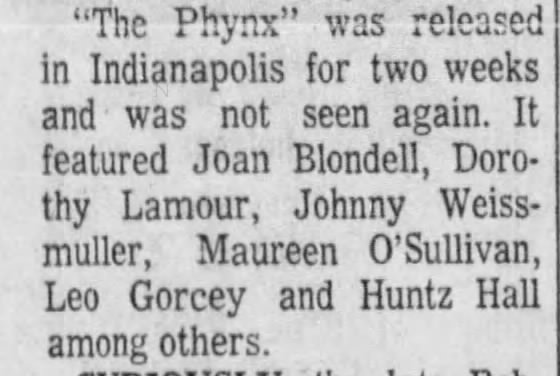
There was a small effort to promote The Phynx, although executives, who could watch dailies, rough cuts and previews, must have been aware the film was a turkey. My friend, David Grudt combed though newspaper archives and found the clips you see on this post, originally published in 1970 in the Indianapolis Star. The top clip promises a "world premiere" and mentions a "Rock and Roll Phynx contest." That must have been a big hit. (sarcasm intended) The second clip shows many of the guest stars and cameos in The Phynx. Poor Joe Louis gets his name misspelled.


So there was publicity for the film, an effort was made. It was all for naught. As then-UPI columnist Vernon notes in our final clip, "The Phynx was released in Indianapolis for two weeks and not seen again."


Despite its many faults, The Phynx, like any cult film, gets better the more you watch it. Despite being far more like Skidoo than Head, the film can bring the occasional smile.


NOTES: The best part of the film is when the has-been celebrities appear and we get to hear their banter. Some is witty. Pat O'Brien observes that if he had played the Gipper in Knute Rockne All-American, the 1940 classic, he'd be in Sacramento. That's a dated but funny gag as Ronald Reagan, who played The Gipper, was governor of California at the time. Reagan, of course, later became U.S. president. O'Brien played Rockne in the film. Another bittersweet funny gag is Joe Louis pointing out one advantage of being in Albania was there's no income tax. The joke has time-era relevance as Louis was hounded by tax authorities after his career for not paying taxes. Finally, maybe the best line is former Tarzan Johnny Weismuller turning to former Jane Maureen O'Sullivan, and saying, "Me Tarzan. You Jane." Despite the popularity of the quote, Weismuller never said that in a Tarzan film. The Phynx were played by A "Michael" Miller, Ray Chippeway, Dennis Larden, and Lonny Stevens. They are forgotten today. Only Larden had any marginal success singing, and it was before The Phynx. He was part of a group called Every Mother's Son that scored a hit with "Come on Down to My Boat." The group disbanded in 1968.


Monday, January 30, 2023

Freaks and The Devil-Doll: two great Tod Browning classics


By Doug Gibson


We love Tod Browning's films at Plan9Crunch blog, and we thought we'd spare some paragraphs on a couple of his better MGM films of the 1930s: Freaks, 1932, (see news clipping ad above) and  The Devil-Doll, from 1936. Also, thanks to David Grudt, of Long Beach, Calif., we go back in time and see classic newspaper clips about the films.


FREAKS


Besides “Dracula,” the film Browning may be best known for is the 1932 "Freaks." It is a masterpiece of surreal horror. The plot involves a selfish, beautiful trapeze artist (Cleopatra) who marries a little man (Hans) for his money. With her strongman lover (Hercules), she plots to kill Hans. Their big mistake is that they assume the circus “freaks” are little children, rather than adults capable of retribution. What they learn too late is that the “freaks” — and the actors really were such — act like children as a defense mechanism. They want to be left alone. But threatened in their environment, they draw strength from numbers.


For 40-plus minutes of this slightly longer than an hour film, we are not scared. Instead, we learn about life in a circus, and we view the “freaks” as human beings. The last 20 or so minutes are horrifying as the “freaks” gain revenge on two who would falsely request their trust and then try to kill one of them. The scenes of the “freaks” with knives and guns, peering through windows and under wagons, slithering, hopping, sliding and pursuing Hercules and Cleopatra through a dark rainy night are frightening. For years, the fim ended with a brief, jarring shot of what the “freaks” had done to Cleopatra. It’s one of the most shocking finales in film. But now “Freaks” when seen on Turner Classic Movies, adds the epilogue with Hans and other characters that diminishes the impact a little.


“Freaks” was ahead of its time. The suits at MGM hated the film and barely distributed it. More than any other film, it damaged Browning’s career. In fact, it was banned in Britain for 40 years. See it for yourself: it’s a masterpiece that draws on Browning’s love and respect for carnival life. In fact, before his film career Browning worked in a carnival. He allowed himself in these Grand-Guignol-like events to be "buried alive." More newspaper clips of Freaks below:


THE DEVIL-DOLL


One more Browning film worth seeing is the 1936 “The Devil-Doll.” (See newspaper clipping above)  It stars Lionel Barrymore as Paul Lavond, a framed banker who breaks out of France’s Devil’s Island prison with a mad scientist who can turn people into doll-sized humans who can be manipulated by human masters’ thoughts. It’s a wild plot. Outside Paris the mad scientist dies. Lavond’s and the scientist’s widow — who is as crazy as her husband — continue the experiments. She wants to turn the whole world little; Lavond just wants to gain revenge on his ex-partners who framed him and also help his blind mother and daughter, who were impoverished by his imprisonment. He uses the “devil dolls” to get his revenge on his ex-partners and clear his name.

Watch this film for the special effects and Barrymore’s performance. He’s great as a mostly decent man who can’t control his thirst for revenge and knows it. As an actor, Barrymore could be very kindly, as in Frank Capra's "You Can't Take It With You," and also quit evil, as in Capra's "It's a Wonderful Life" and an earlier Browning film, "West of Zanzibar."

More newspaper clippings for The Devil Doll below, including a mid 1930s review.:


Saturday, January 7, 2023

Hitler's Madman a film that rallied Allied audiences in 1943


I love old newspaper clippings, and again kudos to my friend, David Grudt, of Long Beach, Calif., for locating several clips for the John Carradine-starring "Hitler's Madman," 1943, which detailed the assassination of Nazi sadist/mass murderer Reinhard Heydrich, and the subsequent mass retaliation murder within the Czech town of Lidice. The above review was penned by The New York Daily News Wanda Hale, who was a founder of the New York Film Critics Association. Hale spent roughly 40 years reviewing films for the Daily News, retiring in the early 1970s.


"Hitler's Madman" (see a newspaper-published still below) was filmed as a poverty-row effort by Producers Releasing Corporation, but had enough mojo to garner a planned release by a bigger poverty-row producer, Republic Pictures. However, its fortunes leaped when the head honchos at major-studio MGM were impressed enough to take over final production. MGM also added a few scenes, one where Carradine's Heydrich is inspecting young Czech teen girls for use in a forced brothel. One of the teens in that scene is a very young, just-under-contract Ava Gardner.


Carradine is great in this role. You really hate him in a role in which he is playing the personifaction of pure evil. The details within the tale of Heydrich's assassination and the massacre of Lidice are liberally fictionalized, but it's excellent patriotic somber entertainment for wartime morale. Two lovers are reunited, one working as an agent against the Nazis. He recruits his lover and tries to persuade others to rebel. Townspeople are split between secret rebels, those who loathe the Nazis but discourage rebellion and a few Nazi-favoring quislings who include the mayor. The Nazis' main use for Lidice is to harvest male soldiers to die at the front and force women into brothels for Nazi soldiers. After Heydrich casually murders townspeople blocking his roadwayway during a town event, a plot develops against his life. He is ambushed and badly wounded.


Heydrich dies a slow agonizing death. Before he dies, he is visited by Heinrich Himmler, who clearly is more or less unconcerned, and offers bland platitudes about dying for Germany. Before his death, Heydrich, unable to deal with his mortality and in agony, refuses to die for Hitler and says that the war is probably lost for the Nazis. In his report to Hitler, Himmler assures the fuhrer that Heydrich died praising the Third Reich. It's a very strong scene, underscoring the banality of death and its ultimate insignificance for the evil.


Himmler orders the town destroyed and many of its males killed. The famous poem, The Murder of Lidice, bookends the film. It is recited at the beginning and the end. The film ends very strongly with the ghosts of the Lidice massacre walking through the streets, murdered in body but not conquered in spirit.


I imagine this film inspired a lot of audiences during World War II. It is very well made. Besides Carradine, stars include Alan Curtis and Patricia Morison, and Ralph Morgan. It is directed by future A-director Douglas Sirk. It was Sirk's first film after he escaped from Nazi Germany.


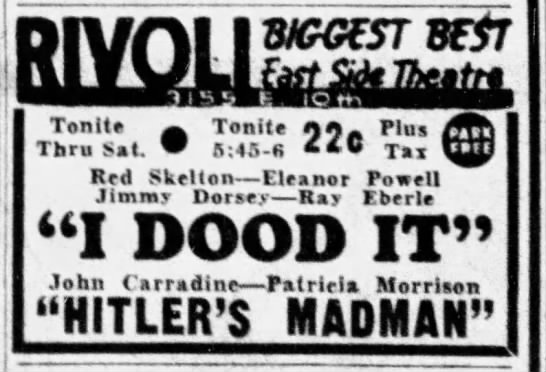
Before are a couple of more newspaper ads from 1943. I confess I was amused that the very serious, somber "Hitler's Madman" was paired in a double-feature with the Red Skelton comedy, "I Dood It." I guess audiences came to laugh and cry.


-- Doug Gibson


Sunday, December 18, 2022

Santa Claus Conquers the Martians, through newspaper archives


---

On Christmas Eve, at noon MST on the Comet Network, “Santa Claus Conquers the Martians” airs. Although not aired in theaters, or much on TV anymore, the 1964 holiday film lasted in theaters for a decade, and played often on TV for a couple more decades. It has become legitimate cult film. I’m fascinated with the film, its durability and its history as a staple of the Saturday Kids Matinee offerings once ubiquitous in movie world.

As you can see above, we’ve researched Newspaper Archives to find examples of ads, marketing, publicity reviews, etc. to provide our readers, this holiday season, a look at how it once was for this fun, goofy film. -- Doug Gibson


At the very top is an ad for SSCTM from the Sacramento Bee, Nov. 20, 1965. Below it is a review from The New York Daily News from Dec. 17, 1964. The terms "far out" is included to describe the film. Just below is a list of films playing published in the Dec. 18, 1965 Los Angeles Times. SCCTM is playing in several theaters. As my friend David Grudt (who located most of these clips) notes, the film was playing in my hometown of Long Beach, Calif., at The Towne Theater. I was about 27 months old. Maybe my parents took me to the show! Who knows?


Here are a couple of previously published reviews of Santa Claus Conquers the Martians. The first is from my co-blogger, Steve D. Stones. Read on:


SANTA CLAUS CONQUERS THE MARTIANS: LITTLE GREEN MEN AND SANTA on MARS! The critics have not been kind to this film over the years. Every time I view the film, I keep in mind that it is intended for children. With this in mind, I am willing to overlook the poor acting, bad make-up and cardboard sets. The title alone is so campy and kitsch that it grabs my attention immediately.

The children of mars have grown bored, depressed and discontent. A Martian father named Kimar, played by Leonard Hicks, concludes that the children of mars have become this way from watching “meaningless earth programs.” The children see a newscaster interview Santa on television from the North Pole and wish that mars also had a Santa Claus. The newscaster complains of the cold outside Santa’s workshop, yet he wears no gloves and his breath cannot be seen as he speaks. This adds to some of the unintentional humor of the film.


Back on mars, Kimar meets with the “council of the wise” at Thunder Forrest. The council consists of Lomas, Rigna, Hargo and Voldar, and seeks the advice of an 800 year old Wiseman named Chochum. Long before Yoda was seen on movie screens, Chochum the wise was seen in this film. Perhaps the two wise men knew each other and trained at the Jedi academy? Not very likely, I’m afraid!

Chochum suggests to the council of the wise that they kidnap Santa Claus from the North Pole and bring him to mars to bring joy and happiness to the children of mars. Voldar, the protagonist of the group, opposes Chochum’s plan. He insists that he does not want the children of mars to play with games and toys and run around joyfully. “The earth has had Santa Claus long enough! We will bring him to Mars!” proclaims Kimar.

Despite Voldar’s opposition, the group is lead by Kimar to the North Pole in a spaceship that looks like a painted toilet paper roll. Shortly after landing, they see two children in a park and ask them where they can find Santa. They kidnap the children so that they cannot run to the police to report Martians coming to earth.

After finally landing at the North Pole, the Martians use their giant robot named Torg to kidnap Santa at his workshop. Torg appears to be made of painted cardboard and ventilation pipes. Voldar freezes Mrs. Claus and many of Santa’s elves with his ray gun that looks like a toilet plunger. Santa is brought to the spaceship and taken back to mars.

What follows for the rest of the film is a series of attempts by Voldar and his henchmen to either kill Santa or sabotage his efforts on mars. For example, in one particular scene Voldar rewires the toy machines in Santa’s workshop so that they create poorly designed toys. On their way back to mars, Voldar locks Santa and the two kidnapped children in a compression room of the space ship in an attempt to open a door and have them sucked away into space. The group conveniently escapes before the door can be opened.


Eventually Santa’s workshop on mars is running smoothly. Voldar and his henchmen are captured and imprisoned by Kimar for threatening Santa and the children. Kimar decides to allow Santa to go back to earth in time for Christmas. A happy ending always concludes any Christmas movie, which is certainly the case with this film.

In his book “Cult Science Fiction Films,” Welch Everman suggests that Santa Claus Conquers The Martians is such a terrible film that not even children would enjoy watching it, and would find it “stupid.” I disagree with this statement. Although I did not see Santa Claus Conquers The Martians until I was an adult, I can imagine myself enjoying this film even more so if I had seen it as a five-year-old child. If I had been aware of it as a child, I may have included it in my long list of Christmas films to view every 
December. I encourage you to gather up your family and watch Santa Claus Conquers The Martians this Christmas Season.


And here’s my more brief take on "Santa Claus Conquers the Martians."  (I love the above ad from the Nov. 4, 1972 Park Forest (Illinois) Star (Carnal Knowledge on at nights and Santa Claus in the kiddie matinee. — This 1964 film was shot in an abandoned airport hangar in Long Island, N.Y., using many minor cast members from a NYC stage production of "Oliver Twist." It has a catchy theme song, "Hurray for Santy (sic) Claus," that you'll hum afterward. The plot involves Martians coming to earth, kidnapping Santa and whisking him away to cheer up the Martian kiddies. Two earth children are kidnapped along with Santa. Santa and the earth kids fight off a Martian baddie, prep a goofy Martian to become that planet's Santa, and launch off to earth in the spaceship.


We never know if they made it home — perhaps the budget didn't allow that. The acting has to be seen to be believed, but the film has a goofy charm. It was a big hit on the now-gone "weekend matinee" circuit and played theaters for years. Pia Zadora, who was briefly a sexy starlet in the 1980s, plays one of the Martian children. John Call, as Santa, does a mean "ho, ho, ho."

---

Here is a video podcast Steve and I did for Plan9Crunch 11 years ago on SCCTM. Below is another fun ad, also from the Dec. 17, 1964 New Yotrk Daily News, that shows SCCTM playing at the same theater also showing "roughie" horrors "The Awful Dr. Orloff" and "The Horrible Dr. Hichcock."


Finally, a couple more ads to see. The top is from the Dec. 1, 1967 edition of the Roselle-Register (Illinois). It played at the same theater showing a Best Picture Oscar. Notice Santa Claus Conquers the Martians secure perch as a perennial Saturday children's movie. Below the Roselle-Register as is one from the Nov. 19, 1965 Daily Independent Journal of San Rafael, Calif. It's advertised as a "small-fry matinee."

We hope you enjoyed this blog. Again, our thanks to David Grudt for his help.