Translate

Showing posts with label Cult Movies Magazine. Show all posts

Friday, May 9, 2025

Last of the American Hoboes: A review


Review by Doug Gibson


The actor above is the late Titus Moede (also known as Titus Moody). It's a still from the film "The Last American Hoboes," which has a date of 1967, but I don't believe it premiered until at least 1969.  View a trailer here.


I used to read about this film in the pages of Cult Movies Magazine. Moede occasionally contributed for the pub, either as interviewee or interviewer. He was active in the film industry for 40-plus years. Early in his career he was a TV actor. He moved toward low-budget cinema in the '60s, working for Coleman Francis and Ray Dennis Steckler. My favorite Moede film is "Rat Pfink a Boo Boo." 


Like some of his peers, Moede gravitated to adult cinema. His tasks included directing and photography. But "Last of the American Hoboes" was a passion project of his. Over the course of several years, Moede, along with script writer/actor Gordon Barclay, gathered film for this pseudo documentary that included a healthy dose of filmed dramatic inserts. Moede and Barclay moved from skid row streets to railroads, to "hobo jungles," to flophouses, cheap late-night diners, skid row, country homes, old trees, and many roads of middle America and the American West. The film has a lot of atmosphere with the relaxed outdoor hobo camps, and trains, and the different, cramped, oppressive life in downtown skid row. It culminates in Britt, Iowa, where a hobo convention is held and a hobo king crowned.


The film includes a few low-budget cult names of the era, besides Moede and Barclay. Genre fans will notice Coleman Francis and Bruno VeSota. The cast includes hoboes of the 1960s, including contenders vying for the title of hobo king.


I am really surprised this film never made it to the now-canceled TCM Underground movie series. Or maybe I missed it. But I doubt it. It also seems like a film that public television of that era might have been interested in airing.


I always wanted to see this film, and could have bought it thirty years ago. The magazine had ads for it. But it was an era when I was yet to solidify a career and couldn't easily part with the cash. But every few years I would casually scan the Internet for the entire film, but no luck. It had been a few years but recently I looked for it again and lo and behold, it's currently free to watch on Tubi.


The film also released an album of songs (see cover below). These are songs of the road and hobo history. The film boasts of covering 70 hears of hobo life. I enjoy the songs a bunch and will probably haunt Ebay to find a reasonably priced copy of the album. I was surprised a reviewer of the film on IMDB.com panned the songs. They are actually quite cool. 


So, after finally viewing it, what's my take on "Last of the American Hoboes?" Thumbs up. It's far from a great film. The low budget hampers it. Often scenes are shot silent and voices dubbed in. I would have liked to have seen more action in Britt, Iowa, and less inserted drama. The actors are earnest but limited. Also on IMDB.com a reviewer recalls being in the film as a child. She has nice things to say about Moede.


But those are really minor quibbles. This a fascinating film, a deeply personal endeavour from Moede and Barclay, who clearly have love and passion for the subject. Just the locations they moved into, and the unique individuals, as well as points of view that are inserted in the film, make it remarkable. Without condescension, the lives of hoboes, tramps and stationary homeless individuals are treated with respect. The film recreates history, including the unfair, sad state of the Depression-era Bonus marchers and the criminal trial and execution of IWW "Wobblie" labor leader Joe Hill.


The best acting is from Barclay, who portrays a traveling hobo. With his haunted, gaunt, unshaven face, and old clothes, he conveys effectively the frustration, and impotent anger of a man who understands all too well he's getting the short straw in life. His accounting of a man's suicide in a flop house is moving.


Moede is prominent later in the film as a bearded traveler riding the roads to the convention. 


I have no idea if this film played theaters. Our newspaper archive expert in Long Beach, Calif., David Grudt, found some newspaper clips for the film, which shows it garnered publicity in southen California. Rumor has it Moede garnered awards for the film. Late in his life, Moede received a career achievement award at a Cult Movies Magazine convention. He died in 2001. 


Below is a snippet of a Hollywood Citizen-News column in 1971, from Criswell, plugging the film. It's from the last edition Cult Movies magazine published.


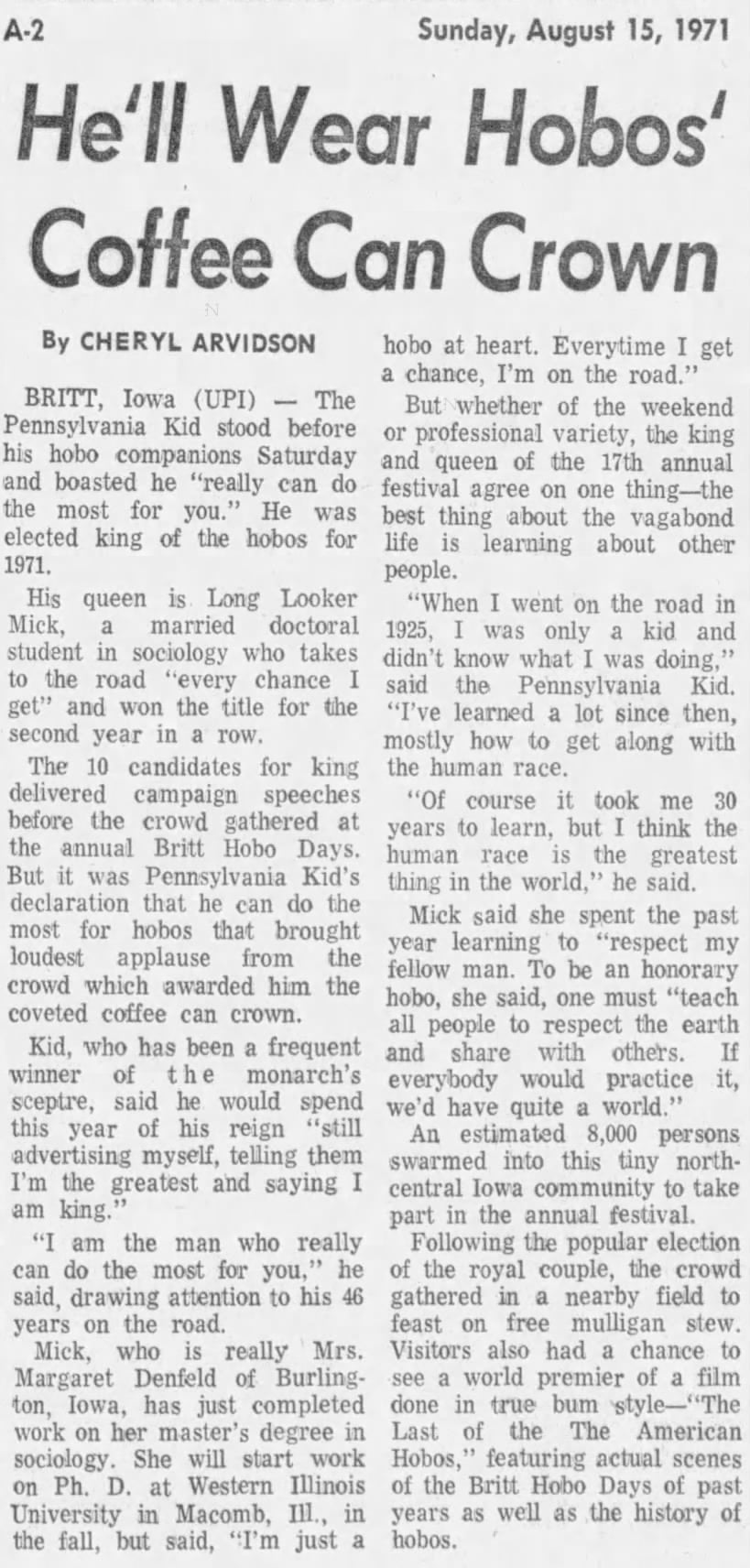
Below are David's clips from, in order, The San Francisco Examiner, June 13, 1969; Ventura County Star, Aug. 15, 1971; Redding Calif., Record Searchlight, May 21, 1975; and finally, two small clippings from The Los Angeles Times that ran roughly 25 years apart! Same notice, Sept. 2, 1972 and Aug. 28, 1997. (I would have enjoyed a serving of Moede's hobo stew!). The film was sold for a long time at the now-gone Mondo Video a Go-Go in Los Angeles.



Sunday, January 17, 2021

Hellborn -- the Ed Wood wannabe movie that never was completed


 Review by Doug Gibson

Thanks to Greg Dziawer, Ed Wood researcher, I finally was directed to my first viewing of "Hellborn," a video marketed by Cult Movies Magazine 27 years ago. It contains takes from an Ed Wood-directed wannabe film that would have been titled, drum roll, "Hellborn." Plans were to have Conrad Brooks and Ed Wood star in this Wood-directed effort on the juvenile delinquency "crisis" of the 1950s.

Michael Copner, former editor at the magazine, hosts the video along with the late Wood company actor Conrad Brooks. Long ago I wasn't persuaded by the ads to buy "Hellborn." Later, after the magazine ceased publication and my interest in Ed Wood increased, I couldn't find a way to purchase "Hellborn." It wasn't streamed. It wasn't for sale on EBay or Amazon. I thought I'd missed my chance on this one.

Until this weekend, when Dziawer alerted me it's now on YouTube. It's not easy to find in the site's search function so here is a direct link.  So, after wanting to see this film for roughly a generation, what's my take?

First, the "Hellborn" takes included are not the best parts of the film, although they are fun to watch and mandatory for a Wood completist. The best takes from "Hellborn" are not in this film because they were used in two films, "Night of the Ghouls," and "The Sinister Urge," which features the best scene, a pretty cool fight between Ed Wood and Conrad Brooks. Wood apparently sold or donated that footage to producer Roy Reid, of Headliner Productions, for whom Wood directed "The Sinister Urge." The "Night of the Ghouls" "Hellborn" takes include a decent crash scene with a teen dangling, presumably dead, from the window of a car.

So what's left for "Hellborn" the video is a long take of a particularly violent beating on a street, with another Wood actor, Mona McKinnon, watching the beating. (A little bit of that is in "Night of the Ghouls.") The primary new scene for viewers is one of a bunch teens going out to a picnic of sorts, filmed at Griffith Park, and then pairing off later for sexcapades. As Wood fans know, several scenes include Wood in drag pretending to play teenage women. Even with the poor quality of the then almost 50-year-old footage in 2003, Wood does not really fool anyone.

Prior to the takes, Copner and Wood discuss the history of the Hellborn effort. The genesis of the film extends as far back as the "Glen Or Glenda" era. Producer George Weiss, Brooks relates, failed to generate interest initially among investors. Then later films crowded out time for and interest in "Hellborn," although sporadic filming continued well into the mid 1950s.

There's more to this roughly hour-long documentary. Although I think much of the footage can be seen in other films, Brooks narrates footage of a "home movie" Wood directed and produced for Conrad and his brothers in 1948. It's a western of sorts. As entertaining as the footage is Brooks' narration, pointing out Hollywood of 70 plus years ago and noting other Wood characters such as Johnny Carpenter. 

Frankly, in this footage the still-young Wood is incredibly handsome. Calling him an Errol Flynn type is not an exaggeration. It's easy to see why he attracted Dolores Fuller, for example. It's jarring to see this Wood and then turn the clock ahead 20 years and see the bloated, red-faced, alcoholic Wood of 20 years later in "Love Feast." 

There's more in "Hellborn." We then see an eight-minute short that Brooks directed, called "Mystery in Shadows." It's shot with actors as shadows, accompanied by a narrator/storyteller. It's actually kind of interesting and entertaining; as a one-reel short.

Finally, there's even one more segment to "Hellborn." It's my favorite part of the film; definitely the most bittersweet. It's an interview with former movie actor, Peter Coe, in whose house Ed Wood died in late 1978, soon after he and his wife Kathy were evicted. Coe's films included "House of Frankenstein" and "The Mummy's Curse." Coe relates incidents such as hunting with Lon Chaney Jr.


It's very emotional to see Coe in this interview. He looks very old and emaciated, lying in bed. He was very near death when this interview was conducted. Brooks is very kind, as is Copner, during the interview. Coe seems exhausted early and his answers are brief, due to his condition, not his temperament, which is polite. He perks up later, seemingly genuinely pleased when told fans of the magazine ask about him. Near the end of the interview, describing how Wood is removed from his home in a mere bag, Coe effectively conveys his outrage at the disrespect Wood was shown. "It was sickening," he says with passion and emphasis.

Issues of Cult Movies magazines contain articles on "Hellborn." I recall Brooks sharing some faux publicity blurbs Wood had written, including one about it being the "winner" at the Cannes Film Festival. Also, in another edition of Cult Movies magazine, there's a longer interview with Coe.

So that's the elusive "Hellborn" video. It's a must for the real fans of Ed Wood, and we know who we are. The takes from the main film are of interest. The footage of the Brooks film directed by Wood is great, and the interview footage with a dying Coe is priceless.


Tuesday, June 23, 2020

Poverty row Lugosi films getting more respect nowadays

Essay by Doug Gibson

I love the book, Poverty Row HORRORS, by Tom Weaver, published originally in 1993. I earlier reviewed it here and interviewed Weaver here. Weaver can be a bit mean in his criticism (he uses the term "lowly hacks" to describe Steve Sekely and Frank Wisbar. That's bad enough. But he even snarks that the term "maybe" applies to Edgar G. Ulmer! Come on!

Nevertheless, he does love the poverty row films, and his pre-Internet book is a fantastic source, with detailed production notes, analysis and various reviews of the era. There is also an exhaustive filmography for dozens of actors who performed in the low-budget horrors; and a great index.

Although he can criticize Lugosi, Weaver understands that Lugosi is a major reason there is fandom for the poverty-row era. His PRC film, Devil Bat, and the nine Monogram films he made are the linchpin of this genre. George Zucco of PRC and John Carradine, who worked for multi poverty-row studios, can't compare to Lugosi's' efforts. As Weaver notes, Zucco could come across as mean and Carradine too often gave passive, or downright goofy (think Voodoo Man) performances.

But Lugosi gave it all in these five-day productions. He took it as seriously as if he was starring in Dracula. You can appreciate Lugosi's pride in his craft by watching Boris Karloff give less than his best effort in low-budget films (a good example is Karloff in Monogram's The Ape).

I digress to read passages from a couple of publications of that era that also recognized Lugosi's value to poverty row and why it has an impact today.

From Midnight Marquee Actors Series Bela Lugosi (1995) Gary Svehla writes, "Bela ... approached every movie as though each film performance was as important as the one before. Good films, bad films; good characterizations, cliche roles simply were not part of Lugosi's vocabulary. The only thing that seemingly mattered was the next film and the next performance. Approach the current film as being the ultimate chance to display your talents and perhaps you would have the opportunity to act again. Or, to state the philosophy more succinctly, an actor is only as good as his last film."

Here is an excellent assessment of the Monogram films from Michael Copner, formerly of Cult Movies magazine, writing in the 1990 publication, Bela Lugosi: Then and Now (also known as Cult Movies 1): "If you go into it expecting the nice atmosphere and music of the Universal productions, if you expect the thing to actually make sense, you're going to be in trouble. These movies are the pulp novels of the screen; their only purpose in the world is to make money. So you must watch them in the same way -- just a string of meaningless events going on until Bela Lugosi can come back on the screen again. That's why we're here. If you do that, you will actually begin to enjoy the cheapness a bit, and develop a new appreciation of what  Bela was able to do with absolutely nothing to go on. If this were Michelangelo, forced to create something with a single crayon on a sheet of cardboard; or Paderewski, having to perform on a baby's toy piano, you'd give them this same consideration, wouldn't you? Take this attitude the next time you watch The Corpse Vanishes and you will be amazingly rewarded."

I took Copner's advice and have been rewarded by these films for generations.

At the back of Weaver's book, he has 26 genre experts rate the nine Monogram films 1 through 9. The reviewers include Forrest J. Ackerman, Richard Bojarski, Buddy Barnett, Copner, Weaver, Svehla, Richard Gordon, Joe Dante, Arthur Lennig, and William K. Everson. A lot of these reviewers died in the ensuing years.

The cumulative results are not surprising for almost 30 years ago:

1) Invisible Ghost
2) The Corpse Vanishes
3) Voodoo Man
4) Bowery at Midnight
5) Return of the Ape Man
6) Black Dragons
7) The Ape Man
8) Spooks Run Wild
9) Ghosts on the Loose


I think today, more than 25 years later, that Invisible Ghost (a screen shot is seen above) is still the technically best film. It's probably not the funnest film, though. I'd go with The Corpse Vanishes, and then Black Dragons. Other fun films are Bowery at Midnight and The Ape Man. In my opinion, Voodoo Man and Return of the Ape Man would be second and third on the list. I think they have gained more respect the past decade or so, primarily because Lugosi's performances are so strong. His mad scientist, Professor Dexter, in Return of the Ape Man, is almost as good as his Dr. Richard Vollin in The Raven. And the East Side Kids films are still 8 and 9, although Spooks Run Wild is three times as good as the dismal Ghosts on the Loose, which really wastes Bela. Here I go:  My list:

1) Invisible Ghost
2) Voodoo Man
3) Return of the Ape Man
4) The Corpse Vanishes
5) Bowery at Midnight
6) The Ape Man
7) Black Dragons
8) Spooks Run Wild
9) Ghosts on the Loose

Be aware, that my choices for 4, 5 and 6 are more or less a tie.

This pandemic spring I re-read Lennig's superb biography of Lugosi, "The Immortal Count." My only peeve is that Lenning really seems to despise Lugosi's Monogram films, although his barbs are perhaps mostly directed at the lazy writing, poor acting by co-stars, and direction. But these poverty-row films, as Weaver and others point out, are a major part of Lugosi's legacy today. Without them, I don't think his mystique and fan base would be as strong. Imagine what we'd think today if Lugosi had chosen to be a consistent seventh lead in an A level studio pumping out dramas in the 40s and 50s? Boring. I much prefer Bride of the Monster.

I've noticed this past year a resurgence, and increased respect, for the poverty-row films of the '40s, particularly Lugosi's. Recently, we have reviewed, from  BearManor Media, "Bela Lugosi and the Monogram 9," with critical essays from Gary D. Rhodes and Robert Guffey. And we have reviewed two short story anthologies based on Monogram and other poverty-row films. They are "The Monogramthology," from Arcane Shadows Press, and "Chillers: Tales Inspired By Classic Horror Films," (compiled by Brad Braddock), from Midnight Marquee Press. Authors in both those collections include genre writers Greg Mank and Frank Dello Stritto.

But again, no matter how "respectable" these films become, they are still thrillers to be enjoyed, to have fun with. Weaver's Poverty Row Horrors is a must for fans to possess. You can buy it here.

Sunday, December 10, 2017

Ed Wood documentaries: Three early ones


LOOK BACK IN ANGORA

This is the only Ed Wood documentary, besides The Incredibly Strange Film Show, I am aware of to feature Ed’s wife Kathy Wood in interview segments. That alone makes it a valuable piece of Ed Wood history. Produced by Rhino Home Video in 1994, the documentary takes sound bites and images from Wood’s films and uses them to give the film a humorous narrative.

The opening gives us Kathy Wood commenting on how no one really cared much about Ed Wood until his death in 1978. Now, ironically, there is a renewed interest in his films and life. Ed’s marine buddy Joseph Robertson is also interviewed, and describes Ed’s fascination for wearing women’s clothing, even under his army outfit.

Robertson produced such 1960s cult classics as: The Crawling Hand and The Slime People. He went on to direct the adult feature entitled Love Feast, also known as The Photographer and Pretty Girls All In A Row (see my review of Love Feast on this website.).

This documentary also borrows segments of Conrad Brooks’ interviews from On The Trail of Ed Wood (see my review in this post.). The documentary is presented in segments that use Wood’s name in a clever way, such as: Drift Wood, Holly-Wood, Wood’s Stock Company, and Dead Wood.

THE ED WOOD STORY: THE PLAN 9 COMPANION

Of all the Ed Wood documentaries that have been released, I would have to say that this one is the best.

Not only because it carefully examines the career and films of Ed Wood, but also because it highlights the lives and careers of the key actors of Plan 9 From Outer Space: Bela Lugosi, Vampira, Tor Johnson and Criswell. This documentary also has informative insights and humorous commentary by famous fans of Ed Wood and Plan 9 From Outer Space, such as: Sam Raimi, Drew Friedman, Harry Medved, Bill Warren, Joe Dante, Forrest J. Ackerman and Wood’s biographer, Rudolph Grey.

Of great interest is the segment of Conrad Brooks taking the viewer on a tour of the old Quality Studios in Hollywood where Plan 9 was filmed. The first time I viewed the Plan 9 Companion, my heart raced with excitement in being able to see what Quality Studios looks like today. Conrad even reenacts a famous cemetery scene that was shot there with his co-star Carl Anthony.

Lee Harris, the host and narrator of The Plan 9 Companion, also takes us on a tour of the old cemetery location used in the opening shots of Plan 9. Director Mark P. Carducci produced the film with Harris in 1994 and released it to MPI Home Video. Vampira fans will also be pleased with this documentary, since Maila Nurmi offers many insights into her own career and the career of Ed Wood. 

ON THE TRAIL OF ED WOOD

Although the title of this documentary informs us of being on the trail of Ed Wood, perhaps a better title would have been: On The Trail Of Conrad Brooks. I say this only because the entire fifty-six-minute documentary is from the point of view of Conrad Brooks being interviewed in his home, unlike so many other Ed Wood documentaries that interview many of Wood’s stock actors and friends. I got the feeling that the producer Buddy Barnett and director Michael Copner did not have the time or budget to include other Ed Wood actors and friends in this documentary, or perhaps they weren’t interested in anyone else’s views about Wood?

However, there are some informative aspects of this documentary. Conrad takes us on a tour of Ed Wood’s Yucca apartment complex in Hollywood, the last apartment complex he lived in before his death at Peter Coe’s apartment in 1978.

The tour also takes us to the KFWB soundstage in Hollywood, which was Ted Allen’s studio in the 1950s when Bride of The Monster was filmed there. Conrad explains in the documentary that Tor Johnson demanded double his $100.00 salary for his acting roles in Wood’s films. According to Conrad, Wood almost reconsidered using Johnson in his films because of this demand.

He also claims that Ed took a job as a cab driver in the 1970s to make ends meet. Copner and Barnett, both contributing writers and founders of Cult Movies Magazine, released this documentary in 1990. If Copner or Barnett happen to read this article, we would greatly appreciate it if Cult Movies Magazine was back in publication. The magazine is a valuable resource.

-- Steve D. Stones