Review by Doug Gibson
The actor above is the late Titus Moede (also known as Titus Moody). It's a still from the film "The Last American Hoboes," which has a date of 1967, but I don't believe it premiered until at least 1969. View a trailer here.
I used to read about this film in the pages of Cult Movies Magazine. Moede occasionally contributed for the pub, either as interviewee or interviewer. He was active in the film industry for 40-plus years. Early in his career he was a TV actor. He moved toward low-budget cinema in the '60s, working for Coleman Francis and Ray Dennis Steckler. My favorite Moede film is "Rat Pfink a Boo Boo."
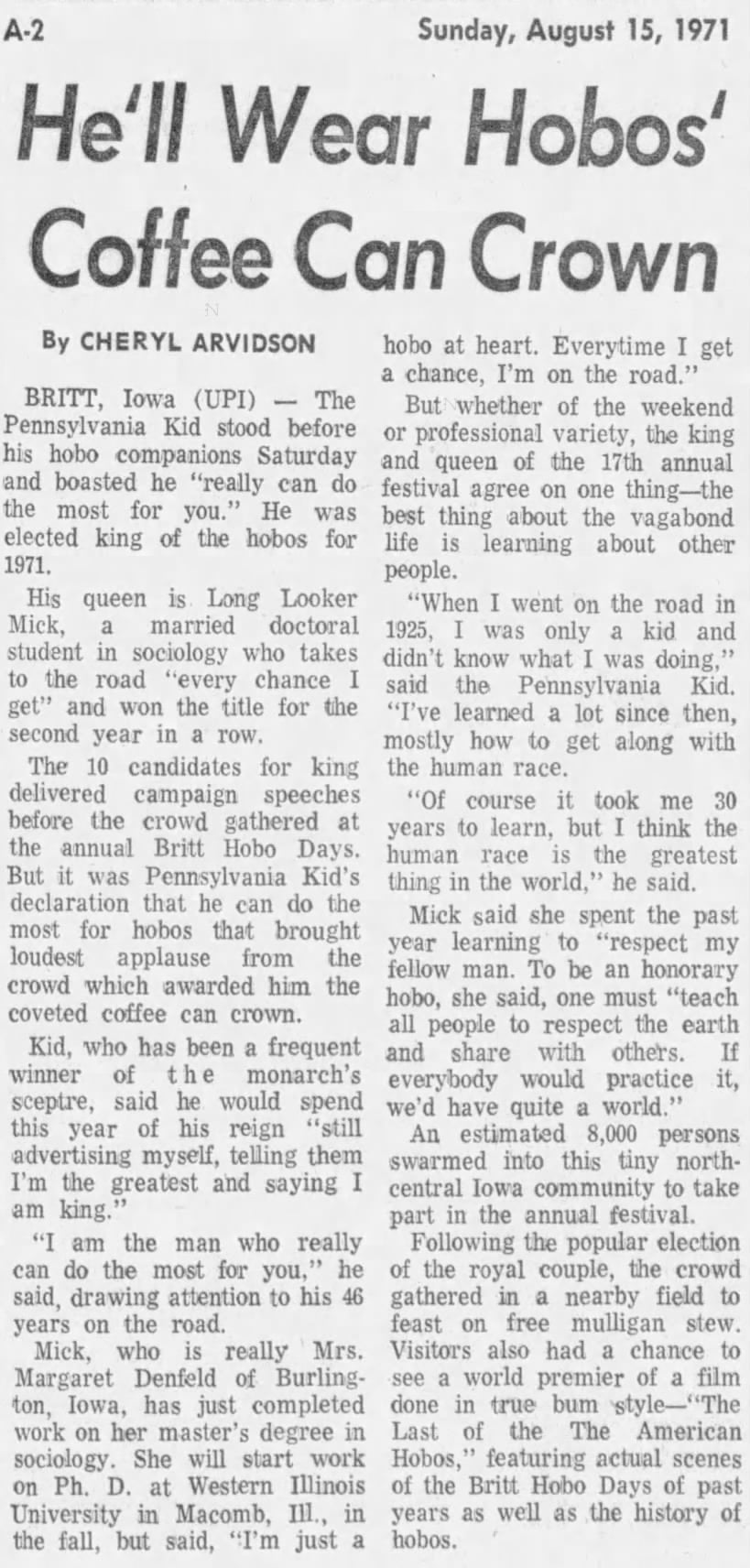
Like some of his peers, Moede gravitated to adult cinema. His tasks included directing and photography. But "Last of the American Hoboes" was a passion project of his. Over the course of several years, Moede, along with script writer/actor Gordon Barclay, gathered film for this pseudo documentary that included a healthy dose of filmed dramatic inserts. Moede and Barclay moved from skid row streets to railroads, to "hobo jungles," to flophouses, cheap late-night diners, skid row, country homes, old trees, and many roads of middle America and the American West. The film has a lot of atmosphere with the relaxed outdoor hobo camps, and trains, and the different, cramped, oppressive life in downtown skid row. It culminates in Britt, Iowa, where a hobo convention is held and a hobo king crowned.
The film includes a few low-budget cult names of the era, besides Moede and Barclay. Genre fans will notice Coleman Francis and Bruno VeSota. The cast includes hoboes of the 1960s, including contenders vying for the title of hobo king.
I am really surprised this film never made it to the now-canceled TCM Underground movie series. Or maybe I missed it. But I doubt it. It also seems like a film that public television of that era might have been interested in airing.
I always wanted to see this film, and could have bought it thirty years ago. The magazine had ads for it. But it was an era when I was yet to solidify a career and couldn't easily part with the cash. But every few years I would casually scan the Internet for the entire film, but no luck. It had been a few years but recently I looked for it again and lo and behold, it's currently free to watch on Tubi.
The film also released an album of songs (see cover below). These are songs of the road and hobo history. The film boasts of covering 70 hears of hobo life. I enjoy the songs a bunch and will probably haunt Ebay to find a reasonably priced copy of the album. I was surprised a reviewer of the film on IMDB.com panned the songs. They are actually quite cool.

So, after finally viewing it, what's my take on "Last of the American Hoboes?" Thumbs up. It's far from a great film. The low budget hampers it. Often scenes are shot silent and voices dubbed in. I would have liked to have seen more action in Britt, Iowa, and less inserted drama. The actors are earnest but limited. Also on IMDB.com a reviewer recalls being in the film as a child. She has nice things to say about Moede.
But those are really minor quibbles. This a fascinating film, a deeply personal endeavour from Moede and Barclay, who clearly have love and passion for the subject. Just the locations they moved into, and the unique individuals, as well as points of view that are inserted in the film, make it remarkable. Without condescension, the lives of hoboes, tramps and stationary homeless individuals are treated with respect. The film recreates history, including the unfair, sad state of the Depression-era Bonus marchers and the criminal trial and execution of IWW "Wobblie" labor leader Joe Hill.
The best acting is from Barclay, who portrays a traveling hobo. With his haunted, gaunt, unshaven face, and old clothes, he conveys effectively the frustration, and impotent anger of a man who understands all too well he's getting the short straw in life. His accounting of a man's suicide in a flop house is moving.
Moede is prominent later in the film as a bearded traveler riding the roads to the convention.
I have no idea if this film played theaters. Our newspaper archive expert in Long Beach, Calif., David Grudt, found some newspaper clips for the film, which shows it garnered publicity in southen California. Rumor has it Moede garnered awards for the film. Late in his life, Moede received a career achievement award at a Cult Movies Magazine convention. He died in 2001.
Below is a snippet of a Hollywood Citizen-News column in 1971, from Criswell, plugging the film. It's from the last edition Cult Movies magazine published.

Below are David's clips from, in order, The San Francisco Examiner, June 13, 1969; Ventura County Star, Aug. 15, 1971; Redding Calif., Record Searchlight, May 21, 1975; and finally, two small clippings from The Los Angeles Times that ran roughly 25 years apart! Same notice, Sept. 2, 1972 and Aug. 28, 1997. (I would have enjoyed a serving of Moede's hobo stew!). The film was sold for a long time at the now-gone Mondo Video a Go-Go in Los Angeles.