Translate

Showing posts with label Cult films. Show all posts

Sunday, June 7, 2026

Our favorite films: Doug Gibson, Rob Craig and Steve D. Stones


Hi Cult Film Fans! We at Plan9Crunch are nerding out a little as summer gets into swing. This week we'll be at Monster Bash, by the way. Anyway, myself, Doug Gibson, acclaimed cult films author Rob Craig, and artist and co-blogger, Steve D. Stones, have named our all-time favorite films, for now. Read on and see how many films you agree should be on the list. And check out the films you've never seen. Believe it or not these films are accessible!


DOUG GIBSON’S FAVORITE FILMS


My favorite 3

Night of the Hunter (1950s)

Dracula (1930s)

The Black Cat (1930s)

--

Silent

The Cabinet of Dr Caligari

Nosferatu 

Haxan

The Golem

Three's a Crowd (Harry Langdon)

The General ( Keaton)

The 1930s

The Bride of Frankenstein 

The Old Dark House 

The Dark Horse (Guy Kibbee)

Mr. Smith Goes to Washington 

You Can't Take It With You

Peach O'Reno (Wheeler and Woolsey)

Duck Soup

The Raven 

1940s

Devil Bat

The Corpse Vanishes

Detour

The Grapes of Wrath 

Stranger of the Swamp

Abbott and Costello Meet Frankenstein 

The Time of Their Lives

1950s

Plan 9 From Outer Space

Bride of the Monster 

Night of the Ghouls

Shane


1960s

Wait Until Dark

The Haunting

Spider Baby

The Human Duplicators

The Sadist

The Thrill Killers

Support Your Local Sheriff

Night of the Living Dead 

1970s

Fat City

Rocky

The Godfather Part 2

Torture Dungeon

Halloween 

Dog Day Afternoon 

Meatballs 

The Outlaw Josey Wales

The Legend of Hell House 

1980s

Tootsie 

Planes Trains and Automobiles 

Indiana Jones and the Last Crusade

Crocodile Dundee

They Live

1990s

Can't think of a great film

2000 on

Return of the King

The Others

Sinners

The Grand Budapest Hotel

Mr. Jones

Nosferatu


ROB CRAIG’S FAVORITE FILMS


Top “50” Horror/Sci-Fi Movies 1953-1984

The Angry Red Planet (1960)

The Asphyx (1972)

The Astounding She Monster (1958)

The Atomic Brain (1964)

Attack of the Mushroom People (1965)

The Baby (1973)

Bloodthirsty Butchers (1970)

The Brain that Wouldn't Die (1962)

Brides of Blood (1968)

The Brood (1979)

A Candle for the Devil (1973)

Carnival of Souls (1962)

The Children (1980)

Creation of the Humanoids (1962)

The Crawling Eye (1958)

The Creeping Terror (1964)

The Cremators (1972)

Day the World Ended (1956)

Death Race 2000 (1975)

Demon Witch Child (1974)

Destroy All Monsters (1970)

Dungeon of Harrow (ca 1964)

Evil Brain From Outer Space (1965)

Eyeball (1975)

Face of the Screaming Werewolf (1965)

Fantastic Planet (1973)

First Spaceship on Venus (1962)

Frozen Scream (1975)

Godzilla vs the Smog Monster (1972)

The Ghastly Ones (1968)

Halloween III: Season of the Witch (1982)

The Horror of Party Beach (1964)

Horror of the Blood Monsters (1970)

The Human Duplicators (1964)

The Incredible 2-Headed Transplant (1971)

Invasion of the Blood Farmers (1972)

It Conquered The World (1956)

“It's Alive!” (1969)

Journey to the Center of Time (1967)

Killers from Space (1954)

The Killer Shrews (1959)

The Lathe of Heaven (1980)

The Little Shop of Horrors (1961)

The Lost Continent (1968)

Manos, the Hands of Fate (1966)

The Manster (1962)

The Man With Two Heads (1972)

Mars Needs Women (1967)

Monster Zero (1970)

The Mutations (1973)

Night of the Bloody Apes (1974)

Night of the Ghouls (ca 1960)

Night of the Living Dead (1968)

1984 (1984)

Not of This Earth (1957)

Parts: The Clonus Horror (1979)

Phase IV (1974)

Pieces (1982)

Plan Nine from Outer Space (1959)

Planet of the Vampires (1965)

The Pyx (1973)

Robot Monster (1953)

Shriek of the Mutilated (1974)

The Terror (1963)

Terror From the Year 5000 (1958)

The Texas Chainsaw Massacre (1974)

Torture Dungeon (1970)

The Undead (1957)

Vampire's Night Orgy (1975)

Videodrome (1983)

Voyage the the Planet of Prehistoric Women (1967)

Warning From Space (1964)

War of the Gargantuas (1970)

When Dinosaurs Ruled the Earth (1970)

The Wild World of Batwoman (1966)

The Wizard of Mars (1965)

Womaneater (1960)

Z.P.G.: Zero Population Growth (1971)


STEVE D. STONES’ FAVORITE FILMS


1). The Cabinet of Dr. Caligari (1919). 2). Dawn of The Dead (1978). 3). Carnival of Souls (1962). 4). Things To Come (1936). 5). The Crawling Eye (aka The Trollenberg Terror) (1958). 6). The Beast of Yucca Flats (1961). 7). Plan 9 From Outer Space (1958). 8). Torture Dungeon (1970). 9). Star Wars - Episode IV - A New Hope (1977). 10). Nosferatu (1922). 11). Killers From Space (1954). 12). Night of The Living Dead (1968). 13). Faster Pussycat, Kill, Kill (1965). 14). A Bucket of Blood (1959). 15). Black Sunday (1960). 16. Rubin & Ed (1991). 17). Creepshow (1982). 18). Forbidden Planet (1956). 19). The Day The Earth Stood Still (1951). 20). The Thing (From Another World) 1951. 21). Godzilla vs. Megalon (1974). 22). Raiders of The Lost Ark (1981). 23). Die Hard (1988). 24). Predator (1987). 25). Dracula (1931). 26). Two Thousand Maniacs (1964). 27). The Phantom of The Opera (1925). 28). For A Few Dollars More (1967) 29). Pink Flamingos (1972). 30). Multiple Maniacs (1970). 31). Once Upon A Time In The West (1968). 32). Jaws (1975). 33). Dirty Harry (1971). 34). Children Shouldn't Play With Dead Things (1972). 35). The Screaming Skull (1958). 36). Jackie Brown (1997). 37). Hellraiser (1987). 38). Time Bandits (1981). 39). Blade Runner (1981). 40). The Hideous Sun Demon (1959). 41). Curse of The Swamp Creature (1968). 42). The Corpse Grinders (1972). 43). Where Eagles Dare (1968). 44). Shock Waves (1977). 45). The Road Warrior (1981). 46). Murder Mansion (1972). 47). Suspira (1977). 48). Star Wars - Episode V - The Empire Strikes Back (1980). 49). The Good, The Bad & The Ugly (1968). 50). Quatermass II: Enemy From Space (1956).   

Wednesday, April 8, 2026

Andy Milligan's Compass Rose, 1968, a look at Caffe Cino of the '60s


If you're a fan of filmmaker Andy Milligan, you are familiar with many of his trademark film characteristics - impalement with a pitchfork, beheadings, actors dressed in cheap period costumes, and his unique camera technique of the swirl camera. Compass Rose (1968) deviates a bit from these characteristics but is still an important film in the Milligan canon. The film explores the lives of struggling actors and bohemian types in New York City at the off Broadway Cafe Cino in the 1960s. (Above and below are two stills from Compass Rose)


The opening sequence shows a couple (Anthony Moscine, Anne Linden) having sex on a bed, kissing and rubbing each other. In true Andy Milligan form - the sex on screen is not very erotic or sexy. These are not bodies that are in perfect shape or very sexy in any way. We can almost smell their body odors as we see their scars, pimples, moles and other imperfections on full display on the screen. Any sex shown in a Milligan film is not intended to arouse or sexually stimulate the viewer. These are real, everyday people engaged in sexual activity, and not body perfect porn stars.

Milligan's wife-to-be, Candy Hammond, wastes no time disrobing for the camera when she first appears on screen. The viewer is treated to a quick glimpse of her pubic area when she runs into a bedroom after disrobing. She is nude in all of her scenes until she commits suicide in her final scene. Hammond always appears to be confident, if not aloof, about her nudity on screen as she frequently touches her breasts. Hammond would eventually marry Milligan in 1968 during the production of Compass Rose.


The viewer is also treated to the inside world of Caffe Cino. The walls of the cafe are plastered with posters, fliers and other visual ephemeral that keep the viewer looking everywhere. Decor and drapery hang loosely from the cafe ceilings. The entire environment is visual overload, which is likely the point. Actors perform strange drag impromptu dialogue on a small stage as patrons of the cafe watch casually while smoking cigarettes.  

If you purchased the Severin films Blu-Ray set of Gutter Auteur: The Lost Legacy of Andy Milligan, the print of Compass Rose has sound which cuts in and out throughout the film. Small segments of the film have no sound at all, and sound sequences are often hard to decipher during conversations between actors. This is not a complaint from this reviewer. We are very fortunate to have this film to view, so we can overlook the sound imperfections.  

The final scene of Compass Rose is a chaotic orgy of naked sadism. Twisted bodies squirm around in an S&M playground, smeared with food in the same basement that Milligan shot The Ghastly Ones (1968). The film ends abruptly with a statement on screen which mentions that Milligan never completed the film. The film was likely unreleasable due to sound problems. 


Milligan's next project was - The Filthy Five (1968), another lost film in the Milligan canon. The Severin Blu-Ray of Compass Rose has an 18-minute interview with film historian Stephen Thrower about the film. Thrower gives us great insight into the career of Milligan and the making of the film. The Degenerate Blu-Ray set also includes Milligan's post-nuke film - The Degenerates (1967), Kiss Me, Kiss Me, Kiss Me (1968), House of Seven Belles (1979), and the documentary - The Degenerate - The Life & Films of Andy Milligan. The three discs are packed with lots of extras. Don't miss it.

Steve D. Stones   

Friday, March 20, 2026

Andy Milligan film The Degenerates fascinates as dysfunctional, chaotic science fiction cult


Review by Doug Gibson


If you're an Andy Milligan fan, or just a fan of the exploitation film genre of the 60s and early 70s, the "holy grail" arrived last year when two long-lost Andy Milligan films turned up. "The Degenerates" and "Kiss Me, Kiss Me, Kiss Me!" Both premiered at Tribeca and have screened a few times since.


Most of us had to wait until this month when Severin shipped the Blu-Ray set, packed with lots of extras, including a new Milligan documentary, "The Degenerate: The Life and Films of Andy Milligan," and versions of the existing but obscure "Compass Rose" and "House of the Seven Belles." In a few days I have devoured this set and will fill this year with posts on Plan9Crunch.


THE DEGENERATES, 1967


Let's get right to the first review. This is one of the lost Milligan films I most wanted to see. A science fiction adult exploitation flick, "The Degenerates" was filmed in the future New York Woodstock area. I think in spirit this film is close to Milligan's "Seeds." The raw family dysfunction bleeds on the screen and gets more chaotic and violent with a strong finale. And "The Degenerates" provides a stronger backstory to its drama than "Seeds" did. This version is 64 minutes. It omits 10 minutes of nudity and soft-core sexual situations. Those scenes are still lost.


The film begins with three soldiers on patrol in the eastern United States. Nuclear wars have killed most of civilization. The soldiers discover a woman frolicking in the wilds. Surprised to see any humans, they chase her to a dilapidated, large farmhouse with battered sheds and a junked vehicle.


The soldiers encounter five sisters, Violet, (Bryarly Lee), Daisy, (Anne Linden), Lily, (Laura Cunningham, as Laura Weiss), Iris, (Marcia Haufrecht, as Marcia Howard), and Rose (Susan Howard). Later the soldiers will discover a sixth sister, Ivy, (Hope Stansbury), who is traumatized and lives a near-feral existence outside. 


Violet, the leader of the sisters, is very hostile to the soldiers but allows them to stay. One soldier is nursing a broken foot. Initially, all three soldiers appear accommodating. However, one will reveal himself to be violent and a rapist. However, even before that escalation Violet's hostility toward her sisters will lead to vicious attacks on two of her siblings and eventually violent deaths to some of the characters.


Lee was an accomplished stage actor and gives the best performance in the film. Her Violet is an authority figure who quickly loses her self-control and sanity when the soldiers and three of her sisters initiate intimate relationships. Something has triggered Violet into acts of sadism. She savagely beats Daisy and burns Lily's hand on a stove. Watching Lee reminds viewers of family matriarch Maggie Rogers' savage, screaming performance in the later Milligan film "Seeds." Lee's Violet seems a younger version of Rogers' character but not yet the hard shell.


There's a suffering vulnerability in Violet. She's clearly been traumatized and wants to be relieved of it. She's closest to her sibling Rose (Susan Howard). Clearly triggered by the men and the ensuing intimacy she can't snuff out, Violet attempts incest with Rose. In what is a patented compelling but deeply uncomfortable Milligan sequence, Rose is repulsed by her seduction attempt, and screaming ensues.


Lee is superb. She may soon become a favored Milligan actress if "The Naked Witch," another lost Milligan film, is discovered. According to a commentary from Milligan historian Alex DiSanto, Lee was notable for her extreme focus on her work during the shoot.


In one scene involving Lee, she commits a Milligan-esque killing with what seems deliberate religious symbolism. Or maybe I'm overanalyzing? Readers can let me know.


Hope Stansbury is iconic within the Milligan genre for her willowy beauty. She gives the second-best performance as the mentally ill Ivy. She and Violet have a savage hatred for each other, which is revealed in the climax. A strong scene for Stansbury is when Ivy shows her soft heart by visiting the beaten Daisy, laying in pain in a shed. Ivy feeds her and tries to tend to her wounds. She also helps further Daisy's romance.


Linden as Daisy gives a good performance as a vulnerable, scared sibling wanting love. She's in several Milligan films, including "The Ghastly Ones." Haurfrecht as Ivy is still active in films today, with an impressive career. She's perhaps the strongest weaker sibling, standing up to Violet's violent control tactics. She's romanced by actor Robert Burgos, who plays the soldier, Jim. He's the best actor of the three men cast and has enjoyed a distinguished acting career. The other soldiers were Vernon Newman and David Blaine.


Laura Weiss as Lily was 18 and plucked off a college campus by a Milligan talent scout (Hal Sherwood?). It's her only film and she does herself proud. Weiss is interviewed on the Blu-Ray set. She's written a couple of memoirs including one on the film's shoot. Not much is known about Susan Howard as Rose but she's effective on screen. Her expressive eyes when she realizes Violet wants to make love to her is a highlight.


The film is photographed in pure Milligan Auricon 16-MM style. Closely framed shots, the actors usually bunched together to hide small sets. Despite the battered print, you can see the dirt, the tired faces, the tattered burlap Milligan-sown tank top-like middies worn by the women, the sweat and blemishes on the faces. The dialogue sound is loud, you can hear the Auricon whirring. The house is more than rustic. It must have been a chore for the actors to survive the shoot. DiSanto in his commentary says it was reputedly haunted. DiSanto recalls a love scene shot inside a filthy outside building having to be re-shot the next day due to a lighting mishap. 


In interviews though, actors recollect the experience fondly. Even Milligan seems to have been even-tempered overall. The only remembrance of frustrations for Milligan was with the novice Weiss.


The film cost $11,000. It was shot in about a week. It was not produced by William Mishkin but was part of an ill-fated three-film effort with three investors who went bankrupt, distributor Jerry Balsam, and Milligan. Sam Sherman was lightly involved. He apparently came up with the title. It was shot as Sin Sisters. The film was profitable, but Milligan was squeezed out. He later sued and collected a few thousand dollars for all three films, a poor return for him.


Weiss recalls standing much later outside a building where Milligan was inside shouting for the $200 she had been promised. It worked. She was paid. In 1966, $200 was slightly more than $2,000 today.


I love this film. It met my expectations as a Milligan cult fan. It has the "Gutter Auteur"'s signature uniqueness that is splashed all over the 20-plus films he directed in his most-active several years. We're not done with the Blu-Ray set. Next, we'll review and provide observations on the re-discovered "Kiss Me, Kiss Me, Kiss Me!"


One more tidbit. Yes, the swirl camera and pitchfork are in "The Degenerates."

Monday, October 20, 2025

40 More Cult Movies offered up by film scholar Jon Towlson


Review by Doug Gibson


A while back I reviewed on Plan9Crunch blog Jon Towlson's 40 Cult Movies. It was an informative 21st Century version of the fascinating cult movies books Danny Peary produced in the 1980s. You can read the review here. Mr. Towlson is a Britiah academic who has many genre books published. He has written screenplays, worked on films, including directing and acting. His Amazon page is here.


Our YouTube page, Plan9Crunch, has interviewed Towlson. The most recent interview was right around the time a sequel, 40 More Cult Movies, was published. Perhaps tongue in cheek, Towlson told me with a smile that he embarked on the second cult movies book in part because I had suggested it in the 40 Cult Movies review.


Whatever his inspiration, 40 More Cult Movies is another interesting provocative read in which Towlson recounts unique films worthy of a cult. One film I want to highlight is a too-overlooked horror film that would be ideal for an October rental or buy. It's Frankenstein (2015) directed by Bernard Rose, who includes the 1992 cult horror film, Candyman, in his resume.


Set in 2015 and shot in the Los Angeles area, I agree with Towlson that this Frankenstein is the finest film adaptation of the original novel. Scientists create an attractive young man and provide him an infant's brain. DNA starts to corrupt and the creation (Adam) becomes grotesque. Overcoming an attempt by his creators to euthanize him, he traverses the rural and urban wastelands of Los Angeles seeking love, which he associates with a female scientist who helped create him.


There are nods to the Universal classic. One includes Adam befriending a young girl and then rescuing her after tossing her in a lake. Police regard him as a criminal and shoot a dog he befriended. Eventually caught, Adam calls the woman scientist "mother" and the police notify her. But she denies knowing him.


Adam has super-human strength and cannot be kept in captivity. In a poignant scene he tells police his name is "Monster" because that's what people call him. Later Adam encounters a friend, a blind street person played by Tony Todd, of Candyman. Adam is a vulnerable creation, seeking acceptance from his creators and those whom he enclunters. They are invariably repulsed by him, fear him, and ironically help prompt Adam to becoming a "monster" who kills.


Towlson has a strength of drawing societal mores and perceptions to film. In his review of Frankenstein (2015) he writes this:


"While Boris Karloff's 1931 creature stood in for war veterans, unemployed homeless men and homosexuals increasingly persecuted as a result of the 'sex crimes' panics which swept through the United States during the Depression, Rose's Monster is representative of the urban poor in modern America. His allegorical function is emphasized by his seeming indestructibility: he repeatedly returns to life after attempts are made to kill him, seeking redress from a society that demonises him and others who are similarly disenfranchised."


Besides providing interesting analysis, Frankenstein (2015) is simply a damn good 89-minute film that merits a cult following. It can be viewed streamed on Amazon Prime and Xumo.


There are 39 other films in 40 More Cult Movies. Tthe lineup will keep cult film fans reading through the early-morning hours. They include: Basket Case; The Black Cat (1934); The Crazies (1973); Curse of the Cat People; Dawn of the Dead (1978); Deathdream; Last House on the Left (1972); I Was a Teenage Wolfman; Rosemary's Baby; The Sorcerers; Targets; Tourist Trap; Witchfinder General. ...


You want to know the rest of the movies featured? Get the book.


Here is Jon Towlson's most recent interview on Plan9Crunch YouTube page.


Here is our first Jon Towlson interview on Plan9Crunch YouTube page.


Thursday, July 10, 2025

Deals with the Devil are made in Frank Dello Stritto's new novel


Review by Doug Gibson


In Frank Dello Stritto's new novel that blends the arts with culture and history, a young man is saved from death during the horrific General Slocum water tragedy 100-plus years ago. His benefactor is a man named Cadwallader, who promises him a life without pain and death for as long as he wants. 

In "Deals with the Devil, Dialogues with Death," (Cult Movies Press, 2025) we are not provided our protagonist's name. He is essentially an "everyman," one without attachments who makes a crucial decision -- in a very rushed manner. He is skeptical of the strange gentleman's offer, but soon learns it is legitimate, and not revocable. (The Amazon link is here.)

This begins a long century of experiences for our man who makes this deal with the devil. He is outwardly a pleasant individual, one capable of earning respect and being kind to others. But he does learn that there is a curse with his endless life. He cannot love conventionally. He can experience long-term relationships. He has to watch -- helplessly -- as people die to the dark futures that beings such as Satan, Lilith (renegade wife of Adam), and Death itself can foresee. And he watches, perhaps with lessening emotion, the fates of souls who have made similar bargains with Old Scratch. His life defines loneliness; with long stretches at sea, dark trips to Europe; a journey on the Hindenburg, and solitary jobs in pawnshops. 

As is customary with these excellently researched and crafted Dello Stritto novels, the plots of movies, television show, books, and historical events serve as settings in our protaganist's life journey.  Films as old as "Haxan" and as new as "Final Destination" are explored. TV show such as "Thriller" serve the plot. If you seek an in-depth discussion on the various going-ons in "Deals with the Devil," Plan9Crunch YouTube interviewed Dello Stritto

Ironically, one reason this is a good novel is that the reader is unsure how all will be resolved. Sure, on paper it seems that our protagonist will live until he chooses to die and is presumably dragged to hell. But it's just not that simple. Our character's two significant pals are Satan (of whom we learn has many faces), and Death. (He does have a relationship with Lilith, but she's all bad news). In fact Death, although disappointed in the choices of his companion, seems to care about our protagonist. Even Satan provides unusual deference for him, far more than he shows to other of his followers. 

Dello Stritto's engaging prose -- this book flows well -- makes the reader grapple with various questions: how responsible are we for our actions?; can free will overcome a contract with the devil?; does deity -- good or bad -- select whom will live and die when there's a tragedy; and, of course, is there ever a time when a human's soul is still retrievable? 

I loved reading this novel. It did not leave me with upbeat, or triumphal feelings. Rather, it was a comprehensive, sobering look at a man who could be any of us, who makes a decision that takes him through adventures no one else can match. But they also come with so much regret and the seeming assurance of hell. Can he make it to heaven one day. We will never know.

Friday, May 9, 2025

Last of the American Hoboes: A review


Review by Doug Gibson


The actor above is the late Titus Moede (also known as Titus Moody). It's a still from the film "The Last American Hoboes," which has a date of 1967, but I don't believe it premiered until at least 1969.  View a trailer here.


I used to read about this film in the pages of Cult Movies Magazine. Moede occasionally contributed for the pub, either as interviewee or interviewer. He was active in the film industry for 40-plus years. Early in his career he was a TV actor. He moved toward low-budget cinema in the '60s, working for Coleman Francis and Ray Dennis Steckler. My favorite Moede film is "Rat Pfink a Boo Boo." 


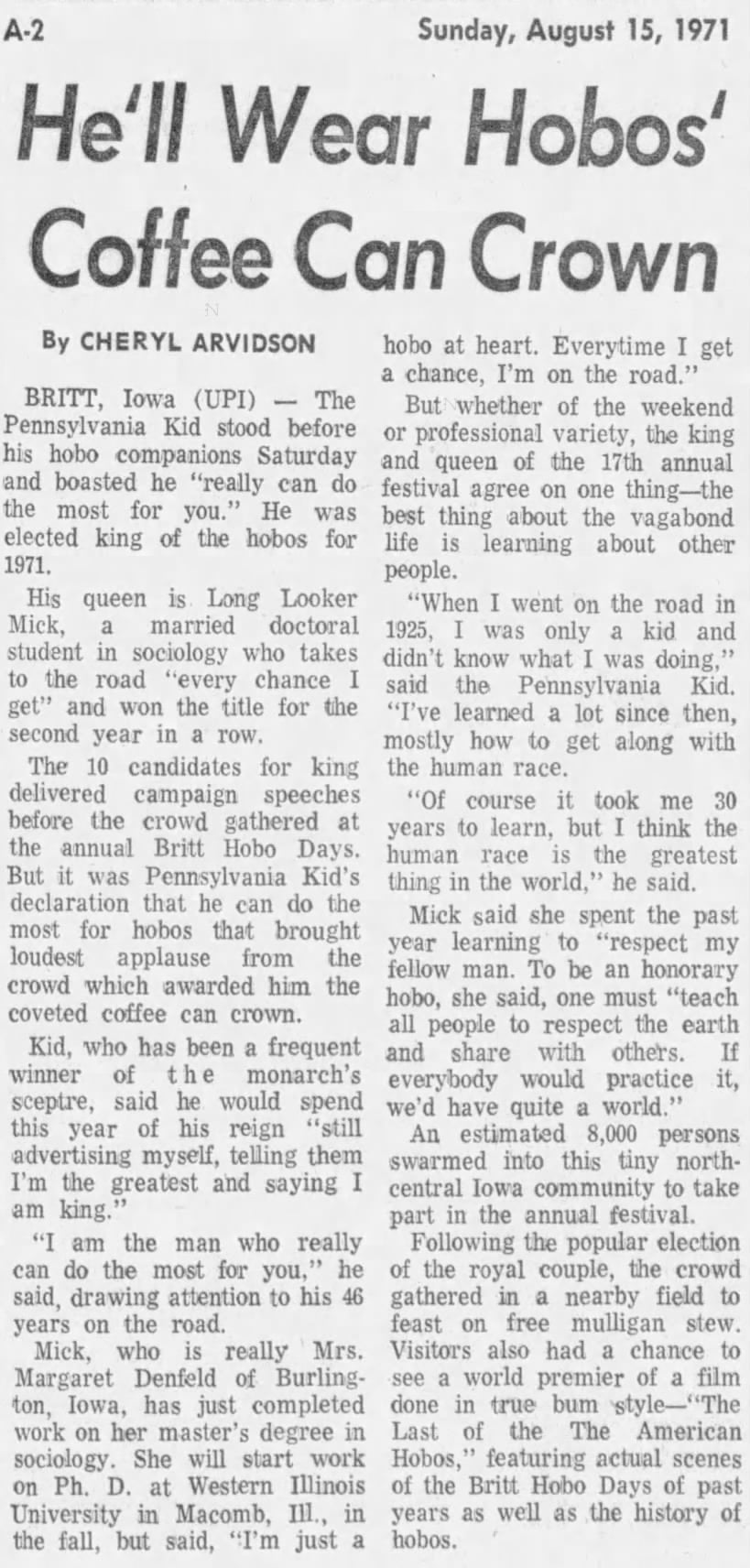
Like some of his peers, Moede gravitated to adult cinema. His tasks included directing and photography. But "Last of the American Hoboes" was a passion project of his. Over the course of several years, Moede, along with script writer/actor Gordon Barclay, gathered film for this pseudo documentary that included a healthy dose of filmed dramatic inserts. Moede and Barclay moved from skid row streets to railroads, to "hobo jungles," to flophouses, cheap late-night diners, skid row, country homes, old trees, and many roads of middle America and the American West. The film has a lot of atmosphere with the relaxed outdoor hobo camps, and trains, and the different, cramped, oppressive life in downtown skid row. It culminates in Britt, Iowa, where a hobo convention is held and a hobo king crowned.


The film includes a few low-budget cult names of the era, besides Moede and Barclay. Genre fans will notice Coleman Francis and Bruno VeSota. The cast includes hoboes of the 1960s, including contenders vying for the title of hobo king.


I am really surprised this film never made it to the now-canceled TCM Underground movie series. Or maybe I missed it. But I doubt it. It also seems like a film that public television of that era might have been interested in airing.


I always wanted to see this film, and could have bought it thirty years ago. The magazine had ads for it. But it was an era when I was yet to solidify a career and couldn't easily part with the cash. But every few years I would casually scan the Internet for the entire film, but no luck. It had been a few years but recently I looked for it again and lo and behold, it's currently free to watch on Tubi.


The film also released an album of songs (see cover below). These are songs of the road and hobo history. The film boasts of covering 70 hears of hobo life. I enjoy the songs a bunch and will probably haunt Ebay to find a reasonably priced copy of the album. I was surprised a reviewer of the film on IMDB.com panned the songs. They are actually quite cool. 


So, after finally viewing it, what's my take on "Last of the American Hoboes?" Thumbs up. It's far from a great film. The low budget hampers it. Often scenes are shot silent and voices dubbed in. I would have liked to have seen more action in Britt, Iowa, and less inserted drama. The actors are earnest but limited. Also on IMDB.com a reviewer recalls being in the film as a child. She has nice things to say about Moede.


But those are really minor quibbles. This a fascinating film, a deeply personal endeavour from Moede and Barclay, who clearly have love and passion for the subject. Just the locations they moved into, and the unique individuals, as well as points of view that are inserted in the film, make it remarkable. Without condescension, the lives of hoboes, tramps and stationary homeless individuals are treated with respect. The film recreates history, including the unfair, sad state of the Depression-era Bonus marchers and the criminal trial and execution of IWW "Wobblie" labor leader Joe Hill.


The best acting is from Barclay, who portrays a traveling hobo. With his haunted, gaunt, unshaven face, and old clothes, he conveys effectively the frustration, and impotent anger of a man who understands all too well he's getting the short straw in life. His accounting of a man's suicide in a flop house is moving.


Moede is prominent later in the film as a bearded traveler riding the roads to the convention. 


I have no idea if this film played theaters. Our newspaper archive expert in Long Beach, Calif., David Grudt, found some newspaper clips for the film, which shows it garnered publicity in southen California. Rumor has it Moede garnered awards for the film. Late in his life, Moede received a career achievement award at a Cult Movies Magazine convention. He died in 2001. 


Below is a snippet of a Hollywood Citizen-News column in 1971, from Criswell, plugging the film. It's from the last edition Cult Movies magazine published.


Below are David's clips from, in order, The San Francisco Examiner, June 13, 1969; Ventura County Star, Aug. 15, 1971; Redding Calif., Record Searchlight, May 21, 1975; and finally, two small clippings from The Los Angeles Times that ran roughly 25 years apart! Same notice, Sept. 2, 1972 and Aug. 28, 1997. (I would have enjoyed a serving of Moede's hobo stew!). The film was sold for a long time at the now-gone Mondo Video a Go-Go in Los Angeles.


Monday, November 6, 2023

'40 Cult Movies' offers a perceptive, interesting new look at the genre


Review by Doug Gibson


Jon Towlson is pretty well known and respected as a genre writer. On the Plan9Crunch blog, we have read and enjoyed his book on pre-code horror films, “The Turn to Gruesomeness in American Horror Films: 1931 to 1936.” But he’s written several books and many articles. The guy’s a legit expert on films.


In “40 Cult Movies: 40 Cult Movies from Alice, Sweet Alice to Zombies of Mora Tau” (2023), he reviews and comments on a wide variety of films, from Freaks to Shivers, from Invasion of the Body Snatchers to Upgrade, to The Legend of Hell House to Drag Me to Hell.


It's a very diverse selection. Some of the films are familiar to all, some familiar to genre fans, and some are obscurities that Towlson notes have small cults. A Serial Killer's Guide to Life and Redeemer: Son of Satan are examples of films with a following in search of a sustained cult. I love that The Legend of Hell House is included. It’s a fantastic horror film overshadowed by another great film, The Haunting. Towlson aptly notes how the haunted house is perfect match for the plot and mood of ... Hell House.


One strength of Towlson’s writing is he can thoroughly discuss a film, its plot, cultural impact, its director's history, its relation to other films, and leave the reader satisfied with what has been read. That is a rare quality in writing.


In his introduction, Towlson makes it clear that if you don’t agree with everything, “that’s OK.” I love that in a writer. Towlson describes how many of his films underscore political or cultural themes. I agree with him in many cases, notably films from Penelope Spheeris, David Cronenberg, and George A. Romero, all with multiple films discussed in this book.


I had a harder time accepting that Invasion of the Body Snatchers represents 1950s conformity and even the McCarthy era. I know director Don Spiegel thought so but to me it’s solely a damn good science fiction piece. But Towlson presents excellent arguments for his takes and I’d likely have a tough time debating him.


The book is full of these types of interesting discussions on how films provoke the culture wars. Cronenberg’s Shivers is an example. Is this tale of a parasite infecting residents with sexual mania actually positive? Is it preferable to a stultified, consumerist life that decreases sexual interest? These, and other reviews of  films such as Martin, Alice Sweet Alice, and others will keep us reading through the night.


Also in his introduction, Towlson hopes that the book prompts readers to seek out the films he has covered. I have already started. In the past two weeks I have watched, for the first time, Horror Hospital, Alice Sweet Alice, Audrey Rose, and Shivers. I also re-watched, Redeemer: Son of Satan, a film I saw a long time ago as Class Reunion Massacre. All have been rewarding views.


This is the best book on cult films since Danny Peary's 1980s series of books. I hope Towlson will do this again with 40 more cult movies. He’s the writer to give us genre in-depth looks at these unique films. I hope we have three or four volumes. 40 Cult Movies would be a great companion buy with "TCM: Undergound: 50 Must-See Films", which we also reviewed on Plan9Crunch.


In his acknowledgments, Towlson writes, “I dedicate this book to anyone who has ever had a tape snarl up in his VCR.” Oh, that is apt. Reading about these films, many I watched for the first time on VHS (I even saw a few in Beta) brings so many great memories of heading to the VCR store and looking for a garishly decorated clamshell VHS. In those days they sold the sizzle more than the steak. I discovered that in films like Dr. Butcher M.D. …, Criminally Insane, Pranks, Bloody Birthday, etc. But there was steak amidst the sizzle, such as Martin, Evil Dead, and Torture  Dungeon, Andy Milligan’s take on Shakespeare that I’d love to see explored in a future volume of Cult Movies ...


Sunday, September 18, 2022

TCM features its must-see Underground cult films in new book


Review by Doug Gibson


Roughly 40 years ago film critic Danny Peary began his Cult Films trilogy book series. It was groundbreaking for its detailed analysis of films that capture our imagination far beyond the first time we viewed them. We have to see them multiple times. Whether arguable great works of cinema, such as "Night of the Hunter," or a malformed puppy, like "Blood Feast," they were so damn unique. Derivative was not in their vocabulary. You could not replicate a film such as "Plan 9 From Outer Space," or "Pink Flamingos." It was the work of inspired minds, even if a bit, or a lot, unhinged.


I read Peary's three books to tatters, of course. I still have copies. But the books began to fade in impact, something that was written a long while ago. And, then in 2006, TCM started its TCM Underground series and suddenly these fantastic cult films that Peary had written about, and many more, began airing in "the wee small hours of the morning." Directors such as Russ Meyer, Herschell Gordon Lewis, Ed Wood, Ray Dennis Steckler, William Beaudine (post 1960), Timothy Carey, William Castle, Jamaa Fanaka, Penelope Spheeris, Paul Bartel, and others joined the list of respectables that dot TCM's schedule.


It's been 17 years of TCM Underground and I never miss it. If for some reason I cannot be up at those hours, I DVR. And yes, I watch re-runs; after all, they're cult films. Without TCM Underground, I don't think I'd have ever discovered diamonds like "Hausa," or "Emma Mae." For a list of all films aired, including shorts, go here


So, when I learned of the October release of "TCM Underground: 50 Must-See Films From the World of Classic Cult and Late-Night Cinema" (Running Press/Turner Classic Movies Philadelphia, 2022), I had to get it. I was hoping for a contemporary update of cult cinema; one that complements Peary's earlier work. 


Readers will not be disappointed. "... 50 Must-See Films" is a gem. The reviews are expertly recapped and analyzed by writers Millie De Chirico (TCM Underground's chief programmer) and critic Quatoyiah Murry. I will briefly recap three reviews. The strength of the analysis includes the authors noting where these cult gems challenged conventional mores of their era, and take positions and assumptions that are accepted more today. Cult films, crudely made or not, can do this. As author/comedian Patton Oswalt says in the book's Foreward: "Moment and feeling always conquer plot and logic, especially out beyond the edge."


The authors have placed the films in various genre categories. Dig just a few of the titles: "I Saw What You Did," "The Honeymoon Killers," "Shack Out on 101." Or "Polyester," "Sometimes Aunt Martha Does Dreadful Things," "Fleshpot on 42nd Street." How about "Blacula," "Haxan" (this film is a big personal favorite), or "Lets Scare Jessica to Death."  And there's "Little Darlings" (I'd forgotten about this film), "Two Lane Blacktop," and the aforementioned "Emma Mae." And besides "Hausa," there is "Belladona of Sadness," "Beyond the Valley of the Dolls," "Mac and Me," and "Funeral Parade of Roses" (which will blow your mind away). 


One thing I like about "... 50 Must-See Films ..." is its daring. It's willing to include films that were almost universally derided. The author's sense films that are just starting to develop a cult. Peary, for example, foresaw that the box office flop "Willy Wonka and the Chocolate Factory" would gain a big following. De Chirico and Murry are putting out the word that '80s box-office failures "Mac and Me," and "The Garbage Pails Kids Movie," have grabbed cults and are worthy of note and further interest.


And, indeed, when you look at the ultra-slick, somehow derivative high-production quality animation and fantasy today, you appreciate the uniqueness of the outcasts of the "... Garbage Pail Kids ...," sent to the State Home for the Ugly, or the awkward, crass, in-your-face commercialism of "Mac and Me." It's endearing to see another one-time failure, "Xanadu," bloom today from new viewers who simple marvel at its ability to capture a dozen artistic genres in one feature.


Here are recaps of three films in the book that represent cult genres that -- to my observations -- were not noted as cult material 40 years ago, during the era of Peary. 


The first is "Emma Mae" (1976). Lumped incorrectly as "blacksploitation," (it was given a cheesy other title, "Black Sister's Revenge," in hopes of boosting sales) the film details a young, naive southern girl/woman (Jerri Hayes) moving to live with relatives in Compton. It's a whole new life and culture. She's awkward, not conventionally pretty, and sometimes mocked by family and others. But Emma Mae has a mixture of sweetness and ferocity that slowly earns her respect and friendship. Naively, she falls in love with a man who disrespects her badly, even after she's risked her life and freedom for him. The authors correctly note that this is a hybrid film. "It's part fish-out-of-water story, part coming of age, part family drama, and part revolutionary tale of Black female empowerment."


Another film is the Andy Milligan-directed "Fleshpot on 42nd Street." I was very pleased that TCM Underground finally recognized Milligan's work. His films, ranging in budgets of $10,000 to $40,000, often were "horror" flicks. But Milligan's real skill was digging deep into the domestic lives of his characters, and creating dysfunctions that often led to violence and death. "Fleshpot" is not a horror film. It captures the grimy, dangerous lives of sex workers around 42nd Street in New York City in the 1970s. The main character is Dusty (Laura Cannon) a semi-grifter who steals and leaves her current boyfriend, grifts a horny antique dealer, and moves in with transgender sex worker friend Cherry Lane (Neil Flanagan). (Flanagan, by the way, would note an Oscar nomination if conventional Hollywood cared a whit about grindhouse cinema.)


A small time is spent with these characters, who are survivors enduring life, and we are voyeurs, witnessing their world in grubby sex settings, the streets of 42nd Street, and a lower-tier bar with an eclectic mass of characters, including two sisters who need to be seen to be appreciated. Things might began to look up for Dusty. She meets an interesting man. But you get the feeling there are far more lows than highs in this world. Even Dusty and Cherry -- who need each other -- began to quarrel. 


This is a powerful film. The authors note: "Viewing this edgy classic will likely be a jarring experience for most filmgoers today, even the staunchest cult movie fan. This film was made for a particular and very small subsection of the public, not the masses. This is its charm and its strength. Its an examination of a concealed world operating in the fringes outside mainstream society, and from the artistic bird's-eye view alone, it's a captivating watch."


Many of Milligan's films are lost. Thank heavens "Fleshpot" is one that survived.


The authors also include "Wild Seed," 1965, a film about a teenager 17, Daffy, who runs away from home. After being sexually attacked, she runs into a protector named Fargo, a somewhat harsh 20-something man who is a migrant worker and drifter. He takes her on a nomadic train-hopping cross-country journey to Los Angeles, with all the dangers this type of life offers.


Daffy (Celia Milius) wants to confront her father. She begins to have feelings for Fargo, but he's been battered by life into a type of protective cynicism. But through conflict, they yearn for each other. The authors write: "Wild Seed" is a sensitive, thoughtful film, big on mood and atmosphere and with tons of talent behind it .... (Daphne's) foray into the train-jumping life feels like a glimpse into a secret society ..."


Fans of diverse genres of film will love this book. Readers will make it a constant occasional read, skipping through and back to pages to different films they enjoy at that particular time, and wish to revisit. I hope that, given the amount of films already shown on TCM Underground, there will be several further editions of "50 Must-See Films." 

Sunday, December 13, 2020

Ed Wood's Jail Bait -- a look at it through old newspaper clippings

Another series of Plan9Crunch looking at the history of a cult film through clippings.


Jail Bait, 1954, 72 minutes, Howco, B and W. Directed by Edward D. Wood, Jr. Starring Lyle Talbot as Inspector John, Dolores Fuller as Marilyn Gregor, Herbert Rawlinson as Dr. Boris Gregor, Steve Reeves as Lt. Bob Lawrence, Clancy Malone as Don Gregor, Timothy Farrell as Vic Brady, Theodora Thurman as Loretta, Bud Osborne as the night watchman, and Mona McKinnon as Miss Willis. Conrad Brooks has a cameo. Schlock-Meter rating: 8 and 1/2 stars out of 10.


Jail Bait is a cult film lover's delight. It's Ed Wood's first foray into crime pictures, and except for a very annoying musical score, it's not a half-bad film. Of course, it has Wood's mark of organized chaos, where he simply didn't have the budget to make this picture, but that just adds to the viewing fun.

The plot concerns a young man gone bad from a nice family (Malone) and his sinister confederate in crime (Farrell, who really is good in the role). Malone is eventually killed by Farrell, who then takes the slain gangster's sister (Fuller) and father (Rawlinson) hostage. The dad is a plastic surgeon, and he has a few tricks up the sleeve for Farrell at the end of the film. Talbot and strongman Reeves (in his first film) play cops assigned to catch Malone and Farrell. Theodora Thurman, who was a top model in the 1950s, plays Farrell's moll. (According to the new book on Wood's films, Malone delivered Wood's groceries prior to his sole acting credit.)


The acting is, of course, weak, and Wood hurries through each scene, reflecting the tiny budget. But Wood's eccentric personality is on full display. Depending on which print you view, action is interrupted for a blackface show (Cotton Watts) or a very faded scene of a striptease. (my copy shows the striptease) Also the climax of the film takes place at a motel, where Wood stole shots. Wood tries hard to achieve a type of film noir atmosphere, and almost succeeds at times, particularly with Farrell.

Like any Wood film, the story behind the movie is just as interesting as the film. Watch silent film star Rawlinson very closely during his scenes as the aging dad/plastic surgeon. If he appears tired it shouldn't be a surprise. He died the morning after filming. Rawlinson's role, in fact, was intended for Bela Lugosi, but he was too sick to do it. Also, Reeves took 27 takes to tie his tie, which must have driven the thrifty Wood mad. The great actor Jimmy Cagney was visiting the motel where Wood and cast was stealing a scene shot. Cagney offered to be in the film, but everyone was chased from the motel by the irate manager. If you are a Wood fan, buy Jail Bait. It's a must for your cult films collection. But even those who aren't Wood fans will find it worth a $2 rental. By the way: Jail Bait in the title refers to a gun, not a woman.

I, Doug Gibson, wrote that review long ago. I like the second newspaper clip because it mentions a star, Dolores Fuller. The above clip at top mentions many stars of the Howco film, including Lyle Talbot, Steve Reeves, and Theodora Thurman. I think the woman in the ad is Mona McKinnon, who had a smaller role.

Jail Bait played in many areas, Ohio, California, but it did a lot of business in the South, where Howco marketed their films heavily. My friend David Grudt, who helps with these searches, located an actual newspaper review from the Elizabethtron, Tenn., Star edition of Sept. 25, 1955. I know the review is lifted -- likely -- from a press package, but it's great to find records of reviews for these films. They didn't get many published. It's below:


Nice to see Clancy Malone, Timothy Farrell, and Bud Osborne get mentioned too. I am sharing several clips that David Grudt unearthed for this blog post. The first and second are from the Sacramento, Calif. Bee editions of Aug. 15 and 16, 1954. The third is from the Columbian, Miss., Progress of Nov. 18, 1954. The fourth is from the Greenville, S.C., News of Aug. 16, 1954, and the final is a blurb notice of Jail Bait playing in the Tampa, Fla. Times of Nov. 13, 1954. You will notice that Jail Bait played in some "adult" theaters with burlesque-type films. I hope the burlesque films satisfied any prurient interest of attendees, because is at best a mild PG film. I guess the adult houses used the hard-to-see sequence involving a striptease, Other theaters used the cringeworthy blackface routine The last time I saw Jail Bait on television - this year - neither sequence was used. The scene, not needed for story flow, was excised. 


It might interest readers to know that a Sam Katzman-produced film, Teenage Crime Wave, was also released in 1954, a bit later than Jail Bait. However, Teenage Crime Wave in some locations used the name Jail Bait as its title. We had to watch for this while we researched Wood's film. In the early process, I downloaded ads with the wrong Jail Bait. The ad below for an all-night drive-in showing of thrill films includes Jail Bait. It was published in the Jackson, Tenn., Sun on July 9 1954. I am at least 80 percent sure this is Wood's film.


Finally, enjoy a few more ads of Jail Bait that I located, as well as noting the films that played with it. I love the diversity of the films that Jail Bait played with. Everything from Untamed Mistress and Naughty New Orleans to Our Miss Brooks and Heidi! Even today, Jail Bait frequently airs on The Movies Channel in the middle of the night.