Translate

Showing posts with label Severin. Show all posts

Wednesday, April 8, 2026

Andy Milligan's Compass Rose, 1968, a look at Caffe Cino of the '60s


If you're a fan of filmmaker Andy Milligan, you are familiar with many of his trademark film characteristics - impalement with a pitchfork, beheadings, actors dressed in cheap period costumes, and his unique camera technique of the swirl camera. Compass Rose (1968) deviates a bit from these characteristics but is still an important film in the Milligan canon. The film explores the lives of struggling actors and bohemian types in New York City at the off Broadway Cafe Cino in the 1960s. (Above and below are two stills from Compass Rose)


The opening sequence shows a couple (Anthony Moscine, Anne Linden) having sex on a bed, kissing and rubbing each other. In true Andy Milligan form - the sex on screen is not very erotic or sexy. These are not bodies that are in perfect shape or very sexy in any way. We can almost smell their body odors as we see their scars, pimples, moles and other imperfections on full display on the screen. Any sex shown in a Milligan film is not intended to arouse or sexually stimulate the viewer. These are real, everyday people engaged in sexual activity, and not body perfect porn stars.

Milligan's wife-to-be, Candy Hammond, wastes no time disrobing for the camera when she first appears on screen. The viewer is treated to a quick glimpse of her pubic area when she runs into a bedroom after disrobing. She is nude in all of her scenes until she commits suicide in her final scene. Hammond always appears to be confident, if not aloof, about her nudity on screen as she frequently touches her breasts. Hammond would eventually marry Milligan in 1968 during the production of Compass Rose.


The viewer is also treated to the inside world of Caffe Cino. The walls of the cafe are plastered with posters, fliers and other visual ephemeral that keep the viewer looking everywhere. Decor and drapery hang loosely from the cafe ceilings. The entire environment is visual overload, which is likely the point. Actors perform strange drag impromptu dialogue on a small stage as patrons of the cafe watch casually while smoking cigarettes.  

If you purchased the Severin films Blu-Ray set of Gutter Auteur: The Lost Legacy of Andy Milligan, the print of Compass Rose has sound which cuts in and out throughout the film. Small segments of the film have no sound at all, and sound sequences are often hard to decipher during conversations between actors. This is not a complaint from this reviewer. We are very fortunate to have this film to view, so we can overlook the sound imperfections.  

The final scene of Compass Rose is a chaotic orgy of naked sadism. Twisted bodies squirm around in an S&M playground, smeared with food in the same basement that Milligan shot The Ghastly Ones (1968). The film ends abruptly with a statement on screen which mentions that Milligan never completed the film. The film was likely unreleasable due to sound problems. 


Milligan's next project was - The Filthy Five (1968), another lost film in the Milligan canon. The Severin Blu-Ray of Compass Rose has an 18-minute interview with film historian Stephen Thrower about the film. Thrower gives us great insight into the career of Milligan and the making of the film. The Degenerate Blu-Ray set also includes Milligan's post-nuke film - The Degenerates (1967), Kiss Me, Kiss Me, Kiss Me (1968), House of Seven Belles (1979), and the documentary - The Degenerate - The Life & Films of Andy Milligan. The three discs are packed with lots of extras. Don't miss it.

Steve D. Stones   

Friday, March 20, 2026

Andy Milligan film The Degenerates fascinates as dysfunctional, chaotic science fiction cult


Review by Doug Gibson


If you're an Andy Milligan fan, or just a fan of the exploitation film genre of the 60s and early 70s, the "holy grail" arrived last year when two long-lost Andy Milligan films turned up. "The Degenerates" and "Kiss Me, Kiss Me, Kiss Me!" Both premiered at Tribeca and have screened a few times since.


Most of us had to wait until this month when Severin shipped the Blu-Ray set, packed with lots of extras, including a new Milligan documentary, "The Degenerate: The Life and Films of Andy Milligan," and versions of the existing but obscure "Compass Rose" and "House of the Seven Belles." In a few days I have devoured this set and will fill this year with posts on Plan9Crunch.


THE DEGENERATES, 1967


Let's get right to the first review. This is one of the lost Milligan films I most wanted to see. A science fiction adult exploitation flick, "The Degenerates" was filmed in the future New York Woodstock area. I think in spirit this film is close to Milligan's "Seeds." The raw family dysfunction bleeds on the screen and gets more chaotic and violent with a strong finale. And "The Degenerates" provides a stronger backstory to its drama than "Seeds" did. This version is 64 minutes. It omits 10 minutes of nudity and soft-core sexual situations. Those scenes are still lost.


The film begins with three soldiers on patrol in the eastern United States. Nuclear wars have killed most of civilization. The soldiers discover a woman frolicking in the wilds. Surprised to see any humans, they chase her to a dilapidated, large farmhouse with battered sheds and a junked vehicle.


The soldiers encounter five sisters, Violet, (Bryarly Lee), Daisy, (Anne Linden), Lily, (Laura Cunningham, as Laura Weiss), Iris, (Marcia Haufrecht, as Marcia Howard), and Rose (Susan Howard). Later the soldiers will discover a sixth sister, Ivy, (Hope Stansbury), who is traumatized and lives a near-feral existence outside. 


Violet, the leader of the sisters, is very hostile to the soldiers but allows them to stay. One soldier is nursing a broken foot. Initially, all three soldiers appear accommodating. However, one will reveal himself to be violent and a rapist. However, even before that escalation Violet's hostility toward her sisters will lead to vicious attacks on two of her siblings and eventually violent deaths to some of the characters.


Lee was an accomplished stage actor and gives the best performance in the film. Her Violet is an authority figure who quickly loses her self-control and sanity when the soldiers and three of her sisters initiate intimate relationships. Something has triggered Violet into acts of sadism. She savagely beats Daisy and burns Lily's hand on a stove. Watching Lee reminds viewers of family matriarch Maggie Rogers' savage, screaming performance in the later Milligan film "Seeds." Lee's Violet seems a younger version of Rogers' character but not yet the hard shell.


There's a suffering vulnerability in Violet. She's clearly been traumatized and wants to be relieved of it. She's closest to her sibling Rose (Susan Howard). Clearly triggered by the men and the ensuing intimacy she can't snuff out, Violet attempts incest with Rose. In what is a patented compelling but deeply uncomfortable Milligan sequence, Rose is repulsed by her seduction attempt, and screaming ensues.


Lee is superb. She may soon become a favored Milligan actress if "The Naked Witch," another lost Milligan film, is discovered. According to a commentary from Milligan historian Alex DiSanto, Lee was notable for her extreme focus on her work during the shoot.


In one scene involving Lee, she commits a Milligan-esque killing with what seems deliberate religious symbolism. Or maybe I'm overanalyzing? Readers can let me know.


Hope Stansbury is iconic within the Milligan genre for her willowy beauty. She gives the second-best performance as the mentally ill Ivy. She and Violet have a savage hatred for each other, which is revealed in the climax. A strong scene for Stansbury is when Ivy shows her soft heart by visiting the beaten Daisy, laying in pain in a shed. Ivy feeds her and tries to tend to her wounds. She also helps further Daisy's romance.


Linden as Daisy gives a good performance as a vulnerable, scared sibling wanting love. She's in several Milligan films, including "The Ghastly Ones." Haurfrecht as Ivy is still active in films today, with an impressive career. She's perhaps the strongest weaker sibling, standing up to Violet's violent control tactics. She's romanced by actor Robert Burgos, who plays the soldier, Jim. He's the best actor of the three men cast and has enjoyed a distinguished acting career. The other soldiers were Vernon Newman and David Blaine.


Laura Weiss as Lily was 18 and plucked off a college campus by a Milligan talent scout (Hal Sherwood?). It's her only film and she does herself proud. Weiss is interviewed on the Blu-Ray set. She's written a couple of memoirs including one on the film's shoot. Not much is known about Susan Howard as Rose but she's effective on screen. Her expressive eyes when she realizes Violet wants to make love to her is a highlight.


The film is photographed in pure Milligan Auricon 16-MM style. Closely framed shots, the actors usually bunched together to hide small sets. Despite the battered print, you can see the dirt, the tired faces, the tattered burlap Milligan-sown tank top-like middies worn by the women, the sweat and blemishes on the faces. The dialogue sound is loud, you can hear the Auricon whirring. The house is more than rustic. It must have been a chore for the actors to survive the shoot. DiSanto in his commentary says it was reputedly haunted. DiSanto recalls a love scene shot inside a filthy outside building having to be re-shot the next day due to a lighting mishap. 


In interviews though, actors recollect the experience fondly. Even Milligan seems to have been even-tempered overall. The only remembrance of frustrations for Milligan was with the novice Weiss.


The film cost $11,000. It was shot in about a week. It was not produced by William Mishkin but was part of an ill-fated three-film effort with three investors who went bankrupt, distributor Jerry Balsam, and Milligan. Sam Sherman was lightly involved. He apparently came up with the title. It was shot as Sin Sisters. The film was profitable, but Milligan was squeezed out. He later sued and collected a few thousand dollars for all three films, a poor return for him.


Weiss recalls standing much later outside a building where Milligan was inside shouting for the $200 she had been promised. It worked. She was paid. In 1966, $200 was slightly more than $2,000 today.


I love this film. It met my expectations as a Milligan cult fan. It has the "Gutter Auteur"'s signature uniqueness that is splashed all over the 20-plus films he directed in his most-active several years. We're not done with the Blu-Ray set. Next, we'll review and provide observations on the re-discovered "Kiss Me, Kiss Me, Kiss Me!"


One more tidbit. Yes, the swirl camera and pitchfork are in "The Degenerates."

Tuesday, September 20, 2022

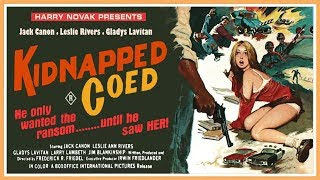
Kidnapped Coed a quirky, interesting grindhouse film from 1970s


Review by Steve D. Stones


Severin Films has released an excellent double feature Blu-ray of director Fredrick R. Friedel's two only known features – Axe (1975) and Kidnapped Coed (1976). Both films star Jack Canon, an underrated actor who should have gone on to make a bigger name for himself and to star in bigger-budget films. Canon is excellent in both films and steals every scene he is in. Kidnapped Coed was also known as Date With A Kidnapper and The Kidnap Lover. Here is the trailer under the title Kidnap Lover. 


In Kidnapped Coed, Canon plays a down-on-his-luck gangster named Eddie Mattlock, who kidnaps a young red-haired beauty named Sandra Morely (Leslie Ann Rivers). Sandra leaves her boarding house one morning and is held up at gunpoint in the back of her car by Eddie. He threatens to kill Sandra if she makes any attempt to escape. Eddie calls Sandra's father and demands ransom money for the safe return of his daughter. Although some reviews of this film suggest that Eddie is indebted to the mob as his motivation for kidnapping Sandra, the film never really makes this clear as his motivation.


Eddie takes Sandra to a sleazy, run-down hotel. The hotel clerk, played by Larry Lambeth, appears to be a questionable character who does not take his job very seriously as he lounges behind the counter all day drinking vodka and smoking as he tells his guests that today is his last day on the job. The camera pans to a closet behind the clerk's desk with a body laying next to cases of bottled soda. The viewer immediately suspects that there is something very wrong going on in the hotel and the clerk has something to do with it.


After entering their hotel room, Sandra locks herself in the bathroom and pretends to be taking a shower. She writes a desperate message in lipstick on a roll of toilet paper and throws it out the window. The hotel room is up three stories high, so she cannot jump out of the window. A young boy in the street down below kicks the toilet paper roll into the gutter.


While brushing her hair on the hotel room bed, a knock is heard at the door. Sandra opens the door to see the hotel clerk and another man pointing a gun at her and Eddie. She thinks the two men are detectives who have come to rescue her. The clerk and the other man tie up Eddie to a chair as the clerk rapes Sandra on the bed in one of the most brutal sequences of the film. Director Friedel builds great tension in this scene by showing close ups of Eddie's frustrated and bloody face as he watches the rape take place on the bed. The sex act is never shown on screen, yet the viewer fills in the blanks by imagining this sadistic act as Eddie's face helps to reveal the uneasiness of it.


Eddie is able to untie himself from the chair and shoot both men in the genitals with a gun. The couple flee the room and drive to an abandoned farm shack. Here Eddie paces back and forth in the shack, smoking a cigarette, as he decides what his next move is. The two flee the shack when they hear a car approaching. They encounter a group of women bird watchers. One of the bird watchers is the store clerk in Axe, who has a bottle of ketchup shot above her head.


Director Friedel throws in little bits of weirdness in the film that give it some strange yet surreal characteristics. A close up of an old man rocking in a chair with a cane out in the street after Eddie shoots the clerk and his sidekick in the genitals is one example. A strange red-colored telephone booth not connected to any wiring appears out in the middle of barren fields in a number of scenes where Eddie goes to make a phone call.  He uses the telephone booth to call his mother, who hangs up on him. A child sitting on a curb flips Eddie the middle finger as he drives by shortly after kidnapping Sandra.


Perhaps the most effective aspect of both Axe and Kidnapped Coed is that both films have very sparse use of dialogue. Both films rely more on visual aspects to tell a story and to keep the narrative moving forward. The viewer is not always given any explanation for why many of the characters behave the way that they do, or why they are in the situation that they are in. This ambiguity keeps the viewer wondering and questioning the motivations of many of the characters in both films.


Also of interest are the many extras contained on the Severin Blu-ray. One of the extras interviews the cast, crew and director Friedel. In one interview, Friedel expresses his frustrations with producer/distributor Harry Novak, who completely took over the rights and distribution of both films, leaving Friedel with practically nothing in return. Friedel spent time at Novak's run-down office, combing through piles of old dusty boxes to look for the negative of Axe and Kidnapped Coed. He was able to locate both films for this official Severin release. The extras are every bit as interesting and exciting as watching both films. Happy viewing.


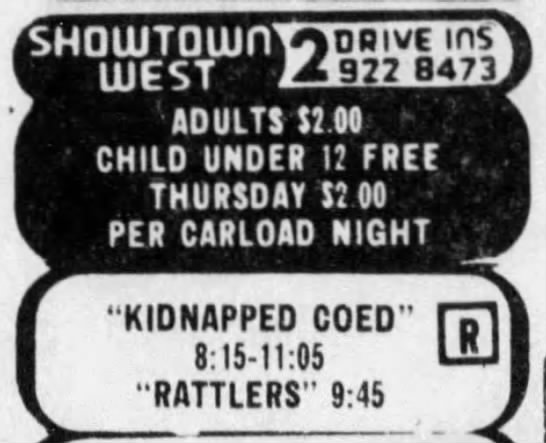
(Kidnapped Coed was defintely marketed as grindhouse/drive-in fare. Here are a few more newspaper ads. We'd like to thank David Grudt, of Long Beach, Calif., for his help in locating some of these vintage ads.)