Translate

Showing posts with label 1970s cult cinema. Show all posts

Sunday, February 26, 2023

A thorough, entertaining book on Ray Dennis Steckler's incredible career


Review by Doug Gibson


Christopher Wayne Curry is the author of the new book, The Incredibly Strange Features of Ray Dennis Steckler, McFarland & Company, Inc., Publishers, Jefferson, N.C. (800-253-2187). It's a very thorough, very entertaining overview of the late cult director's career. Curry dug deep into old press releases, reviews, tons of interviews, insights, and a journalist's' doggedness to blend Steckler's career and personal life together into a history worth reading.


There's a great movie, or streaming series, to be produced from the C- and D-budget producers/directors/actors of the 1960s, and this book could provide the inspiration.


The iconic-looking Steckler, he kind of resembles a poverty-row version of Nicolas Cage in films he starred in -- is a bit of a contradiction for me. His films, while certainly very unique and fun to watch, have never been among the top of my cult lists. However, the man himself is one of the most interesting cult film director auteurs. He made films from scratch, more often than not without a script, or more than a conventional month's pay to start. There is a necessary spontaneity in his films; the tone and theme was capable of changing in the middle, from thriller to comedy, to travelogue, to musical, from horror flick to rodeo show.


And from what I've seen of him in video interviews and print interviews and articles, he seemed a genuinly decent man, a lifelong film obsessive who tried his best to keep the moods of the vintage films he loved, especially the 1930s and 1940s western 'oaters, into his films of the '60s and early '70s.


With a couple of exceptions, Steckler's incredible cult heyday comprised about a decade, starting with directoral and acting duties in "Wild Guitar," "Incredibly Strange Creatures Who Stopped Living and Became Mixed-Up Zombies," "The Thrill Killers," "Rat Pfink a Boo Boo," "The Lemon Grove Kids Meet the Monsters," and "Body Fever." Things got darker with "Sinthia: The Devil's Doll" (the first film since "Wild Guitar" where Steckler was a "hired-gun" director), and "Blood Shack." He also made a very funny short called "Goof on the Loose." (Below are scenes from "The Thrill Killers" and Incredibly Strange Creatures Who Stopped Living and Became Mixed-Up Zombies.")


Curry takes the reader through Steckler's early years, his time in the U.S. Army, and his late '50s entry into Hollywood. He was a hard worker, one of his earliest assignments was as a prop man, and later assistant cameraman, on Timothy Leary's long-running project, "The World's Greatest Sinner." It was a hand-to-mouth existence. As Curry notes, when Steckler met his future wife and star of many of his films, Carolyn Brandt -- a dancer with a unique, angular beauty -- he was living out of his car.


Steckler had talent and could work inexpensively. That earned him the "Wild Guitar" director duties for Arch Hall Sr. The film was one of several that starred his son, Arch Jr. Steckler got along OK with Hall and son, but an independent streak, and a desire to decide how his films were marketed, eventually moved Steckler to other partners and producers, notably George J. Morgan, during his main "cult" era.


The anecdotes from the mid 60s films of Steckler underscore their cult status. "Incredibly Strange Creatures" is a visual trip, with its exterior setting of the old Pike amusement park in Long Beach Calif.; its non-sexy dances; shrill musical numbers; bizarre makeup of the monsters. This mishmash of musical horror somehow ends on a beach with wild surf and dangerous rocks. The female lead was replaced by a carnival dancer who now had two parts. In garish color, there is a controlled chaos to the film that keeps a viewer looking at it.


"The Thrill Killers" starred Liz Renay, an ex-con former moll of a Mafia chief. Steckler literally grabbed her as she was released. The film is a violent tale of a gang killing many, but it also plays homage to Steckler's love of westerns with horse chases, motorcycles racing, a baddie chasing a heroine through rough terrain, and lots of shooting. 


"Rat Pfink a Boo Boo" starts out as a tale of a film star (Brandt) -- with a singing star boyfriend -- being terrorized by thugs. Once she gets in real peril, it suddenly transforms into a comic-like superhero tale with her boyfriend and his friend becoming caped crusaders Rat Pfink and Boo Boo. This film, which also involves a gorilla, is surreal to the max. Its guerilla, on-the-spot, take-what-you-can filmmaking is underscored by a final scene where the masked heroes crash a southern California parade that is definitely not part of the movie. It's exhilerating!


"The Lemon Grove Kids Meet the Monsters" are three short films made into one film. It is a wacky, low-brow comedy tribute to the Bowery Boys films. Steckler loved those films, and especially Huntz Hall's stupid/funny Sach character. Curry relates that when Steckler finally got a chance to meet his idol Hall, he was treated very disrespectfully by the aging Hollywood star, and then threatened with a lawsuit unless changes were made to Steckler's character. 


Several of the actors and crew who worked with Steckler made it to A features in Hollywood. Steckler never begrudged them. He seemed happy with their success, from interviews I have read. But I cannot help thinking that Hall's casual cruelty to a colleague and fan had an impact on Steckler's optimism and enthusiasm. He never made another film as deliriously inventive or spontaneous than the four just mentioned.


They were family-centered (including his kids and their playmates), friends-centered, film-troup regular-centered low-budget creations. And as Curry so interestingly relates, they were barnstormed around the country in roadshow styles, with matinees and/or midnight showings, with ushers hired to "terrorize" theater-goers, with small musical events, often in a parking lot. As Curry describes the histories of these films, it must have been exciting times. What a creep Hall was to blow smoke on Steckler's dreams.


"Body Fever" (see photo above) was Steckler's ode to crime noir, and '40s detectives in the '70s. Carolyn Brandt is absolutely gorgeous in the film as femme fatale Carrie Erskine, who steals cash from mobster Big Mac. He was played very effectively by Bernard Fein, creator of TV show "Hogan's Heroes", Steckler is good as a low-energy but somehow effective private eye. I think this is technically Steckler's best film. It's a fun story. It has wonderful Los Angeles atmosphere, and there are touches, such as Steckler's scene with actor/director Coleman Francis, that add authenticity to the story. (The backstory to this, which really highlights Steckler's kindness, is that Coleman, who had been in earlier films, was down and out due to alcoholism. When Ray met him, he created a role for Francis to help him out.)


Yet, as Curry and history notes, "Body Fever" quickly went to the shelf. No interest. And except for an otherwise pedestrian serial killer grindhouse film, "The Hollywood Strangler Meets the Skid Row Slasher," 1979, that is somewhat saved by its grimy LA slum settings and an unsettling, strong performance by Brandt, Steckler's era of making unique, interesting films was over. The 1971 unreleasable "Blood Shack," shot in Nevada, is just not that good. Its only small value is seeing Brandt and Steckler's children in the film. An alternate release, called "The Chooper," is slightly better. But again, another film shelved until video arrived.


Curry notes that this late 60s, early 70s era was when Steckler's marriage with Brandt was falling apart. In a remarkably frank interview with Curry, Brandt recalls her failing marriage and Steckler's repeated adulteries. In fact, she tells Curry that her least favorite film is the first "Lemon Kids" short because Ray was having an affair with the actor who played "Roxy." It's a credit to the pair's relationship and commitment to their children that they remained on cordial terms. Both remarried.


Curry handles with tact that beginning in 1971 Steckler began making hard-core pornography, apparently over a decade-plus. I've never seen one and have no interest in watching the few that are in Severin's recent Blu-Ray release of Steckler's films. Curry appropriately goes over the history of these films but it's a small section of the book. In an interview with Steckler's daughter, Laura, who acted in and helped with his mainstream films, she plaintively wishes that the films were mosty omitted from the book.


According to Curry, Steckler would abruptly end interviews if questions about his porn films were offered. According to an interview Curry does with actor Ron Jason, Steckler was let go from his film teaching job at the University of Nevada Las Vegas because of his porn films. "...he was broken-hearted when they let him go," Jason said. In her interview, Laura Steckler surmises that her dad made those films to pay the bills, which seems likely.


With the mid to late 80s cult genre video boom, Steckler enjoyed a renaissance that lasted until his death. He owned three video stores in Nevada, and was a genial, considerate man who would talk to his fans and sign his videos. At one point he re-edited his main cult films into hour-long black and white versions, with new titles. He called it The Steckler Collection. It'd be fun to access those films again. They do no seem to be for sale anymore.


Like other cult icons, the sheer uniqueness of Steckler's films will provide him fame that will exceed most peers who "graduated" to big budgets. Unlike an Ed Wood, he was fortunate to live long enough to enjoy recognition. And he enjoyed it with kindness, grace and consideration.


Curry's book is a treasure. Through the pages, we witness a smaller but no less interesting Hollywood of the 1960s. Steckler surrounded himself with so many eclectic, often eccentric interesting colleagues. He had his casts, his producers, his crew, even his hangers-on. It's fun to follow all those who populated Steckler's world.


I'll close with another Steckler actor, legendary stuntman Gary Kent, who tells Curry: " ... there was never much pay at all. Lunch would be a bologna sandwich, if that. You were working mainly because you wanted to be in a movie ... So Ray brought his enthusiasm and that big camera and I just loved the sight of it."'


Amazon link to buy book is here.


Saturday, February 4, 2023

Blood Shack, 1971 -- The Chooper will Get You!


---

Review by Steve D. Stones


Severin Films has recently released an awesome Blu-Ray boxed set of 20 incredibly strange films by director Ray Dennis Steckler. Included in the set is his 1971 film – Blood Shack, and an alternative cut of the film - The Chooper. The boxed set also includes an informative booklet about Steckler, his films and career.


In Blood Shack, three young people in an antique car pull up to an abandoned house in the middle of the Nevada desert. A young woman in the group named Connie, played by Laurel Spring, has recently had an argument with her husband and has left him. She dares the two young men she's with to stay in the abandoned house overnight. The two men refuse to stay in the house, claiming a local legend says it's haunted and that the entire ranch surrounding the house is possessed by a sword slashing, ancient Indian spirit known as “The Chooper.” The two men leave Connie alone at the house.


A shirtless rancher named Daniel, played by Jason Wayne, warns Connie not to stay in the house overnight. Connie ignores his warning and goes into the house. She lays out her sleeping bag on a worn, soiled mattress in the middle of the front room of the house and strips down to her underwear. The camera shows close ups of large holes in the walls, torn wallpaper and a very dark interior. A dark dressed figure enters the room and chases Connie throughout the house. He stabs Connie several times with a sword, killing her.


Daniel arrives the next morning to see Connie's dead body in the house. “I told you the Chooper was gonna get you! I told you!” he screams out, as he places Connie's body in the back of his pick up truck to bury her corpse out in the desert. Apparently this is not the first time Daniel has found a corpse in the house that was killed by the dark figure.


Carol, played by Steckler's beautiful wife Carolyn Brandt, inherits the abandoned house and the ranch from her family. She arrives soon after Connie's death to inspect the property. She is immediately pressured by a local land investor named Tim Foster (played by Ron Haydock, the hero of Steckler's 1966 film - RatPfink A Boo Boo) to sell the entire ranch. Carol refuses to sell the ranch to Foster, but is pressured by Foster several times to sell. Foster becomes more and more aggressive to buy the land as the film progresses.


Also included on the Blood Shack disc in the Blu-Ray set is the alternative cut of the film – The Chooper. This cut of the film runs 14 minutes longer. The opening narration by Carolyn Brandt is also longer, and gives a greater description of how the ranch curse and The Chooper began. This print of the film is not as sharp as the Blood Shack print, so it likely has not been digitally remastered. The opening titles of The Chooper, however, are much more interesting by showing crudely painted bloody graphics and titles which omit director Steckler's screen pseudonym of Wolfgang Schmidt. Steckler's name does not appear in the opening credits of Blood Shack.


The Chooper also has a scene in which Carol speaks to Daniel in an office room with posters from many of Steckler's movies hanging on the walls. This scene is not shown in the Blood Shack print of the film. Other added scenes in this cut of the film show Tim Foster confronting Carol at a worn down gas station to ask her again to sell the ranch. More scenes of Steckler's children Linda and Laura are also in this cut of the film that are not shown in Blood Shack.


A pony named Peanuts stars in The Chooper in a brief scene and also gets a screen credit at the end of the film. Steckler inserts several scenes of a local rodeo in the film. These scenes are more frequent in The Chooper cut of the film. Steckler is careful not to reveal the face of The Chooper every time he appears in a scene to chase and stab his next victim. Blood Shack is also known for its third title - “Curse of The Evil Spirit.” In an opening commentary, movie critic Joe Bob Briggs says The Chooper is the original cut of the film. Happy Viewing.

---

Editor's note: McFarland Press has just released a new book, The Incredibly Strange Features of Ray Dennis Steckler, by Christopher Curry. We have ordered it. You can here.

Tuesday, September 20, 2022

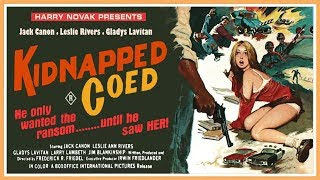
Kidnapped Coed a quirky, interesting grindhouse film from 1970s


Review by Steve D. Stones


Severin Films has released an excellent double feature Blu-ray of director Fredrick R. Friedel's two only known features – Axe (1975) and Kidnapped Coed (1976). Both films star Jack Canon, an underrated actor who should have gone on to make a bigger name for himself and to star in bigger-budget films. Canon is excellent in both films and steals every scene he is in. Kidnapped Coed was also known as Date With A Kidnapper and The Kidnap Lover. Here is the trailer under the title Kidnap Lover. 


In Kidnapped Coed, Canon plays a down-on-his-luck gangster named Eddie Mattlock, who kidnaps a young red-haired beauty named Sandra Morely (Leslie Ann Rivers). Sandra leaves her boarding house one morning and is held up at gunpoint in the back of her car by Eddie. He threatens to kill Sandra if she makes any attempt to escape. Eddie calls Sandra's father and demands ransom money for the safe return of his daughter. Although some reviews of this film suggest that Eddie is indebted to the mob as his motivation for kidnapping Sandra, the film never really makes this clear as his motivation.


Eddie takes Sandra to a sleazy, run-down hotel. The hotel clerk, played by Larry Lambeth, appears to be a questionable character who does not take his job very seriously as he lounges behind the counter all day drinking vodka and smoking as he tells his guests that today is his last day on the job. The camera pans to a closet behind the clerk's desk with a body laying next to cases of bottled soda. The viewer immediately suspects that there is something very wrong going on in the hotel and the clerk has something to do with it.


After entering their hotel room, Sandra locks herself in the bathroom and pretends to be taking a shower. She writes a desperate message in lipstick on a roll of toilet paper and throws it out the window. The hotel room is up three stories high, so she cannot jump out of the window. A young boy in the street down below kicks the toilet paper roll into the gutter.


While brushing her hair on the hotel room bed, a knock is heard at the door. Sandra opens the door to see the hotel clerk and another man pointing a gun at her and Eddie. She thinks the two men are detectives who have come to rescue her. The clerk and the other man tie up Eddie to a chair as the clerk rapes Sandra on the bed in one of the most brutal sequences of the film. Director Friedel builds great tension in this scene by showing close ups of Eddie's frustrated and bloody face as he watches the rape take place on the bed. The sex act is never shown on screen, yet the viewer fills in the blanks by imagining this sadistic act as Eddie's face helps to reveal the uneasiness of it.


Eddie is able to untie himself from the chair and shoot both men in the genitals with a gun. The couple flee the room and drive to an abandoned farm shack. Here Eddie paces back and forth in the shack, smoking a cigarette, as he decides what his next move is. The two flee the shack when they hear a car approaching. They encounter a group of women bird watchers. One of the bird watchers is the store clerk in Axe, who has a bottle of ketchup shot above her head.


Director Friedel throws in little bits of weirdness in the film that give it some strange yet surreal characteristics. A close up of an old man rocking in a chair with a cane out in the street after Eddie shoots the clerk and his sidekick in the genitals is one example. A strange red-colored telephone booth not connected to any wiring appears out in the middle of barren fields in a number of scenes where Eddie goes to make a phone call.  He uses the telephone booth to call his mother, who hangs up on him. A child sitting on a curb flips Eddie the middle finger as he drives by shortly after kidnapping Sandra.


Perhaps the most effective aspect of both Axe and Kidnapped Coed is that both films have very sparse use of dialogue. Both films rely more on visual aspects to tell a story and to keep the narrative moving forward. The viewer is not always given any explanation for why many of the characters behave the way that they do, or why they are in the situation that they are in. This ambiguity keeps the viewer wondering and questioning the motivations of many of the characters in both films.


Also of interest are the many extras contained on the Severin Blu-ray. One of the extras interviews the cast, crew and director Friedel. In one interview, Friedel expresses his frustrations with producer/distributor Harry Novak, who completely took over the rights and distribution of both films, leaving Friedel with practically nothing in return. Friedel spent time at Novak's run-down office, combing through piles of old dusty boxes to look for the negative of Axe and Kidnapped Coed. He was able to locate both films for this official Severin release. The extras are every bit as interesting and exciting as watching both films. Happy viewing.


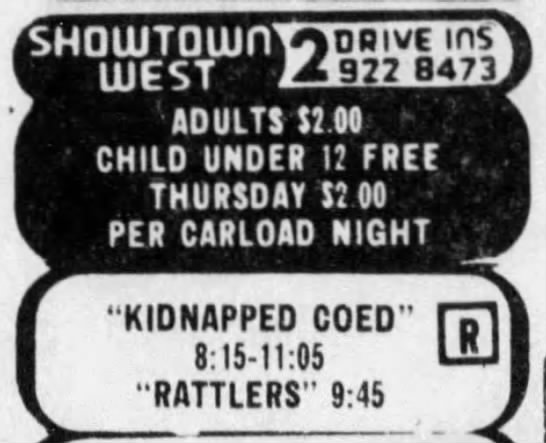
(Kidnapped Coed was defintely marketed as grindhouse/drive-in fare. Here are a few more newspaper ads. We'd like to thank David Grudt, of Long Beach, Calif., for his help in locating some of these vintage ads.)


Sunday, August 28, 2022

Andy Milligan's 'Blood' is grindhouse auteur's monsterama


---

Review by Doug Gibson

Stephen King, in his book Danse Macabre, trashed grindhouse filmmaker Andy Milligan. Writing of his film, "The Ghastly Ones," King said something about it being the result of morons with cameras. 

King's comments lend credence to the maxim that even one of our greatest writers can be a total ass when pontificating on other subjects. Crude "The Ghastly Ones" may be, but Milligan cobbled it together on a budget of roughly $10,000, perhaps a little bit more. He also created something unique, with his signature stamp of family dysfunction leading to chaotic, deadly horror.

Ironically, Stephen King later directed a film, "Maximum Overdrive." King later accurately labeled it "a moron movie." It cost $9 million and was a derivative mess. (I wasted $5 or so watching it in a theater). Since it grossed $7.5 million, King's film ended up losing -- on a conservative guess -- about $10 million.

"The Ghastly Ones" made likely a tidy fortune for Milligan's tight-fisted producer, William Mishkin. It played drive ins and grindhouses for years. It's probable Milligan saw none of those profits. I've read rumors that Mishkin gave Milligan about $20,000 to make a film, and Milligan only spent half so he would see a healthy paycheck for himself.

With this preamble over, this post is a review of the 1974 Andy Milligan film, "Blood." For a long time it was hard to find, and then a murky, ragged 57-minute or so print was located. You can see it on YouTube. Tubi has a ragged 69-minute version. There's a complete, roughly 73-minute Blu-Ray version of the film on Severin's Andy Milligan "Dungeon" box set. 

Milligan was ending his association with Mishkin around the time of "Blood." It was funded by backers of "The Texas Chainsaw Massacre" and even "Deep Throat!" The budget is significantly bigger than for a film like "The Ghastly Ones." I'd say, maybe $30,000 was provided. Even so, "Blood" was not a high-priority project. It was meant to be a co-feature to a film called "Legacy of Satan," -- also on Tubi -- helmed by "Deep Throat" director Gerard Damiano.

Like most Milligan films, "Blood" improves upon repeat viewings. It's a Universal Studios-style monsterama, with "Day of the Triffids" thrown in. There's this wildly imaginative plot, with an added spice of deep family dysfunctions and secrets, with rage directed at sleazy lawyers, nosy real estate agents, and the requisite old crone, who haunts a creepy cemetery. 

Imagine if Andy Milligan had directed Universal's "House of Dracula." It might have resembled this: Lawrence Orlovsky (Allan Berendt) rents a house in 19th century (Staten Island?). He lives with his wife, Regina (Hope Stansbury). Weird experiments are going on in the house. Also residing are research associates, Carrie, her husband Orlando, and Carlotta. Orlovsky is overseeing a host of dangerous plants, who have already mutilated the servants. Orlando is legless; Carrie has a rapidly deteriorating infection on her leg, and Carlotta has become a disabled, moronic hulk due to blood being taken from her to supply the plants. The house furniture and fixtures resemble the 1970s but that is pure Milligan.

The plants are designed to keep Regina healthy. As it turns out, she's a vampire, and needs the sustenance. One of the few terrifying moments is where we discover what Regina looks like prior to a plant infusion. After the plant treatment, she has a dark, pale beauty, but she's obviously mad as a hatter. Also, we learn that Lawrence is really the son of the Wolf Man, Lawrence Talbot. This is likely the only film in which the daughter of Dracula is married to the son of the Wolf Man. And yes, the son also suffers from dad's curse.

It's apparent very soon that there's no love between these two. He stoically endures her. She pleads for affection, but is obviously too insane to provide affection. Hope Stansbury, involved in several Milligan productions, is at her best in "Blood." She is a whiny, bitchy, angry, jealous killer, unable to feel any emotion that fails to feed her need for blood. Berendt, who only made one film, is good as the harried Wolf Man, who eventually allows his romantic eye to wander to the comely secretary of his crooked lawyer. The actor sort of resembles "Puddy" in the series "Seinfeld."

Typical Milliganisms include Carrie's long-lost brother, a globe-trotting sailor, surprising her with a visit. Their joyful greeting soon includes passionate kissing and caresses, insinuations of past incest. He's very concerned with Carrie's limp and wounded leg. Before he can leave, Regina, unbeknownst to Carrie, coaxes him downstairs on an errand, and kills him. Regina also kills the nosy real estate agent, the hag at the cemetery, and even a quivering defenseless mouse (I hope that scene was not real.) Her lycanthropic husband is also after the corrupt lawyer, who cheated him of much of his estate. His vampire wife, for her part, is lusting for revenge on the comely secretary of the lawyer, who has turned hubby's Wolf Man heart. And the plants are getting bigger, bolder and more deadly.

It's all very much in the Milligan style, with cramped settings, lots of arguments, and long talky scenes punctuated with bursts of horror and violence. There's a short but pretty good end-scene battle royale, and a witty final "bookend" scene.

If your a Milligan fan you'll enjoy "Blood" more each time you view it. If this is your introduction to Milligan, you may be pleasantly surprised, but I'd recommend watching a few of his earlier films to better get more flavor of this "gutter" auteur.

Monday, July 27, 2020

Andy Warhol's Bad -- a '70s cult film


By Doug Gibson

I just watched "Andy Warhol's Bad," one of the Factory's films from the 1970s that sought to shock people, a la John Waters, etc. There are the requisite shocks: limbs being cut off, a dog being stabbed, and the biggee, a baby tossed out of a tenement several floors high. With deliberately poor FXs, the camera lingers on this stuff.

"Bad" s mostly forgotten now. It's attempt at savage, gross-out black comedy never goes as far or as acid as John Waters' contributions, such as "Female Trouble," Desperate Living" or the infamous "Pink Flamingos," which has the late Divine eating dog poop. (FYI, the dog pop scene is not the most disturbing scene in "Pink Flamingos," -- not even close. So "Bad" has faded away.

And that's for the best; although the best produced Warhol film, it's often dreary as the main actors, Carrol1 Baker and Perry King, underplay their roles. In fact, King has more energy than Baker, perhaps the only time King had more energy than a co-star in any film! Other Warhol films, such as "Trash," and the monster flicks, are more interesting.

The plot involves Baker as running a hair removal and murder for hire businesses out of her home, which she shares with a doughty family, a few hit girls, including the beautiful actress Stefania Casini. Enter hit man Perry King, who needs to stay a few days before his appointment to kill an autistic boy whose parents want to get rid of. There's also a creepy cop harassing Baker, who basically is the main breadwinner in the dysfunctional family business. The film is as close a look at persons who are basically sociopaths sans any moral functions as any other film has attempted. Susan Tyrell has a role as Baker's marginally moronic daughter in law, who the sociopathic hit girls like to torment.

"Bad" is not a bad film lol, it's just not a great film,. I'd suggest '70s cult completists watch it, though, to see what cinema was competing with Waters for gross-you-out black comedy genre. The 1977 film runs a too-long 105 minutes. Watch a clip below.


Friday, September 15, 2017

Murder Mansion (La Mansion De La Niebla) – 1972


Review by Steve D. Stones

Directed by Francisco Lara Polop in 1972, this Spanish-Italian production, Murder Mansion, was not released until late 1973. The film is not a great masterpiece, but it manages to be genuinely creepy and entertaining. 

The eerie music score by Marcello Giombini contributes greatly to the mood and atmosphere of the film. Lots of thick fog in a cemetery and an old mansion also contributes to the ominous atmosphere. This is not to be missed for any fan of 1970s European horror films. 

The film follows three groups of travelers who are on separate journeys but manage to all end up in the same place by the film's ending. A motorcyclist named Fred, played by Andres Resino, is being chased by a car in the opening of the film, which gets the viewer questioning why the two are chasing each other. The car, driven by a man named Porter - played by Franco Fantasia, pulls over to the side of the road to pick up a sexy, young hitchhiker in a skirt out in the cold fall weather. Fred was also hopeful of picking up the hitchhiking woman, for obvious reasons. 

Fred eventually makes his way to the same roadside restaurant as the driver and hitchhiker. Because the young woman experienced sexual advances in the car with Porter, she decides to leave with Fred instead. The two eventually get lost in a thick cloud of fog near a cemetery and end up on foot trying to find a safe place for the night. 

On their way they encounter a tall man dressed in black carrying a giant scythe. Later they also encounter a hysterical lost woman named Elsa, played by Analia Gade. Fred, Elsa and the young hitchhiker make their way to a fog-infested mansion in the middle of nowhere. Surprisingly, Porter answers the door with a gun in hand. He asks the three to enter the mansion. Here we see a middle-aged couple who also got lost in the fog and ended up walking on foot to the mansion. 

All the strangers are soon greeted by the young matriarch of the house and told they can stay the night until the fog passes. The film places much emphasis on the past of Elsa, with flashback sequences that show her relationship with her father and ex-husband. It is apparent from these sequences that Elsa has had great troubles with the men in her life. This maybe why she is so detached from the rest of the group in the mansion. She goes out of her way to avoid most of the strangers in the mansion, particularly the men. 


The matriarch of the mansion begins to tell her visitors strange tales about the history of the mansion, its former occupants and some of her family history of vampirism and witchcraft. Soon, the strangers are picked off one by one and murdered in the mansion. Watch carefully for the surprise, twist ending. 

If you are trying to seek this film out, I recommend a good print of it that can be found on You-Tube. Sinister Cinema in Medford, Ore., sells a DVD print of it, but the entire film looks as if it was drenched in green punch. The same Sinister Cinema print has been known to show up in a number of value-packed DVD sets. The film was also marketed at Maniac Mansion. Happy viewing.

Tuesday, September 15, 2015

Andy Milligan biographer Jimmy McDonough talks about 'The Ghastly One ...'

It's no secret that at Plan9Crunch, we are fans of the cult filmmaker Andy Milligan. His no-budget grindhouse films of a generation ago had a unique stamp that defined Milligan's compelling, dysfunctional style. Milligan died of AIDS almost 20 years ago, broke and more or less forgotten. Biographer Jimmy McDonough spent time with Milligan in his final years, and helped with a couple of his later films. His biography of Milligan captures the life Milligan led, from Cafe Cino productions, off-0ff Broadway productions, grindhouse filmmaking and his gay, hustling lifestyle that led to his death. We sent Jimmy several questions about Milligan, and he was kind enough to answer them with candor and insight. McDonough has written several acclaimed biographies that include the lives of Neil Young, Russ Meyer, and his latest, due out in about a week, Tammy Wynette. http://www.amazon.com/Tammy-Wynette-Tragic-Country-Queen/dp/0670021539 Here's the interview, unedited, conducted by Doug Gibson and Steve Stones. Thanks again, Jimmy!
---
1) How much of an influence did Cafe Cino have on the evolution of grindhouse (42nd St.) cinema and eventually on mainstream cinema?

McDonough: I'm not sure it had any influence on 42nd Street. It had a great deal of influence on Andy, though. Freedom. It gave him the license to create. And to make flesh certain fantasies lurking in his mind. Very powerful, that. If I had a time machine that is one place I'd go back to...the Cino, to watch one of Milligan's productions. Better yet, watching Andy watching of his productions. See those beady little eyes dancing as he utters a low, evil chuckle, all while watching a couple of actors beat up on one another. I think the Cino days held great promise for Andy. He had a big framed picture of Joe Cino, an unusually sentimental thing for Milligan. I still have it."

2) Why didn't Andy Milligan, in your opinion, make it out of the grindhouses as a director, given that he had more critical success at Cafe Cino and as an off-Broadway theater director? McDonough: "He was self-destructive. Milligan refused to tailor his act for anybody. He was incapable of it. And Andy could be an angry, angry guy. It scared people. Producer William Mishkin was the only one who could deal with Andy for more than a picture or two, and even that relationship was fraught with tension. Mishkin gave him the opportunity to make movies, but it was never financially rewarding enough to lead anywhere. The limitations were always the same--and primarily it was, "make it for nothing." Bill was a very cautious individual who wanted to see a return for every dollar spent. Andy was caught in a trick bag, stuck on the Mishkin plantation. All he could do was grind out one cheapo film after another. Eventually he burned out and grew very bitter about it all."

3) There seems to be mixed accounts as to whether or not Milligan actually made some of his films in England. One individual told us that he did not make any of his films there. Can you somehow confirm if Milligan did/did not make any of his films in England? What evidence or information do you have to suggest that Milligan did indeed film in England?

McDonough: Didn't make any films in England?!? You can't be serious. What poppycock. Is this the same "individual" who goes around claiming Andy wasn't homosexual? Bloodthirsty Butchers, The Body Beneath, Nightbirds, The Man with Two Heads, The Rats Are Coming... were all shot in England (parts of Rats were shot on Staten Island). The English estate where Milligan shot Body Beneath and Rats--do you think that's a set? Done with CGI? All the overseas actors--Berwick Kaler, Julie Shaw, Annabella Wood, Dennis DeMarne, so many others--did Andy fly them all to Staten Island? He didn't have enough in the budget to buy the crew coffee! You read the book, right? Reliable witnesses like John Borske and John Miranda are quoted about working with Andy overseas. Andy HIMSELF talks about living and working in England. He made films for an English producer, Leslie Elliot, also quoted in the book. Are they liars? Did I make it all up? What would be the point of such a conspiracy, anyway?"

4) What are your thoughts as to whether or not Milligan will ever achieve the cult status of someone like Ed Wood? Could Milligan ever achieve the same status as Wood, and could you envision Hollywood ever making a big budget film of his life, like Tim Burton did of Ed Wood? If Milligan will never achieve the status of Ed Wood, why is this?

McDonough: There was a certain innocence about Ed Wood (however angora-swathed) Milligan never had. Andy comes from a grimier, more recent time. He kind of picks up where Wood left off. Every week I get more and more mail about Andy. So something is happening, however tiny. Much to my amusement, there has been talk of a film of The Ghastly One, but I don't see how that particular environment could ever be replicated. Maybe in England. Don't tell anybody!"

5). In your own view, what is it specifically that makes Milligan films so sought after by cult film fans? What is his appeal to you as a writer?

McDonough: You know how there are these utterly obscure 45s that record fanatics savor? Some nobody--let's call him Herman--cuts a few great records at midnight in the back of a radio station and only 500 copies slip out to the world. Herman doesn't make a dime, works his entire life as a high school custodian, then dies of cirrosis of the liver at his Mom's house. Twenty years later he has a fan club in Sweden and the French are writing books about him. Suddenly Herman's got a cult! It may only be twenty-six people, but they're willing to die for the guy. Why? Who knows. Something in what Herman did struck a chord within these few. And if one person catches the virus, it's a given somebody else will get it, too. That's one of the few things that makes life bearable: sharing a movie or a book or a song with another person. Suddenly you're not alone. Everything's so homogenized these days, it's like it all comes out of the same fast-food vat. Movies are so slick, TV is all the same reality show, the radio's filled with songs that have been AutoTuned free of emotion. There's no use crying about it, that's just the way things work. The Model T turns into the PT Cruiser. You can't escape it. Andy is a refreshing antidote to all that. His is a timeless world, a dirty aquarium swimming with threadbare thespians in outlandish costumery, all of them ranting and raving the Milligan world view. Within seconds you know where you are, and it isn't pretty. There's something so original, so crackpot about the vision. For better and for worse, there's nothing remotely like it. Andy's movies are looking better and better as the years go by. I think I was too hard on his films in the book. That's the only thing I regret about The Ghastly One. What appeals to me most of all is that Milligan did it against all odds. People laughed at him, told him he was no good. He kept right on going. Make no mistake, Andy was an artist. You may think his art is something that should be scraped off the bottom of your shoe, but he was a true artist until the bitter end. One of the many reasons I admired him."

6) Milligan is noted for his "swirl technique" in early films, as well as long shots and facial closeups. Is this all due to the limitations and weight advantages, of an Auricon, or did he have his own style techniques that he deliberately used?

McDonough: "I think it was a combination plate. Andy couldn't be bothered by technical things, even the simplest adjustments that would've made his films a thousand times more bearable. The guy had no patience. Try to show him a different way of doing anything and he went berserk. Yes, he was affected by the limitations of his equipment, but primarily he was driven by emotions that way were beyond his control. Andy was a walking, talking 'swirl camera.' So that seeped out of his fingers and through the 16mm Auricon. His 35mm pictures are more earthbound. You couldn't 'swirl' that tank."

7) I was watching Tom Vazzo on a GURU DVD extra talking about working with Milligan's later films. He has little nice to say about Milligan's film-making. You were there for a couple of films. I'd like you to relate some positives of Milligan's skills that showed up even in a film such as Monstrosity?

McDonough: "You can't judge Andy by Hollywood (or even 'Independent Filmmaker') standards. He existed in a creepy little snowglobe all his own. Milligan made pictures for no money. NO MONEY. Anybody who's worked in the film business knows how hard it is to make a movie, particularly if you're a one man band like Milligan. There was something heroic in the way he did it. And he swept you up in the enthusiasm. It was the best fun ever. I wish you could've been there. I worked on big budget Hollywood pictures and it was a total bore. With Andy it was always total lunacy. Whenever I get together with Charlie Beesley, my primary cohort from those days, we end up doing impressions of Andy--or his much-beloved 'script girl' Frank Echols, who was always rolling his eyes at whatever atrocious faux pas Milligan had just committed. Honestly, I think of those times and I laugh out loud. Some of the happiest days of my life, working for Andy.

8) In The Ghastly One, you describe Milligan as an ill-tempered misanthrope capable of tantrums and vilifications, yet your affection for the man comes through in a genuine manner. Explain this paradox. How could someone who pushed so many people away from him be so well liked by you and others? 

McDonough: Explain? I don't think I can. My job as biographer is to evoke, not explain. Cantankerous, complex characters deserve friends, too. I've spent my life around them, and apparently I am one. Andy could be screaming about shooting drag queens one minute and then turn around and do something so kind and gentle you'd do a double-take. Not many people saw this side of him, but it was there. Not a day goes by that I don't think of Andy. I still wear the cowboy boots he gave me. I still have the cowboy shirts he made for me. And they still reek of his scent, which, I must tell you, is quite unforgettable. Eau d' Milligan!" 

9) Why were Milligan and other grindhouse filmmakers so easily manipulated and exploited by people such as the Mishkins, etc. Did they have any legal recourses they could have used?

McDonough: "I think a loaded gun would've worked much better. Those days were like the wild west. A handful of people held the power on 42nd Street. They controlled what played there. You wanted to play your pitiful little picture there, fine, but bend over first. A handful of distributors were savvy enough to swim in this shark tank and William Mishkin was one of them. He was the filter between Andy and the powers that be. Once Milligan lost Mishkin, it was really over for him. No way was he going to deal with somebody like Bingo Brandt and emerge without his feathers. I have a lot of respect for William Mishkin. Did he treat Andy as good as he could've? Probably not. But they made a lot of pictures together. And those lurid campaigns we all love came from Bill's feverish mind, nowhere else. In terms of exploitations campaigns the guy was a genius. I love the posters and pressbooks for Milligan's pictures as much as the movies themselves. I have a lot of respect for William Mishkin. Did he treat Andy as good as he could've? Probably not. But they made a lot of pictures together. And those lurid campaigns we all love came from Bill's feverish mind, nowhere else. In terms of exploitations campaigns the guy was a genius. I love the posters and pressbooks for Milligan's pictures as much as the movies themselves."

10) Do you think any "lost" Milligan films, such as The Naked Witch and "The Degenerates," might have prints that are still lurking out there somewhere?

McDonough: "You never know. I think I might've just located a 16mm reel that I believe is from "Depraved."

Last question: If you have any box office information on Milligan's films, we'd love to share that info on the blog. Also, any chance of a release of Nightbirds some day? (It took us a long time to find Torture Dungeon, Blood and Legacy of Horror, and I'm not sure the last two were worth it!

McDonough: "(I'm) happy that my collection of Milligan films now resides with the noted Danish director Nicolas Winding Refn and he plans on releasing them on DVD. Mr. Refn is just the man for the job. He loves all things Milligan and I know he'll do a great job with it all. A huge relief, that." Editor's Note: "Nightbirds" was released in 2012 by BFI DVD's Flip Side label with "The Body Beneath" and extras.

Tuesday, December 17, 2013

A break from Xmas -- 'Andy Warhol's Bad' a forgotten 1970s' curio


By Doug Gibson

I just watched "Andy Warhol's Bad," one of the Factory's films from the 1970s that sought to shock people, a la John Waters, etc. There are the requisite shocks: limbs being cut off, a dog being stabbed, and the biggee, a baby tossed out of a tenement several floors high. With deliberately poor FXs, the camera lingers on this stuff.

"Bad" s mostly forgotten now. It's attempt at savage, gross-out black comedy never goes as far or as acid as John Waters' contributions, such as "Female Trouble," Desperate Living" or the infamous "Pink Flamingos," which has the late Divine eating dog poop. (FYI, the dog pop scene is not the most disturbing scene in "Pink Flamingos," -- not even close. So "Bad" has faded away.

And that's for the best; although the best produced Warhol film, it's often dreary as the main actors, Carrol1 Baker and Perry King, underplay their roles. In fact, King has more energy than Baker, perhaps the only time King had more energy than a co-star in any film! Other Warhol films, such as "Trash," and the monster flicks, are more interesting.

The plot involves Baker as running a hair removal and murder for hire businesses out of her home, which she shares with a doughty family, a few hit girls, including the beautiful actress Stefania Casini. Enter hit man Perry King, who needs to stay a few days before his appointment to kill an autistic boy whose parents want to get rid of. There's also a creepy cop harassing Baker, who basically is the main breadwinner in the dysfunctional family business. The film is as close a look at persons who are basically sociopaths sans any moral functions as any other film has attempted. Susan Tyrell has a role as Baker's marginally moronic daughter in law, who the sociopathic hit girls like to torment.

"Bad" is not a bad film lol, it's just not a great film,. I'd suggest '70s cult completists watch it, though, to see what cinema was competing with Waters for gross-you-out black comedy genre. The 1977 film runs a too-long 105 minutes.