Translate

Showing posts with label 1970s horror. Show all posts

Saturday, April 6, 2024

Messiah of Evil – An underrated 1970s horror film


Directed in 1973 by Willard Huyuk, Messiah of Evil is an underrated 1970s horror film that deserves some newfound attention. If you're a fan of zombie movies, you may find some interest in Messiah of Evil. Huyuk's treatment of zombies is much different than how zombies are portrayed in George Romero's zombie films. Romero gives viewers a clear explanation for why zombies become the way that they are. Messiah of Evil leaves the explanation for zombies ambiguous.


Arletty Lang (Marianna Hill) travels to a small coastal town called Point Dune in California to find her artist father, who she has not heard from in weeks. Her father, Joseph Lang (Royal Dano), is part of an artist's colony at Point Dune. The local art gallery does not have any of his paintings on display, as Arletty discovers when she approaches the gallery curator to inquire if anyone has seen her father or spoken to him.


After failing to find anyone who has spoken to her father, Arletty arrives at her father's beachfront house, only to find it abandoned. She decides to stay in the house until she can discover where her father has disappeared to. She spends time going through his art studio and personal belongings and discovers a diary. In the diary, Lang talks about darkness and evil consuming Point Dune, and strange nightmares he experiences in his sleep. Most of his writings in the diary appear to be directed at Arletty. He speaks of her frequently in his writings.


While continuing to search for her father, Arletty is told by the art gallery curator in town to go to a local motel to seek out some individuals who inquired about Lang's paintings earlier that day. Arletty arrives at the motel and speaks with Thom (Michael Greer) and his two attractive traveling companions – Toni (Joy Bang) and Laura (Anita Ford). The trio are currently interviewing a crazy homeless man who tells them strange stories about the history of Point Dune.


Thom, Toni and Laura are asked to leave the motel, then make their way to Arletty's father's house. Arletty allows the group to stay in the home overnight. Since Thom is a stereotypical womanizer, he attempts to make sexual advances towards Arletty. This angers Laura, so she leaves the group and hitchhikes with an albino truck driver (Bennie Robinson), who eats a live mouse while driving the truck. Frightened by this, Laura gets out of the truck and makes her way to a grocery store with an empty parking lot. In the store she witnesses zombies eating raw meat in the meat department.


Unlike the slow moving zombies in George Romero films, the zombies in Messiah of Evil move quickly and run after Laura in the store. They are hungry for human flesh, as most zombies are in any zombie film. Laura's friend Toni suffers the same fate when she attends a movie and is barricaded in the movie theater with zombies who attack her.


After viewing Messiah of Evil a number of times, I have yet to understand how the opening scene connects to the rest of the film. In the opening, a profusely sweating man is seen running to a swimming pool. He lays down next to the pool, gasping for breath. A teenage girl approaches him, smiles at him, then slashes his throat with a razor. The scene then transitions into the title and credits of the film. I spend the rest of the film trying to connect this opening scene to the remainder of the film, as bizarre as the scene may be. The scene gives the appearance of a flashback sequence, yet it never connects to the rest of the film.


Look carefully for a scene in Woody Allen's 1977 film – Annie Hall, which shows a theater marquee advertising Messiah of Evil on the marquee (see still above). It's not likely that Messiah of Evil was ever shown on a double feature with Annie Hall. Messiah of Evil was put on a double feature DVD with The Devil's Nightmare (1972) by Diamond Entertainment in 2001. Happy viewing.


Steve D. Stones


Tuesday, February 21, 2023

Three cheers for Satan's Cheerleaders?


---

Review by Steve D. Stones

Any movie or book with the word Satan or Evil in the title has always got my immediate attention. Even as a child, I often wondered why grown adults would believe in such nonsense as the Devil any more than they would believe in Santa Claus, the Tooth Fairy or the Easter Bunny. Yet the majority of our population seems to strongly feel that the Devil is alive and well, and corrupts our souls. If the Devil did exist and he made this film, perhaps he deserves to be banished to Hell for corrupting the souls of viewers who sit through this turkey?

One good thing going for the film, "Satan's Cheerleaders," is that is that it stars Yvonne De Carlo of television’s The Munsters fame. John Carradine also stars in the film, and seems to appear in the majority of all cult films ever made. Surprisingly, Debra Hill, co-writer and co-producer of John Carpenter’s Halloween, served as script supervisor for the film. Carpenter’s director of photography, Dean Cundey, also served as director of photography for this film. The director was Greydon Clark.

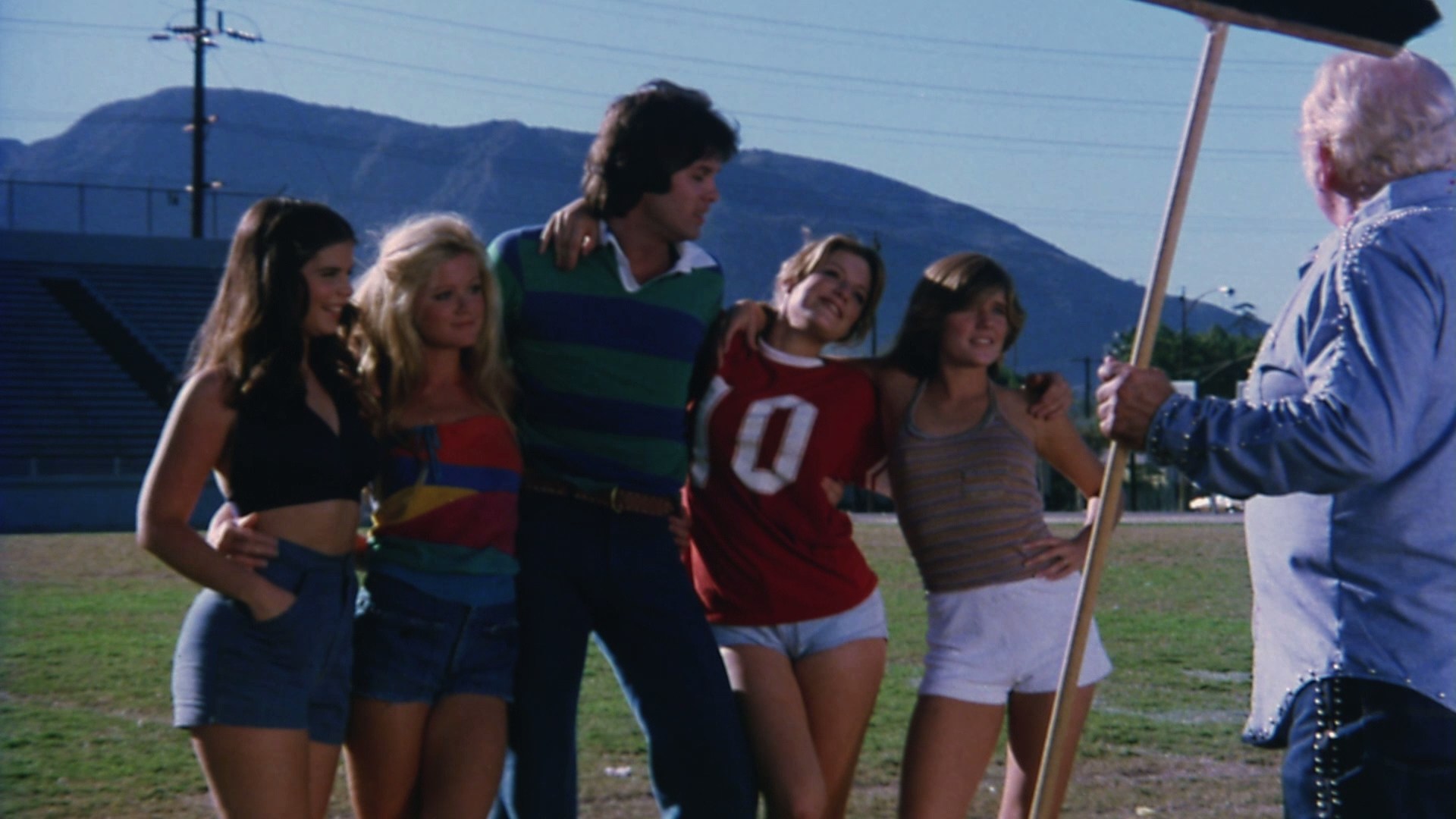
It’s the eve of the first football game of the school season, and Benedict High’s cheerleaders are on the beach practicing their cheers for tomorrow night’s big football game. They take a break and play football with some of the football players. The football coach is upset about this and tries to break up the group so that they can prepare for the game.


The day of the big game arrives, and the janitor of the high school, Billy, breaks up the cheerleaders from fooling around with one of the football players on the field. A carload of cheerleaders from the opposing team arrives on the field and showers the group with water balloons.

After football practice, the janitor sits at his office desk reciting a satanic chant while grasping his pentagram necklace. He peeks through an air vent behind the locker room wall to watch the girls showering. He places a curse on the girls by rubbing their clothes with his pentagram necklace. 

As the girls and their cheer coach, Ms. Johnson, leave for the game in a car, the janitor follows behind them in his pick up truck. He continues reciting a satanic chant and clutching his pentagram necklace. Apparently he is placing a curse on the girls.

The curse causes the car to swerve off the road. Although the car has not crashed into anything, this leaves the car completely disabled. The girls walk down to the main road to flag down someone for help. Billy the janitor shows up in his truck and piles the girls into the back. Ms. Johnson sits up front as Billy threatens her while fondling her breasts.

As Ms. Johnson and Billy struggle in the front seat of the truck, Billy loses control of the vehicle. This scene is some of the worst acting in the entire film.

The girls and Ms. Johnson leave the truck and walk down the hill. Billy is not far behind them. They encounter a sacrificial altar and a giant sculpture of a horned beast. Patti, the pretty blond of the group, removes her clothes and lies on the altar. She cries out coos of orgasmic pleasure. The rest of the group seems oblivious to any of this going on. This causes the janitor to drop over dead. The group seems unconcerned and unsympathetic to his death. This is another scene of really bad acting.

They leave in the janitor’s truck and encounter John Carradine on the road picking up aluminum cans. He appears to be a vagabond. Carradine is unable to help them, so they drive further down the road and pass a sign identifying the town as Nether, California, population 360. Soon they encounter the local sheriff named B. L. Bubb. The sheriff invites them to his office. A giant pentagram hangs above the fireplace, but the girls do not seem to notice or care about it. Soon Yvonne De Carlo, the sheriff’s wife, walks into the room to greet the girls.

We soon discover that sheriff Bubb and his wife De Carla are the head of a local satanic cult and they want a young virgin girl for one of their sacrifices. Who would have guessed? The viewer can see this coming from a mile away.

After the sheriff orders the girls to stay in the upstairs room of the office, they soon escape out the second floor window and flee into the woods. One of the cheerleaders, Debbie, breaks off from the group and encounters Carradine again living in an old abandoned car in the woods. She asks for his help, but soon discovers he too is a part of the cult from the pentagram hanging around his neck. She flees back into the woods.

The entire cult chases after the cheerleaders, but they don’t seem too quick or urgent about it. They take their vicious dogs named Lucifer and Diablo with them to find the girls. The dogs may be the best actors in the film so far.

Meanwhile De Carlo stays behind and prays to a giant pentagram with an eye in the center. She summons the two dogs to attack Patti because shebelieves Patti is the "chosen one" and the virgin maiden they seek for their sacrifice.

The cult eventually catches up to the girls, but discover that none of them is a virgin except for Ms. Johnson, the cheer coach. Here we discover that Patti is actually a witch summoned by the cult.

The film ends with the girls cheering at the High School football game. Patti uses her satanic powers to get the team to win the game.


This is certainly a film that any mainstream audience would have a difficult time sitting through. The girls in the cheerleading squad fit many of the stereotypes we have of cheerleaders. Chris is busty and naive, but not nearly as naïve as Ms. Johnson. Patti is a tramp who likes to remove her clothes at any opportunity she can get, and yet she is also the smartest one of the group. Debbie is independent, and breaks off from the group to save her own skin.

If you are a fan of John Carradine, you may find this film to be a bit of a disappointment because his role is very brief. Nevertheless, you may still want to check it out anyway. Yvonne De Carlo fans may also want to see this film, if only to see what she was up to long after The Munsters television show had ended. De Carlo was a very beautiful woman, even in her later years of life, as you will see in this film. Seeing her in a red satanic cult outfit is actually kind of cute in an evil sort of way.

Sunday, August 28, 2022

Andy Milligan's 'Blood' is grindhouse auteur's monsterama


---

Review by Doug Gibson

Stephen King, in his book Danse Macabre, trashed grindhouse filmmaker Andy Milligan. Writing of his film, "The Ghastly Ones," King said something about it being the result of morons with cameras. 

King's comments lend credence to the maxim that even one of our greatest writers can be a total ass when pontificating on other subjects. Crude "The Ghastly Ones" may be, but Milligan cobbled it together on a budget of roughly $10,000, perhaps a little bit more. He also created something unique, with his signature stamp of family dysfunction leading to chaotic, deadly horror.

Ironically, Stephen King later directed a film, "Maximum Overdrive." King later accurately labeled it "a moron movie." It cost $9 million and was a derivative mess. (I wasted $5 or so watching it in a theater). Since it grossed $7.5 million, King's film ended up losing -- on a conservative guess -- about $10 million.

"The Ghastly Ones" made likely a tidy fortune for Milligan's tight-fisted producer, William Mishkin. It played drive ins and grindhouses for years. It's probable Milligan saw none of those profits. I've read rumors that Mishkin gave Milligan about $20,000 to make a film, and Milligan only spent half so he would see a healthy paycheck for himself.

With this preamble over, this post is a review of the 1974 Andy Milligan film, "Blood." For a long time it was hard to find, and then a murky, ragged 57-minute or so print was located. You can see it on YouTube. Tubi has a ragged 69-minute version. There's a complete, roughly 73-minute Blu-Ray version of the film on Severin's Andy Milligan "Dungeon" box set. 

Milligan was ending his association with Mishkin around the time of "Blood." It was funded by backers of "The Texas Chainsaw Massacre" and even "Deep Throat!" The budget is significantly bigger than for a film like "The Ghastly Ones." I'd say, maybe $30,000 was provided. Even so, "Blood" was not a high-priority project. It was meant to be a co-feature to a film called "Legacy of Satan," -- also on Tubi -- helmed by "Deep Throat" director Gerard Damiano.

Like most Milligan films, "Blood" improves upon repeat viewings. It's a Universal Studios-style monsterama, with "Day of the Triffids" thrown in. There's this wildly imaginative plot, with an added spice of deep family dysfunctions and secrets, with rage directed at sleazy lawyers, nosy real estate agents, and the requisite old crone, who haunts a creepy cemetery. 

Imagine if Andy Milligan had directed Universal's "House of Dracula." It might have resembled this: Lawrence Orlovsky (Allan Berendt) rents a house in 19th century (Staten Island?). He lives with his wife, Regina (Hope Stansbury). Weird experiments are going on in the house. Also residing are research associates, Carrie, her husband Orlando, and Carlotta. Orlovsky is overseeing a host of dangerous plants, who have already mutilated the servants. Orlando is legless; Carrie has a rapidly deteriorating infection on her leg, and Carlotta has become a disabled, moronic hulk due to blood being taken from her to supply the plants. The house furniture and fixtures resemble the 1970s but that is pure Milligan.

The plants are designed to keep Regina healthy. As it turns out, she's a vampire, and needs the sustenance. One of the few terrifying moments is where we discover what Regina looks like prior to a plant infusion. After the plant treatment, she has a dark, pale beauty, but she's obviously mad as a hatter. Also, we learn that Lawrence is really the son of the Wolf Man, Lawrence Talbot. This is likely the only film in which the daughter of Dracula is married to the son of the Wolf Man. And yes, the son also suffers from dad's curse.

It's apparent very soon that there's no love between these two. He stoically endures her. She pleads for affection, but is obviously too insane to provide affection. Hope Stansbury, involved in several Milligan productions, is at her best in "Blood." She is a whiny, bitchy, angry, jealous killer, unable to feel any emotion that fails to feed her need for blood. Berendt, who only made one film, is good as the harried Wolf Man, who eventually allows his romantic eye to wander to the comely secretary of his crooked lawyer. The actor sort of resembles "Puddy" in the series "Seinfeld."

Typical Milliganisms include Carrie's long-lost brother, a globe-trotting sailor, surprising her with a visit. Their joyful greeting soon includes passionate kissing and caresses, insinuations of past incest. He's very concerned with Carrie's limp and wounded leg. Before he can leave, Regina, unbeknownst to Carrie, coaxes him downstairs on an errand, and kills him. Regina also kills the nosy real estate agent, the hag at the cemetery, and even a quivering defenseless mouse (I hope that scene was not real.) Her lycanthropic husband is also after the corrupt lawyer, who cheated him of much of his estate. His vampire wife, for her part, is lusting for revenge on the comely secretary of the lawyer, who has turned hubby's Wolf Man heart. And the plants are getting bigger, bolder and more deadly.

It's all very much in the Milligan style, with cramped settings, lots of arguments, and long talky scenes punctuated with bursts of horror and violence. There's a short but pretty good end-scene battle royale, and a witty final "bookend" scene.

If your a Milligan fan you'll enjoy "Blood" more each time you view it. If this is your introduction to Milligan, you may be pleasantly surprised, but I'd recommend watching a few of his earlier films to better get more flavor of this "gutter" auteur.

Tuesday, July 5, 2022

Axe -- its spare bleak terrain and characters heighten suspense, terror


Axe, a very low-budget North Carolina regional film, was shot in 1974 by a 20-something filmmaker, Frederick R. Friedel. The budget was only slightly more than $20,000.  Harry Novak, who ran Boxoffice International Pictures, Inc., a now-cultish mostly grindhouse distributor, picked it up from Friedel, along with another micro-budget Friedel film, Kidnapped Coed.

I haven't seen the latter film but I always wanted to see Axe, mainly thanks to a creepy trailer Novak put together. (You can see the trailer at the IMDB link to Axe above) I saw ads for the video/DVD when Something Weird was pitching it, but never bit. A key reason was despite several exceptions, Novak-released films generally seemed to be wanna-be porn that skirted the gray area between X and XXX.

Axe popped up on YouTube recently and I decided to finally check it out. I had recently learned that it was one of the "video nasties" that England banned for a while long ago. 

Axe kind of blew me away. It's only slightly longer than an hour, and it's no Novak-type sex film. It's an intense revenge film where the spare, bleak settings, buildings and emotionally spare characters create both a suspenseful and ultimately terrifying film. Novak, who was trying hard to stay in business in the mid to late '70s, was wise to pick up Axe. I hope it made a few bucks.

The film involves three criminals. Two are sadistic psychopaths. One is a weak man who goes along with the murdering and robbing. After killing one man and causing his terrified male lover to leap to his death, they take off for the country in search of plunder. In a small convenience store on the road, the two sadists casually terrorize and sexually humiliate the lone female employee. It's uncomfortable and gradually more frightening to watch. People shouldn't be allowed to terrorize innocents like this. They do in life, though. It's a harsh reality.

The trio eventually stop at a large house off the road, very southern style, wih a long front porch. Inside is a grandfather, who is paralyzed and cannot speak. He is tended to by granddaughter Lisa (Leslie Lee), a pretty girl/woman with an age difficult to ascertain. She is quiet, emotionless and solemn, speaking rarely and without emotion. She could have medical issues except in her bedroom there is art of girls laughing and smiling. They even look like Lisa. It's clear something traumatic has changed  Lisa.


She is a stoic and does not emote when two of the criminals very soon become threatening to her and her granddad. The third, weaker criminal, develops a crush on Lisa. Director Friedel has set up an odd kidnapping situation where the "hostages" barely acknowledge their captors. When a police vehicle stops by looking for the criminals, Lisa blandly acquises with the kidnappers' ponderous threats not to tell. 

The contrast to the terror victims experiences in the two previous scenes, a double murder, and a robbery, to what's occurring in this remote southern house, is striking. Stoicism without fear is being exhibited by Lisa. The criminals are too crudely dumb to be concerned.

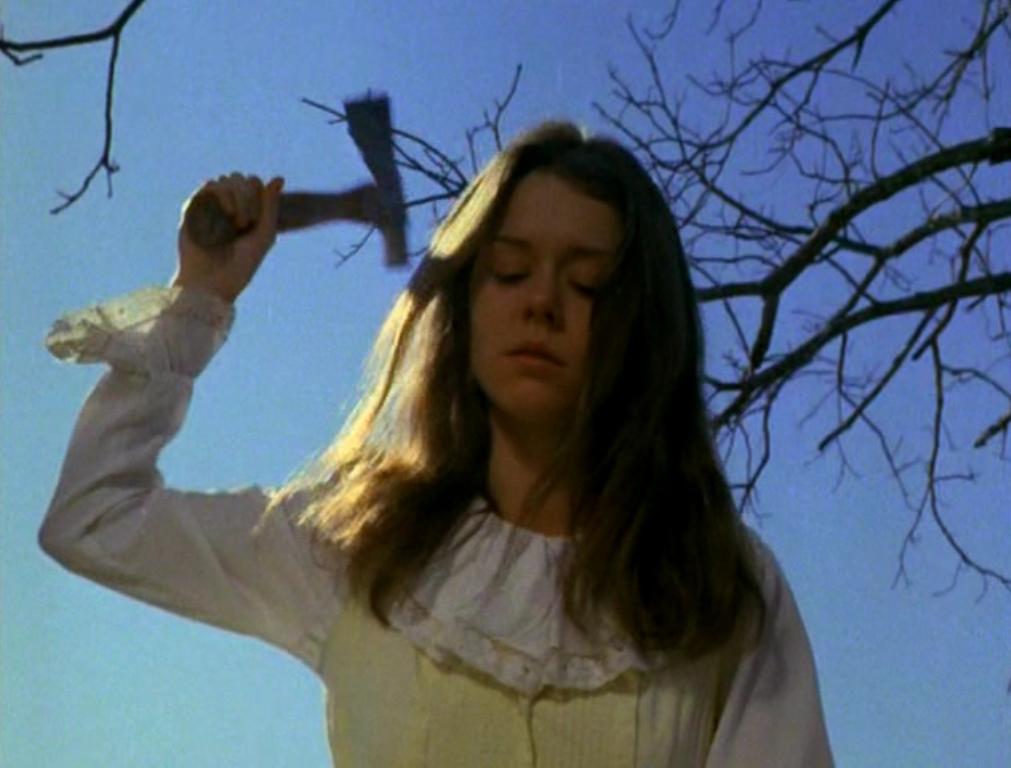
That night, one of the psychopaths enters Lisa's girlish bedroom with an intent to rape her. But Lisa has a straight razor in bed with her. The criminal dies a graphic, painful, bloody death. Lisa, exerting tremendous strength, cleans up and tries to hide the body. 

This is an intense film. We know there are flaws. We don't have a backstory as to how Lisa became an emotionless, almost robotic character. We don't know what spurs the fire inside her to fight back. But what Roger Ebert said in his review of Last House on the Left applies also to Axe, which at heart is a less explicit version of Last House ... Ebert said he was describing what occurs in this intense film, not trying to deconstruct it. It may be unpleasant. It may be horrific. But the story is lean and mean and told effectively. The music works in Axe, as well. It's haunting, with a kind of hopeless melody.

The scenery, the house, bedrooms, living room, kitchen, the shabby store where the clerk is terrified, all are "characters" that contribute to this grim tale of revenge. The scenes of Lisa feeding her disabled grandfather, without emotion, while evil hovers around her, are at first disconcerting but later forbidding. It becomes so clear that these criminals are way in over their heads with this 100-pound protagonist.

Axe eventually has garnered a very small cult. Severin Films has released a Blu Ray of it and Kidnapped Coed, which is a film I'll also see once I buy the Blu-Ray. The Blue-Ray includes a blending of both films that Friedel released 30 years later, called Bloody Brothers.

I urge readers to see Axe. I want to know what you think. It grabs me with its spare, devoid of emotion crude justice. It's only about 66 minutes. Edited for the times, of course, it would have been a superb idea for Monogram or PRC 80 years ago. You can watch Axe (for now) here. Also see a South Carolina 1974 release ad under its original title, Lisa, Lisa (below).

-- Doug Gibson


Thursday, April 1, 2021

Night of The Seagulls – the fourth “Blind Dead” film


--
This 1975 Spanish horror film, "Night of the Seagulls," written and directed by Amando de Ossorio, is the fourth and final entry in the Knights Templar “blind dead” series – and is the sequel to The Ghost Galleon (1974). The film was also marketed as “La noche de las gaviotes,” “Don't Go Out At Night” and “Night of The Death Cult.” Although it's often thought of as the least effective of the four blind dead films, I find it to be a much better film and more entertaining than The Ghost Galleon and the second blind dead film – Return of The Blind Dead (1973).

Young Dr. Henry Stein (Victor Petit) and his wife Joan (Maria Kosti) arrive at a small, inhospitable coastal town in Spain. Stein is to be the new doctor of the village. The current doctor is an elderly man who wants to retire and leave the village immediately. He tells Stein that the villagers don't want doctors in the village and to not ask questions, pry into anyone's business or go out at night. He communicates a deep sense of fear about living in the village. The Steins are staying at the elderly doctor's house.


After settling in the elderly doctor's house that night, the Steins hear a church bell and the screams of a flock of seagulls. Joan mentions that seagulls are not supposed to scream and fly at night. The Steins leave the house to investigate and come across a procession of villagers dressed in hooded robes walking along the beach. The procession ties a young woman dressed in white to a rock on the beach. The corpses of Knights Templars, who have been dead for over 600 years, arrive on horses to kidnap the young girl and sacrifice her to a Sea God statue.


In the following days, the local villagers, including a grocery merchant, continue to ignore and avoid the Steins. Joan meets a young girl named Lucy at the local store. Lucy asks for a job as a housekeeper at the Stein's home. Joan agrees to her employment while Lucy reminds her that the villagers don't like strangers. The two become good friends.


Dr. Stein's first day on the job does not go well, since no patients arrived for an appointment. The Stein's hear the sound of the bell again and the screams of seagulls as someone aggressively knocks at their door. A young girl named Tilda is at the door – hysterical with fear. Dr. Stein gives her a tranquilizer to calm her down. Tilda's father arrives to take her home, upset that Stein has treated her and tells Stein to leave Tilda and the villagers alone. The procession of villagers arrives to escort Tilda to the beach where she is to become the next sacrifice to the Templars. Her heart is cut out at the statue of the Sea God.


The next morning, the Steins walk the village to inquire where Tilda has disappeared to. Tilda's father lies to Dr. Stein and says she left with a cousin to the city. Lucy tells the Steins that every year for seven days, a sacrifice to the Templars is made of seven victims. The procession of villagers take Lucy from Stein's home. She is to be the next sacrifice.


Dr. Stein locates Lucy at the sacrificial rock and frees her from the rock as the Templars on horses arrive to take her away. The Steins and Lucy barricade themselves inside the Stein home as the Templars try to get inside. They make their way to the attic and get out, sliding down the roof and onto the horses of the Templars.


Unlike scenes in the first three blind dead films, most of the scenes of Templars in Night of The Seagulls are shot in well-lit and near-dark environments, which reveal greater details of their features, especially with close up shots. The closing shots of the Steins riding on horses as they are chased by the Templars are some of the most effective, gloomy sequences of the film because of the grainy appearance of the shots. The Templars approaching the beach on horses to confront their next sacrificial victim are also some of the most effective shots in the film. Many of these shots are shown in slow motion, which adds to their creepy appearance.


The four blind dead films do not need to be watched in the order of their release to enjoy them. They can be watched out of order and still enjoyed, although the first film – Tombs of The Blind Dead (1971) does go into the greatest details about who the Knights Templar are and where they came from. Two of the blind dead films – Tombs of The Blind Dead and Return of the Blind Dead (1973) inject a predictable love triangle story that we don't see in this fourth film. Leaving the love triangle story out of Night of The Seagulls makes it a more effective and gloomy film.


Blue Underground released an interesting DVD box set of the four films in 2006 contained in a collectible coffin shaped box. The set also contains a booklet about the films with lots of production photos, and a DVD documentary about director Amando de Ossorio. Watch a trailer of Night of the Seagulls here. Happy viewing.


-- Steve D. Stones