Translate

Showing posts with label 1960s cult cinema. Show all posts

Tuesday, April 14, 2026

Andy Milligan's Kiss Me, Kiss Me, Kiss Me! - Domestic discord


The recent Severin Gutter Auteur Blu-Ray release features two previously thought-lost films from cult director Andy Milligan: The Degenerates and Kiss Me, Kiss Me, Kiss Me! a filmed-in-1966 soft-core domestic -- New York City -- melodrama that was released in Britain in 1968; and in the United States a year later.


Kiss Me ... was a hit for William Mishkin, Milligan's tight-fisted producer and money man. The tale of a brassy, adulterous, sometimes-alcoholic housewife (Natalie Rogers) was reviewed by the New York Times (below) and Boxoffice Magazine trade publication (further below). Even Variety gave it a plug.


The plot: Rogers and Don Williams are lower-middle class couple Jean and Stan Novak -- with one child -- living in a cramped '60s tenement. They're a dysfunctional pair, with Stan -- consumed with self-pity -- occasionally beating his loquacious wife.


Jean appears to love her husband despite his abuse. But beneath her Type A personality and chattiness there are unsatisfied sexual needs that result in affairs, particularly with her husband's close friend, Eddie (Peter Ratray). Eventually Stan and Jean introduce Eddie to Stan's sister, Ellen (Joy Martin). Eddie and Ellen fall in love. That leads Jean to alcohol binging when she realizes Eddie won't sleep with her anymore. Chaos results. The final 15 minutes is pure Milligan screaming, violent dysfunction that ends darkly.


This was not a film that Milligan wrote the script for. Josef Bush, a screenwriter who also acted in two currently lost Milligan '60s films, Depraved and The Naked Witch, wrote the screenplay. As a result, this is more restrained Milligan through most of the film. Non-Milligan touches include a montage, a long scene in an art gallery, and another with our four principles enjoying a double date at the beach. Also, as Milligan historian Alex DiSanto notes, there is little of the long Milligan-style dialogue stretches between characters.


Still, it's a Milligan film, with in-depth, close-up shots of the characters with the wheezing Auricon 16-mm camera. The crowded tenement life is well captured. The film also beautifully shows New York City of that era. Outside shots, including the beach, the tops of the tenement, its crowded stairway, beds on the floor, sleazy cafes, and trips to street stores capture the era. Several Milligan "troupe" actors have small roles, including Gerald Jacuzzo, Veronica Radburn, Robert Dahdah, Matt Baylor, and even Ron Keith. The Novak's small child, Jimmy, is played by Sean Martin, Joy Martin's son.


This is Natalie Rogers' film. Finding this movie provides a glimpse at her considerable acting talent. Rogers was a method actor, and her portrayal of Jean dominates. Her character is a full-of-life overt who nevertheless is struggling to maintain her sanity in an environment she clearly wants to change. The cord that keeps her relatively sane eventually snaps. Her relationship with her husband Don is dysfunctional but fascinating. They argue, he beats her but there are still intimacy and comfort between them through most of the film. It's certainly a sinister form of enablement. According to DiSanto, Rogers was paid $500, twice the amount of the other main actors received. Today, $500 would be about $5,000.


Producer Mishkin saw the handsome Peter Ratray as a Marlon Brando type, and Natalie Rogers as a Marilyn Monroe type. That's not a bad interpretation but I'd argue Rogers is a combination of Monroe, Judy Holliday and Barbara Nichols. Ratray moved on from low-budget films and has enjoyed a distinguished career since. Nichols married, helped run the Dove theater in New York City, and entered academia. Her accomplishments include writing a best-selling book on public speaking.


Watching this low-budget, soft-core (R-rated today) chaotic drama, one might think today that it might have been a film that an up-and-coming director would make before moving to A features. But we know that didn't happen with Milligan. On the bright side, however, had he moved up we likely would never have enjoyed the rest of his considerable, unique cult films.


I hope more Milligan lost films can be discovered. I believe they will be.


-- Doug Gibson


Thanks to Alex Disanto for providing the images of the New York Times and Boxoffice Magazine reviews.


Sunday, August 17, 2025

Curse of the Swamp Creature – One of Larry Buchanan's Best Films


The films of Texas filmmaker Larry Buchanan have really grown on me over the years. I place Buchanan in the top five of my favorite cult film directors. After reading author Rob Craig's excellent book – The Films of Larry Buchanan: A Critical Examination (McFarland 2007), I have an even greater respect for Buchanan's films. Craig gives the reader great insight into the mind and films of Buchanan. Buchanan directed six made for television films for American International Television under the Azalea company title. One of these Azalea films is the 1968 science fiction thriller – Curse of The Swamp Creature, starring John Agar.


In Curse of the Swamp Creature, oil surveyor Driscoll West (Bill Thurman) arrives at the Fly-N-Fish Motel and sits down at the bar for a drink. A beautiful raven-haired woman named Brenda Simmons (Shirley McLine) sits down at the bar next to West and begins to flirt with him. Simmons pumps West for information about oil surveying in the local area, but West refuses to answer her questions and decides to go back to his hotel room.


West returns to his motel room to find young Ritchie (Cal Duggan) going through his personal belongings in the motel room. The two men fight, punching and wrestling each other to the ground. Ritchie stabs West in the stomach with a knife, killing him. The motel manager named Frenchie (Roger Ready) and Simmons enter the room and plot how to get rid of West's body. They decide to put West's body through a swamp-cutting machine.


Before West's death, he was scheduled to meet with geologist Barry Rogers (John Agar) at the hotel for a trip to survey the local swamp. Simmons comes up with the idea that when Rogers arrives, she will simply tell him that West could not attend the meeting and that she is West's wife sent to fill in for him. Rogers arrives at the Fly-N-Fish motel and is greatly puzzled by Simmons' news that West will not be joining them. Nevertheless, Rogers, Simmons and a swamp guide named Rabbit embark on a trip through the local swamp the next morning.


Meanwhile, Dr. Simon Trent (Jeff Alexander) is conducting bizarre experiments at a nearby swamp plantation not far from the Fly-N-Fish Motel. A scaly hand of a monster similar to the Gill Man in Creature From The Black Lagoon (1954) emerges from a vat of mist in Trent's laboratory. He yells at the creature to “Breathe! Breathe! Live!” Unfortunately the creature dies, and Trent wraps him up in a white blanket and throws him to the alligators who happen to dwell in his backyard pool.


Dr. Trent tells his assistants, Valjean and Tracker, that he expects them to keep close eyes on the plantation and not to allow any intruders near the plantation so that no one will interfere with his work. Local natives suspect that Trent is conducting evil experiments on the natives. Both Valjean and Tracker appear to be incompetent at their jobs because the natives have come near the plantation many times looking for lost family members. Trent tells them that he will not tolerate any more incompetence if they continue to allow natives near the plantation.


Rogers, Simmons, Ritchie and Rabbit eventually arrive near Dr. Trent's plantation. Instead of hiding from the group, Dr. Trent orders Tracker to bring them to the plantation mansion so he can offer them hospitality. The group meets in Trent's home and he discusses with them some of his experiments and research. Trent's wife Pat (Francine York) is excited to meet the group because she has not seen other people in over a year. The group is offered to stay the night at Trent's home. Trent keeps Pat locked up in a room and secluded from the rest of the world.


Tracker is persuaded by Pat to release her from her locked room. She wanders into her husband's laboratory and finds Dr. Trent's assistant – Tom (Enrique Touceda III – billed as “Anthony Huston”) floating in the lab tank with wiring attached all over his body. She flees the room, screaming and hysterical. Dr. Trent catches her and tries to assure her that Tom is not dead, and that Tom volunteered for the experiment. Mrs. Trent of course does not believe him. Tom questioned Trent's work, so he was drugged and placed in the tank for experimentation. Trent later wraps Tom up in a white sheet and dumps him into the alligator pool. Another failed experiment. The alligators feast on Tom's body.


After his failed experiment with Tom's body, Dr. Trent uses Brenda Simmon's body as his next experiment. She quickly evolves into a masculine looking green monster with bulging eyes. Dr. Trent orders the creature to kill the natives that have come to his home to confront him. The Simmons creature disobeys Trent and instead picks up Trent and throws him into the pool of alligators. Simmons then offers herself as a sacrifice by plunging off the dive board of the pool into the alligators.


One very strange aspect of this film is when Dr. Trent places his assistant Tom in the vat for experimentation. After placing Tom in the vat, he never fully evolves into a creature. Even after the camera shows him in a number of scenes in the vat, he remains in human form unchanged. However, when Dr. Trent places Brenda Simmons' body into the vat, she immediately evolves into a green masculine creature. It's as if experimenting on a woman achieves immediate results in contrast to experimenting on a male subject. Why is this? The viewer is left puzzled by this (at least I was).


At the time actor John Agar was cast in Curse of The Swamp Creature, he was battling a lifetime of alcoholism, which negatively impacted his acting career and ended his earlier marriage to actress Shirley Temple. Agar spent the decade of the 1960s being cast in a number of low-budget features, including another Buchanan Azalea TV film – Zontar – The Thing From Venus (1967), and Night Fright (1967), Journey To The Seventh Planet (1962), Women of The Prehistoric Planet (1966), and many others.


As mentioned at the beginning of this writing, Buchanan made a total of six made-for-TV films for American International Television under the Azalea company title. The five other Azalea films are: Zontar – The Thing From Venus (1967), Mars Needs Women (1968), The Eye Creatures (1965), In The Year 2889 (1969) and Creature of Destruction (1967). Stay tuned for other articles on Plan 9 Crunch about these Buchanan films produced by Azalea. Happy viewing.


- Steve D. Stones

Saturday, June 7, 2025

Outlaw Motorcycles, 1966, an early genre documentary


Review by Doug Gibson

On this blog, I recently reviewed the semi-obscure "The Last of the American Hoboes," a late '60s feature-length documentary/narrative film history of hoboes. It was directed by Titus Moede (Moody), an iconoclastic actor/director/camerman/screenwriter/photographer who shot his films on a shoestring budget, when he could shoot them.


Moede died in 2001. I've long wanted to see an earlier documentary/narrative he bundled together. It's "Outlaw Motorcycles," 1966, a 35-minute short. Like "... Hoboes," it knocked around the basements of film distribution, with Moede selling many copies of both at a Los Angeles "mondo" film store, and through mail order. Both films entered the century largely ignored; neither was placed on the now-defunct TCM Underground. Both would have been ideal choices. In late 2023, both films were part of the several-films offering "Lost Picture set" Blu-Ray from Vinegar Syndrome. "Outlaw Motorcycles" was an extra for "The Last of the American Hoboes."I've seen both recently because "...Hoboes" is playing on Tubi. "...Motorcycles," for the time being, is on YouTube.


So, what do I think of "Outlaw Motorcycles?" Like "Hoboes," it's not a great film, but it's a fascinating time-capsule effort that merits more attention. This wasn't the first movie to feature motorcyclists, but it was very likely one of a just a few that was open-minded about its subjects. In this film law enforcement, while not overtly villains, are represented as individuals with power who will hassle the motorcycle gangs of that era.


Moede, who has solid history as a working actor, was a bohemian. While some scenes are staged -- as in "Hoboes," -- he walked the talk. The majority of participants belong to the motorcycle gangs that traversed California roads. Much of it was shot outdoors, and you can feel the uneasiness and/or fascinations people of that era felt watching the gangs.


The print I viewed was faded. Much of the dialogue (like "Hoboes") was probably dubbed later or just barely heard due to the low budget. But much of the film delivers authenticity. I particularly enjoyed the scene of a "biker wedding." The groom, after kissing his bride, gives several male biker buddies smooches on the lips. Another strong scene is a biker gang member's funeral.


The film has a scene where members of a biker gang meet and decide to raise money to buy lunches for victims during the Watts riots. The scene is probably staged but I'll accept that it occured. Like "Hoboes," it's strengthened by Moede's contacts and ability to go to locations that other films did not offer. In one scene a motorcycle gang member sports a Nazi swastika. I had though that association was a cliche, but apparently not.


Viewers learn in the film what a motorcycle gang's "mama" is. I'll keep it a secret. It leads to likely the most notorious/popular scene: a visit to a tattoo location where two "mamas" receive tattoos on two personal parts of the body. Gordon Barclay, an actor friend of Moede's who wrote and acted in "Hoboes," is the tattoo artist. I've read this film was banned in some locations. This scene is likely the reason. One shot in the scene, involving one of the "mamas," may be iconic. I know I've seen it before. It has the word "property" in it.


It's very low-budget, the film can plod at times, but it's an important film. Like Andy Milligan's early '60s short "Vapors," (a film about a NYC bathhouse) it provides a non-judgmental look at a culture that contemporary America -- at that time -- almost universally shunned and disliked.


Saturday, April 8, 2023

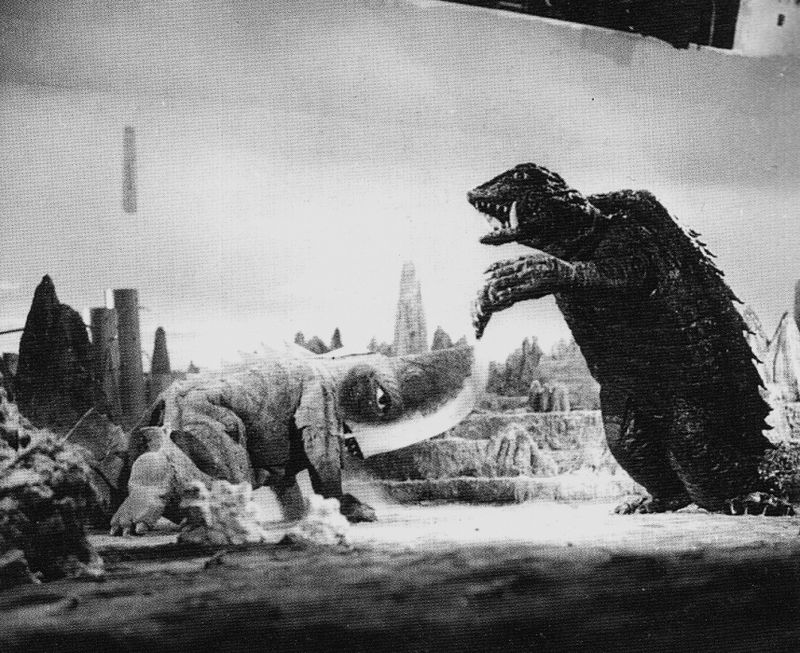
Gamera versus Guiron was fun fare for kiddie monster movies


I watched this film, Gamera versus Guiron, on Prime, in Japanese with subtitles. It was charmingly hysterical. Two little boys team with Gamera to make the world safer (and decrease "traffic accidents.") Guiron sort of resembles a deranged "Barney." This must have filled kiddie Saturday matinees.

The plot involves two little boys who somehow find their way into outer space, traveling with, and held hostage by, two beautiful space woman who are the sole remaining members of their destroyed planet. The women are not nice. They want to eat the brains of the boys to enhance themselves. The use Guiron, which has a sharp mega blade for a knife, as a weapon.

Eventually, Gamera, described as a friend of children, flies out to help the children, and there's the requisite battle.

The film is oddly, goofily entertaining. Despite what I wrote in the first paragraph, I'm not sure it played kiddie matinees (they were dying out by 1970). I'm not sure it even had a theatrical release here. But by 1971, 1972, it was ubiquitous on TV, airing under the title, Attack of the Monsters. Enjoy some more stills from film below.

-- Doug Gibson


Sunday, February 26, 2023

A thorough, entertaining book on Ray Dennis Steckler's incredible career


Review by Doug Gibson


Christopher Wayne Curry is the author of the new book, The Incredibly Strange Features of Ray Dennis Steckler, McFarland & Company, Inc., Publishers, Jefferson, N.C. (800-253-2187). It's a very thorough, very entertaining overview of the late cult director's career. Curry dug deep into old press releases, reviews, tons of interviews, insights, and a journalist's' doggedness to blend Steckler's career and personal life together into a history worth reading.


There's a great movie, or streaming series, to be produced from the C- and D-budget producers/directors/actors of the 1960s, and this book could provide the inspiration.


The iconic-looking Steckler, he kind of resembles a poverty-row version of Nicolas Cage in films he starred in -- is a bit of a contradiction for me. His films, while certainly very unique and fun to watch, have never been among the top of my cult lists. However, the man himself is one of the most interesting cult film director auteurs. He made films from scratch, more often than not without a script, or more than a conventional month's pay to start. There is a necessary spontaneity in his films; the tone and theme was capable of changing in the middle, from thriller to comedy, to travelogue, to musical, from horror flick to rodeo show.


And from what I've seen of him in video interviews and print interviews and articles, he seemed a genuinly decent man, a lifelong film obsessive who tried his best to keep the moods of the vintage films he loved, especially the 1930s and 1940s western 'oaters, into his films of the '60s and early '70s.


With a couple of exceptions, Steckler's incredible cult heyday comprised about a decade, starting with directoral and acting duties in "Wild Guitar," "Incredibly Strange Creatures Who Stopped Living and Became Mixed-Up Zombies," "The Thrill Killers," "Rat Pfink a Boo Boo," "The Lemon Grove Kids Meet the Monsters," and "Body Fever." Things got darker with "Sinthia: The Devil's Doll" (the first film since "Wild Guitar" where Steckler was a "hired-gun" director), and "Blood Shack." He also made a very funny short called "Goof on the Loose." (Below are scenes from "The Thrill Killers" and Incredibly Strange Creatures Who Stopped Living and Became Mixed-Up Zombies.")


Curry takes the reader through Steckler's early years, his time in the U.S. Army, and his late '50s entry into Hollywood. He was a hard worker, one of his earliest assignments was as a prop man, and later assistant cameraman, on Timothy Leary's long-running project, "The World's Greatest Sinner." It was a hand-to-mouth existence. As Curry notes, when Steckler met his future wife and star of many of his films, Carolyn Brandt -- a dancer with a unique, angular beauty -- he was living out of his car.


Steckler had talent and could work inexpensively. That earned him the "Wild Guitar" director duties for Arch Hall Sr. The film was one of several that starred his son, Arch Jr. Steckler got along OK with Hall and son, but an independent streak, and a desire to decide how his films were marketed, eventually moved Steckler to other partners and producers, notably George J. Morgan, during his main "cult" era.


The anecdotes from the mid 60s films of Steckler underscore their cult status. "Incredibly Strange Creatures" is a visual trip, with its exterior setting of the old Pike amusement park in Long Beach Calif.; its non-sexy dances; shrill musical numbers; bizarre makeup of the monsters. This mishmash of musical horror somehow ends on a beach with wild surf and dangerous rocks. The female lead was replaced by a carnival dancer who now had two parts. In garish color, there is a controlled chaos to the film that keeps a viewer looking at it.


"The Thrill Killers" starred Liz Renay, an ex-con former moll of a Mafia chief. Steckler literally grabbed her as she was released. The film is a violent tale of a gang killing many, but it also plays homage to Steckler's love of westerns with horse chases, motorcycles racing, a baddie chasing a heroine through rough terrain, and lots of shooting. 


"Rat Pfink a Boo Boo" starts out as a tale of a film star (Brandt) -- with a singing star boyfriend -- being terrorized by thugs. Once she gets in real peril, it suddenly transforms into a comic-like superhero tale with her boyfriend and his friend becoming caped crusaders Rat Pfink and Boo Boo. This film, which also involves a gorilla, is surreal to the max. Its guerilla, on-the-spot, take-what-you-can filmmaking is underscored by a final scene where the masked heroes crash a southern California parade that is definitely not part of the movie. It's exhilerating!


"The Lemon Grove Kids Meet the Monsters" are three short films made into one film. It is a wacky, low-brow comedy tribute to the Bowery Boys films. Steckler loved those films, and especially Huntz Hall's stupid/funny Sach character. Curry relates that when Steckler finally got a chance to meet his idol Hall, he was treated very disrespectfully by the aging Hollywood star, and then threatened with a lawsuit unless changes were made to Steckler's character. 


Several of the actors and crew who worked with Steckler made it to A features in Hollywood. Steckler never begrudged them. He seemed happy with their success, from interviews I have read. But I cannot help thinking that Hall's casual cruelty to a colleague and fan had an impact on Steckler's optimism and enthusiasm. He never made another film as deliriously inventive or spontaneous than the four just mentioned.


They were family-centered (including his kids and their playmates), friends-centered, film-troup regular-centered low-budget creations. And as Curry so interestingly relates, they were barnstormed around the country in roadshow styles, with matinees and/or midnight showings, with ushers hired to "terrorize" theater-goers, with small musical events, often in a parking lot. As Curry describes the histories of these films, it must have been exciting times. What a creep Hall was to blow smoke on Steckler's dreams.


"Body Fever" (see photo above) was Steckler's ode to crime noir, and '40s detectives in the '70s. Carolyn Brandt is absolutely gorgeous in the film as femme fatale Carrie Erskine, who steals cash from mobster Big Mac. He was played very effectively by Bernard Fein, creator of TV show "Hogan's Heroes", Steckler is good as a low-energy but somehow effective private eye. I think this is technically Steckler's best film. It's a fun story. It has wonderful Los Angeles atmosphere, and there are touches, such as Steckler's scene with actor/director Coleman Francis, that add authenticity to the story. (The backstory to this, which really highlights Steckler's kindness, is that Coleman, who had been in earlier films, was down and out due to alcoholism. When Ray met him, he created a role for Francis to help him out.)


Yet, as Curry and history notes, "Body Fever" quickly went to the shelf. No interest. And except for an otherwise pedestrian serial killer grindhouse film, "The Hollywood Strangler Meets the Skid Row Slasher," 1979, that is somewhat saved by its grimy LA slum settings and an unsettling, strong performance by Brandt, Steckler's era of making unique, interesting films was over. The 1971 unreleasable "Blood Shack," shot in Nevada, is just not that good. Its only small value is seeing Brandt and Steckler's children in the film. An alternate release, called "The Chooper," is slightly better. But again, another film shelved until video arrived.


Curry notes that this late 60s, early 70s era was when Steckler's marriage with Brandt was falling apart. In a remarkably frank interview with Curry, Brandt recalls her failing marriage and Steckler's repeated adulteries. In fact, she tells Curry that her least favorite film is the first "Lemon Kids" short because Ray was having an affair with the actor who played "Roxy." It's a credit to the pair's relationship and commitment to their children that they remained on cordial terms. Both remarried.


Curry handles with tact that beginning in 1971 Steckler began making hard-core pornography, apparently over a decade-plus. I've never seen one and have no interest in watching the few that are in Severin's recent Blu-Ray release of Steckler's films. Curry appropriately goes over the history of these films but it's a small section of the book. In an interview with Steckler's daughter, Laura, who acted in and helped with his mainstream films, she plaintively wishes that the films were mosty omitted from the book.


According to Curry, Steckler would abruptly end interviews if questions about his porn films were offered. According to an interview Curry does with actor Ron Jason, Steckler was let go from his film teaching job at the University of Nevada Las Vegas because of his porn films. "...he was broken-hearted when they let him go," Jason said. In her interview, Laura Steckler surmises that her dad made those films to pay the bills, which seems likely.


With the mid to late 80s cult genre video boom, Steckler enjoyed a renaissance that lasted until his death. He owned three video stores in Nevada, and was a genial, considerate man who would talk to his fans and sign his videos. At one point he re-edited his main cult films into hour-long black and white versions, with new titles. He called it The Steckler Collection. It'd be fun to access those films again. They do no seem to be for sale anymore.


Like other cult icons, the sheer uniqueness of Steckler's films will provide him fame that will exceed most peers who "graduated" to big budgets. Unlike an Ed Wood, he was fortunate to live long enough to enjoy recognition. And he enjoyed it with kindness, grace and consideration.


Curry's book is a treasure. Through the pages, we witness a smaller but no less interesting Hollywood of the 1960s. Steckler surrounded himself with so many eclectic, often eccentric interesting colleagues. He had his casts, his producers, his crew, even his hangers-on. It's fun to follow all those who populated Steckler's world.


I'll close with another Steckler actor, legendary stuntman Gary Kent, who tells Curry: " ... there was never much pay at all. Lunch would be a bologna sandwich, if that. You were working mainly because you wanted to be in a movie ... So Ray brought his enthusiasm and that big camera and I just loved the sight of it."'


Amazon link to buy book is here.


Thursday, November 26, 2020

The Beast of Yucca Flats -- what was it paired with in theaters?


How about that clipping from November 1967 in Redlands, Calif. A triple bill of "spook" features, designed for the kids. Besides Wasp Woman and Madman (sic) of Mandoras (AKA They Saved Hitler's Brain) Beast of Yucca Flats was the third film, a role it usually played in its distribution history. I have to assume that if the show was for kids, the brief boobs scene at the beginning of Beast of Yucca Flats was edited out. 

I often wonder how the many ultra-cheap cult films were marketed? Where did they play and for how long. With my subscription to Newspaper Archives and a friend who has access to newspapers.com, Plan9Crunch has started an occasional series of films' clippings history.

As I noted in a past of Beast of Yucca Flats (below) Beast had a tough distribution go initially. The producers rented theaters in San Diego at first. But it had a small but steady distribution for a decade, almost always as a second or third feature. It played often on TV in the later '70s. Look at the interesting films it was paired with, including  Outlaw Riders, with Valda Hansen. Tony Cardoza was the producer of Outlaw Riders and also co-produced Beast. The Beast of Yucca Flats also played with The Mysterians.  The Newspapers and dates are below the clips. Note than an ad claims Beast is in "dazzling color." I have never seen a print of Beast that is in anything other than black and white. Have you? I think the whole "dazzling color" thing was a fib! 


Here is our review of this fun cult film. Trust me, you may gape when you first see it but it grows on you.


---

THE BEAST OF YUCCA FLATS

We need to give this ultra-cheap, kitschy 55-minute film its due -- it has persevered. It's gone from simple schlock to unique so-bad-it's-good cult film status. Heck, it even survived a MST3K riff. Here, for the record, is my several-year-old review after my first viewing.

Few films are as inept as The Beast of Yucca Flats. After watching it, I'm convinced that a talented group of ninth graders with a few thousand dollars and a long weekend could do a better job than Tor Johnson, Coleman Francis and company. (Nah, I take that back several years later) The plot? A woman is murdered. A defecting Russian scientist (Tor Johnson) is attacked in a desolate part of Nevada by communist agents. An atom bomb explodes. Tor is turned into a mutant beast who wants only to kill. Tor kills, then chases a hapless family through the Yucca Flats. Finally, two inept cops kill Tor. (Yeah, the plot is the same).

Be forewarned: The preceding plot summary is far more exciting than this dog of a film. (NOT TRUE ON RETROSPECT) There is virtually no action, (wrong) and when Tor is on the chase, his big, aging blubbery body inspires far more pity than fear. (Today I change pity to fascination; Tor looks ill and is very obese, but give him credit for lumbering around a very hot desert outdoor set) Francis shot the film without dialog, which was dubbed badly into the finished film. The viewer rarely sees lips move when actors speak. (This adds to a unique, other word-type surrealism to the film. No one seems to be looking at each other, even when they speak. In fact, for all his grunts, Tor the beast appears to be the best listener) Also, the self-pretentious Francis adds ridiculous, over-the-top narration, spoken like a man on LSD. My favorite meaningless phrase is "Flag on the Moon." (NOT TRUE ANYMORE: the bizarre narration adds to the film's outlandish plot and conspiracy. In this film, everyone looks disgruntled and depressed or lazy. I love the scene where one of the desert cops is roused from looks like a bout of morning sex with the missus or mistress. As he leaves, to narration, the broad in the bed gives him a look of utter disgust and cynicism. It somehow seems very appropriate for the bizarro world director Francis has unleashed.)


It merits three stars only because The Beast is Tor Johnson, whose always fun to watch bellow. Those who dare watch it should see the MST3K version. At least there's a few laughs. (Doug Gibson speaking: I must admit, adding to this a few years later after originally writing the review, the film has grown on me. It is bad, but unique and strangely watchable; a real cult film. I give it an extra star!) (and now I've added an extra star. (Also, I neglected in the original review to mention the nude scene prologue, which makes no sense. A young woman gets out of the shower. Sits down a very depressing cot-bed, and is squeeze-strangled to death by a fat, meaty hand that look like Tor's. But why, the good Dr. Javorsky has yet to be nuked? Ah, the intentional nonsensical plot of a cult cheapie!


Notes: Ed Wood actor Conrad Brooks has a small role; Cult figure Titus Moody helped with production; Coleman Francis directed three films spoofed by MST3K: Beast, Skydivers, and Red Zone Cuba; Francis' wife and sons were in the film. The non-MST3K version has a very brief nude scene. "Beast of Yucca Flats" is essentially a silent film, with narration and brief dialog, obviously recorded since you don't see the speaking actors' faces. The entire film can be seen on YouTube and is part of the UEN Sci-Fi Friday cycle of movies. (I'll add that this cheapie played the third or fourth bill of drive-ins and grindhouses for more than a decade -- I guess that nude scene paid off. I read somewhere that originally, the producers could not find a distributor so a movie house was rented in San Diego. Apparently, the film sold well here, and Tor was mobbed by fans.)

Film is here, grindhouse scene virtually edited out


Sunday, October 11, 2020

The Sadist is a low-budget scary masterpiece


 Review by Doug Gibson


Simply stated, ‘The Sadist’ (watch it here) will scare the hell out of you: Imagine that you are trapped with a psychopath who holds all the cards and seems intent on killing you. While he’s terrorizing you, you can hear the sounds of life going on for all those others who are safe in the world, but you’re just a little bit away from normalcy, and you’re going to die as a result.

That’s the plot of “The Sadist,” a nail-biting, knuckle-crunching, nerve-wracking little movie made in 1963 for $33,000. The plot: Three schoolteachers, two men and a woman, are heading to a baseball game. A detour leads them to psychopath Charlie Tibbs (Arch Hall Jr.) and his moronic girlfriend, Judy Bradshaw (Marilyn Manning). The tension and fear level builds -- in real time, by the way, just like "High Noon" -- as it becomes apparent what a murderous loon Tibbs is. He quickly kills one of the male teachers and engages in a game of I'm Going To Kill You Soon with the others.

Make no mistake: Tibbs is planning to kill the others, Doris Page (Helen Hovey), and Ed Stiles (Richard Alden). They know he lusts to torture and kill them, and like mice locked in a cage with a snake, they desperately seek to extend their terror-filled existence just a little longer. Big-budget studios spent scores of millions of dollars making "Natural Born Killers" and "Kalifornia," but both pale in comparison to the impact of director James Landis' "The Sadist," which has steadily gained fans since its obscure beginnings. The cinematography is top-notch and it ought to be since it was helmed by future Oscar winner Vilmos Zsigmond.

I mention the characters can hear normal life going on through the 94 tense minutes of this film. The radio of the teachers' car is left on and we hear the pre-game show for the Dodgers baseball game. The jocular tone of the announcers heightens the nightmare the victims are living through. They will die yet life will go on. It's a tough message for most of us to accept. The secret of good horror filmmaking is to care about the victims to the point of empathy. Landis achieves that in "The Sadist."


The film was made by producer Arch Hall Sr., who made several films in the 1960s starring his teenage son, Arch Hall Jr. Most of those films are campy for their earnest cheapness . Arch Jr. was a singer with an striking -- not always to a positive -- face. He's best known for the unlikely hit "Eegah," also starring Manning, which has been lampooned on Mystery Science Theater 3000. Hall Jr. made only one great film and it was "The Sadist." He is terrifyingly loony and evil playing with his victims. Hall and Manning must have reminded audiences of the then-recent real-like killer Charles Starkweather and girlfriend Caril Fugate, who went on a murder spree only five years earlier.

I want to spare a paragraph talking about Helen Hovey, who played the victim Doris Page. This was the only film she ever made but her acting is mature. She doesn't fall to pieces or gain unnatural inner strength. The ordeal turns her into a survivor, a person willing to scrabble and fight for every second of life. I have no idea if this was intentional but watch her closely in the film. Hovey's character gets more beautiful as the film progresses.

"The Sadist" was paired with another cult film, "The Incredibly Strange Creatures Who Stopped Living and Became Mixed- Up Zombies" on the drive-in circuit of the 1960s. It took decades for this film to gain its full respect. Had it been made today, DVD exposure probably would have made stars of Hall Jr. and Hovey. (Below is a scene with Hall and Manning and another with Manning terrorizing Hovey). 


Friday, June 22, 2018

Astro Zombies – A 1960s Horror, Science-Fiction and Spy Caper.


Astro Zombies (1968) is director Ted V. Mikels' best known film, although it's not his best film. Mikels wrote the screenplay, along with Wayne Rogers of TVs MASH. The film is a bit of a confusing mess but required viewing for any Mikels fan. The film appears to show elements typical of a 1960s spy film but then cuts to elements of horror and science-fiction. It's only redeeming value may be the scenes of buxom beauty Tura Satana lounging around in colorful sexy evening gowns smoking phallic cigarettes against the backdrop of bad 1960s furniture and décor.

Doctor DeMarco, played by cult actor John Carradine, is conducting secret experiments in his laboratory with the organs of murdered victims. He is testing a new thought wave transmission machine in an attempt to create Astro Zombies, which are super-human men who cannot be destroyed. DeMarco is assisted by his mute hunchback side-kick Franchot, played by William Bagdad. Franchot conducts some of his own experiments on beautiful young women with his spare time. Franchot is the stereotypical, cliched lab assistant that we can trace back to the Universal horror films of the 1930s.


Apparently, lovely Satana is the head of a spy ring who is determined to track down DeMarco and steal his secrets so she and the spy ring can build a race of super-human zombies bent on doing their will. This is where part of the confusion takes place in the film. At first, the viewer is lead to believe that Satana and her henchmen are working for DeMarco, at least this is how I viewed the film. It isn't until several minutes into the film that we realize that her operation has no ties to DeMarco, but is trying to track down DeMarco himself.

As film critic Welch Everman points out in his 1993 book – Cult Horror Films (Citadel Press), one of the most ridiculous scenes in the film shows an Astro Zombie running away from a rape scene with a flashlight inserted into a portal in his head. Apparently his brain was charged with battery power, and the flashlight serves to recharge his brain as he runs from the rape scene. It's an unintentionally funny scene, but nevertheless funny and ridiculous.

A continuity error shows Satana and her two sidekicks – Juan (Raphael Campos) and Tiros (Vincent Barbi) pulling into an underground parking structure to confront some CIA agents. As the car pulls into a parking spot, the camera shows the car overlapping two parking stalls. When the scene cuts back to the parked car, it is pulled perfectly into one parking stall. These odd bits of continuity problems make for interesting cult movie viewing.

Watch for a scene in the film of shirtless director Mikels playing drums on stage with a painted nude dancer against a psychedelic backdrop. Much of the music used in the film is the same library music used in the 1950s science-fiction classic - Missile To The Moon (1958). Astro Zombies was also titled Space Vampires, although there are no vampires in the film. Happy viewing!

-- Steve D. Stones


Friday, August 26, 2016

The Sadist will scare the heck out of you

 Review by Doug Gibson

Simply stated, ‘The Sadist’ (watch it here) will scare the hell out of you: Imagine that you are trapped with a psychopath who holds all the cards and seems intent on killing you. While he’s terrorizing you, you can hear the sounds of life going on for all those others who are safe in the world, but you’re just a little bit away from normalcy, and you’re going to die as a result.

That’s the plot of “The Sadist,” a nail-biting, knuckle-crunching, nerve-wracking little movie made in 1963 for $33,000. The plot: Three schoolteachers, two men and a woman, are heading to a baseball game. A detour leads them to psychopath Charlie Tibbs (Arch Hall Jr.) and his moronic girlfriend, Judy Bradshaw (Marilyn Manning). The tension and fear level builds -- in real time, by the way, just like "High Noon" -- as it becomes apparent what a murderous loon Tibbs is. He quickly kills one of the male teachers and engages in a game of I'm Going To Kill You Soon with the others.

Make no mistake: Tibbs is planning to kill the others, Doris Page (Helen Hovey), and Ed Stiles (Richard Alden). They know he lusts to torture and kill them, and like mice locked in a cage with a snake, they desperately seek to extend their terror-filled existence just a little longer. Big-budget studios spent scores of millions of dollars making "Natural Born Killers" and "Kalifornia," but both pale in comparison to the impact of director James Landis' "The Sadist," which has steadily gained fans since its obscure beginnings. The cinematography is top-notch and it ought to be since it was helmed by future Oscar winner Vilmos Zsigmond.

I mention the characters can hear normal life going on through the 94 tense minutes of this film. The radio of the teachers' car is left on and we hear the pre-game show for the Dodgers baseball game. The jocular tone of the announcers heightens the nightmare the victims are living through. They will die yet life will go on. It's a tough message for most of us to accept. The secret of good horror filmmaking is to care about the victims to the point of empathy. Landis achieves that in "The Sadist."


The film was made by producer Arch Hall Sr., who made several films in the 1960s starring his teenage son, Arch Hall Jr. Most of those films are campy for their earnest cheapness . Arch Jr. was a singer with an striking -- not always to a positive -- face. He's best known for the unlikely hit "Eegah," also starring Manning, which has been lampooned on Mystery Science Theater 3000. Hall Jr. made only one great film and it was "The Sadist." He is terrifyingly loony and evil playing with his victims. Hall and Manning must have reminded audiences of the then-recent real-like killer Charles Starkweather and girlfriend Caril Fugate, who went on a murder spree only five years earlier.

I want to spare a paragraph talking about Helen Hovey, who played the victim Doris Page. This was the only film she ever made but her acting is mature. She doesn't fall to pieces or gain unnatural inner strength. The ordeal turns her into a survivor, a person willing to scrabble and fight for every second of life. I have no idea if this was intentional but watch her closely in the film. Hovey's character gets more beautiful as the film progresses.

"The Sadist" was paired with another cult film, "The Incredibly Strange Creatures Who Stopped Living and Became Mixed- Up Zombies" on the drive-in circuit of the 1960s. It took decades for this film to gain its full respect. Had it been made today, DVD exposure probably would have made stars of Hall Jr. and Hovey. (Below is a scene with Hall and Manning and another with Manning terrorizing Hovey).