By Joe Gibson
Previously, here on
Plan9Crunch, Doug Gibson and I compared our thoughts on Robert Eggers' Nosferatu 2024 in this video on our YouTube channel: https://www.youtube.com/watch?v=G9tFhlQzbg8
We based our discussion
on the two twin blog post reviews we released upon seeing the film for the
first time, which you can read here: https://planninecrunch.blogspot.com/2024/12/nosferatu-2024-is-near-classic-great.html
https://planninecrunch.blogspot.com/2024/12/nosferatu-symphony-of-misplaced.html
Having watched the film
since, we convened again for another YouTube discussion: https://youtu.be/nWB7Lh8BFgA?si=vX23UcIUk8Guciqg
And now, it is time for
this post, where I shall share some more finalized thoughts and evaluations of
the film, informed by two additional watchthroughs of the film, one of which
with the commentary track by Robert Eggers.
Syphilis vs Bubonic
Plague
So, one of the largest
points I raised (in word count and overall pervasiveness) was that this film
functions necessarily within certain subtextual contexts that, this being a
Nosferatu movie, are supposed to link back to the bubonic plague but, this
being a Dracula story, can very easily lend themselves to syphilis. I elaborate
more on that in my original blog post (https://planninecrunch.blogspot.com/2024/12/nosferatu-symphony-of-misplaced.html). Robert Egger’s feature commentary track (we will be
looking more closely at it towards the end of this essay) claims that Orlok was
just scarier as a rotting corpse than as an old man (implicitly, Eggers thinks
that the rotting naked corpse was the scariest possibility, not just the
scarier one of two options, to which I do not agree but I respect the
viewpoint). A rotting corpse representing a character’s sexual regret may have potent
folkloric implications, but this is an adaptation of a 19th century story set
once again in the 19th century, and neurosyphilis is uniquely suited to explain
the delusion of Herr Knock and Mr. Renfield. You need to be very careful
reintroducing syphilis into a story where it had to be deliberately removed and
replaced with a different ailment.
Technically, with
syphilis cases ballooning in the last half a decade, there is a valid artistic
exigence to include syphilis subtext. I just think it detracts from the plague
imagery in this ratio (you do not have to agree; I can fathom alternative
viewpoints). I also think that the syphilis imagery was unintended, merely the
intersection of the Dracula IP with Robert Egger’s instinct to draw from
folklore about vampires, sexual demons and the Death and the Maiden motif. I
think that weakens the thematic unity (you do not have to agree). That said, I
do have to acknowledge that I missed the major piece of plague imagery that
serves to balance this scale somewhat.

According to https://dianadagaz.substack.com/p/symbolism-in-nosferatu-2024, the shot of Nosferatu unleashing the plague across
Wisbourg through his hand is established and codified plague imagery based on a
popular painting (“A Giant Hand Roaming
Through the Dark Streets of London, People and Rats Try to Escape Its Grasp;
Representing Bubonic Plague” by Richard Tennant Cooper, circa 1912).
Incidentally, this image is by the same artist as the syphilis image I shared
last time, which makes it at least as relevant but probably more so since the
bubonic plague image was actually referenced in the film. Once I realized this
image existed, I had to include it here and concede that I was wrong about the
film being lopsided (though there absolutely is superfluous syphilis in this
film). For what it is worth, according to Eggers, the shot in Nosferatu 2024
was referencing a different Murnau film that also carried plague subtext.
While we are on the
topic of Orlok’s shadowy hand imagery as a motif, in our most recent Nosferatu
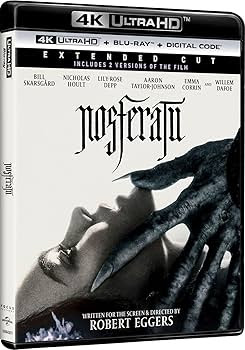
video on the channel, my dad and I discussed the cover art for the official
Blu-Ray release of this film and how it consists of Nosferatu’s hand grabbing
Ellen. In the original movie, Orlok’s grotesque proportions translate into its
most memorable imagery, especially when the shadows on the wall (shadows always
have similarly warped proportions) literally become Nosferatu and vice versa.
But while the new movie uses that very well for the full body shots, I feel the
original did it a lot better in regard to the hands to where it did not put in
the work to make Nosferatu synonymous with dark mysterious hands the same as
the original film.
For an example, you can
look at the recent Legendary Godzilla films. One of the main posters for
Godzilla 2014 unveiled just his dorsal fins (they were trying to hide the full
body design), but people complained because not only were those dorsal fins so
different from the original Japanese ones, but the films had not come out yet
to code Godzilla’s appearance through those slate peaks. The movies came out
and used his dorsal fins to create and shape the imagery (Godzilla swims with
those dorsal fins sticking out of the water and often glowing), so, by the time
Godzilla vs Kong’s main poster came out showing a monkey squaring off against
those dorsal fins, people knew what it meant. The films had to earn the use of
the symbol through repetition and focus.

I suspected the deleted
scenes could help in some of my criticisms, and, indeed, the first deleted
scene has another major moment of the image of Orlok’s hands, even as shadow
grabbing Ellen in the window, a very iconic scene that justifies the cover art
entirely. (There are other moments with the hand across Ellen’s face in the
movie, such as when Orlok’s rats feed on Anna but none as striking as that
deleted window scene.)
Now, it is not fair to
hold the marketing of a film against the film itself, because different teams
make that, and the access that the marketing and product design teams have to
the film varies, so it is not a mark against the film but a detail that
confused me and now makes sense. That is the point of this tangent, to try to
understand this film in great detail, because if I can argue how and why the
film did what it did, then I have a hope of being able to articulate if the
film did what it did well or not.
There is another
consideration to glean from the cover art’s emphasis on just the two figures:
the grotesque hand and Ellen. As my father said (and I am prone to agree),
Ellen, in this movie, has a far greater emphasis, role and strength, and that
contributes to a very specialized feminist lens one can analyse this film
through.
Radical Ecofeminism
Again, I am not talking
about whether or not movies in general should or should not have feminist
messages; I am just saying that I think, somewhat obviously, this film was
always going to be a little feminist with Ellen as the hero (when Mina was not
the one to kill Dracula) and that specifically there is a very tenable radical
ecofeminist reading.
One of the most
important ideas in feminist theory is the restrictive patriarchy. Some forms of
feminism aim to work within the patriarchy to solve it, while the more radical
forms posit that growth can only be done outside and to overthrow the system.
If, for instance, this film had a wealthy male character who is ineffectual to
the point of failing to protect his family and who seems devoted to keeping
Ellen in her place, labeling her premonitions as hysteria, that would be a
pretty textbook character to represent the patriarchy.
The character I just
described is Friedrich Harding by the way; I just wanted to lay out the
feminist reading of him before I said who. Harding's wife, being a woman
complicit to her husband's patriarchy mistreatment of Ellen but also a
character that Ellen can innately connect with, touches on ideas in radical
essentialist feminism. Von Franz literally tells Ellen that, in a society more
accepting of her feminine instincts and gifts, she could have been a religious
leader, connecting to the radical feminist concept of a matriarchy being
superior to a patriarchy. We must also consider that the nuns know the best,
even better than Von Franz, what is going on and are able to treat Hutter to
the point where he recovers almost completely after just a couple days of being
home (while in that same time frame, Harding, who relies on the patriarchal
hegemony of science and reason falls ill and dies).
Ultimately, the reason I
think radical ecofeminism as the specific feminist lens most suitable here is
because Orlok, an immortal agent of the patriarchy and Hutter, an unwitting
instigator, cast Wisbourg into an ecological nightmare with the plague that
only Ellen can stop (if I lost you with Harding, you have to admit that Orlok
is a man using his higher standing to persecute and dominate Ellen, and Orlok
is also specifically mistreating the environment through his same Ellen focused
patriarchal actions. That is already the bare minimum for ecofeminism in a
story). Despite the men holding all the power in the society, they are impotent
by the end of the movie (Orlok has lost the chess game the moment he enters
Ellen's embrace, Harding loses his mind and dies during necrophilia, and Hutter
is not fast enough to save his wife), and the movie seems to be implying that
it always takes a woman to kill a vampire (that is not to say that the vampire
hunting ritual of virgin girl on a white horse is feminist liberation but that
Ellen is reclaiming the power in a situation forced upon her by society).
Ellen also voices
opposing ecological perspectives from Hutter when she takes issue with him
killing the beautiful flowers. I cannot speak to any intent (all of the
specifically ecofeminist subtext could have been built accidentally from
needing to follow the Nosferatu plot points but wanting to show more
nonspecific feminist concepts), but I think it works. The only thing that gives
me pause is that Von Franz (a man of high status) and Ellen are on the same
page about the environment (the film connects their attitudes explicitly and
through their shared love of cats). I think it's simple enough to say that Von Franz
being revealed to have never killed a vampire and being shown to accept the
natural order of feminist vampire slaying (and being a disgraced scientist,
thus cast out of the patriarchy) keeps this reading intact, but Von Franz is
also an odd character that I think I am only beginning to grasp.
Von Franz Is Not Van
Helsing
Dr. Albin Everhart Von
Franz is the Van Helsing character in 2024’s Nosferatu. The original Nosferatu
had its own Van Helsing called Professor Bulwer, but he did not factor into the
action. According to Egger’s commentary, he likes the Van Helsing archetype and
wanted to include him, naming him Von Franz due to the naming scheme of Harker
being similar to Hutter and Sievers being similar to Seward. I would argue,
however, that Von Franz’ treatment has more in common with Friedrich Harding.
Harding is the Arthur
Holmwood of this story, the upper class wealthy beneficiary of the fellowship
with his own love interest that is doomed to die. As I already wrote about in
my first article on this film (https://planninecrunch.blogspot.com/2024/12/nosferatu-symphony-of-misplaced.html), Harding is a subversion, inversion or perhaps downright
deconstruction of Arthur, which you can see especially in Arthur’s moment in
his family’s sepulchre. Whereas in Dracula, Arthur stakes the vampirized Lucy,
Harding commits necrophilia with the dead Anna and then dies himself. Harding,
like Arthur, follows in his own father’s footsteps occupationally, but there is
not a title change to Godalming and no other fatherly connection to the Van
Helsing of this version.
Von Franz is an
enigmatic character. He has moments implying psychic precognition similar to
Ellen and talks about the different psychic extents to which people can operate
and be acted upon by demons. While he has the ethos, pathos and logos of the
traditional Van Helsing, he is messier in his approach, stabbing Ellen to prove
she feels no pain in trance and cackling like a lunatic while setting locations
on fire. I was incorrect when I previously said that prayer is shown to be in
vain in the movie; the nuns and Dafoe do employ it and advocate for it to good
effect. It just is not the final authority, and neither is Von Franz at least
compared to the now mythologized vampire hunter Van Helsing (https://planninecrunch.blogspot.com/2025/01/opinion-van-helsing-has-outlived-his.html).
According to the
commentary track, the writings, beliefs, attitudes and symbology of Dr. Carl
Gustav Jung are very important to understanding Von Franz. I have only a
passing knowledge of the man and his thoughts, but Ellen’s question to Von
Franz “Does evil come from within us or from beyond?” seems coded to Jungian
thought, pertaining to an external quote Jung included in his own writings,
“Those things we call evil, then, are defects in good things….” Von Franz even
later says that the fight against evil is about finding it in one’s self, which
brings to mind the Jungian idea of the shadow, the unconscious undesirable
traits or implications of one character, often embodied by an antagonist, but
essential for every man to identify and overcome in order to become conscious
and aware.
Even though the design
of Orlok in this movie was mostly to be a period accurate Transylvanian
nobleman, I find striking similarities to the design of Von Franz that I will
qualify in a moment, but doubles relationships, the self and shadow, are
intrinsic to Jungian thought, so Nosferatu and Von Franz are allowed to be deep
foils.
Nosferatu, The Shadow of
Von Franz

When Hutter enters the
room for negotiations with Orlok, the latter is dimly lit with a feast on the
table. So too do Sievers and Harding find Von Franz in a dimly lit room where
he offers them drink. Orlok speaks in a dead language, and Von Franz too is babbling
incoherently until he recognizes Sievers. Most notably, they are dressed to
match: a stupid hat (or nightcap), a stupid coat (or nightgown) and stupid
mustache for both. Orlok has skin dislocation due to being a walking corpse,
but you can also see in a key moment that Von Franz has discoloration of his
fingers due to his pipe smoking. This is deliberate; it has to be. None of this
is intrinsic to book Van Helsing, and the movie already has a penchant for
warping the book characters. Willem Dafoe has played Nosferatu before. This is
intentional shadow symbology per the Jungian ideas present in the character.
And in case you doubt that, explain to me why else (according to the commentary
track) it is the Nosferatu theme song that plays when Sievers and Harding first
encounter Von Franz in his home.
When you rewatch with
this in mind, certain key details take on new importance. Orlok lives in the
company of three or so wolves as well as rats, while Von Franz lives with cats.
So does Ellen. We’ll get back to what that means but not only should you keep
in mind the cat and mouse and dog and cat dynamic but that Von Franz is coded
this way even stronger due to having at least double the amount of cats Ellen
does and having a close connection to her cat. Most importantly, for Ellen to
protect her husband, she has to go behind his back and make a pact with this
devil Orlok to condemn him, but, before she can do that, she takes Von Franz
aside and makes a pact with him that she will do that.
So what is the point of
this? Why posture Orlok and Von Franz as Jungian foils other than the idea it
is neat? I cannot speak to the intent outside of just following that string of
the animals a little deeper. When Orlok is in the castle, he is at his most
potent and virile, surrounded by wolves and able to control Ellen. Wolves are
more powerful than cats. But when Nosferatu comes to Wisbourg, he comes with
rats, which cats feed on, and Nosferatu is unable to save himself from Ellen. I
would not think that significant except that Ellen also relocates to the
Hardings’ and takes her cat with her. Now, cats per Jung, represent femininity
and intuition, but the film is already telling us that because Ellen’s cat is
named Greta after the original actress of Ellen (who is a character defined by
feminine intuition).
If it seems weird to you
that Jungian Von Franz is being associated with feminine animals you must keep
in mind that Jung delineated male and female strength and that truly aware
conscious people must accept their own inner woman (if they are a man and vice
versa). Eggers talks on the commentary track about the deepening relationship
between Ellen and Von Franz, and, truly, based on my own watchthroughs he sees
her as a source of strength he grows from. Orlok underestimates her and seeks
to control her, and she kills him, but the first thing Von Franz does to Ellen
is tell Sievers to untie her, and the last thing he does in the movie is lift
up her cat, the symbol of their victory.
Not every detail is
going to be too important to this overall reading. The connection of Orlok to
wolves is meant to communicate his predatory nature and ravenous lack of self
control (as well as the vestigial connection of vampires to wolves in Bram
Stoker’s book and the folklore). The presence of multiple wolves does not
indicate that Nosferatu intends to build a harem or army, and the fact that the
wolves do not try to eat Hutter until after he wakes is not meant to
communicate that they do have self control actually; it is either Eggers or
Orlok allowing Hutter to live (there are some indications that Orlok does not
want to kill Hutter, so either he gave the wolves very confusing instructions
to give Hutter a chance to live or this was the best way Eggers could think of
to keep Hutter in peril but alive while asleep with ravenous wolves in the
room)
Does The Commentary Fix
My Issues
Robert Eggers seems to
me like a genius visionary director. Listening to Eggers describe the set,
performances, and filming down to minute details shows the specificity of his
approach in this movie. All that said, commentary tracks are often slapped
together not prepared with the same scope, editing and cogent final cut that
the films are provided. Often times, commentary tracks are cut down by the studio,
resulting in a director’s words on one scene being transplanted to a different
scene (Adam Wingard’s Godzilla vs Kong commentary track is one such example),
so it would be bad faith and quite possibly hypocritical for me to complain
about the way a director discusses their movie. They will have forgotten some
ideas that were very important at the time, some moments in the film will be
relics of previous drafts and plot considerations that got cut (such as much of
Ellen’s sleepwalking getting cut but the film still referring to her as a
somnambulist per Eggers), and sometimes the director did say literally
everything but the studio trimmed it down arbitrarily. That said, while this
commentary track does serve to clarify authorial intent within some of the scenes
I take issue with, it does not for others.
Per the commentary
track, the Romanian man that laughs at Hutter and the Roma camp is the vampire
hunter from later on and played by a Romanian pop star. This raises more
confusion to me whether or not the vampire hunters are Roma or Romanian (but
that should be easy enough to figure out by comparing the extras in the crowd
whether or not they were in the Roma camp or the inn). This does not clarify
whatsoever where the other vampire came from, why it was possible to kill this
vampire without the death of the pure maiden and why Hutter never told/Von
Franz and Ellen never listened to this firsthand account of a proven way to
kill a vampire that would not have sacrificed Ellen.
It is a massive
coincidence that Thomas crosses paths with a different vampire if it has
nothing to do with Orlok, but the film gives us nothing to explain how that
vampire was made, which we need to know to fully understand the stakes of
facing Orlok (if what Orlok brings is not exactly the bubonic plague, but he is
the “undead plague carrier” as Von Franz says, then at what point does his
infection entail vampirism if there also exists a lower class vampire in
practically his backyard considering how far his control can extend?). Also, if
other vampires are still active around the world, it becomes that much less
likely that Willem Dafoe would never have found one or that the Romanian
vampire hunter would not have already launched a full scale assault on Orlok’s
castle. (It does help to justify, however, why the nunnery had such efficient
undead plague treatments). For the worldbuilding to be seamless, we need to
either know that Orlok did and could create other vampires if he wants to or
that he had nothing to with that and can’t be killed by the same methods
because he is explicitly a different type of vampire (though that would make it
weird again that the nuns were able to treat Hutter’s symptoms so well).
Based on the way Eggers
articulated his authorial intent in the commentary track, moments like the
driverless carriage were different in part because all other adaptations show
Dracula in some form driving the carriage but also because it was more mystical
and magical. (Again, giving him the benefit of the doubt, he probably also
considered how it would interplay with the script, and we are not seeing that
part.) Just in terms of what I can see, it gives Orlok much greater magical
power than any other Dracula, as we can also see through his admittedly
somewhat limited mind control of Ellen an entire ocean away. Now, actually, the
overseas control of Ellen has an explanation in this commentary track. Because
other adaptations keep it just to the presence or lack of a photograph of
Ellen/Mina/Lucy, this film incorporated a lock of Ellen’s hair that Orlok can
smell to seem more viscerally creepy, but, also, having a piece of Ellen’s body
in his possession helps him to influence her. I could not find any exposition
of that in the film, but, it is after he procures it that he is able to influence
her sleepwalking, so we can accept it within an interpretation focused on
textual evidence.
Authorial intent is all
well and good, and I would argue it is important, but, at the end of the day,
we have to judge a film by what is in the film. It is possible I am mistaken on
certain details and have an incorrect understanding of the other vampire’s
implications on the story. You would use the film to prove me right or wrong,
not the author's statements after the fact. My issue is with the film for not
exploring the question. If there were an answer in the commentary track, I
would still have an issue with the film, but it would be for not showing the
answer they explored behind the scenes. Failure to consider one’s own plot is
not exactly the same as failure to communicate those considerations, and, when
applicable, it is in the best faith to analyze whatever instances of both that
we can find.
There was not really
another section to put this criticism, but I take issue with Knock’s escape
from solitary confinement. He tipped over the chair and started foaming at the
mouth, which resulted in an orderly untying his left hand and starting to loose
the restraints on his back to the chair. Knock bites into his neck and somehow
kills the man with just his jaw and one hand, then somehow escapes the rest of
his restraints. I cannot describe what actions he would have taken, and I do
not really accept the blanket statement of “a mad man’s strength” because
either he was restrained proportional to his strength to begin with (likely
after he already attacked his captors) or he was lying in wait the whole time,
which I do not buy for Knock at this moment because he grows more and more
unstable throughout the runtime and thus would not be able to keep a secret this
long. It changes very little in the long run except that Knock would have to
escape in different circumstances and would not die if he failed to escape
altogether.
Conclusion
In conclusion, this is a
very dense and rich film in its detail to a self indulgent degree. I think, for
the most part, it earned its decadence of detail, because it is a consistently
deep exploration of its themes and characters, especially where there are
differences with the original Nosferatu and the source text Dracula. Eggers
constructed an impenetrable tone of dread through the consistent application of
powerlessness, fog, moody lighting, intense physical acting by Lily-Rose Depp
and a subtle but effective score.
Eggers has gone on
record multiple times about the unique utility of Nosferatu (as opposed to
Dracula) as a modern fairy tale in its presentation and structure. Some people
may use that as a deflection against analysis that relies on plot cohesion and
consistency. People never question why the Mother and Father Bear sleep in
separate beds in the Goldilocks story because it needs to be that way for the
structure of the story to remain intact. I understand and even respect the
impulse; I just cannot do that myself. And that is because there was a very
good reason in the original version of the Three Bears story that they slept in
different beds: they were three bachelors rooming together until that got
changed by people unaware what they were affecting by making that change (the
bear’s marital dynamic).
So fairy tales can pass
scrutiny in select versions, and here is where I would pose a question to you
if you believe that Nosferatu being the fairy tale version of Dracula makes it
immune from criticism. Is this film not already fleshing out the characters of
Ellen, Hutter, Harding, Sievers, Von Franz and Orlok to make them more
believable and realistic characters? The film itself seems to think it has the
capacity to improve on the original and make it make more sense (whether it
succeeded is a different thing, but it definitely tried by making the
motivation of Ellen through a pseudo love triangle the focal point), and I
would argue it should follow that through to not only characterization,
technical aspects and tone but also in plot and worldbuilding. You do not need
to agree, but I do not really understand the argument that the film does not
need to make sense.
Though I am presenting
myself as somewhat of an authority on this film and its surrounding topics, I
am not, and I do lack clinical precision in many of these criticisms. I think I
have conducted a fairly good literary analysis here, but I am alternating
between different theories, not sticking to any particular style guide, and
applying this analysis to a movie where Bill Skarsgard grinds a prosthetic
penis on a cowering Nicholas Hoult (this prosthetic penis winding up in Hoult’s
possession after the movie came out). If you can offer any alternative thoughts
and reflections, I would invite that and thank you for reading this far. If you
can offer corrections to any errors I have made or perpetuated, I would thank
you all the more. Until such time as anyone else at Plan9Crunch shares their
further thoughts on Nosferatu 2024, that’s a wrap.