Translate

Showing posts with label George A. Romero. Show all posts

Saturday, November 30, 2024

Hot Spur is a grimy western roughie, but National Review apparently liked it


--


Review by Doug Gibson


I'm not much for the 1960s "roughie" genre (today essentially violent R-rated films with nudity), but one film has always intrigued me. It's called "Hot Spur," a 1968 revenge western directed by Lee Frost and co-written by exploitation genre legend Bob Cresse. The reason? Legend has it that the  conservative opinion magazine National Review named it one of its Top 10 films of the year.


Is this true? Perhaps I'll need to search back archives of the magazine to confirm. But just the thought that the late William F. Buckley might have traversed 42nd Street to see this sleazy film, with its frequent nudity and violence, intrigued me. I had to view it and did, for free, on Plex.


It is indeed grimy. A Mexican teenager stablehand, Carlo, is sick and tired of seeing his sister raped. The films opens with a sexual assault on a barmaid, who might be his sister; it's kind of unclear. The teenager follows the rapists back to the ranch. He eventually kidnaps the rich rancher's wife, and rapes and tortures her. There is a very bloody, nihilistic finale. There is gratitious nudity. A typical long-scene example is a visit by the misogynistic assaultants to a bordello, where prostitutes disrobe and for several minutes are groped, squeezed and have beer poured on them by the clothed men, who behave like pigs.


So is this film a step above its low-tier genre?  Maybe a little. It's a pithy tale, direct and to the point; brevity works here. Perhaps National Review was impressed by the crude frontier justice and chaos that results. Also, Carlo, played by James Arena, is kind of interesting. At first the viewer has sympathy for him, due to the abuse he takes from the cowboys and rancher. But as the film goes on Carlo's actions turn evil and his character loses sympathy. That reminds me of George A. Romero's "Martin," where the title wannabe vampire, played by John Amplas, could evoke sympathy but simply goes too far until the audience wants him dead.


Apparently Joseph Mascolo, who plays the rancher Jason O'Hara, became a soap opera star later. Virginia Gordon plays his kidnapped wife, Susan O'Hara. My assumption is she was a star of the adult genre of that era.


Besides Plex and other streamers, this film is for sale by Severin Films as a Blu-Ray, with accompanying feature, shorts and interviews. I believe this weekend it's half price for Black Friday. The Blu-Ray is also at Amazon. If you like this revenge western genre, Plan9Crunch has also reviewed "Cain's Cutthroats." John Carradine is great in that grimy film.

Monday, November 6, 2023

'40 Cult Movies' offers a perceptive, interesting new look at the genre


Review by Doug Gibson


Jon Towlson is pretty well known and respected as a genre writer. On the Plan9Crunch blog, we have read and enjoyed his book on pre-code horror films, “The Turn to Gruesomeness in American Horror Films: 1931 to 1936.” But he’s written several books and many articles. The guy’s a legit expert on films.


In “40 Cult Movies: 40 Cult Movies from Alice, Sweet Alice to Zombies of Mora Tau” (2023), he reviews and comments on a wide variety of films, from Freaks to Shivers, from Invasion of the Body Snatchers to Upgrade, to The Legend of Hell House to Drag Me to Hell.


It's a very diverse selection. Some of the films are familiar to all, some familiar to genre fans, and some are obscurities that Towlson notes have small cults. A Serial Killer's Guide to Life and Redeemer: Son of Satan are examples of films with a following in search of a sustained cult. I love that The Legend of Hell House is included. It’s a fantastic horror film overshadowed by another great film, The Haunting. Towlson aptly notes how the haunted house is perfect match for the plot and mood of ... Hell House.


One strength of Towlson’s writing is he can thoroughly discuss a film, its plot, cultural impact, its director's history, its relation to other films, and leave the reader satisfied with what has been read. That is a rare quality in writing.


In his introduction, Towlson makes it clear that if you don’t agree with everything, “that’s OK.” I love that in a writer. Towlson describes how many of his films underscore political or cultural themes. I agree with him in many cases, notably films from Penelope Spheeris, David Cronenberg, and George A. Romero, all with multiple films discussed in this book.


I had a harder time accepting that Invasion of the Body Snatchers represents 1950s conformity and even the McCarthy era. I know director Don Spiegel thought so but to me it’s solely a damn good science fiction piece. But Towlson presents excellent arguments for his takes and I’d likely have a tough time debating him.


The book is full of these types of interesting discussions on how films provoke the culture wars. Cronenberg’s Shivers is an example. Is this tale of a parasite infecting residents with sexual mania actually positive? Is it preferable to a stultified, consumerist life that decreases sexual interest? These, and other reviews of  films such as Martin, Alice Sweet Alice, and others will keep us reading through the night.


Also in his introduction, Towlson hopes that the book prompts readers to seek out the films he has covered. I have already started. In the past two weeks I have watched, for the first time, Horror Hospital, Alice Sweet Alice, Audrey Rose, and Shivers. I also re-watched, Redeemer: Son of Satan, a film I saw a long time ago as Class Reunion Massacre. All have been rewarding views.


This is the best book on cult films since Danny Peary's 1980s series of books. I hope Towlson will do this again with 40 more cult movies. He’s the writer to give us genre in-depth looks at these unique films. I hope we have three or four volumes. 40 Cult Movies would be a great companion buy with "TCM: Undergound: 50 Must-See Films", which we also reviewed on Plan9Crunch.


In his acknowledgments, Towlson writes, “I dedicate this book to anyone who has ever had a tape snarl up in his VCR.” Oh, that is apt. Reading about these films, many I watched for the first time on VHS (I even saw a few in Beta) brings so many great memories of heading to the VCR store and looking for a garishly decorated clamshell VHS. In those days they sold the sizzle more than the steak. I discovered that in films like Dr. Butcher M.D. …, Criminally Insane, Pranks, Bloody Birthday, etc. But there was steak amidst the sizzle, such as Martin, Evil Dead, and Torture  Dungeon, Andy Milligan’s take on Shakespeare that I’d love to see explored in a future volume of Cult Movies ...


Friday, February 12, 2021

The Grapes of Death - Jean Rollin's Most Frightening Film


Review by Steve D. Stones


Although made in 1978, the opening scene of The Grapes of Death (French title Les Raisins De La Mort!) reflects the times in which we live today with the Coronavirus pandemic. Winery workers dressed in cloth coverings and masks on their faces walk the fields of the Roubles wine making vineyard in central France while spraying pesticides on the grape crops. Tractors also drive over the fields spraying pesticides.


A young vineyard worker named Kowalski collapses in the arms of his supervisor after driving the fields in a tractor and complains of having a fever and neck pains. The boss dismisses his complaints and orders him back to the fields to work. He tells Kowalski that more tightly fitting masks are soon to arrive.


After his shift, Kowalski boards a train with only two other young women college students on board who are traveling to Spain. One of the girls named Elizabeth (Marie George Pascal) leaves her compartment on the train to find another empty compartment. While Elizabeth sits in the compartment reading a magazine, Kowalski enters the compartment and sits down. His neck and face begin to drip with a disgusting ooze of pus. This frightens Elizabeth, so she runs out of the compartment as Kowalski slowly chases after her. Elizabeth finds her friend Brigitte dead in another compartment. She pulls the emergency stop cord on the train and quickly runs from the train.


After walking for hours in the French countryside, Elizabeth arrives in a small village and runs to knock on the doors of local residents to get help and call the police. She enters the home of Antoinette (Patricia Cartier) and her father. Antoinette's father has a strange growth on his left hand – similar to the growth Elizabeth saw on Kowalski's neck and face on the train. The father and daughter offer Elizabeth a glass of wine as she desperately pleads to use their telephone to call the police. They tell her that their phone and car do not work.


Antoinette and her father insist that Elizabeth stay with them as she tries to flee the house. She is taken to a bedroom upstairs where she finds Antoinette's mother lying dead on a bed with her throat slashed. Antoinette explains to Elizabeth that it was her father that killed her mother. She gives Elizabeth the car keys to leave the village, but both girls are confronted by the father as they try to leave the house. Antoinette is raped and impaled with a pitch fork by her father as Elizabeth leaves the house in the car.


After crushing Antoinette's father against a rock with the car, Elizabeth drives to another nearby village and is confronted by another young man who has a strange growth on his forehead oozing with pus. Elizabeth leaves the car after shooting the man in the head with a gun. She then encounters Lucy (Mirella Rancelot), a blind girl who has wandered away from the nearby village.


Lucy and Elizabeth make their way back to Lucy's home after walking the French countryside all evening. The village is a grim sight of dead bodies lying on the ground and fires burning homes throughout the village. Lucy is desperate to find her brother Lucas (Paul Bisciglia). When Lucas is found, he too has a growth on his face – along with the rest of the villagers who appear to be zombies.


Nailed to a door in crucifixion style, Lucy is found raped and dead, killed by her brother Lucas. Lucas decapitates Lucy in the most gruesome scene of the film. The village zombies begin to chant - “Lucy, we love you, Lucy, we love you”


Elizabeth is pulled into a house in the village by porn actress Brigitte Lahaie. Lahaie's character does not have a name in the film, so I will refer to her as Lahaie. Elizabeth is told by Lahaie that the house is owned by the local mayor and his wife, both were killed by the villagers. She also tells Elizabeth that they will be safe if they remain in the house.


Eventually leaving the mayor's house, Lahaie incapacitates Elizabeth outside the house so the zombie villagers can attack her. In a sexy see-thru night gown, Lahaie blazes the town with a torch while walking two dogs. Two men in a pick up truck, Paul (Felix Marten) and his friend Lucien (Serge Marquand) arrive to save Elizabeth. Lahaie removes her night gown to prove to the two men that she is not marked like the rest of the village zombies. Director Jean Rollin never misses an opportunity to show naked female flesh in his films, as Lahaie has done for him many times.


Elizabeth, Paul and Lucien eventually make their way to the vineyard where Elizabeth's fiance Michel (Michel Herval) is employed. The trio determine that the zombie outbreak of the villagers must have been a result of the wine consumed by the villagers at the Grape Harvest Festival a week earlier. Paul and Lucien claim they were immune because they drank beer at the festival instead of wine.


It's no mistake that throughout the entire film Elizabeth wears a purple colored shirt, the color of grapes and royalty, as she stands in a winery tank at the end of the film with the purple walls of the tank sharply contrasting the purple of her shirt. The blood of her fiance Michel drips on her face from above the tank. The blood sacrifice symbolism in Christianity is apparent in this final sequence of the film – both with the blood on Elizabeth's face and the reference of wine as part of the sacrificial ritual. This scene connects well with the crucifixion of Lucy in an earlier scene. I'm not sure if director Rollin had this symbolism in mind as he constructed the final scene, but viewers could certainly interpret it this way.


The Grapes of Death may be Rollin's most commercial effort in film making and is said to be the first French zombie film. It is certainly Rollin's most frightening and well-made film. Most of Rollin's previous films are an exercise in strange surrealism and have interesting elements of experimentation to them. The Grapes of Death has often been compared to George Romero's Night of The Living Dead (1968) and The Crazies (1973). Both Romero and Rollin employ zombies to communicate the perils of a natural disaster. Happy viewing. (Watch the trailer here.)


Tuesday, August 1, 2017

The Legacy of George A. Romero (1940 - 2017)


By Steve D. Stones

In honor of the legacy of director George A. Romero, here are five of my most favorite Romero films. Romero's impact on the horror film industry cannot be objectively measured or overstated. Romero was a true maverick loved by those who worked with him. He will be greatly missed.
  1. Night of The Living Dead (1968). Here is the zombie horror movie that lays the foundation for every zombie movie that follows. A young woman named Barbara is attacked in a Pennsylvania cemetery by a zombie. She finds her way to a small farm house occupied by five other people hiding in the basement. News footage seen on a television gives the film a realistic, documentary feel that continually puts the viewer on the edge of his seat. The occupants of the farmhouse fight for their lives to stay alive. Our hero is an African-American man, Duane Jones, who does not triumph in the end, but makes a strong political statement on the coat tails of Martin Luther King Jr. and the race riots of the 1960s. Remade in 1990.
  2. The Crazies (1973). Romero continues on with a post-apocalyptic theme seen in Night of The Living Dead, and will continue even further in Dawn of The Dead. Like Night of The Living Dead, this film also has a realistic, documentary feel that leaves the viewer nervous and tense. It shows how our trusted institutions, such as law enforcement, news media and military, can be torn apart in the event of a tragedy. No one is to be trusted or can be turned to in the event of a disaster. A cynical view, but one which permeated American culture in the mid-1970s after President Nixon's resignation. A film which coincides well with the Watergate Era. Also known as Code Name: Trixie. Remade in 2010.
  3. Martin (1978). This creative film is an interesting take on the vampire myth. Martin is a peculiar young man who has a taste for blood – literally and figuratively. There's just one problem. Martin does not have fangs like a vampire, nor does he sleep in coffins during the day or avoid sunlight. All the established vampire iconography is stripped away in this film. Martin even has to use razor blades to get blood from his victims. Romero has often mentioned Martin as his best film. Many film critics agree.
  4. Dawn of The Dead (1979). Occurring just a few years after Night of The Living Dead, this film is a direct commentary on the consumer culture of the American lifestyle. Even in death, American zombies have the mind dulling sense to flock to a shopping mall to consume more stuff they cannot afford. The zombie becomes a parody and cartoon character, adding to Romero's critique of consumer culture. The irony here is that the living want it all too, but eventually end up dead because of their greed. We are all mindless zombies who want to consume more and more, in the eyes of Romero's Dawn of The Dead. Remade in 2004.
  5. Creepshow (1982). An anthology of five short stories in comic book fashion, Romero teamed up with horror writer Stephen King for this installment. The first story, Father's Day, is my favorite of the five. Here, a deceased father exhibits his patriarchal power over his daughter, even from the grave. He crawls his way out of the grave to complain about not getting a Father's Day cake. Actor Ed Harris gets smothered with his tombstone after falling into the grave. The father finishes the day by serving up his daughter's head on a platter. Who could ask for a better Father's Day?

May you rest in peace – George A. Romero, knowing that your zombies have made a profound impact on cinema and the horror genre. We love you George.

Saturday, September 17, 2016

Review: Bloodsuckers From Outer Space


By Steve D. Stones

Just the title alone of this mid-1980s low budget horror film made me want to seek it out. The theme song of the film is also quite campy, yet very catchy. “Bloodsuckers From Outer Space, there’s something in the air! They’re not in it for the money! They’re not in it for the love! They’re out for blood!” I found myself singing this song over and over again in my head as I sat through the film and wrote this article.

A Texas farmer feeds his animals and tends to his duties as a strong wind blows across his farm property. As the wind dies down, the farmer begins to act as if he has a pain in his stomach. He falls to the ground, throwing up blood. As he lies on the ground, it’s obvious that a tube is placed under his left chin as someone is pumping out gallons of stage blood. A young photographer named Jeff Rhoades arrives to photograph some bloody corpses lying in a field near his Texas hometown. Sam, the sheriff’s deputy, insists that Jeff cannot print photos of the corpses in the local newspaper. He asks Jeff to report the cause of death as “exposure to the elements” to avoid public panic.

Beauford, the local hillbilly, suggests that the deaths were caused by local “devil worshipping homos.” Meanwhile, a group of young scientists are conducting experiments at Research City on some of the bloodsucking zombies. One of the zombies happens to be Dr. Pace, who once headed Research City. It seems he has now become one of the bloodsuckers. Dr. Jeri Jett of the group looks and talks similar to the actress Annie Potts in Ghostbusters and the Designing Women TV show of the 1980s. Also in the group is Dr. Ralph Rhoades, who is the older brother of newspaper photographer Jeff Rhoades. After a failed attempt at photographing the corpses for his newspaper, Jeff pays a visit to his Uncle Joe and Aunt Kate. Joe and Kate raised Jeff after his parents were killed in an accident when Jeff was just a boy.

Uncle Joe is interested in Jeff working for him on the family farm as a diary farmer. Jeff insists that he is an artist, and wants to continue to photograph for the local newspaper. “When you gonna learn that art is sh*t? No one understands it,” says Uncle Joe to Jeff. He gives Jeff an ultimatum to either become a diary farmer and inherit the family farm, or go off on his own and keep being a photographer for the local newspaper. Jeff needs time to decide, so he leaves their home to collect his thoughts. While leaving his Uncle’s home, Jeff’s car has a tire blow out. Jeff discovers his spare tire is flat, so he gets angry and breaks all the windows and lights on the car.

A cute brunette in a Corvette pulls up and offers Jeff a ride. He is very happy to accept her offer. She tells Jeff that she’s wandering through town, trying to get away from her hometown of Dallas, Texas. General Sanders of the U.S. Army visits Research City with Major Hood. The general fits the movie stereotype of a general. He smokes large cigars, has a southern accent, wears sunglasses, and arrogantly talks trash of other people.

Dr. Rhoades and Dr. Jett inform the general that an energy field has descended upon some of the local citizens and has had a bizarre effect on those who were infected by it. They go on to say that the infected have respiratory problems that cause blood hemorrhaging in the blood vessels, causing them to become bloodsucking zombies. General Sanders does not buy into their analysis, and labels them as “scientific wise *sses.” He insists on destroying the bloodsuckers, instead of allowing the scientists to continue to conduct research on them.

After making out at Jeff’s home, Julie and Jeff return to Uncle Joe and Aunt Kate’s home for dinner at the dairy farm. Jeff and Julie arrive, only to discover that his Aunt and Uncle are now bloodsucking zombies. Uncle Joe attacks Jeff. Jeff cuts off Joe’s arm with a shovel. Jeff and Julie flee the home. The two stop by an abandoned home to make a phone call, where another bloodsucking farmer attacks Julie. Jeff finds a chainsaw and cuts off the farmer’s head as he is standing. The corpse continues to walk around as blood pours out of his neck.

Jeff and Julie’s only hope now is to go to Research City to find his brother Dr. Rhoades. When they arrive, they find that Dr. Pace has broken free, and is giving a lecture in an auditorium to the four remaining research doctors. All four doctors are sitting on the front row dead, including Jeff’s brother Ralph. Once again, Jeff and Julie flee the scene. They run out of gas and are forced to sleep in Julie’s car overnight. The next morning, Jeff and Julie go looking for gas in a small town named Enloe.

Jeff calls Sam, the sheriff’s deputy, to tell him about the events he has witnessed. Sam is uninterested and does not believe him. Jeff has called Sam while he is having sex with his girlfriend. Sam and his girlfriend quickly take a shower together before Jeff and Julie arrive. Here they experience a strong wind blowing in the shower that turns them into zombies. They too have become bloodsuckers, and greet Jeff and Julie as zombies when they arrive.

The military arrives in the town of Enloe to kill the zombies. The soldiers fall victim to a trap the zombies have set for them. The zombies corner the soldiers and rip them apart. General Sanders calls the President of The United States to suggest that a nuclear bomb be dropped on the infected area of Enloe. The President answers the phone call with a busty blonde woman sitting on his lap. She looks just like Glenn Close in Fatal Attraction. The President points out that a nuclear bomb cannot be dropped on a town of innocent American citizens. The beautiful blonde stokes his hair and smiles frequently. He continually stares down at her cleavage while talking on the phone with Sanders.

Finally, the President gives in to the general’s demands if he promises not to call or bother him any further. The general has the President’s authority to drop a bomb. This is one of the funniest scenes in the entire film. General Sanders pushes a button on a computer, launching a stock footage sequence of a missile darting out of the ocean and an A-bomb explosion. Major Hood informs Sanders that the bomb came nowhere near the target, but instead landed on a Methodist encampment some 60 miles away from the target. At least he was able to destroy some religious fanatics, even if it was a big mistake. No big loss.

As I watched this film, I thought of so many other low budget films that I have seen a million times. I immediately thought of the 1956 version of Invasion of The Body Snatchers. In that film, it’s giant space pods that take over the bodies of a small California town. This becomes a metaphor for the “red scare” tactics of McCarthyism that was going on in the 1950s.

In Bloodsuckers From Outer Space, it is the wind that impacts the citizens of a small Texas town and causes them to become bloodsucking zombies. General Sanders even refers to the bloodsuckers' problem as a “communist conspiracy.” This is where I drew the connection of Bloodsuckers From Outer Space to Invasion of The Body Snatchers.

Saturday, October 4, 2014

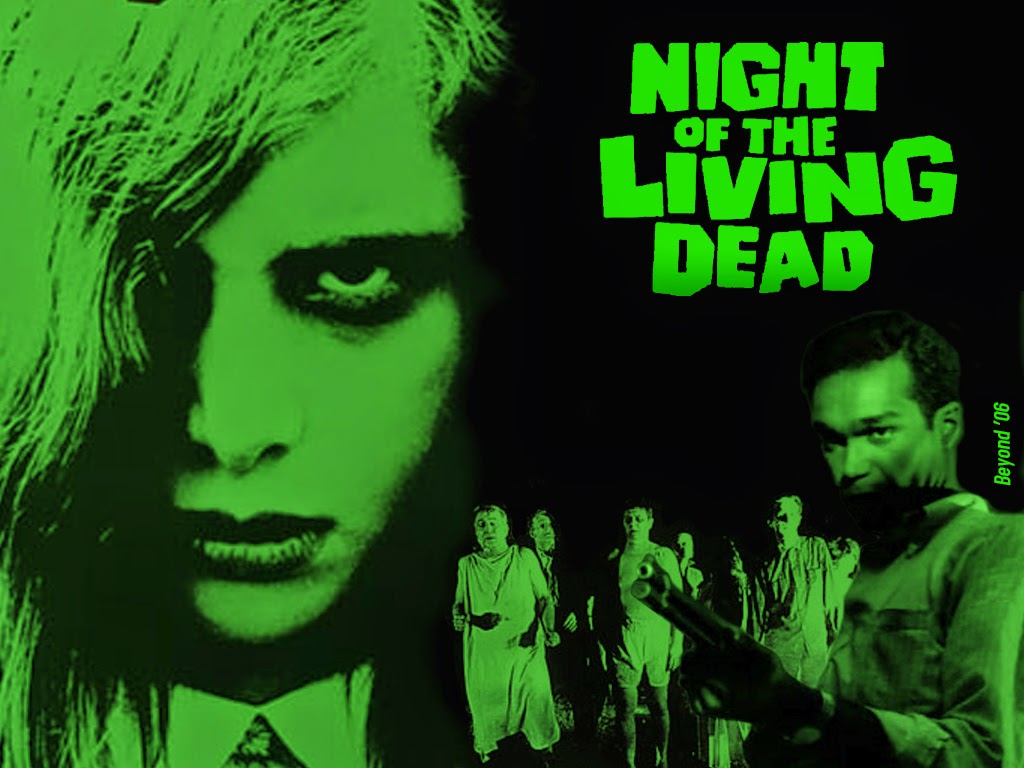
Night of The Living Dead (1968) – The Godfather of Zombie Movies


By Steve D. Stones

There’s no question that director George A. Romero is the Godfather of the zombie movie. His Night of The Living Dead (1968) is the standard to which all following zombie movies are measured. Prior to this landmark black and white film, the zombie was portrayed as a figure created through voodoo ritual. This zombie was a slow moving, brain dead person moving in a sort of somnambulistic trace. 

Romero changed this stereotype. In Romero’s world, zombies are vicious creatures who were once our friends, neighbors and loved ones, and they eat the flesh of the victims they attack. This was a big change from the voodoo zombie seen in Jacques Tourneur’s “ I Walked with a Zombie (1943).”
Watch closely, and you will see a film steeped in political and social commentary, and one which makes a statement about the breakdown of the family unit. The hero is a young African American man named Ben – played by stage actor Duane Jones. To cast a black man as the lead role and hero was risky business in the 1960s following a decade of racial tension, riots and Dr. Martin Luther King’s march on Birmingham.

The story may be familiar to you by now. Night of The Living Dead concerns a group of terrified individuals who have trapped themselves in a Pennsylvania farmhouse to protect themselves from hungry zombies. As the group fights desperately to survive the attack of zombies outside the house, the real struggle is between two men – Ben (Duane Jones) and Harry Cooper – played by Karl Hardman. Both are desperate to have complete control over the situation. The two continually argue with each other through the entire film.

Cooper’s wife and child and a young couple have barricaded themselves in the basement. Ben insists that everyone come upstairs and protect the ground level of the house. Cooper rejects this request, and a conflict between the two men occurs. Both men think they have the best plan for protecting the entire group, but as we see in the end – the zombies eventually break into the house, and only Ben is able to race downstairs and barricade himself in the basement for protection.

Ben survives the attack, but is mistaken for a zombie as a posse approaches the house and kills him. His body is thrown on a pile of dead zombies and burned at the end of the film. No heroes prevail in Romero’s zombie world.

The opening sequence of Barbara (Judith O’Dea) and Johnny (Russell Streiner) driving through an empty Pennsylvania cemetery covered with fallen leaves is one of the most effective scenes in horror cinema. Without showing a single zombie in the opening, the viewer immediately knows something dramatic and intense is about to happen. From the moment Johnny is attacked by a zombie wandering through the cemetery, the film never lets up on the zombie assault.

Shot on a shoestring budget by a group of Pennsylvania filmmakers working in television and commercials, the group formed the production name Image Ten based on the ten investors who put up the money and worked on the film. For further information on Night of The Living Dead, see Danny Peary’s “Cult Movies volume one” and Joe Kane’s excellent book “Night of The Living Dead – Behind The Scenes of The Most Terrifying Zombie Movie Ever.”

A remake was made in 1990 and 2006. The 2006 remake is a 3-D movie that comes with 3-D glasses if you buy the DVD.  Avoid the 30th Anniversary print with new scenes added. Romero had nothing to do with this version, and if you see it – you’ll understand why. The new scenes add nothing to the original film, and do not blend well with the original print.  Also avoid the computer colorized print that was released on VHS in the 1980s. The zombies are portrayed in a ridiculous green color that is laughable.

Don’t miss Romero’s excellent 1978 follow up – Dawn of The Dead. This sequel steps up the graphic horror and violence about ten notches and is in color. Happy viewing. 

Monday, July 21, 2008

Dawn of the Dead and those zombie imitations

Dawn of the Dead and those zombie imitations
By Steve D. Stones
In 1978 George A. Romero teamed up with legendary Italian filmmaker Dario Argento to create a horror masterpiece – Dawn of The Dead. The film was hugely successful, particularly in Europe. It was released in that continent under the title: Zombie: Dawn of The Dead. Immediate rip-offs were soon to follow. To cash in on the success of the film, another Italian filmmaker, Lucio Fulci, quickly made a film entitled Zombie 2: The Dead Are Among Us. Some critics have suggested that this film is superior to Romero’s Dawn of The Dead but I strongly disagree, even though I’m a fan of both films. After all, Romero created the genre, and is a master at using the zombie as a critique of contemporary society. His zombies in Dawn of The Dead reflect just how mindless we are as consumers of “stuff.” Even when we’re dead, we have a desire to want to go to the shopping mall. The shopping mall comforts us, and makes us feel safe and secure as consumers. The living understand the security of the shopping mall too. That is why they choose to make the mall their sanctuary in Dawn of The Dead. In 2004 Zack Snyder made a remake-homage to Romero’s Dawn of The Dead. In this film we see that the zombie is no longer a clumsy, slow walking corpse. Here the zombies are more athletic and can run quickly to catch up to their living victims in no time. Although I enjoyed this film and felt it was well made, there is something more appealing and frightening to me about the slow-moving, clumsy zombie used in Romero’s films. No matter where you run to or hide, the slow-moving zombie eventually catches up to you. This is extremely frightening to me. Snyder’s zombies catch you immediately. There is no fun or fright in this approach to the zombie. Romero’s zombies are playful and a farce of just how mindless and clumsy even living human beings can be. Snyder’s zombies are vicious, mean and downright barbaric. Romero even shows a gentle, softer side of the zombie in his version Dawn of The Dead. In one particular scene the character Francine, played by Gaylen Ross, is looking through the glass of a department store while loading her pistol. A zombie in a baseball uniform looks through the glass on the opposite side as if he is trying to communicate something to her. He doesn’t rush the glass in attack mode as if he wants to eat her. This is a very powerful, touching scene that shows a kinder, softer side to the zombie. As mindless as they may be, the zombies can also have emotions and a desire to want to communicate to the living. This is something lacking in the Snyder film. Another appealing aspect to the Romero film is the strange music score by Italian pop-rock group Goblin. The music of Goblin was also featured in a 1977 Dario Argento film, Suspiria, which is considered Argento’s horror masterpiece. The music of Goblin was featured once again in a terrible 1983 zombie film: Night of The Zombies, which is an obvious rip-off of Romero’s Dawn of The Dead. Night of The Zombies was written by Italian filmmaker Claudio Fragasso, who also served as assistant director. Fragasso has gained a bizarre cult following in recent years for his “best-worst” film, Troll II.