Translate

Showing posts with label Monogram. Show all posts

Saturday, January 25, 2025

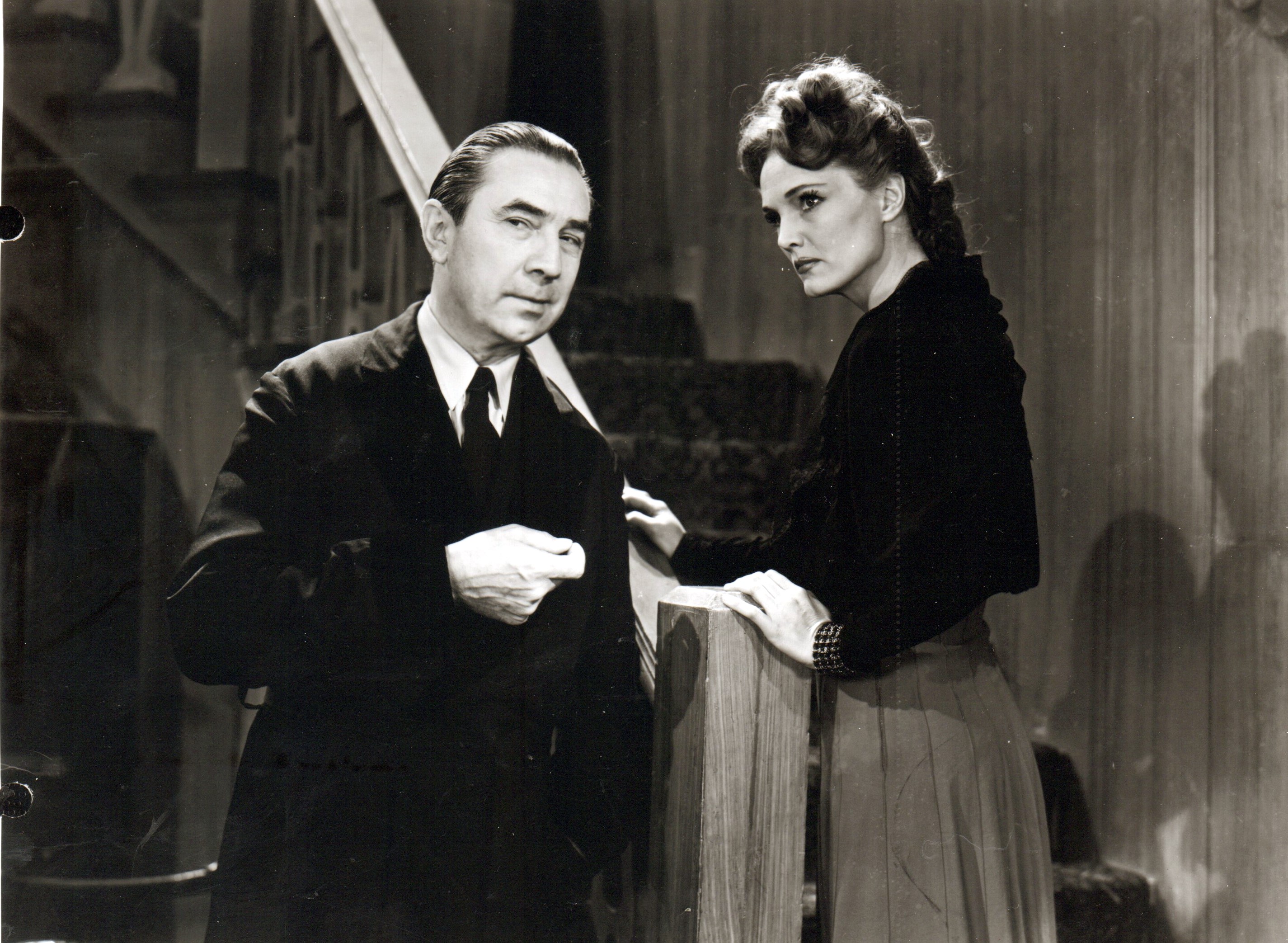
Bela Lugosi produces menace, chills in Invisible Ghost


By Doug Gibson

Once,  I spared a paragraph on "Invisible Ghost," Bela Lugosi's first Monogram film. Ironically, it was the first Lugosi Monogram I ever saw and years ago I was rather dismissive of the film, particularly Lugosi's insane murder moments. Watching it again, as recent as last night, and comparing it to other Lugosi Monograms, I re-evaluate it as technically, the best looking Lugosi poverty-row offering of the 1940s, if not the most campy or cultish. That notice still remains with "Devil Bat," "Bowery at Midnight," and "The Ape Man."

Here's what I wrote on this blog: "THE INVISIBLE GHOST, 1941:

"Lugosi's first Monogram has a convoluted plot but benefits from above-average direction from Joseph H. Lewis. Lugosi plays a kindly man whose wife deserted him. Unbelievably, she still lives on the grounds and he goes quite mad when he catches glimpses of her. The deaths lead to the execution of one innocent man whose brother (same actor) comes to the house to seek justice. Lugosi's hypnotic walk when under the murder spell of his wife is campy but the actor also brings pathos to it. Former silent star Betty Compson plays Lugosi's estranged, insane wife."

Lewis' direction is superb, and he throws in touches that other, run of the mill cheapie directors do not do, including interesting shots from a fire place, with the flames dancing in front of the actors, and excellent forward shots of a horrified Lugosi seeing his wife Compson through the window in a storm. The acting is better, particularly black actor Clarence Muse as Evans the butler who acts with dignity, and not a Stephen Fetchit portrayal. And the film's love interest is the talented Polly Ann Young, the least successful of the sisters in Hollywood trio that included Loretta Young and Sally Blane. Also, the sets seem of better quality than an average Monogram film.

One the minus side, the script is weak and convoluted, and mildly confusing. I think quality of scripts are the biggest difference between Universal B films and poverty row offerings in the 1940s. The other distinction is depth of acting talent in the films. Also, although Lugosi is excellent in his role -- even now I see the restraint in his insane moments that I missed on my first viewing, his playing of Mr. Kessler is not a role that demands any particular expertise or trait that made Lugosi unique. For example, the role could easily have been played -- at 90 percent of Lugosi's strength -- by George Zucco.

The film has Lugosi as a usually decent man who has temporary insane moments believing his long-departed wife is living in the house. The wife, played by Compson is actually on the grounds, being cared for -- without Lugosi''s character's knowledge. However, he occasionally sees her through his house's windows. That prompts him to go into a trance and kill whomever is in his sight. Early in the film is a genuinely scary scene where Lugosi, in a murderous trance, kills a maid in her bed. Director Lewis films this superbly, with a leering Lugosi coming closer to the terrified girl on the bed, and lifting a garment as a murder weapon. A radio playing pleasant music adds to the creepiness of the scene.

One more thing to add: Compson does a very good job as Lugosi's insane wife, who wanders around the Kessler estate. The poor script offers very little in how she could manage this so consistently, but as mentioned, scripts were not a priority on poverty row.

I highly endorse "Invisible Ghost" as a strong Lugosi poverty row offering. It appropriately belongs in the top tier of the Monogram cheapies and comes the closest to looking like a Universal B offering.

Tuesday, October 17, 2023

Enjoy Bela Lugosi's poverty-row gem The Corpse Vanishes


By Steve Stones

The Corpse Vanishes is my favorite Bela Lugosi Monogram film. It is also the first Monogram film I ever remember seeing on TV as a child sometime in the late 1970s. The scene of police opening a coffin in the back of Lugosi’s car is priceless. The look on Lugosi’s face as they open the coffin is unintentionally hilarious.


Speaking of coffins, the film also stars Tristram Coffin as Dr. Foster. Coffin starred in many serials of the 1940s and 50s. Angelo Rossitto, star of Freaks and countless other Monogram cheapies, plays Lugosi’s midget assistant Toby. He is billed in the opening credits as simply Angelo. It’s interesting to note that Rossitto would go on to star in the Mel Gibson film Mad Max Beyond Thunderdome some forty years later. He also starred in Al Adamson’s cult classic Dracula vs. Frankenstein.


Young brides are dying at the altar and Dr. Lorenz, played by Lugosi, is kidnapping their bodies for scientific experiments to rejuvenate his countess wife’s youth and beauty. She is played by Elizabeth Russell, best known in RKO's Cat People and Curse of the Cat People. Newspaper reporter Patricia Hunter, played by Luana Walters, discovers that all the kidnapped brides were wearing a rare wild orchid. Her investigation leads her to Dr. Lorenz, who raised the rare orchids. Apparently the smell of the orchid caused the brides to collapse at the altar.


On route to Dr. Lorenz’s home for an interview, Hunter meets Dr. Foster, who warns her of Lorenz’s eccentric and weird ways. Arriving at the Lorenz home, the Countess Lorenz expresses her unwelcoming nature to Hunter by slapping her in the face. Lorenz convinces Foster and Hunter to stay the night because of the pouring rain outside.


During the night, Hunter discovers a passage to an underground mausoleum and sees some of the kidnapped brides being held there. She also witnesses Lorenz and his wife sleeping in separate coffins. Lorenz explains to Hunter the next morning that sleeping in a coffin is much more comfortable than sleeping in a normal bed. Lorenz also suggests that Hunter was having a bad dream when she thought she witnessed seeing the kidnapped brides in the mausoleum.

Hunter decides to return to her newspaper headquarters and comes up with a plan to trap Lorenz in the act of kidnapping a bride by staging a fake wedding. The wedding day is set, and Lorenz does not fall for the trap, but instead kidnaps Hunter at the scene of the wedding. Foster and the local police catch up to Lorenz just as he is about to conduct an experiment on Hunter. The film ends with Hunter and Foster getting married. This time Lorenz cannot kidnap the bride.


It’s also interesting to note that Barney A. Sarecky was the associate producer of this film. Sarecky was one of the screenwriters for the Flash Gordon serials of the 1930s, starring Buster Crabbe as Flash.

Any fan of Bela Lugosi cannot afford to miss The Corpse Vanishes. All of Lugosi’s Monogram films are an absolute delight to watch. I particularly love this one because of the simple plot. Watch for the scene of Lugosi whipping his laboratory assistant named Angel. It’s a precursor to Lugosi’s famous scene of whipping Tor Johnson in Ed Wood’s classic The Bride of The Monster. Enjoy watching the film here.  Also, more photos from film and a newspaper ad.


Sunday, May 22, 2022

Three of our favorite Bela Lugosi Monogram films


In the early 1940s, Bela Lugosi signed a deal to star in several Monogram low-budget horror flicks (a couple were comedy/thrillers with the East Side Kids). It was a decision that allowed Lugosi to be the top actor on the set, an occurrence diminishing at Universal Studios. The films are just OK save Lugosi's usual excellent performance. Bela makes the films something special. Unlike Boris Karloff, for example, Lugosi never phoned in performances in low-budget films. We've reviewed most of the Monogram films at Plan9Crunch, but I want to give capsule salutes to three of my favorites. 


Doug Gibson


BOWERY AT MIDNIGHT, 1942:

Although the competition is fierce, this is likely the most kitschy delight when it comes to chaos and convolution. Lugosi plays a man cursed with three personalities: college professor, kindly operator of skid row soup kitchen and ruthless criminal. My favorite Lugosi scene: When the master criminal, reacting to a low level crook's joy at being part of a big robbery, casually tosses the crook off a multi-story roof, thereby creating the disruption necessary for he crime. Review here.


THE APE MAN, 1943:


Often derided as a "worst film," it isn't. Lugosi goes way beyond what's just to give some dignity to this film as a mad scientist who turns himself into part ape and has to kill to get a spinal fluid that might cure him. Wallace Fox and Louise Currie are also excellent co-stars who play journalists who foil his plans. See this film. Our review is here.


THE INVISIBLE GHOST, 1941:

Lugosi's first Monogram has a convoluted plot but benefits from above-average direction from Joseph H. Lewis. Lugosi plays a kindly man whose wife deserted him. Unbelievably, she still lives on the grounds and he goes quite mad when he catches glimpses of her. The deaths lead to the execution of one innocent man whose brother (same actor) comes to the house to seek justice. Lugosi's hypnotic walk when under the murder spell of his wife is campy but the actor also brings pathos to it. Former silent star Betty Compson plays Lugosi's estranged, insane wife. Read a review here.


Sunday, May 15, 2022

Bela Lugosi plays the world-dominator wannabe in The Mysterious Mr. Wong


Review by Doug Gibson

For a huge Bela Lugosi fan such as myself, it was always sort of an outrage that I had not yet seen 1934's "The Mysterious Mr. Wong," Mr. Dracula's first foray into the low-budget world of Monogram Studios. The film is ubiquitous. You can watch it at several locations on the Internet. It's also a staple of the DVD sets of 20 or 50 public domain films that can be purchased for $10 to $20. A decade or so ago I shucked out about $5 for an Oldies.com copy because I like the impressive cover art.

Based on a story by cult writer Harry Stephen Keeler, the tale is, in a crazy sort of way, a little like Lord of the Rings set in cramped Chinatown. Mr. Wong (Lugosi) a tough-looking power-crazy hood who masquerades as a meek shop owner, is busy murdering various Chinese contemporaries in order to get the 12 gold coins that Confucious minted before his death. Through murder and theft, Wong has nabbed 11 of the 12. If he can get them all, he'll achieve some sort of world domination (the script is a little fuzzy on this, but he definitely wants that coin.


Wong, though faces some tough competition from wisecracking newspaper reporter, Jay Barton (played by Wallace Ford, whose fantastic in these types of roles). In between doubting the cops' belief that the murders are over a gang turf war, Barton slowly, in his own inimitable style, begins to piece together who exactly Wong is and what he wants.In his spare time, Barton -- who gets his hands on the 12th gold coin -- breezily romances newspaper operator girl Peg, played by the pretty Arline Judge. It all leads to a final showdown where Wong menaces Jay and Peg.


This is nowhere near Lugosi's best film, but it's a fun way to waste 63 or so minutes. Despite its low budget and usual "where-the-heck-is-this-going" Monogram plot, it was lean enough to carry my wife and son through the film. And Lugosi, although one look at that nose kills any belief that he's Chinese, is suitably menacing. Scenes where he brutally tosses a man down into a cellar filled with rats is almost chilling, as is a scene where he bullies two Chinese women who disapprove of his plans. And he certainly has sadistic, murderous plans in store for Jay and Peg (Judge screams well) as the climax approaches.

William Nigh's direction is OK; he keeps scenes moving briskly. Ford has his usual good snark and adequate comic timing. Robert Emmett O'Connor is not too bad as an inept Irish cop to provide humor fodder. Another plus is a chance to witness what life was like 88 years ago in the outdoor city shots as well as the studio shots of he newsroom Jay and Peg work in. It's worth watching and a must for Lugosi fans. 

"The Mysterious Mr. Wong" likely made money for Monogram. It played throughout the nation. Below it shows up as a feature option for readers of the Quitman Wood County (Texas) Democrat newspaper in the Nov. 28, 1935 edition.


Thursday, November 11, 2021

King of the Zombies -- Monogram poverty-row gold


King of the Zombies, 1941, B&W, 67 minutes. Directed by Jean Yarbrough. Starring Dick Purcell, Joan Woodbury, Mantan Moreland. Schlock-Meter rating 6 stars out of 10. 


King of the Zombies is an old curio from Monogram, forgotten by most, enjoyed by purists. The plot involves three men in a plane who crash land in a West Indies island and encounter a very strange doctor (the role cries out for Bela Lugosi) who has a zombie-like wife, a cute secretary, and a collection of zombies. He also has an allied military officer held captive (it's WW2), and the convoluted plot involves the mad doctor wanting allied military secrets. 

He's foiled, of course, as his zombies eventually turn on him. The film has none of the atmosphere, moods or chills of White Zombie. It substitutes comic relief for frights. The only character who shows any real depth is Mantan Moreland, who plays Jeff, the black sidekick of the crash victims. It's a very racist role, from a different, less-tolerant era, but Moreland, whose first name is even a tacky racist gag, brings life to his character. 


The scenes where he mistakenly believes he's a zombie are very funny. There is the usual romance between crash victim Purcell and secretary Woodbury. Not a great film, but worth a look for fans and others who want to study the C movies from poverty row 60-plus years ago. For Monogram, it's gold quality.

Notes: Yarbrough also directed the Lugosi PRC film Devil Bat; It's rumored that Lugosi was slated to play the mad doctor in King of the Zombies. It certainly would have been a nice contrast to his evil, mad doctor role in White Zombie. Watch King of the Zombies here via YouTube.
-- Doug Gibson

Sunday, May 30, 2021

Bela Lugosi's The Ape Man often co-featured with B westerns


There he is, the great Bela Lugosi in one of his most iconic poverty-row roles, Monogram's "The Ape Man." In this post Plan9Crunch blog is doing its occasional peek at how these vintage films were covered in the newspapers. 


What I found particularly interesting is that movie houses of 1943, when the film was released, often paired "The Ape Man" with westerns. Look at "Sierra Sue," with Gene Autry, or "Blocked Trail," with the "Three Mesquiteers," who included Bob Steele. 


And it played with other poverty-row chillers, as one ad showing it with George Zucco's "The Black Raven." It was also a featured film on old-time spook shows; note its presence in Dr. Zomb's Black Mask Mysteries, and a Midnite Voodoo Party show. Of course it played with comedy shorts; one shows an Our Gang short offering, another a Three Stooges short. And a trip to see "The Ape Man" included a serial chapters. One was "Daredevils of the West." Another was "Adventures of Smiling Jack." 


We've included some published in newspapers PR blurbs and photos, and a columnist musing (unsigned). I particularly like "Handsome Bela Lugosi will star in ..." from the columnist. OK, they're talking about "Return of the Ape Man" but I think it's cool that as late as 1943 Lugosi was still being described as handsome. 


Here's a portion of a review I wrote in this blog on "The Ape Man."

Of such bizarre plots were Monogram cheapies of the 1940s created. It's a lot of fun to watch, even if the production values are predictably low. Lugosi, as usual, acts far above the product he's pitching, and he manages to make the audience feel sympathy for his plight. His ferocious temper tantrums are effective. He nearly strangles his sister in one scene. Urecal, by the way, is great as the slightly creepy sister. In an Los Angeles Times review (the paper actually liked the film) the reviewer suggested Urecal be given her own horror film to star in. So far as I know, it never happened, although she was also very good in the Lugosi vehicle The Corpse Vanishes. Currie and Ford as the wisecracking journalists have strong chemistry. B movie veteran actor McDonald is also an asset to the film. In a bit part is Earnest Morrison, better known as Sunshine Sammy Morrison of The East Side Kids.


I really like the photo below describing Bela as the Master of Horror. You can watch The Ape Man here. As always, my friend David Grudt, of Long Beach, Calif., assisted in finding these newspaper treasures. I do plan on adding an index below, in the near future, noting where each clipping originally appeared.


Sunday, February 21, 2021

Newspaper mentions of Return of the Ape Man


This week at Plan9Crunch we re-visit Monogram with Bela Lugosi's "Return of the Ape Man." For a very long time this was a hard Lugosi poverty-row effort to find. I remember high-fiving after snaring a weak DVD-R duplicate via E-Bay. Of course now, you can buy the Blu-Ray, which I have done. My friend David Grudt and I have checked Newspaper Archives and Newspaper.com and found a healthy selection of ads and even reviews, no doubt from the film's PR department, though.


Here's a few ads. It was paired with many films, including an 'oater, Trail to Gunsight, many serials, including Perils of Nyoka, a comedy short, Wedded Bliss (I ended up acquiring a copy of that Columbia short), as well as a Universal ghost comedy, Ghost Catchers. Also Monogram ran it with an East Side Kids feature, Follow the Leaders, and other features of the glorious '40s. It even was paired with what must have been a re-issue, the mid 1930s Boris Karloff horror, The Walking Dead. The film also headlines a Halloween spook show!


Here is a review of Return of the Ape Man I posted in the past:


In “Return of the Ape Man,” one of Bela Lugosi’s final Monogram offerings, his deviously mad scientist, Professor Dexter, offers , with polite arrogance, this laconic remark at a fashionable party to another guest. “You know, some people’s brains would never be missed.” Shortly afterward, Dexter tries to prove it by luring the intended of his partner’s niece to his laboratory for an unwilling partial brain transfer to a reanimated, prehistoric “ape man.” Only the interference of partner Professor Gilmore, with the added persuasion of a gun, stops Dexter. “He might not die,” is Dexter’s defense.


If not for Lugosi, “Return of the Ape Man” would be virtually forgotten. Even John Carradine underplays his role as Gilmore to the point of near narcolepsy. The rest of the cast also seems to play their roles with lethargy. The script, frankly, is unimaginative, and cheats viewers of a climax with Bela’s character alive. But Lugosi’s Dexter is his second-best mad scientist role; only Dr. Vollin in 1935’s “The Raven,” surpasses Prof. Gilmore in mad, ethics-be-damned-crime-be-damned, obsession. Like Vollin, Gilmore is courtly, charismatic, dedicated and mad as a hatter in his desire to reanimate a primitive human and provide him a decent brain, at any cost.

Casual fans of the genre may not know that Lugosi played a mad scientist far more often on screen than he did a vampire. He has some great lines in “Return of the Ape Man.” They include: “Murder is an ugly word. As a scientist I don’t recognize it;” and “Fool, you’ll pay for this!” is Dexter’s angry retort when Gilmore stops him the first time. The too-passive Gilmore eventually becomes the subject of Dexter’s partial brain transplant, and the mad glee that fills the countenance of Lugosi’s Dexter is chilling and unforgettable. Do yourself a favor, Lugosi fans, see “Return of the Ape Man.

Now, here are a few newspaper "reviews" of the film and more ads.: One review is a "phooey" pan from then Hollywood columnist Jimmie Fidler.


Watch this film via YouTube here.

Saturday, November 14, 2020

Bela Lugosi Monogram film Black Dragons looked through the clipping services time capsule


Cult film fans, here is "Black Dragons," the Bela Lugosi-starring Monogram film released mere months after Pearl Harbor in 1942. Poverty-row studios were quick to capitalize on the new World War, and Lugosi's tale of a Nazi plastic surgeon gaining revenge on Japanese members of the Black Dragons turned into U.S. industrialists determined to destroy Uncle Sam's economy was as endearingly patriotic, and wacky, as the dependable Monogram cheapie.

We love these films though. They are entertaining madness, always featuring a magnificent performance by Bela Lugosi, even when surrounded by pedestrian direction and acting, and writing that seems to have been written in one night, and then constantly changed every 15 minutes. Here's a link to a review I wrote of Black Dragons on the blog. There's a link to the film.

A snippet of the review: The plot is delightfully bizarre. Lugosi not only conducts plastic surgery on the Japanese agents, he lightens their skin and provides them accents, as well as hair and body shapes. All the industrialists who are now having doubles were killed off sans anyone knowing, even their families! Once Lugosi's character is tossed into a Japanese cell, which appears to be all stone, he somehow is able to conduct perfect plastic surgery -- from his bag -- on another prisoner!

Back to the blog. Myself and my friend David Grudt have been going through separate clipping services, trying to create time capsule looks at classic cult films, how they were promoted through newspapers of the times, the smaller the towns and cities the better. We found a surprising amount of clips regarding Black Dragons; perhaps that is due to its World War II storyline. Enjoy these clips, whether ads, mentions or reviews. When there is not a date or newspaper attached to the graphic, we'll provide the information.

And do yourself a favor -- watch Black Dragons. It's a lot of semi-coherent fun. Get you magnifying glass for the Jimmie Fidler in Hollywood column. Black Dragons is mentioned 7 lines before the end of the second paragraph in column two. Below that we were thrilled to find an actual review in the Alabama paper, although it's probably from the movie's press packet.


In the below Movieland, Its People and Products column hed, in the March 17, 1942 Appleton, Wisc., Post Crescent, the next graphic, part of the column, mentions "Black Dragons."


AND HERE ARE A COUPLE MORE REVIEWS, we were thrilled to find them published, from Detroit and Cumberland, Md. Detroit is a little tough to read. 


Finally, one more ad we culled, from the aforementioned Appleton, Wisc. Post Crescent, June 5, 1942.