Translate

Showing posts with label Poverty-row cinema. Show all posts

Saturday, January 25, 2025

Bela Lugosi produces menace, chills in Invisible Ghost


By Doug Gibson

Once,  I spared a paragraph on "Invisible Ghost," Bela Lugosi's first Monogram film. Ironically, it was the first Lugosi Monogram I ever saw and years ago I was rather dismissive of the film, particularly Lugosi's insane murder moments. Watching it again, as recent as last night, and comparing it to other Lugosi Monograms, I re-evaluate it as technically, the best looking Lugosi poverty-row offering of the 1940s, if not the most campy or cultish. That notice still remains with "Devil Bat," "Bowery at Midnight," and "The Ape Man."

Here's what I wrote on this blog: "THE INVISIBLE GHOST, 1941:

"Lugosi's first Monogram has a convoluted plot but benefits from above-average direction from Joseph H. Lewis. Lugosi plays a kindly man whose wife deserted him. Unbelievably, she still lives on the grounds and he goes quite mad when he catches glimpses of her. The deaths lead to the execution of one innocent man whose brother (same actor) comes to the house to seek justice. Lugosi's hypnotic walk when under the murder spell of his wife is campy but the actor also brings pathos to it. Former silent star Betty Compson plays Lugosi's estranged, insane wife."

Lewis' direction is superb, and he throws in touches that other, run of the mill cheapie directors do not do, including interesting shots from a fire place, with the flames dancing in front of the actors, and excellent forward shots of a horrified Lugosi seeing his wife Compson through the window in a storm. The acting is better, particularly black actor Clarence Muse as Evans the butler who acts with dignity, and not a Stephen Fetchit portrayal. And the film's love interest is the talented Polly Ann Young, the least successful of the sisters in Hollywood trio that included Loretta Young and Sally Blane. Also, the sets seem of better quality than an average Monogram film.

One the minus side, the script is weak and convoluted, and mildly confusing. I think quality of scripts are the biggest difference between Universal B films and poverty row offerings in the 1940s. The other distinction is depth of acting talent in the films. Also, although Lugosi is excellent in his role -- even now I see the restraint in his insane moments that I missed on my first viewing, his playing of Mr. Kessler is not a role that demands any particular expertise or trait that made Lugosi unique. For example, the role could easily have been played -- at 90 percent of Lugosi's strength -- by George Zucco.

The film has Lugosi as a usually decent man who has temporary insane moments believing his long-departed wife is living in the house. The wife, played by Compson is actually on the grounds, being cared for -- without Lugosi''s character's knowledge. However, he occasionally sees her through his house's windows. That prompts him to go into a trance and kill whomever is in his sight. Early in the film is a genuinely scary scene where Lugosi, in a murderous trance, kills a maid in her bed. Director Lewis films this superbly, with a leering Lugosi coming closer to the terrified girl on the bed, and lifting a garment as a murder weapon. A radio playing pleasant music adds to the creepiness of the scene.

One more thing to add: Compson does a very good job as Lugosi's insane wife, who wanders around the Kessler estate. The poor script offers very little in how she could manage this so consistently, but as mentioned, scripts were not a priority on poverty row.

I highly endorse "Invisible Ghost" as a strong Lugosi poverty row offering. It appropriately belongs in the top tier of the Monogram cheapies and comes the closest to looking like a Universal B offering.

Sunday, July 7, 2024

The Rogues' Tavern, poverty-row '30s film; review includes newspaper clips


By Doug Gibson


"The Rogues' Tavern," 1936 black and white film, directed by Bob Hill, produced by Mercury Pictures and released by Puritan Pictures, is one of the reasons I love film. It's just a stroke of luck, and a blessing, that this low-budget, 70-minute C-movie is still around for film fans to enjoy. It's like stepping into a wonderful time capsule, and getting a glimpse of what your grandparents watched in the 1930s before the "A" picture was shown.


Let's see some old newspaper clippings that involved this great film. Above is a newspaper ad from the The Kokomo (Ind.) Tribune, of Dec. 15, 1936. You see that starting Wednesday at the Wood theater is Rogues' Tavern. "IT'S FIRST RUN ... and its described as "A Roadside Inn Turned Into a Trap of Doom!" A few paragraphs down is a clip ad for both 'Rogues' and a Noah Beery film, 'Stormy,' in the Warrensburg (Mo.) Daily Star-Journal of May 22, 1936. I love the admission prices back then, 10 cents, 15 cents. My dad was telling the truth when he told me you could spend 25 cents, see the movies and have a hamburger way back then. Finally, a few paragraphs down we see a feature/review clip of 'Rogues'. It was in the May 9, 1936 edition of The Moberly (Mo.) Monitor-Index and Moberly Evening Democrat. It provides a feature of star Wallace Ford's life and then seques into a positive review. 


Enough reminiscing, here's the plot. Wallace Ford (Jimmy Kelly) and Barbara Pepper (as Jimmy's fiancee Marjorie Burns) are detectives heading to the Red Rock Inn to meet a justice of the peace and get hitched. "It is a dark and stormy night" with lots of whistling wind and there are quite a few eccentrics in the tavern. They include the renters, Mr. and Mrs. Jamison (Clara Kimball Young and John Elliott), a mentally-challenged handyman, Bert, (Vincent Dennis), and a collection of nervous, shady characters, including a nervous, but very beautiful Mexican lady named Gloria Rohloff (Joan Woodbury). Finally, there's also a dog, Silver Wolf, running around.


For reasons known only to themselves, the Jamisons deny Jimmy and Marjorie two rooms, or one if the justice of the peace arrives. The couple, who are a poor man's Nick and Nora -- for those who recall William Powell and Myrna Loy of The Thin Man series -- settle down in the lobby, which boasts a very impressive fireplace. (According to the book, Forgotten Horrors, the film was lensed at RKO-Pathe Studios, which was favored as a place for low-budget production companies that liked the fireplace as a prop)


Back to the film: One by one, the nervous, shady characters start getting murdered. Jimmy, with typical Wallace Ford bravado, starts to take charge of the investigation. Fiancee Marjorie, a very pretty blonde who acts a lot like Lucille Ball, tries doggedly to help her slightly sexist love interest. At first the dog is the chief suspect, but interest soon coalesces around a mysterious "Wentworth," who apparently called the endangered characters to the inn, and later a mysterious "Morgan." We soon learn that the nervous character at the inn have a history of jewel thievery.


That's all the plot I'll provide. This is an "old dark house" programmer, common for the era. What makes "The Rogues' Tavern" special is that it's better than the average C-movie programmer. The murders are well plotted, it' a bit goofy, Ford and Pepper are talented actors with good comic timing. My favorite lines of witty dialogue involve Pepper, after reflecting on the romantic fireplace, exclaim to Ford, "I feel so poetic, I could make love to a snowman." Ford retorts, "If that justice of the peace doesn't show up, you'll have too!"


In fact, Rogues' Tavern boasts an excellent cast. Besides Fox and Pepper, Kimball Young and Elliott were silent film stars. Woodbury wears a very slinky dress that thumbs its nose at the Hays Commission morality censors of that era. Her breasts, while not shown, are quite well defined despite being covered. The producer is Sam Katzman, who worked at Monogram with Bela Lugosi.


Ford starred in the legendary "Freaks" for Universal but was mostly a C- and B-movies star. He was a good actor with comic timing and may be best known for his role in the Bela Lugosi Monogram effort "The Ape Man." Woodbury was a steady actress who appeared in the Monogram film, "King of the Zombies." Pepper, who was a friend of Lucille Ball's, later in her career was a regular on Green Acres.


The film is fairly easy to find. It can be purchased at oldies.com and Sinister Cinema and is part of a 50-film set that can be bought cheaply. You can watch it free on the Net and it's the type of film that should pop up on Turner Classic Movies. I've been lobbying TCM to air it. The sets are better than an average C-programmer, which probably was filmed for less than $40,000.


The film has a lot of twists, some clever, some clumsy. It's about 10 minutes too long, particularly in the last third, with too many red herrings and static scenes. But the climax is fun, and a bizarre surprise, and the first 45 minutes are very entertaining in its mixture or murder and comedy mystery. Thanks to my friend David Grudt, of Long Beach, Calif., for providing the newspaper clips.


Wednesday, June 19, 2024

Valley of the Zombies: Republic does poverty-row horror


This 1946 Republic Pictures poverty-row horror film is a lean and mean 56-minute programmer. Ian Keith is a mostly forgotten actor today, but he was one of the finalists to play Dracula in 1931. In Valley of the Zombies, he plays a vampire-like character who forces a doctor to help him murder and get the blood he needs. Keith is creepy in the role and the film is a great, spooky hour to kill.


Keith also was considered for the role of Dracula in Abbott and Costello Meet Frankenstein, so he lost out to Bela Lugosi twice. Republic was known mainly for low-budget westerns and better-than-average serials. This film, very cheaply done, is kind of a mix with sparse sets similar to an ‘oater and enough shocks and surprises for a few serial short episodes.


Robert Livingston and Adrian Booth are mediocre as the man and woman romantic heroes, but it really doesn’t matter. The action moves so fast and there’s a really exciting climatic scene. It's odd that Keith is billed fourth in the credits. He's the reason to view this film. You can watch this film via YouTube here and of late this film has actually received a Blu-Ray release. If not above $20, it’s worth a buy.


-- Doug Gibson


Saturday, January 7, 2023

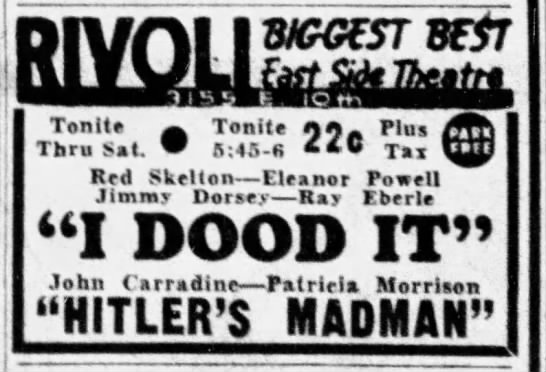
Hitler's Madman a film that rallied Allied audiences in 1943


I love old newspaper clippings, and again kudos to my friend, David Grudt, of Long Beach, Calif., for locating several clips for the John Carradine-starring "Hitler's Madman," 1943, which detailed the assassination of Nazi sadist/mass murderer Reinhard Heydrich, and the subsequent mass retaliation murder within the Czech town of Lidice. The above review was penned by The New York Daily News Wanda Hale, who was a founder of the New York Film Critics Association. Hale spent roughly 40 years reviewing films for the Daily News, retiring in the early 1970s.


"Hitler's Madman" (see a newspaper-published still below) was filmed as a poverty-row effort by Producers Releasing Corporation, but had enough mojo to garner a planned release by a bigger poverty-row producer, Republic Pictures. However, its fortunes leaped when the head honchos at major-studio MGM were impressed enough to take over final production. MGM also added a few scenes, one where Carradine's Heydrich is inspecting young Czech teen girls for use in a forced brothel. One of the teens in that scene is a very young, just-under-contract Ava Gardner.


Carradine is great in this role. You really hate him in a role in which he is playing the personifaction of pure evil. The details within the tale of Heydrich's assassination and the massacre of Lidice are liberally fictionalized, but it's excellent patriotic somber entertainment for wartime morale. Two lovers are reunited, one working as an agent against the Nazis. He recruits his lover and tries to persuade others to rebel. Townspeople are split between secret rebels, those who loathe the Nazis but discourage rebellion and a few Nazi-favoring quislings who include the mayor. The Nazis' main use for Lidice is to harvest male soldiers to die at the front and force women into brothels for Nazi soldiers. After Heydrich casually murders townspeople blocking his roadwayway during a town event, a plot develops against his life. He is ambushed and badly wounded.


Heydrich dies a slow agonizing death. Before he dies, he is visited by Heinrich Himmler, who clearly is more or less unconcerned, and offers bland platitudes about dying for Germany. Before his death, Heydrich, unable to deal with his mortality and in agony, refuses to die for Hitler and says that the war is probably lost for the Nazis. In his report to Hitler, Himmler assures the fuhrer that Heydrich died praising the Third Reich. It's a very strong scene, underscoring the banality of death and its ultimate insignificance for the evil.


Himmler orders the town destroyed and many of its males killed. The famous poem, The Murder of Lidice, bookends the film. It is recited at the beginning and the end. The film ends very strongly with the ghosts of the Lidice massacre walking through the streets, murdered in body but not conquered in spirit.


I imagine this film inspired a lot of audiences during World War II. It is very well made. Besides Carradine, stars include Alan Curtis and Patricia Morison, and Ralph Morgan. It is directed by future A-director Douglas Sirk. It was Sirk's first film after he escaped from Nazi Germany.


Before are a couple of more newspaper ads from 1943. I confess I was amused that the very serious, somber "Hitler's Madman" was paired in a double-feature with the Red Skelton comedy, "I Dood It." I guess audiences came to laugh and cry.


-- Doug Gibson


Sunday, July 24, 2022

The Mad Monster -- George Zucco is a brooding genius maniac


The Mad Monster, 77 minutes, Producers Releasing Corporation, B&W. Directed by Sam Newfield. Starring George Zucco as Dr. Lorenzo Cameron, Johnny Downs as Tom Gregory, Anne Nagel as Lenora Cameron, Glenn Strange as Petro/the monster, and Sarah Padden as the grandmother. Schlock-meter rating: 5.5 stars out of 10.


By Doug Gibson

The first time I watched this vintage PRC cheapie, I trashed it and compared it to later dogs like Beast of Yucca Flats and The Creeping Terror. However, during my second viewing I warmed a little to the film. It is, as one reviewer has said, so bad it fascinates. I agree. The plot: Mad scientist Lorenzo Cameron (Zucco), rebuffed by his peers, injects wolf blood into a simpleminded handyman (Strange) turning him into a well-dressed dog/wolf man. Ostensibly, the crazy doc plans to create warriors to defeat the Nazis and other enemies with his injections, but he eventually uses the monster to kill his enemies. The plot, which is recycled pulp, includes a backwoods country swamp setting, a beautiful daughter, her reporter boyfriend, and the cops.


The bottom of the barrel budget hampers Mad Monster, but there are scenes of high camp that are bizarre: The opening sequence involves the mad Zucco injecting Petro in the laboratory with blood from a snarling creature in a cage. During the scene, the doctor hallucinates a debate with his scientist colleagues (who appear as misty personages). I guess low-budget director Newfield was trying to show Zucco is mad, but it seems like he's on an LSD trip. Also, some filter is used to make the country swamp seem dank and foggy, but it just looks like the air is filled with cheesecloth.


The film lags often and should have been trimmed to an hour. There are several scenes where actors, who have nothing to do, sit and wait for the camera to stop rolling. Despite the budget and bad script, Zucco, a veteran of low-grade horrors, does a capable job. PRC starlet Nagel is pretty, and has a voice that is a dead ringer for Judy Garland. Unfortunately her reporter/boyfriend Gregory has a squeaky voice. Strange, who later would play the Frankenstein monster in a few films, is terrible. As the dim-witted Petro, he's a fourth-rate imitation of Lon Chaney Jr's Lenny in Of Mice and Men. In fact, he seems to have a far better personality as the monster. In a small role, Padden is creepy as a cackling backwoods grandma. The film ends, as was often the style 60 years ago, with the young lovers embracing in front of a burning house. It's worth a rental if you like C and B movies from the 30s and 40s.

Thursday, November 11, 2021

King of the Zombies -- Monogram poverty-row gold


King of the Zombies, 1941, B&W, 67 minutes. Directed by Jean Yarbrough. Starring Dick Purcell, Joan Woodbury, Mantan Moreland. Schlock-Meter rating 6 stars out of 10. 


King of the Zombies is an old curio from Monogram, forgotten by most, enjoyed by purists. The plot involves three men in a plane who crash land in a West Indies island and encounter a very strange doctor (the role cries out for Bela Lugosi) who has a zombie-like wife, a cute secretary, and a collection of zombies. He also has an allied military officer held captive (it's WW2), and the convoluted plot involves the mad doctor wanting allied military secrets. 

He's foiled, of course, as his zombies eventually turn on him. The film has none of the atmosphere, moods or chills of White Zombie. It substitutes comic relief for frights. The only character who shows any real depth is Mantan Moreland, who plays Jeff, the black sidekick of the crash victims. It's a very racist role, from a different, less-tolerant era, but Moreland, whose first name is even a tacky racist gag, brings life to his character. 


The scenes where he mistakenly believes he's a zombie are very funny. There is the usual romance between crash victim Purcell and secretary Woodbury. Not a great film, but worth a look for fans and others who want to study the C movies from poverty row 60-plus years ago. For Monogram, it's gold quality.

Notes: Yarbrough also directed the Lugosi PRC film Devil Bat; It's rumored that Lugosi was slated to play the mad doctor in King of the Zombies. It certainly would have been a nice contrast to his evil, mad doctor role in White Zombie. Watch King of the Zombies here via YouTube.
-- Doug Gibson

Sunday, May 30, 2021

Bela Lugosi's The Ape Man often co-featured with B westerns


There he is, the great Bela Lugosi in one of his most iconic poverty-row roles, Monogram's "The Ape Man." In this post Plan9Crunch blog is doing its occasional peek at how these vintage films were covered in the newspapers. 


What I found particularly interesting is that movie houses of 1943, when the film was released, often paired "The Ape Man" with westerns. Look at "Sierra Sue," with Gene Autry, or "Blocked Trail," with the "Three Mesquiteers," who included Bob Steele. 


And it played with other poverty-row chillers, as one ad showing it with George Zucco's "The Black Raven." It was also a featured film on old-time spook shows; note its presence in Dr. Zomb's Black Mask Mysteries, and a Midnite Voodoo Party show. Of course it played with comedy shorts; one shows an Our Gang short offering, another a Three Stooges short. And a trip to see "The Ape Man" included a serial chapters. One was "Daredevils of the West." Another was "Adventures of Smiling Jack." 


We've included some published in newspapers PR blurbs and photos, and a columnist musing (unsigned). I particularly like "Handsome Bela Lugosi will star in ..." from the columnist. OK, they're talking about "Return of the Ape Man" but I think it's cool that as late as 1943 Lugosi was still being described as handsome. 


Here's a portion of a review I wrote in this blog on "The Ape Man."

Of such bizarre plots were Monogram cheapies of the 1940s created. It's a lot of fun to watch, even if the production values are predictably low. Lugosi, as usual, acts far above the product he's pitching, and he manages to make the audience feel sympathy for his plight. His ferocious temper tantrums are effective. He nearly strangles his sister in one scene. Urecal, by the way, is great as the slightly creepy sister. In an Los Angeles Times review (the paper actually liked the film) the reviewer suggested Urecal be given her own horror film to star in. So far as I know, it never happened, although she was also very good in the Lugosi vehicle The Corpse Vanishes. Currie and Ford as the wisecracking journalists have strong chemistry. B movie veteran actor McDonald is also an asset to the film. In a bit part is Earnest Morrison, better known as Sunshine Sammy Morrison of The East Side Kids.


I really like the photo below describing Bela as the Master of Horror. You can watch The Ape Man here. As always, my friend David Grudt, of Long Beach, Calif., assisted in finding these newspaper treasures. I do plan on adding an index below, in the near future, noting where each clipping originally appeared.


Friday, May 28, 2021

Strangler of the Swamp, an effective atmospheric poverty-row horror

This is a fabulous film, Strangler of the Swamp, perhaps Producer Releasing Corporations best, along with Bluebeard, although I have a soft spot for The Devil Bat. The 1946 film is lean, just under an hour, directed by Frank Wisbar. It's a sort of remake of a German film Wisbar made in 1936. The atmosphere is incredible. The swamp is other-wordly, and the rural Americans seem to exist in another time and world. Charles Middleton, the gaunt, frightening Strangler, was the Emporer Ming in the old Flash Gordon serials. Rosemary LaPlanche, former Miss America, has a purity and innocence that connects to the vengeful Strangler. 

A young, later to be famous as a director/writer Blake Edwards, is good as LaPlanche's love interest. Rural locals in the film are well cast as well. (LaPlanche later starred in PRC's weird "sequel" to "The Devil Bat," "Devil Bat's Daughter. 

Some writers I respect, including Tom Weaver in Poverty Row Horrors, have trashed this film and accuse many "Strangler" fans of parroting an earlier upbeat review by William Everson in "Classics of the Horror Film." I can't speak for others, but I never read Everson's book and Weaver is just plain wrong. There is a pervasive atmosphere of dread Wisbar creates as the Strangler slowly goes after his revenge. The swamp creates a claustrophobic atmosphere that adds to the dread. I admire LaPlanche's mixture of stoicism and faith to deal with the terror.

Here is a small capsule review I wrote for "Strangler of the Swamp" as part of a column for The Standard-Examiner and also on Plan 9 Crunch's main blog:

"Strangler of the Swamp" — Made in 1948, this atmospheric thriller involves a man, hanged for a murder he didn't commit, who returns as a ghost and assumes the role of ferryman at the swamp. Instead of ferrying passengers, he strangles locals in revenge. Finally, a young woman (Rosemary LaPlanche) prepares to offer herself as a sacrifice to get the ghost to leave. The strangler (Charles Middleton) was "Emperor Ming" in the old "Flash Gordon" serials.

As mentioned, a great 40s C genre film, better than most A productions of that time. Don't miss it!
-- Doug Gibson

Saturday, November 14, 2020

Bela Lugosi Monogram film Black Dragons looked through the clipping services time capsule


Cult film fans, here is "Black Dragons," the Bela Lugosi-starring Monogram film released mere months after Pearl Harbor in 1942. Poverty-row studios were quick to capitalize on the new World War, and Lugosi's tale of a Nazi plastic surgeon gaining revenge on Japanese members of the Black Dragons turned into U.S. industrialists determined to destroy Uncle Sam's economy was as endearingly patriotic, and wacky, as the dependable Monogram cheapie.

We love these films though. They are entertaining madness, always featuring a magnificent performance by Bela Lugosi, even when surrounded by pedestrian direction and acting, and writing that seems to have been written in one night, and then constantly changed every 15 minutes. Here's a link to a review I wrote of Black Dragons on the blog. There's a link to the film.

A snippet of the review: The plot is delightfully bizarre. Lugosi not only conducts plastic surgery on the Japanese agents, he lightens their skin and provides them accents, as well as hair and body shapes. All the industrialists who are now having doubles were killed off sans anyone knowing, even their families! Once Lugosi's character is tossed into a Japanese cell, which appears to be all stone, he somehow is able to conduct perfect plastic surgery -- from his bag -- on another prisoner!

Back to the blog. Myself and my friend David Grudt have been going through separate clipping services, trying to create time capsule looks at classic cult films, how they were promoted through newspapers of the times, the smaller the towns and cities the better. We found a surprising amount of clips regarding Black Dragons; perhaps that is due to its World War II storyline. Enjoy these clips, whether ads, mentions or reviews. When there is not a date or newspaper attached to the graphic, we'll provide the information.

And do yourself a favor -- watch Black Dragons. It's a lot of semi-coherent fun. Get you magnifying glass for the Jimmie Fidler in Hollywood column. Black Dragons is mentioned 7 lines before the end of the second paragraph in column two. Below that we were thrilled to find an actual review in the Alabama paper, although it's probably from the movie's press packet.


In the below Movieland, Its People and Products column hed, in the March 17, 1942 Appleton, Wisc., Post Crescent, the next graphic, part of the column, mentions "Black Dragons."


AND HERE ARE A COUPLE MORE REVIEWS, we were thrilled to find them published, from Detroit and Cumberland, Md. Detroit is a little tough to read. 


Finally, one more ad we culled, from the aforementioned Appleton, Wisc. Post Crescent, June 5, 1942. 


Sunday, September 20, 2020

Spooks Run Wild -- how the newspapers saw it in 1941


 At Plan9Crunch we've been interested in searching out old newspaper clippings for some of the cult films we love to discuss. The Bela Lugosi Monogram films are a subject of study. We'll be clipping from all the films periodically and we are starting with "Spooks Run Wild." The above clipping is a movie review of the film (favorable) from the Oct. 6, 1941 Los Angeles Times.

Below is an ad for "Spooks Run Wild" as being part of a midnight spook show. It's the film paired with the Asylum of Horrors show, with an in-person Frankenstein monster. It's from the Harvey, Illinois Tribune, of Nov. 27, 1941. Wouldn't it have been cool to see that spook show. 


Below is a previously published review we did of "Spooks Run Wild" by co-blogger Steve D. Stones.


A bus transporting the East Side Kids to a summer camp for the needy arrives in a small town known as Hillside. A radio announcer heard on the bus radio warns of a killer monster on the loose in the town. The bus driver stops to check the tires of the bus. A local magician named Nardo, played by Bela Lugosi, is seen in the Hillside cemetery with his midget side kick, played by Angelo Rossitto. Rossitto also played Lugosi's assistant in The Corpse Vanishes (1942), also a Monogram release.

The East Side Kids find their way to the Hillside cemetery. A local grave digger warns them to leave, shooting Peewee, played by David Gorcey, in the back. The group leaves the cemetery to look for medical aide for Peewee. They soon come across the Billings House, a rundown mansion thought to be haunted, according to Hillside locals.


Nardo The Magician greets the East Side Kids at the entrance of the house and allows them to stay the night, but mentions that the house has no telephone to contact a doctor for Peewee. Scruno, played by Sammy Morrison, and Peewee are assigned to a room together. Peewee awakes in a sleep walker state after sleeping for hours, and roams the halls of the Billings House. Scruno is trapped in the room, but is later rescued by the rest of the group as he refers to Peewee as a Zombie.

It's interesting to note that Lugosi dresses in a cape and wears a suit in this film similar to his 1931 Dracula character. This gives the film great appeal to me. Lugosi's appearance greatly adds to this film, but he does not take himself nearly as seriously in this role as he does playing the evil Nazi henchman in the follow up film of Ghosts On The Loose. Lugosi and Rossitto make for a great pairing, as they did in The Corpse Vanishes (1942).


Above is a newspaper blurb in the Oct. 18, 1941 Bakersfield Californian of "Spooks Run Wild" that includes a photo of East Sides Kids star Leo Gorcey, who was in the film. It was set to play at the Kern theater with "Top Sergeant Mulligan," that included Nat Pendleton, who would later star with Bela in "Scared to Death."

Below that blurb, in the Oct. 21 Californian, is an ad for the above-mentioned double feature, I love noting the start time for the features was 8:30 p.m., the address was 2024 Chester and the phone number was 7-7084.


But look, above. As late as April 3, 1942, Bela and "Spooks Run Wild" was still headlining -- at The Strand theater -- as this blurb from the Sheboygan, Wisc., Press noted. The co-feature to "Spooks Run Wild" was a film called "Mail Train," with Gordon Harker and Phyllis Calvert. 


But the next newspaper ad above is even more interesting. It's from May 7, 1952, in the Axtell, Kan., Standard. It advertises "Spooks Run Wild" as paired with the earlier, bigger-budgeted Lugosi film, "The Invisible Ray," from 1936, that also starred Boris Karloff. It was at the Seneca Theater on Saturday beginning at 11:30 p.m. I that would have been so much fun. It's great to know that 10-plus years later these films were circulating. It's a pity Bela didn't receive a cent from the re-issues.


Just a couple of more newspaper memories. Above is from the Moberly, Mo., Monitor Index edition of July 28, 1942, and it shows a double-Bela night-time horror show with "Spooks Run Wild" and "Black Dragons." Included at the 4th Street theater was the latest newsreel. Finally, below, again from the Bakersfield Californian, May 22, 1942 edition, is a tiny review blurb (probably cribbed from a press packet), for "Spooks Run Wild," which was playing at The Rialto. The co-feature was "The Feminine Touch," that included Rosalind Russell and Don Ameche in the cast. Besides the films, there were cartoons and Chapter 10 of "The Adventures of Captain Marvel" serial.

(Thanks always to my friend David Grudt who helped track down these newspaper clippings)


Sunday, April 28, 2019

Bela Lugosi and the Monogram 9 -- a book review


Review by Doug Gibson

Since we heard about this a year or so ago, we Bela Lugosi super-fans have been -- at times impatiently -- waiting for the release of "Bela Lugosi and the Monogram 9," (BearManorMedia, 2019), a collection of essays from academics Gary D. Rhodes (who's written more than several books on Lugosi) and Robert Guffey, on the series of features Lugosi made for the poverty-row studio during the first half of the 1940s.

That's a handful of a paragraph/sentence, so what to make of this collection, ranging from "Invisible Ghost" to "Return of the Ape Man"? Short answer: I liked it a lot. However, and this is important for the casual Lugosi fan -- these are not production histories/movie reviews of the films. The 10 essays, two are reserved for "Invisible Ghost," are artistic criticism and analysis. Some of it's deep; you may want to Google individuals such as the surrealist Andre Breton and the eccentric but talented artist Stanislav Szukalski. Their philosophies relate with some of these two-week productions, or so say the authors.

And I kind of agree with them, with reservations. I love all but one of the Monogram films, and let's roll them out: "Invisible Ghost," "Spooks Run Wild," "Black Dragons," "The Corpse Vanishes," "Bowery at Midnight," "The Ape Man," "Ghosts on the Loose," "Voodoo Man," and "Return of The Ape Man." The only four-flusher in the list is "Ghosts on the Loose," and even that clinker I've seen more the once.

Until I read "... The Monogram 9,"' my love for the films was solely predicated on Bela Lugosi's dominance within eight of the films. His charisma and thespian talents make the films special. The reason "Ghosts on the Loose" is a clunker is because it's the only film of the series in which Lugosi is not the important or interesting character; he's almost background material.

I know I'm rambling so let's get to the essays, and provide some snippets, to hopefully whet your interest. The authors' scholarly musings are well-researched. Both provide insight on "Invisible Ghost," regarded as the best-directed film. The director was Joseph H. Lewis, who went on to bigger acclaim. Rhodes' essay conveys his directorial skills, noting the unique camera angles, from the fireplace, actors almost nose to nose across from a window. He also explains in detail how Lewis shot perhaps the scariest scene in the film, where Lugosi's character strangles a family maid in her bed.

Guffey's essay focuses on the film's surreal qualities, citing the aforementioned Breton. Lugosi's character is both respected man and cold killer. Guffey correctly notes the lack of concern over a long tally of death and how characters, such as the police, almost serve as props while the murders in the house occur. Bad dreams appear to be reality. Is the murder of the maid a subconscious act of violence by the killer toward his hidden, mentally ill wife? What of the reappearance of the "doppelganger" brother of a doomed, early character? Is all of this just happening in Lugosi's character, Charles Kessler's mind? Artistic criticism offers many questions that can spark even more answers, is perhaps the theme of this essay.

In the essay on "Spooks Run Wild," Rhodes, after noting Lugosi's  various "sinister" roles in films, tabs "Spooks ..." as perhaps Lugosi's most developed "red herring" role, in which he appears to be the villain until the end. As the author notes, Lugosi, playing a magician suspected of being a murderer, appears and acts a lot like Dracula. It was his first film with the comedy "East Side Kids" cast. Somnambulism, magic, suits of armor, and human monsters all factor into the film, adds Rhodes.

In the essay on "Black Dragons," in which Lugosi plays a betrayed Nazi doctor who gets even with the Japanese agents, in America, who turned on him earlier, Guffey compares this bizarre, war propaganda film with the term "the Cinema of Hysteria." Now in my opinion this is a surreal film. It has a tough plot to follow, a lot of sexual banter and attraction between spies and lovely young ladies (as Guffey notes) and Lugosi, for the last time in the film, is looked at with interest by a starlet. Oddly, as Guffey notes, though the film contains a strong nationalist, even racist message to be on constant watch against the enemy, it contradicts itself by how showing how easily Japanese agents can plastic surgery their way into the highest levels of U.S. government. Racial profiling won't work, the film seems to subtly say.

Rhodes' essay on "The Corpse Vanishes" has some interesting insights. The film's hero is a persistent female reporter, a stock character in many '30s and '40s films. Also, although Lugosi's Dr. Lorenz is no vampire, Rhodes notes similarities to "Dracula." Lorenz is from Eastern Europe, it seems. His wife is a countess. The villagers near his remote home fear him. The reporter wanting to see him can't get a ride there. Also, the captured brides in the home could represent Dracula's brides. Lorenz and his countess wife sleep in coffins. All these are noted by Rhodes, who also alludes to the significance of families in horror films, noting that Lugosi refers to his assistants and henchmen as part of my "little family." (My co-blogger Steve D. Stones and I regard "The Corpse Vanishes" as the most entertaining Monogram films and Rhodes' insights I found valuable.)

Guffey's essay on the multi-plotted "Bowery at Midnight" compares the film as "slipstream" cinema. In a nutshell, that means one really can't nail down the action and plot with a single definition. That makes sense, as this chaotic but fun film can be tagged a crime drama, a missing persons drama, a multiple personality drama, a deceiving husband film, or a horror film. Multiple realities occupy individual and settings in the film. And how do dead people turn into zombies and then reappear as normal individuals, asks Guffey. That does happen in the film, I guess. I thought the doctor just healed them. But to be fair to Guffey, how did they all exist for so long in that cramped basement?

"Artifices, lies and false fronts" define "The Ape Man," Guffey says in that film's essay. At heart, the film is a deliberate con job, like a magician offering the audience all the secrets of how he's pulling their legs on the theater screen, he notes. "The Ape Man" is a lot of nonsensical fun and that's due in part to a goofy, extraneous character, Zippo, who serves as narrator to move the action along. He serves as a kind of God, deciding who lives and dies. Guffey writes that the film is an example of the thinker  Bertolt Brecht's Theory of Alienation. To sum up, it's an effort to dislodge an audience from the traditional suspension of belief by disrupting the flow of the film and forcing said audiences to slip out of the film's trance and become active participants of the art. I know it sounds a bit goofy but one can argue that having a narrator interact with an audience accomplishes that.

Rhodes does his best with the boring film "Ghosts on the Loose," which has the East Side Kids outwitting Nazi publishers (headed by Lugosi) living in a fake haunted house. In the essay, he recounts historical instances of criminals attempting to cover up crimes with tales of haunted houses. On a side note, a very funny episode of The Andy Griffith Show has moonshiners scaring Deputy Barney Fife and others by using a "haunted house" that they rigged with spooky tricks. So there's an example of an effective short comedy. Fife's Don Knotts made another fake haunted house film, "The Ghost and Mr. Chicken."

For "Voodoo Man," one of my favorite-half Monogram entries, in his essay Rhodes says that syncretic best describes the film, meaning that several "discrete sources" are used to fuse a film together. One particular fusion of a film: a character Lugosi, with the help of voodoo religion confederates, kidnaps and stores young women kept in a zombiefied state to try to reanimate his zombie-like wife. But the voodoo has no traditional Caribbean source. It appears to be a white man's voodoo in a rural area close to Southern California. There also appear to be elements of Svengali (Trilby) in the film as Lugosi's character can hypnotize and summon women from far away.

Finally, Guffey concludes the book with an essay on "Return of the Ape Man," This is probably Lugosi's strongest mad scientist performance short of "The Raven." He is beyond obsessed with bringing a neanderthal man back to life and trying to experiment with sharing his brain with modern man. This has the usual disastrous results. Guffey draws a fascinating connection with the famed artist Stanislav Szukalski, who had this bizarre theory that mankind, after Noah's flood, intermingled with a Yeti-like race, producing a polluted version of homo sapiens. He even wrote a book about it, called "Behold!!! The Protong," notes Guffey. Szukalski was a great talent; unfortunately much of his work was destroyed during and after World War II. He's such an interesting character that his outlandish theories spark renewed interest in the man, a true survivor of an adversity-filled life. Ironically, a month ago I watched a great Netflix documentary on Stanislav Szukalski, "Struggle: The Life and Lost Art of Stanislav Szukalski." I highly recommend it. Honestly, I doubt the artist ever saw "Return of the Ape Man." It's possible, of course. But I just think it's really cool to read an analysis of the Lugosi film that includes "Protong," etc.

Let me add a note here, to be fair to Guffey in particular. The authors are not claiming that there are deliberate connections to the arts, theories and genres mentioned as artistic connections to the Monogram 9 films. It's acknowledged often that the relationships are likely unintentional, more products of the directors' training or past experiences as they were learning the film craft. Like the creation of a cult film, the insertion of a philosophy is nearly always unintentional. To try to force it into a film never succeeds. It turns the film into something derivative, labored and clumsy.

The Monogram 9 were for the most part remarkable achievements given budgets and time constraints. Their legacies were fueled by an iconic, charismatic star and directors forced to rely on their first instincts to create a finished film within a two-week period. Monogram profit margins were tiny; no allowances were given for wasted time and money. It's a credit to Rhodes and Guffey that these films have been rewarded with a bit of scholarship that took far longer to create than the films being discussed.