We love Tod Browning's films at Plan9Crunch blog, and we thought we'd spare some paragraphs on a couple of his better MGM films of the 1930s: Freaks, 1932, (see news clipping ad above) and The Devil-Doll, from 1936. Also, thanks to David Grudt, of Long Beach, Calif., we go back in time and see classic newspaper clips about the films.
FREAKS
Besides “Dracula,” the film Browning may be best known for is the 1932 "Freaks." It is a masterpiece of surreal horror. The plot involves a selfish, beautiful trapeze artist (Cleopatra) who marries a little man (Hans) for his money. With her strongman lover (Hercules), she plots to kill Hans. Their big mistake is that they assume the circus “freaks” are little children, rather than adults capable of retribution. What they learn too late is that the “freaks” — and the actors really were such — act like children as a defense mechanism. They want to be left alone. But threatened in their environment, they draw strength from numbers.
For 40-plus minutes of this slightly longer than an hour film, we are not scared. Instead, we learn about life in a circus, and we view the “freaks” as human beings. The last 20 or so minutes are horrifying as the “freaks” gain revenge on two who would falsely request their trust and then try to kill one of them. The scenes of the “freaks” with knives and guns, peering through windows and under wagons, slithering, hopping, sliding and pursuing Hercules and Cleopatra through a dark rainy night are frightening. For years, the fim ended with a brief, jarring shot of what the “freaks” had done to Cleopatra. It’s one of the most shocking finales in film. But now “Freaks” when seen on Turner Classic Movies, adds the epilogue with Hans and other characters that diminishes the impact a little.
“Freaks” was ahead of its time. The suits at MGM hated the film and barely distributed it. More than any other film, it damaged Browning’s career. In fact, it was banned in Britain for 40 years. See it for yourself: it’s a masterpiece that draws on Browning’s love and respect for carnival life. In fact, before his film career Browning worked in a carnival. He allowed himself in these Grand-Guignol-like events to be "buried alive." More newspaper clips of Freaks below:
THE DEVIL-DOLL
One more Browning film worth seeing is the 1936 “The Devil-Doll.” (See newspaper clipping above) It stars Lionel Barrymore as Paul Lavond, a framed banker who breaks out of France’s Devil’s Island prison with a mad scientist who can turn people into doll-sized humans who can be manipulated by human masters’ thoughts. It’s a wild plot. Outside Paris the mad scientist dies. Lavond’s and the scientist’s widow — who is as crazy as her husband — continue the experiments. She wants to turn the whole world little; Lavond just wants to gain revenge on his ex-partners who framed him and also help his blind mother and daughter, who were impoverished by his imprisonment. He uses the “devil dolls” to get his revenge on his ex-partners and clear his name.
Watch this film for the special effects and Barrymore’s performance. He’s great as a mostly decent man who can’t control his thirst for revenge and knows it. As an actor, Barrymore could be very kindly, as in Frank Capra's "You Can't Take It With You," and also quit evil, as in Capra's "It's a Wonderful Life" and an earlier Browning film, "West of Zanzibar."
More newspaper clippings for The Devil Doll below, including a mid 1930s review.:
I love old newspaper clippings, and again kudos to my friend, David Grudt, of Long Beach, Calif., for locating several clips for the John Carradine-starring "Hitler's Madman," 1943, which detailed the assassination of Nazi sadist/mass murderer Reinhard Heydrich, and the subsequent mass retaliation murder within the Czech town of Lidice. The above review was penned by The New York Daily News Wanda Hale, who was a founder of the New York Film Critics Association. Hale spent roughly 40 years reviewing films for the Daily News, retiring in the early 1970s.
"Hitler's Madman" (see a newspaper-published still below) was filmed as a poverty-row effort by Producers Releasing Corporation, but had enough mojo to garner a planned release by a bigger poverty-row producer, Republic Pictures. However, its fortunes leaped when the head honchos at major-studio MGM were impressed enough to take over final production. MGM also added a few scenes, one where Carradine's Heydrich is inspecting young Czech teen girls for use in a forced brothel. One of the teens in that scene is a very young, just-under-contract Ava Gardner.
Carradine is great in this role. You really hate him in a role in which he is playing the personifaction of pure evil. The details within the tale of Heydrich's assassination and the massacre of Lidice are liberally fictionalized, but it's excellent patriotic somber entertainment for wartime morale. Two lovers are reunited, one working as an agent against the Nazis. He recruits his lover and tries to persuade others to rebel. Townspeople are split between secret rebels, those who loathe the Nazis but discourage rebellion and a few Nazi-favoring quislings who include the mayor. The Nazis' main use for Lidice is to harvest male soldiers to die at the front and force women into brothels for Nazi soldiers. After Heydrich casually murders townspeople blocking his roadwayway during a town event, a plot develops against his life. He is ambushed and badly wounded.
Heydrich dies a slow agonizing death. Before he dies, he is visited by Heinrich Himmler, who clearly is more or less unconcerned, and offers bland platitudes about dying for Germany. Before his death, Heydrich, unable to deal with his mortality and in agony, refuses to die for Hitler and says that the war is probably lost for the Nazis. In his report to Hitler, Himmler assures the fuhrer that Heydrich died praising the Third Reich. It's a very strong scene, underscoring the banality of death and its ultimate insignificance for the evil.
Himmler orders the town destroyed and many of its males killed. The famous poem, The Murder of Lidice, bookends the film. It is recited at the beginning and the end. The film ends very strongly with the ghosts of the Lidice massacre walking through the streets, murdered in body but not conquered in spirit.
I imagine this film inspired a lot of audiences during World War II. It is very well made. Besides Carradine, stars include Alan Curtis and Patricia Morison, and Ralph Morgan. It is directed by future A-director Douglas Sirk. It was Sirk's first film after he escaped from Nazi Germany.
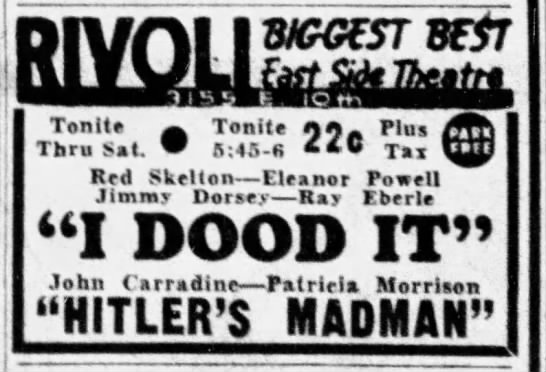
Before are a couple of more newspaper ads from 1943. I confess I was amused that the very serious, somber "Hitler's Madman" was paired in a double-feature with the Red Skelton comedy, "I Dood It." I guess audiences came to laugh and cry.
When I watch Tod Browning's 1927 silent masterpiece "The Unknown," and I've seen the film many times, for 50 minutes time ceases to exist. I'm lost in a film that is simply Lon Chaney's greatest performance, and yes that includes "Phantom of the Opera" and "The Hunchback of Notre Dame." "The Unknown" is the most intense performance Chaney had, and 90 percent of the effectiveness is in his facial expressions.
The film involves a small circus troupe, owned by a gypsy entrepreneur. Alonzo the Armless (Chaney) is the star attraction, a man without arms who can do amazing stunts, such as throw knives around the pretty torso of the circus owner's daughter, Nanon, played by a very young, barely clothed, and very gorgeous Joan Crawford. Another star performer is circus strongman, Malabar, played by Norman Kerry. Malabar loves Nanon, but she shrinks from him, telling Alonzo that she hates to have men's hands pawing her.
Alonzo is assisted by a little person, Cojo (John George). Cojo helps Alonzo conceal a secret -- that he really has arms. In fact, he has a hand with two thumbs. Alonzo, it's learned, is on the run the police, who are looking for a suspect with arms. All this is interesting but ultimately it is supporting material to the film's theme, which is Alonzo's desire to posses Nanon and gain her love. I hesitate to say that Alonzo is in love with Nanon. He equates love with possession, and ownership. Chaney's facial expressions when Alonzo is near Nanon are movie legend, combinations of pride, desire, lust, deformed love, coveting, desperation.
In the guise of being a friend, Chaney encourages Malabar to try to embrace and kiss Nanon, fully knowing that will repel the object of his desire. When Malabar is near, Alonzo's face often changes into a furious loathing individual, with envy, jealously and hate making his visage truly terrifying. One senses easily what a dangerous man Chaney's Alonzo really is when disturbed. Indeed, after being humiliated by Nanon's father, circus owner Antonio Zanzi (Nick De Rita) Alonzo swiftly finds him alone and kills him.
It's evident that if his possessive longing for Nanon -- one that Alonzo can only hide with great effort -- is not requited soon, mortal trouble may emerge soon. This leads Alonzo to engage in a macabre, desperate act that he hopes will win Nanon's love. When his ploy backfires, the minute or so where Chaney's countenance changes from hope, ecstasy, confusion, despair, anger and finally rage disguised as maniacal laughter is perhaps the strongest in silent films, and perhaps all films. The late Burt Lancaster cited the scene as the most compelling he ever witnessed in film. Alonzo's ensuing desperation leads to a climax that threatens Nanon, Malabar and himself.
Adding to the eccentricity and creepiness of this movie is its accurate descriptions of life in a small-town circus, a job that a younger Browning once had. Chaney was, as always, a perfectionist, and with Browning's direction gets excellent acting performances from Crawford, Kerry, and others. Although it looks on the screen as if Cheney is actually performing stunts, and everyday activities, with his feet, Browning used a an armless double, Paul Desmuke, to manipulate the toes. For a long time "The Unknown" was virtually a lost film, until a print was located in 1968 in Paris. The 50-minute version is missing a few unimportant scenes. The shorter version actually improves the film, making it leaner and more focused. Chaney's obsessive, jealous desire for Nanon is more focused, with fewer interruptions.
This film is shown several times a year on TCM. Don't miss it the next time it airs. It's also on DVD and snippets are found on YouTube, see below. The film was released by MGM. Versions seen today have a suitable creepy, semi-synthetic score. Watch the trailer below the snippet!
MGM's 1935 thriller, Mark of the Vampire, directed by Tod Browning, is such a marvelous film for 50 minutes that you just want to scream at what Browning did to cheat viewers in the final 9 minutes. Yeah, I know it's a sort of remake of the 1927 London After Midnight, (now lost) and Browning stubbornly refused to mess with that plot. But nevertheless, it was a big mistake to turn this supernatural fantasy into a murder mystery. There's a reason Mark of the Vampire is not discussed in the same revered tones today as Dracula, Frankenstein, or even White Zombie ... it's because that cheat of an ending.
First, the plot: Sir Karell Borotyn, master of an estate in central Europe, is found dead, bloodless, one night in his reclusive castle. The villagers are sure it's the work of a vampire, but Inspector Neumann (Lionel Atwill) scoffs at such a theory. And inquest declares the death from causes unknown. A planned wedding between the Sir Karrell's daughter, Irena, and a young man named Fedor Vicente, has been postponed. Baron Otto Von Zinden (Jean Hersholt) is handling the late man's estate.
Move forward nearly a year. The murder is unsolved. The castle is decaying, full of vermin and insects. Suddenly, two vampires are seen by villagers and other. They are described as the undead bodies of Count Mora (Bela Lugosi) and his daughter, Luna (Carroll Borland). Fedor and Irina are both attacked, presumably by the vampires. The villages are in an uproar. The skeptical Inspector Neumann is joined by eccentric Professor Zelen, played by Lionel Barrymore in an outstanding performance of a very chewy, Van Helsing-like role. Zelen supports the vampire theory. Through further investigation, it is revealed that a personage who resembles the dead Borotyn has been seen roaming the castle and heard playing the organ. A visit to his crypt reveals an empty coffin. Baron Otto Von Zinden is getting very nervous.
The gothic, horror atmosphere in this film is superb. Lugosi is at his best. His vampire performance, short though it is, rivals his Dracula performance. The beautiful Borland radiates screen presence as Luna. Inexplicably, she had a very small film career but her image became iconic because of this role. A scene where she swoops down, in batlike fashion, to the castle's floor, is one of the finest scenes I have seen. The ghostly, filthy decay of the castle is better than Browning's depictions in Dracula. As mentioned, Barrymore is great with his dedicated persistence as the "vampire seeker."
The final 10 minutes reveal the whole affair to be an elaborate practical joke to enable the actual killer, Baron Otto Von Zindon, to recreate the murder on the actor playing Sir Karell. That's bad enough, but Browning also turns Lugosi and Borland into actors and provides silly dialogue at the end. One reason the film maintains such effective mood and atmosphere for so long is because Browning only revealed the trick ending near the end of shooting. Legend has it that most of the cast was furious. In his biography, "The Immortal Count," Lugosi's biographer, Arthur Lennig, mentions Lugosi suggested that the real actors for Mora and Luna arrive at the very end, apologizing for arriving late. That sounds like a great idea that would have retained more fame for this otherwise excellent film, but Browning, and MGM, said no.
The short running time, 59 minutes, was trimmed from an original 75-minute film (the excess is lost). Some say that village humor scenes were cut, Others claim that a subplot, where it's mentioned that Mora committed incest with his daughter Luna, and later killed her and himself, was taken out.It is ironic that Lugosi's Mora has a clear bullet wound on the left side of his forehead/temple. As mentioned, Mark of the Vampire is a remake of Browning's London After Midnight, in which the faux monster is played, with truly horrifying makeup, by Lon Chaney Sr. A 45-minute version of that lost film has been gathered into a movie comprised entirely of still shots. It has played on TCM and turns out to be much better than it would seem to be.
1933, MGM, 66 minutes, Buster Keaton as Elmer J. Butts, Jimmy Durante as Jimmy Potts, Phyllis Barry as Hortense, Edward Brophy as Spike Moran, Roscoe Ates as Schultz and Charles Giblyn as Chief. Schlock-Meter rating: Six stars out of 10 stars.
By Doug Gibson
What -- No Beer? is a curio, a relic from the past. The plot of the comedy deals with prohibition and efforts to repeal it, an issue which dominated headlines more than 80 years ago. It was a box office winner due to its stars, Keaton and Durante, but is generally regarded as a mediocre comedy of the 1930s. It was the pair's last film together. Keaton's drinking problem and absences from the set caused the studio, MGM, to fire him even before the film was released. It was the start of a spiral into film oblivion for Keaton, and his career really did not surge again until television began to thrive two decades later.
The plot: Jimmy Potts (Durante) is a barber and Elmer J. Butts (Keaton) is a luckless businessman. Potts, incorrectly thinking prohibition has been repealed, convinces Butts to invest his money in a long-closed brewery. The stone-faced Butts moons over a pretty gangster moll named Hortense (Barry). He wants to be a millionaire so he can win her love. Seeing no other way to earn the million bucks, he agrees to get into the beer business. Police quickly raid the brewery and arrest the pair, but discover there's no alcohol in the brew. Later, they learn that a stuttering tramp at the deserted plant (Ates) was once a great brewer and real beer is made, which is a big hit. Soon the police and the mob muscle in on Potts and Butts.
There is a sexy pre-code scene in which lovestruck Keaton splashes sexy Barry's dress with water and she disrobes down to sheer underwear while the comic Elmer tries to avoid seeing what the audience is enjoying. The first time I saw this film Durante's obnoxious and loud character annoyed me but it does improve on repeat viewings and one is able to ignore Durante's excess and enjoy the time-capsule period and the final major comedy feature that Keaton starred in. His physical prowess is evident despite the boozing.
Durante bellows and brays and cracks many unfunny jokes. Although he is clearly half-bagged in many of the scenes, one can still admire Keaton. His talent for physical comedy is on display in several scenes, and his naivete and trusting demeanor leads to misunderstandings that bring laughs, particularly a scene where gangsters, sent to muscle him, interpret his bland replies as extreme coolness under pressure, and leave impressed.
What! No Beer? is not a great movie, but it's worth a rental to see an early sound Keaton offering.
MGM's 1935 thriller, Mark of the Vampire, directed by Tod Browning, is such a marvelous film for 50 minutes that you just want to scream at what Browning did to cheat viewers in the final 9 minutes. Yeah, I know it's a sort of remake of the 1927 London After Midnight, (now lost) and Browning stubbornly refused to mess with that plot. But nevertheless, it was a big mistake to turn this supernatural fantasy into a murder mystery. There's a reason Mark of the Vampire is not discussed in the same revered tones today as Dracula, Frankenstein, or even White Zombie ... it's because that cheat of an ending.
First, the plot: Sir Karell Borotyn, master of an estate in central Europe, is found dead, bloodless, one night in his reclusive castle. The villagers are sure it's the work of a vampire, but Inspector Neumann (Lionel Atwill) scoffs at such a theory. And inquest declares the death from causes unknown. A planned wedding between the Sir Karrell's daughter, Irena, and a young man named Fedor Vicente, has been postponed. Baron Otto Von Zinden (Jean Hersholt) is handling the late man's estate.
Move forward nearly a year. The murder is unsolved. The castle is decaying, full of vermin and insects. Suddenly, two vampires are seen by villagers and other. They are described as the undead bodies of Count Mora (Bela Lugosi) and his daughter, Luna (Carroll Borland). Fedor and Irina are both attacked, presumably by the vampires. The villages are in an uproar. The skeptical Inspector Neumann is joined by eccentric Professor Zelen, played by Lionel Barrymore in an outstanding performance of a very chewy, Van Helsing-like role. Zelen supports the vampire theory. Through further investigation, it is revealed that a personage who resembles the dead Borotyn has been seen roaming the castle and heard playing the organ. A visit to his crypt reveals an empty coffin. Baron Otto Von Zinden is getting very nervous.
The gothic, horror atmosphere in this film is superb. Lugosi is at his best. His vampire performance, short though it is, rivals his Dracula performance. The beautiful Borland radiates screen presence as Luna. Inexplicably, she had a very small film career but her image became iconic because of this role. A scene where she swoops down, in batlike fashion, to the castle's floor, is one of the finest scenes I have seen. The ghostly, filthy decay of the castle is better than Browning's depictions in Dracula. As mentioned, Barrymore is great with his dedicated persistence as the "vampire seeker."
The final 10 minutes reveal the whole affair to be an elaborate practical joke to enable the actual killer, Baron Otto Von Zindon, to recreate the murder on the actor playing Sir Karell. That's bad enough, but Browning also turns Lugosi and Borland into actors and provides silly dialogue at the end. One reason the film maintains such effective mood and atmosphere for so long is because Browning only revealed the trick ending near the end of shooting. Legend has it that most of the cast was furious. In his biography, "The Immortal Count," Lugosi's biographer, Arthur Lennig, mentions Lugosi suggested that the real actors for Mora and Luna arrive at the very end, apologizing for arriving late. That sounds like a great idea that would have retained more fame for this otherwise excellent film, but Browning, and MGM, said no.
The short running time, 59 minutes, was trimmed from an original 75-minute film (the excess is lost). Some say that village humor scenes were cut, Others claim that a subplot, where it's mentioned that Mora committed incest with his daughter Luna, and later killed her and himself, was taken out.It is ironic that Lugosi's Mora has a clear bullet wound on the left side of his forehead/temple. As mentioned, Mark of the Vampire is a remake of Browning's London After Midnight, in which the faux monster is played, with truly horrifying makeup, by Lon Chaney Sr. A 45-minute version of that lost film has been gathered into a movie comprised entirely of still shots. It has played on TCM and turns out to be much better than it would seem to be.
Not many know it, but the 1960s was a fertile field for low-budget science fiction space operas. Like 1970s slasher films, the sci-fi genre had not been co-opted by A studios yet. There was a wide variety of low budget scifi, running the gamut from Edgar Ulmer to Hugo Grimaldi to David Hewitt and even Mario Bava.
I'd say among the best of the lot was Bava's Planet of the Vampires, the worst including Space Probe Taurus and Hewitt's Wizard of Mars, although that kitschy film is still a lot of fun. Other mediocre offerings of low-budget scifi include The Human Duplicators, and also that silly film with Richard Kiel as an oafish monster that miniaturized spaceman overpower, when they're not making out with teeny alien women (can't recall the title). Hewitt's Journey To the Center of Time isn't too bad, though, despite its five and dime budget.
Somewhere in the middle, with a definite tilt toward the positive, is the 1966 scifi "Queen of Blood," which you can watch on Amazon Prime or buy as "Planet of Blood" from Sinister Cinema. As you can see above from the green alien woman, it has one creepy monster alien. I use the term "alien" because I think, not unreasonably, that this film played some inspiration for the eventual film "Alien." Our title monster is on a space ship with several astronauts, including an earth woman, and victims get picked off in solitary fashion.
So, the plot: Earth has discovered communications with aliens. The head of all this is a slumming Basil Rathbone, who chews the scenery well as a scientist/administrator who regards gathering and storing information on aliens as more important that the personal welfare of human astronauts, or frankly the earth's future. Speaking of astronauts, a couple of them are played by star John Saxon and future bigger star Dennis Hopper. The obligatory love interest female astronaut, and these films usually had 'em, was played by Judi Meredith.
Once earth learns that the aliens are in distress, earth sends some assistance. Eventually, our human astronauts discover a mysterious colorful (in the hue sense) alien woman (Florence Marley) who is as mentioned, creepy to the max. She doesn't talk, has a smile that would suit Medusa and shies away from any contact. While the astronauts are separated, she preys one the unlucky one, hypnotizing them and sucking out all their blood. The others discover their colleagues dead and the Queen of Blood asleep, with blood trickling from her mouth. She's satiated, until she wakes up again to feed.
Although on my first watch of the film I wished we could learn more about the alien, maybe have her speak, on second viewing I realized that keeping her silently mysterious, even after she's revealed as a killer adds to the sinister themes. Why is she doing this? Is she even aware of its evil, or is it normal behavior among her planet?
I won't give away any more of the plot except to point out that the film does extend beyond the action and horror to illustrate the callousness of scientific obsessives who care far more about keeping the blood-sucking aliens alive than the astronauts in their care. Rathbone is the chief example of this sentiment in the film.
Queen of Blood is a fun, at times shocking 1960s' offering. It was released through a larger studio, MGM, and made a lot of money, although the film has the look of a lower-budget offering. Saxon is good as the chief astronaut and Hopper exudes the charm that more audiences would discover.
Watch the trailer below and check this out if you haven't seen it.