Translate

Showing posts with label " John Carradine. Show all posts

Saturday, January 7, 2023

Hitler's Madman a film that rallied Allied audiences in 1943


I love old newspaper clippings, and again kudos to my friend, David Grudt, of Long Beach, Calif., for locating several clips for the John Carradine-starring "Hitler's Madman," 1943, which detailed the assassination of Nazi sadist/mass murderer Reinhard Heydrich, and the subsequent mass retaliation murder within the Czech town of Lidice. The above review was penned by The New York Daily News Wanda Hale, who was a founder of the New York Film Critics Association. Hale spent roughly 40 years reviewing films for the Daily News, retiring in the early 1970s.


"Hitler's Madman" (see a newspaper-published still below) was filmed as a poverty-row effort by Producers Releasing Corporation, but had enough mojo to garner a planned release by a bigger poverty-row producer, Republic Pictures. However, its fortunes leaped when the head honchos at major-studio MGM were impressed enough to take over final production. MGM also added a few scenes, one where Carradine's Heydrich is inspecting young Czech teen girls for use in a forced brothel. One of the teens in that scene is a very young, just-under-contract Ava Gardner.


Carradine is great in this role. You really hate him in a role in which he is playing the personifaction of pure evil. The details within the tale of Heydrich's assassination and the massacre of Lidice are liberally fictionalized, but it's excellent patriotic somber entertainment for wartime morale. Two lovers are reunited, one working as an agent against the Nazis. He recruits his lover and tries to persuade others to rebel. Townspeople are split between secret rebels, those who loathe the Nazis but discourage rebellion and a few Nazi-favoring quislings who include the mayor. The Nazis' main use for Lidice is to harvest male soldiers to die at the front and force women into brothels for Nazi soldiers. After Heydrich casually murders townspeople blocking his roadwayway during a town event, a plot develops against his life. He is ambushed and badly wounded.


Heydrich dies a slow agonizing death. Before he dies, he is visited by Heinrich Himmler, who clearly is more or less unconcerned, and offers bland platitudes about dying for Germany. Before his death, Heydrich, unable to deal with his mortality and in agony, refuses to die for Hitler and says that the war is probably lost for the Nazis. In his report to Hitler, Himmler assures the fuhrer that Heydrich died praising the Third Reich. It's a very strong scene, underscoring the banality of death and its ultimate insignificance for the evil.


Himmler orders the town destroyed and many of its males killed. The famous poem, The Murder of Lidice, bookends the film. It is recited at the beginning and the end. The film ends very strongly with the ghosts of the Lidice massacre walking through the streets, murdered in body but not conquered in spirit.


I imagine this film inspired a lot of audiences during World War II. It is very well made. Besides Carradine, stars include Alan Curtis and Patricia Morison, and Ralph Morgan. It is directed by future A-director Douglas Sirk. It was Sirk's first film after he escaped from Nazi Germany.


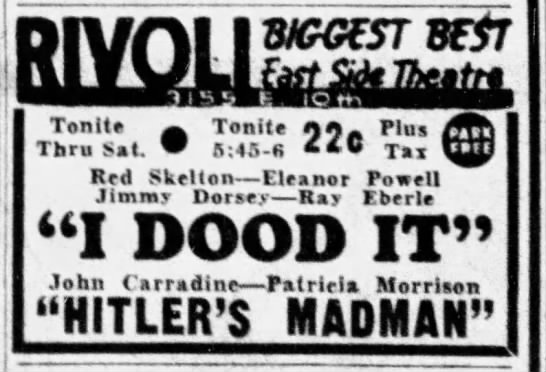
Before are a couple of more newspaper ads from 1943. I confess I was amused that the very serious, somber "Hitler's Madman" was paired in a double-feature with the Red Skelton comedy, "I Dood It." I guess audiences came to laugh and cry.


-- Doug Gibson


Thursday, November 8, 2018

Dr. Terror's Gallery of Horrors -- Sixties anthology schlock


By Doug Gibson

Dr. Terror's Gallery of Horrors, 1966, Color, 82 minutes, American General Pictures. Directed by David L. Hewitt. Starring John Carradine, Lon Chaney Jr., Rochelle Hudson, Roger Gentry, Ron Doyle, Karen Joy, Vic Magee and Mitch Evans. Schlockmeter rating: Four stars out of 10.

This David Hewitt cheapie anthology of horror tales of questionable scariness is legendary for the panning it has received from critics of the genre. The critics are right; this a poor film, with an incredibly low budget. For the entire five tales, I counted only two sound stages. In one case, to save money I suppose, a sound stage was darkened in an unsuccesful effort to make it appear to be a London slum.

Dr. Terror's Gallery of Horrors was essentially an attempt to cash in on the horror anthology craze of the mid 1960s; two better films of that genre that come to mind are Dr. Terror's House of Horrors and Black Sabbath. According to reviewer Tom Weaver in Cult Movies 17, Gallery of Horrors was shot for either $60,000 (that seems too high) or $20,000, or even $15,000! The narrator for the five tales is the ubiquitious John Carradine. He stands in front of (I kid you not) a rigid screen mat of a castle and shoreline. The mat only takes up half the screen, so the producers filled the other half with a blue background.

The acting, except for Carradine, is atrocious from all the performers, including, unfortunately, Chaney Jr. Actress Karen Joy is at least beautiful. And former '30s starlet Rochelle Hudson adds a little acting heft to one story. The tales are poorly developed. Reviewer John Stanley in Creature Features Movie Guide Strikes Again described the tales as the "scrapings of the horror barrel." There are "twist endings" but the lazy screenwriting (or perhaps it's the low budget) never allow the "payoff climax" to develop. A viewer will wait for the telegraphed twist at the end but just as it starts, the segment ends without exploring the consequences of the plot.

Like any low-budget poverty issue, the film is full of stock footage. According to Weaver's review, stock footage of castles and background music was lifted from the popular Edgar Allen Poe films of that era and other American International pictures. The special effects are laughable. Animated blood sweeps over the screen clumsily in an effort to end segments, and "fires" dance around stock footage of castles.

None of the five tales is particularly interesting, but some are less mediocre than others. The first concerns a couple (Gentry and Joy) who buy an old house in Salem. They find an old, supposedly 17th century clock (that type of clock did not exist in that era), re-set it, and an old man (Carradine, in the film's best performance, which isn't saying much)appears. He asks for an old family. The husband learns the family contained a witch (who never appears on screen by the way), and that Carradine and the witch are likely back from the dead because the haunted clock was re-started. The husband stops the clock, and Carradine burns up. The twist ending has another couple buying the house, setting the clock, and "presto," Carradine reappears.

The second tale is the worst. It concerns a vampire-like creature marauding London slum residents in the 18th century. The twist ending is embarrassing. The third tale may be the best. It had potential. A cuckolded living dead zombie doctor, murdered by his wife (Hudson) and corrupt colleague, returns with his faithful servant to exact revenge. Again, the low budget destroys any potential for surprise, and there is a laughably long far away stock shot of a carriage racing to the doctor's castle that seems to go on forever.

The fourth tale stars Lon Chaney Jr, as a former colleague of Dr. Frankenstein. Chaney's character is now a respected medical professor. With the help of two students, he resurrects a murderer. It's sad to watch the bloated semi-drunk, elderly Chaney stumble through his role. As Weaver points out, Chaney neither looks nor acts like a doctor and should have played the revived corpse (played by Vic Magee). Also, though it seems a colleague of Dr. Baron Von Frankenstein would be living in the 19th century, Chaney's character checks his wristwatch and answers a ringing 1960s-model phone in this episode.

The final episode is a poor twist on the Dracula legend that ends with Jonathan Harker (Gentry) turning into a werewolf and turning on Count Alucard, played by Mitch Evans, hands-down the worst Dracula in screen history. Despite the poor quality of Dr. Terror's House of Horrors, it's worth a rental if it can be found. It's an example of the kind of low-budget, harmless, sometimes fun schlock that played drive-ins and on Chiller Theater on TV in the 1960s and 1970s.

Notes: According to Weaver, Carradine received $3,000 and Chaney Jr. $1,500. Also, Weaver said Carradine was supposed to play Count Alucard, but had to leave to fulfill another acting commitment. Gallery of Horrors was the last speaking role Chaney Jr. had. Like many low-budget films, the film had many titles. Others include The Blood Suckers, Gallery of Horrors, Return From the Past (it's TV title) and even Alien Massacre! In 1981 it was released to video as Gallery of Horror by Academy Home Entertainment. How disappointed many teens must have been after renting this "unrated" title with a misleading cover, thinking it was a very gory horror flick, and discovering a hokey, tame unscary G-rated film! Today the film can be purchased at various online outlets.

Friday, March 17, 2017

Doctor Dracula, another Al Adamson two-movie composite


Review by Doug Gibson

I mentioned "Doctor Dracula" in an earlier post. It's not much of a film and merits its very low rating on IMDB.com.

What makes the film marginally interesting is one, it's directed by schlock auteur, the late Al Adamson, two it's likely the only film in which Dracula meets Svengali, three, it has John Carradine (although what trashy '70s film doesn't) and four, it's another example of Adamson practicing film composites, in which he takes two thin films to make an even thinner film.

Adamson and his partner Sam Sherman got their hands on an unreleased film called "Lucifer's Women." They shot a vampire tale to mix with it and managed to get a few actors from the earlier film to create a plot that is deliciously nonsensical in the Adamson tradition.

The film commences with a vampire killing a woman who welcomes his bite. We then switch to an author and mystic named Wainwright (Larry Hankin) lecturing and hypnotizing an audience. He has a book about Svengali. In the audience is Carradine's character and a doctor, Gregorio, (Geoffrey Land) who is openly derisive of Wainwright.


Also in attendance is the daughter, Stephanie, of the woman slain in the opening scene. She's played by actress Susie Ewing, best known as the trucker "Hot Pants" in the film "Smokey and the Bandit."

Stephanie is desperate to find out why her mom died. She consults Wainwright but he's not helpful. She receives greater assistance from Gregorio but his help comes with a bite; more on that.

We also kick to dull scenes in a nightclub where a beautiful singer named Trilby (get it) is performing. Wainwright is falling in love with her. That's because he is turning into the reincarnation of Svengali. There's a whole cult of people, including Carradine, who worship the devil and are involved in the Svengali resurrection. Wainwright/Svengali doesn't want to kill Trilby but the devil cult has a more powerful pull on him and she eventually is readied to be sacrificed. More later.

Meanwhile, Gregorio is -- big surprise -- really Count Dracula. Occasionally he kills women including a somewhat amusing scene where he gives the bite to a tipsy floozy who loves being in a coffin, played by Adamson's wife, Regina Carroll.

In what is probably the sole scene that provides any chills, Gregorio/Dracula produces the undead mother of Stephanie. She has no human qualities left, and openly scorns her daughter.

Dracula has similar plans for Stephanie, and he begins a slow process of controlling her. She may have something to say or do about that later; more on that.

Eventually, the film leads to the sacrifice of Trilby, played by Jane Brunel-Cohen. She may be the worst actress I've seen in a film. Even as she's about to die, she's incapable of conveying emotion.

Dracula crashes the sacrifice and viewers expecting a battle royal between the bloodsucker and the Svengali cult will be disappointed. Spoiler alert: Dracula wins with barely an effort. Land, by the way, is not too bad as Dracula. He's far better than Zandor Vorkoff in "Dracula Versus Frankenstein" or Mitch Evans in "Gallery of Horrors."

There is an abrupt, mildly surprising ending involving Stephanie and Dracula that I won't give away in case you want to see the flick. I recommend it only to Adamson completists and fans of composite films, of which Adamson made several,

The history of the film is interesting. It was made in the late 1970s, in which Adamson's Independent International, and other indie schlock producers, were being moved out of the business. Bigger studios were either making their own shockers or buying better-produced low budget shockers and tidying them up for major releases.

To my knowledge, "Doctor Dracula" was only released to television, which may explain why it's very tame, with virtually no nudity. Rumor has it that it played VHS with Adamson's "Horror of the Blood Monsters" and it got a sole DVD release in 2002. The DVD has the trailer for "Lucifer's Women." A better idea would be for Sam Sherman to apply the entire Paul Aratow-directed film, Lucifer's Women," (if it still exists) as an extra to the DVD.