Translate

Showing posts with label World War II. Show all posts

Saturday, January 7, 2023

Hitler's Madman a film that rallied Allied audiences in 1943


I love old newspaper clippings, and again kudos to my friend, David Grudt, of Long Beach, Calif., for locating several clips for the John Carradine-starring "Hitler's Madman," 1943, which detailed the assassination of Nazi sadist/mass murderer Reinhard Heydrich, and the subsequent mass retaliation murder within the Czech town of Lidice. The above review was penned by The New York Daily News Wanda Hale, who was a founder of the New York Film Critics Association. Hale spent roughly 40 years reviewing films for the Daily News, retiring in the early 1970s.


"Hitler's Madman" (see a newspaper-published still below) was filmed as a poverty-row effort by Producers Releasing Corporation, but had enough mojo to garner a planned release by a bigger poverty-row producer, Republic Pictures. However, its fortunes leaped when the head honchos at major-studio MGM were impressed enough to take over final production. MGM also added a few scenes, one where Carradine's Heydrich is inspecting young Czech teen girls for use in a forced brothel. One of the teens in that scene is a very young, just-under-contract Ava Gardner.


Carradine is great in this role. You really hate him in a role in which he is playing the personifaction of pure evil. The details within the tale of Heydrich's assassination and the massacre of Lidice are liberally fictionalized, but it's excellent patriotic somber entertainment for wartime morale. Two lovers are reunited, one working as an agent against the Nazis. He recruits his lover and tries to persuade others to rebel. Townspeople are split between secret rebels, those who loathe the Nazis but discourage rebellion and a few Nazi-favoring quislings who include the mayor. The Nazis' main use for Lidice is to harvest male soldiers to die at the front and force women into brothels for Nazi soldiers. After Heydrich casually murders townspeople blocking his roadwayway during a town event, a plot develops against his life. He is ambushed and badly wounded.


Heydrich dies a slow agonizing death. Before he dies, he is visited by Heinrich Himmler, who clearly is more or less unconcerned, and offers bland platitudes about dying for Germany. Before his death, Heydrich, unable to deal with his mortality and in agony, refuses to die for Hitler and says that the war is probably lost for the Nazis. In his report to Hitler, Himmler assures the fuhrer that Heydrich died praising the Third Reich. It's a very strong scene, underscoring the banality of death and its ultimate insignificance for the evil.


Himmler orders the town destroyed and many of its males killed. The famous poem, The Murder of Lidice, bookends the film. It is recited at the beginning and the end. The film ends very strongly with the ghosts of the Lidice massacre walking through the streets, murdered in body but not conquered in spirit.


I imagine this film inspired a lot of audiences during World War II. It is very well made. Besides Carradine, stars include Alan Curtis and Patricia Morison, and Ralph Morgan. It is directed by future A-director Douglas Sirk. It was Sirk's first film after he escaped from Nazi Germany.


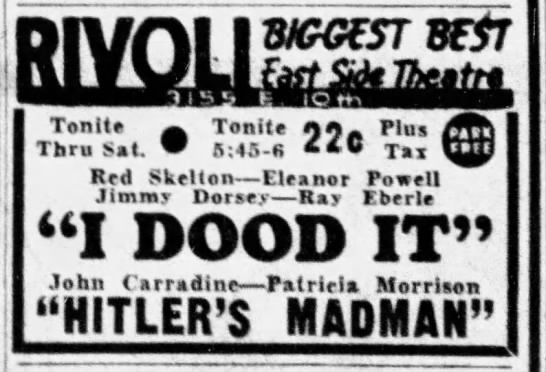
Before are a couple of more newspaper ads from 1943. I confess I was amused that the very serious, somber "Hitler's Madman" was paired in a double-feature with the Red Skelton comedy, "I Dood It." I guess audiences came to laugh and cry.


-- Doug Gibson


Saturday, November 14, 2020

Bela Lugosi Monogram film Black Dragons looked through the clipping services time capsule


Cult film fans, here is "Black Dragons," the Bela Lugosi-starring Monogram film released mere months after Pearl Harbor in 1942. Poverty-row studios were quick to capitalize on the new World War, and Lugosi's tale of a Nazi plastic surgeon gaining revenge on Japanese members of the Black Dragons turned into U.S. industrialists determined to destroy Uncle Sam's economy was as endearingly patriotic, and wacky, as the dependable Monogram cheapie.

We love these films though. They are entertaining madness, always featuring a magnificent performance by Bela Lugosi, even when surrounded by pedestrian direction and acting, and writing that seems to have been written in one night, and then constantly changed every 15 minutes. Here's a link to a review I wrote of Black Dragons on the blog. There's a link to the film.

A snippet of the review: The plot is delightfully bizarre. Lugosi not only conducts plastic surgery on the Japanese agents, he lightens their skin and provides them accents, as well as hair and body shapes. All the industrialists who are now having doubles were killed off sans anyone knowing, even their families! Once Lugosi's character is tossed into a Japanese cell, which appears to be all stone, he somehow is able to conduct perfect plastic surgery -- from his bag -- on another prisoner!

Back to the blog. Myself and my friend David Grudt have been going through separate clipping services, trying to create time capsule looks at classic cult films, how they were promoted through newspapers of the times, the smaller the towns and cities the better. We found a surprising amount of clips regarding Black Dragons; perhaps that is due to its World War II storyline. Enjoy these clips, whether ads, mentions or reviews. When there is not a date or newspaper attached to the graphic, we'll provide the information.

And do yourself a favor -- watch Black Dragons. It's a lot of semi-coherent fun. Get you magnifying glass for the Jimmie Fidler in Hollywood column. Black Dragons is mentioned 7 lines before the end of the second paragraph in column two. Below that we were thrilled to find an actual review in the Alabama paper, although it's probably from the movie's press packet.


In the below Movieland, Its People and Products column hed, in the March 17, 1942 Appleton, Wisc., Post Crescent, the next graphic, part of the column, mentions "Black Dragons."


AND HERE ARE A COUPLE MORE REVIEWS, we were thrilled to find them published, from Detroit and Cumberland, Md. Detroit is a little tough to read. 


Finally, one more ad we culled, from the aforementioned Appleton, Wisc. Post Crescent, June 5, 1942. 


Friday, January 5, 2018

Invisible Agent mixes World War II, Nazis and patriotism


By Doug Gibson

How many of you have heard of "The Invisible Man," the one starring Claude Rains from Universal in 1933? Probably a healthy percentage. It's a legitimate classic, with Rains, then an unknown, giving an intense, unforgettable performance as scientist Jack Griffin, turned insane by his invisibility formula.


Precious few likely recall "The Invisible Agent," one of four sequels to the Rains' original, which was also directed by James Whale, by far Universal's best horror director. However, the 1942 "Invisible Agent" was Universal's top-grossing sequel in the Invisible Man series. It was part of a long series of World War II-era patriotic, propaganda films that cast the Axis, mostly Germany and Japan, as the baddies to be defeated by tough Allies.

Playing a Nazi and a Japanese follower of Toho are respectively, Sir Cedric Hardwicke and Peter Lorre, and both are very good in their roles, particularly Lorre. The veteran actor is very sinister and menacing. In a particularly strong horror scene, he disembowels Hardwicke with a knife and then kills himself with the knife, because both men failed in their duty.

The hero of the movie is two-fisted everyman Jon Hall, playing the grandson of Raines' character. Although working as a printer in the USA, Hardwicke and Lorre try to grab his invisibility formula. They fail. Hall goes straight to the U.S. military, eventually allowing the USA to use his formula if he can be the spy. He embarks on a very dangerous into Nazi Germany, battling Hardwicke, Lorre and others to grab a list of Axis spies in the U.S. 

While there, he matches wits with a beautiful double-agent spy, the truly gorgeous starlet Ilona Massey. Both are attracted to each other but Hall's character is never sure if Massey can be trusted.

All ends well in this pro-war effort film, which is quite exciting. Directed by Edwin L. Marin, it plays often as a tightly directed, higher quality "daredevil" serial-like movie, as Hall and the other good guys escape death on several occasions. Supporting cast includes veteran character actors J. Edward Bromberg, as a pompous Nazi officer, and Keye Luke as a Japanese surgeon.

There is one twist to this Invisible Man series film. Hall, particularly in scenes with Massey, swaths himself in cold cream, and shades and head covering, to present a very lifelike outline of himself. It's a bit too lifelike, though, as we can see his teeth and inside of his mouth. In one scene designed to show the cruelty of the Axis, actor Albert Bassermann, an Allied spy in Germany, is tortured by Nazis. When Hardwicke's character demands he sign a "release" form stating he was not mistreated, he displays his mangled, broken fingers, explaining he can't write due to the torture.

At 81 minutes, "Invisible Agent" is well worth the asking price. Amazon sells it as part of the Universal Invisible Man series. Watch the trailer below.

Sunday, March 13, 2016

Monogram mania - Revenge of the Zombies

By Doug Gibson

Revenge of the Zombies, Monogram, 1943, B and W, 61 minutes, directed by Steve Sekely, starring John Carradine as Dr. Max Heinrich von Altermann, Gale Storm as Jennifer Rand, Robert Lowery as Larry Adams, Bob Steele as U.S. double agent, Mauritz Hugo as Scott Warrington, Mantan Moreland as Jeff, Veda Ann Botg as Lila von Altermann and Barry Macollum as Dr. Harvey Keating. Schlock-meter rating: 6 out of 10.

Let me just first say that Revenge of the Zombies is a wretched film. It's a malformed puppy, as my co-blogger Steve Stones might say. It has poor acting, particularly by star Carradine, who sleepwalks through his role as the heavy. Its zombies are tamer than the commom housefly and there is a lot of forced comic relief that isn't too funny.

But nevertheless, I respect and enjoy this film. It's another example of the bizarre, wild, other-worldly plots that C-movie helmsters such as Monogram would throw at small-town theaters and big city matinees. Imagine David Lynch with a $100,000 budget (far more than this film, I'm sure) and slightly drugged actors and you have the feel of "Revenge of the Zombies."

The plot takes us to the backwoods swamps of Louisiana, in the middle of World War II, where Lila von Altermann (Borg), wife of Dr. Max Heinrich von Altermann (Carradine), has mysteriously died. Skeptical of the details of her death, Lila's brother, Scott (Hugo,) a local doctor (Macollum), and detective Larry Adams (Lowery) decide to investigate the death. They visit Dr. von Altermann and encounter few people other than his very attractive secretary, Jennifer Rand, (Storm), some wisecracking black kitchen staff, other black servants who are obviously zombies -- they walk with their hands stretched forward like Frankenstein's monster -- and, in a casket, seemingly dead, is Lila von Altermann.

For reasons that are generally unclear to any viewer, the visiting trio try to have detective Adams and brother Warrington switch roles, but the ploy is easily detected by Carradine's Dr. von Altermann. I haven't mentioned the very talented black comedy star Mantan Moreland. As Jeff, Detective's Adams' driver, he gets to sling jokes 10 times a minute, appear scared three times a minute and flirt with a pretty kitchen maid (Sybil Lewis). The problem, of course, is that Mantan was being forced to portray the ubiquitous racist scenario of the scared, wisecracking, child-like negro that many films of that era reveled in. Ironically, though, Moreland and the other black actors were likely included so the film could get bookings in the hundreds of theaters that catered to blacks. As mentioned, Moreland was a very talented actor and comedian who often rose above the demeaning roles he was given. He's particularly good in a 1940 Monogram film, King of the Zombies.

OK, here's where the film really gets Monogram-style weird: The visiting trio see Lila, who is clearly a zombie, walking around the secluded von Altermann mansion. Then, in the film's most bizarre scene, Carradine consults with a supposed Nazi agent and admits that he intentionally turned his wife and others into zombies to prove to the Nazis that he could create an army of zombies, who need no feeding and cannot be killed. to defeat the allies (And all you cult film fans thought Black Dragons was a bizarre WW2-era chiller!!) To prove his point, he shoots his dead wife twice, who does not flinch from her stance. However, undead Lila proves to still have a mind of her own, even as a zombie, and that causes her widower doctor some problems.

I won't give away the rest of the plot, but it never deviates from the twisted mind(s) of the poorly paid young writers who toiled at Monogram 60-plus years ago. As mentioned, I'm torn on this film. I love these old cheapies, and I can watch Revenge of the Zombies 10 times. But it's not one of the better poverty row chillers. Carradine is just awful as the villain. He seems dazed throughout and acts as if he is a socialite at a Manhattan party instead of a mad scientist. Storm, Lowery and Macollum are mediocre talents, although Storm later gained fame in the TV show My Little Margie. Former cowboy star Steele has a small, confusing role as a double agent. Borg, as the undead Lila, is the only creepy character in the film. She's tough and could easily lick the other, passive zombies in a fight. Moreland can deliver comedy relief well but he's saddled with a poor script and uninterested co-stars.

The difference between the 1940s Monogram and PRC's low-budget films and Universal's B-monster films were the tightness and disciplines of the Universal scripts and action. Films such as the Mummy series and the House of Dracula or Frankenstein were efficiently acted, to the point, concise, well-directed, lean-mean hour-long or so films. Monogram or PRC could not afford that talent. It's probable most poverty row scripts were hastily written in one draft. Films such as Revenge of the Zombies and even Bowery at Midnight, a much better film, take sudden twists that the films' ultra-low budgets cannot deal with. Invariably, audiences get confused. These C-films relied on the charisma of the star (Bela Lugosi, J. Carrol Naish, George Zucco, Carradine) to maintain interest and suspense. However, one plus for these cheap films is that the sets were always pretty spooky and Revenge of the Zombies is no exception.

But I'm glad Monogram and others made their films in such haphazard ways. If they had been ordinary programmers instead of the mysterious, jaw-dropping mishmashes they became, we wouldn't still be talking about these poverty row wonders, and I probably wouldn't have written this review.

Thursday, May 28, 2015

The time Bela Lugosi made a World War II propaganda film


By Doug Gibson

Black Dragons is probably Bela Lugosi's oddest C-movie cheapie, and let's face it, the competition is fierce. But, oh, how I love these old '40s gems. It's a Monogram film, made under its Banner Productions. I'm sure it played in LA and NYC street theaters and smaller cities and towns, perhaps paired with an East Side Kids flick?

But I digress: Black Dragons, 1942, directed by William Nigh, runs 69 B and W minutes and stars Lugosi as Dr. Melcher and Monsieur Colomb. He's a sinister guy who pops up just as a bunch of American industrialists are getting mysteriously bumped off. There is also pretty Joan Barclay as the niece of a Dr. Saunders (Robert Frazer), who is all mixed up in whatever is going on. It's also fun to see future Lone Ranger Clayton Moore as an FBI agent.

Now, we have mysterious deaths, we have Lugosi. It's all set to be a horror, right ... ahem, no. This is 1942, the U.S. is at war with the Axis, and Monogram head honcho Sam Katzman saw money to be made by creating a combination thriller/WW2 propaganda anti-Japanese film. So that's what Black Dragons is, and it makes the film an interesting historical curio piece. One has to appreciate Katzman's ability to mix patriotism with a quick buck! He had this film in the can and ready for theaters by late spring 1942. The film ends with a banner headline, "Jap spy ring smashed!" and a fade out of Old Glory, the American flag.

You see, these U.S. industrialists are Japanese spies, created through plastic surgery to look like the American industrialists. Lugosi was the Nazi surgeon who did all this in Japan ... and then was doublecrossed and thrown in prison. Somehow -- the film sort of glosses over this -- Lugosi escaped Japan and headed to the U.S. to get his revenge on the spies. The plot is delightfully bizarre. Lugosi not only conducts plastic surgery on the Japanese agents, he lightens their skin and provides them accents, as well as hair and body shapes. All the industrialists who are now having doubles were killed off sans anyone knowing, even their families! Once Lugosi's character is tossed into a Japanese cell, which appears to be all stone, he somehow is able to conduct perfect plastic surgery -- from his bag -- on another prisoner!

As I mentioned, I love these time-capsule films. Monogram was famous for its bizarre intricate plots that its ultra-low budgets just could never keep up with. They dissolve into fun nonsensical action. Lugosi is Lugosi in this film. He's wonderful, whether he's coyly flirting with starlet Barclay or cleverly and calmly dispatching his victims. And there's also that wonderful, ubiquitous menacing, Monogram music. As Lugosi biographer Arthur Lennig notes, this was the last film in which Lugosi (in his early 60s) was considered attractive to a young lovely. Barclay does flirt rather unabashedly with Bela. Also, Robert Frazer, who co-starred with Lugosi in the classic "White Zombie," is in this film.

The boom of video and DVD plus public domain has made Black Dragons, once rather obscure, easy to find. It's often in the $1 DVD bin at Wal-Mart or in the 20- to 50-set public domain offerings. Those with broadband Internet can watch it free on the Net. Buy it and enjoy an hour-plus diversion into a different filmmaking existence. I love the opening sequence, where fat, bloated and old Washington pols, lobbyists and businessmen are partying with lots of liquor, cigars and blonde babes. Some things never change.

Monday, January 5, 2015

'Invisible Agent' was a patriotic film success in 1942


By Doug Gibson

How many of you have heard of "The Invisible Man," the one starring Claude Rains from Universal in 1933? Probably a healthy percentage. It's a legitimate classic, with Rains, then an unknown, giving an intense, unforgettable performance as scientist Jack Griffin, turned insane by his invisibility formula.


Precious few likely recall "The Invisible Agent," one of four sequels to the Rains' original, which was also directed by James Whale, by far Universal's best horror director. However, the 1942 "Invisible Agent" was Universal's top-grossing sequel in the Invisible Man series. It was part of a long series of World War II-era patriotic, propaganda films that cast the Axis, mostly Germany and Japan, as the baddies to be defeated by tough Allies.

Playing a Nazi and a Japanese follower of Toho are respectively, Sir Cedric Hardwicke and Peter Lorre, and both are very good in their roles, particularly Lorre. The veteran actor is very sinister and menacing. In a particularly strong horror scene, he disembowels Hardwicke with a knife and then kills himself with the knife, because both men failed in their duty.

The hero of the movie is two-fisted everyman Jon Hall, playing the grandson of Raines' character. Although working as a printer in the USA, Hardwicke and Lorre try to grab his invisibility formula. They fail. Hall goes straight to the U.S. military, eventually allowing the USA to use his formula if he can be the spy. He embarks on a very dangerous into Nazi Germany, battling Hardwicke, Lorre and others to grab a list of Axis spies in the U.S. 

While there, he matches wits with a beautiful double-agent spy, the truly gorgeous starlet Ilona Massey. Both are attracted to each other but Hall's character is never sure if Massey can be trusted.

All ends well in this pro-war effort film, which is quite exciting. Directed by Edwin L. Marin, it plays often as a tightly directed, higher quality "daredevil" serial-like movie, as Hall and the other good guys escape death on several occasions. Supporting cast includes veteran character actors J. Edward Bromberg, as a pompous Nazi officer, and Keye Luke as a Japanese surgeon.

There is one twist to this Invisible Man series film. Hall, particularly in scenes with Massey, swaths himself in cold cream, and shades and head covering, to present a very lifelike outline of himself. It's a bit too lifelike, though, as we can see his teeth and inside of his mouth. In one scene designed to show the cruelty of the Axis, actor Albert Bassermann, an Allied spy in Germany, is tortured by Nazis. When Hardwicke's character demands he sign a "release" form stating he was not mistreated, he displays his mangled, broken fingers, explaining he can't write due to the torture.

At 81 minutes, "Invisible Agent" is well worth the asking price. Amazon sells it as part of the Universal Invisible Man series. Watch the trailer below.