
Review by Doug Gibson
The Phynx, 1970, from Warner Brothers, is a cult film, albeit with a very tiny cult. It is both jaw-droppingly bad and completely-bizarre unique. I've watched it five times and it's progressed from a total disaster to hey, there's a little bit of fun here. This film had a smidgen of potential to be an extended Laugh In-type gem parody. But it was made by big-studio executives, who had their own idea of how to interpret and capture the youth enthusiasm of the '60s. It was fated to bomb.
Super secret United States intelligence professionals are trying to rescue a lot of aging celebrities and stars who have been kidnapped by Albania. Their efforts, helmed by a Waylon Smithers-type agent named Corrigan, have been failures.
So, Corrigan's superior, named Bogey, played by Michael Kellin, who has the worst Humphrey Bogart accent you'll ever hear, gathers a confab of all the U.S. secret agents. There are Boy Scout agents, prostitute agents, Ku Klux Klan agents, you get the idea. There's also the big leader, the president, who wears a box over his head. He's played by Rich Little.
Eventually it's decided to consult a machine called MOTHA. It is, forced laughter, shaped like a woman. Asked for a solution, its computer mind bubbles in her two metallic breasts and the answer, on a slip of paper, shoots out of MOTHA's ... ahem ... middle section. This is not a subtle movie.
The answer is to form a rock group called The Phynx, and both prepare these four band mates to be the most popular singing group in the world and highly trained agents able to rescue the hostages in Albania.
So four ordinary 60s young guys are kidnapped and taken to a military base where Bogey tells them the situation. One of their trainers is a young Richard Pryor.
To mercifully move this ahead, the Phynx become the number one rock group in the world, despite really terrible songs. I don't think the filmmakers intended for the band to stink, they just do. Some of the ways the Phynx get to the top involve infiltrating record stores, putting a gun to Milton Berle's head (another cameo) and having the president change Thanksgiving to Phynxsgiving (I'm not making that up). Through mass marketing and publicity, they've also made the four singers sex symbols.

The captives cum secret agents also get military training. In one unfunny sequence, a military instructor blows himself up.
The boys start to grumble about lack of female intimacy. So they are allowed an orgy, with Bogey uttering these unforgettable words, "Gentlemen, the United States government is pleased to announce an orgy!" ... It's pretty tame, lots of flesh covered by bikinis, somewhere between PG and PG-13. The Phynx was rated GP. I remember GP. It was below R, an ugly malformed cousin to what would morph into PG a decade-plus later.
There is a creepy, not-good scene after the "orgy" where Corrigan (who plays the sexually frustrated one in this film) picking up the orgy women with a --- I am not making this up -- forklift and dumping them outside the orgy warehouse. The women appear to be sleeping or unconscious.
Meanwhile, there are still more celebrity kidnapping to Albania, with news reports. The Phynx is big on news reports, and montages with dippy doo-dwop music inappropriate for the late 1960s. Finally, the four members of The Phynx are ready for their mission. But they do not exactly know where to go in Albania.
In a staggeringly unfunny scene, a female secret agent (played by Martha Raye) arrives to provide the information. But Bogey stupidly shoots her through a hotel door, mortally wounding her. Before she dies, she informs the quartet that a map -- in three parts -- is tattoed on the tummies of three girls.
So, through London and Copenhagen, the Phynx embarks of thousands of sexual (PG remember) encounters with women searching for the tatooed tummies. They find two, one tummy belongs to Russ Meyer starlet Susan Bernard. In France, the tired overcopulating Phynx are allowed to wear glasses that can see through exterior clothes. This leads to a few unfunny scenes with The Phynx leering, putting on glasses ... However, the glasses don't work when one tries to peek at a nun. But they find all three tummies, put the map together and head to Albania.
The Phynx are so globally popular they're actually welcomed to perform. Once there, they discover the communist dictator is not really the culprit. It's a military officer (played by Michael Ansara) who has gone a bit crazy. He has the only military tank, so he can assert his will and keep the hostages, and the president, his wife, and their very weird son at bay. The Phynx have dinner with the powerless first family. The first lady is played by Joan Blondell, a pre-code sexy star in the '30s. She had a long career beyond the '30s. Blondell is the only non-cameo star of this film who gives a good performance. She's bubbly, witty, and has good comic timing.
So, the Phynx are introduced to all the hostages taken by Albania. They enter a ballroom like it's the Academy Awards. You can read all of the names at the Wikipedia page. They include Dorothy Lamour, Xavier Cugar, Colonel Sanders, Rona Barrett (I remember her), Johnny Weismuller, Maureen O'Hara, Pat O'Brien, Leo Gorcey, Huntz Hall, former boxing champ Joe Louis, Dick Clark, Guy Lombardo, Busby Berkeley, Andy Devine, Butterfly McQueen (Prissy in Gone With the Wind), Ruby Keeler, Patsy Kelly, George Jessell, and more. It's almost like if Hollywood Squares multiplied 25 or so times.
The plot is mostly out the window, and The Phynx and captives think of ways to escape. I won't give it away, but they follow Huntz Hall's suggestion. Seeing Gorcey and Hall together is bittersweet, given their long association. Gorcey died before The Phynx was released.
The next morning the film's climax occurs. Watch it to see the end. It's a $2.99 rental at YouTube. It occasionally shows up on TCM, I believe first as a now-defunct TCM Underground offering. Warner Brothers finally released a DVD roughly a decade ago. Evidence of the film's tiny cult is that for decades fans/collectors would haunt trade shows or more shadowy sellers trying to buy bootleg copies of the film. For a long time, Warner Brothers just wanted to forget about this monetary disaster.
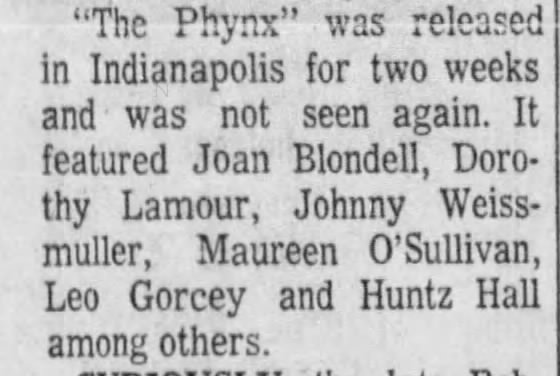
There was a small effort to promote The Phynx, although executives, who could watch dailies, rough cuts and previews, must have been aware the film was a turkey. My friend, David Grudt combed though newspaper archives and found the clips you see on this post, originally published in 1970 in the Indianapolis Star. The top clip promises a "world premiere" and mentions a "Rock and Roll Phynx contest." That must have been a big hit. (sarcasm intended) The second clip shows many of the guest stars and cameos in The Phynx. Poor Joe Louis gets his name misspelled.
So there was publicity for the film, an effort was made. It was all for naught. As then-UPI columnist Vernon notes in our final clip, "The Phynx was released in Indianapolis for two weeks and not seen again."
Despite its many faults, The Phynx, like any cult film, gets better the more you watch it. Despite being far more like Skidoo than Head, the film can bring the occasional smile.
NOTES: The best part of the film is when the has-been celebrities appear and we get to hear their banter. Some is witty. Pat O'Brien observes that if he had played the Gipper in Knute Rockne All-American, the 1940 classic, he'd be in Sacramento. That's a dated but funny gag as Ronald Reagan, who played The Gipper, was governor of California at the time. Reagan, of course, later became U.S. president. O'Brien played Rockne in the film. Another bittersweet funny gag is Joe Louis pointing out one advantage of being in Albania was there's no income tax. The joke has time-era relevance as Louis was hounded by tax authorities after his career for not paying taxes. Finally, maybe the best line is former Tarzan Johnny Weismuller turning to former Jane Maureen O'Sullivan, and saying, "Me Tarzan. You Jane." Despite the popularity of the quote, Weismuller never said that in a Tarzan film. The Phynx were played by A "Michael" Miller, Ray Chippeway, Dennis Larden, and Lonny Stevens. They are forgotten today. Only Larden had any marginal success singing, and it was before The Phynx. He was part of a group called Every Mother's Son that scored a hit with "Come on Down to My Boat." The group disbanded in 1968.


