Translate

Showing posts with label Warner Brothers. Show all posts

Sunday, January 21, 2024

The Phynx is a uniquely bizarre film from 1970 with a tiny cult


Review by Doug Gibson


The Phynx, 1970, from Warner Brothers, is a cult film, albeit with a very tiny cult. It is both jaw-droppingly bad and completely-bizarre unique. I've watched it five times and it's progressed from a total disaster to hey, there's a little bit of fun here. This film had a smidgen of potential to be an extended Laugh In-type gem parody. But it was made by big-studio executives, who had their own idea of how to interpret and capture the youth enthusiasm of the '60s. It was fated to bomb.


Super secret United States intelligence professionals are trying to rescue a lot of aging celebrities and stars who have been kidnapped by Albania. Their efforts, helmed by a Waylon Smithers-type agent named Corrigan, have been failures.


So, Corrigan's superior, named Bogey, played by Michael Kellin, who has the worst Humphrey Bogart accent you'll ever hear, gathers a confab of all the U.S. secret agents. There are Boy Scout agents, prostitute agents, Ku Klux Klan agents, you get the idea. There's also the big leader, the president, who wears a box over his head. He's played by Rich Little. 


Eventually it's decided to consult a machine called MOTHA. It is, forced laughter, shaped like a woman. Asked for a solution, its computer mind bubbles in her two metallic breasts and the answer, on a slip of paper, shoots out of MOTHA's ... ahem ... middle section. This is not a subtle movie.


The answer is to form a rock group called The Phynx, and both prepare these four band mates to be the most popular singing group in the world and highly trained agents able to rescue the hostages in Albania.


So four ordinary 60s young guys are kidnapped and taken to a military base where Bogey tells them the situation. One of their trainers is a young Richard Pryor.


To mercifully move this ahead, the Phynx become the number one rock group in the world, despite really terrible songs. I don't think the filmmakers intended for the band to stink, they just do. Some of the ways the Phynx get to the top involve infiltrating record stores, putting a gun to Milton Berle's head (another cameo) and having the president change Thanksgiving to Phynxsgiving (I'm not making that up). Through mass marketing and publicity, they've also made the four singers sex symbols. 


The captives cum secret agents also get military training. In one unfunny sequence, a military instructor blows himself up.


The boys start to grumble about lack of female intimacy. So they are allowed an orgy, with Bogey uttering these unforgettable words, "Gentlemen, the United States government is pleased to announce an orgy!" ... It's pretty tame, lots of flesh covered by bikinis, somewhere between PG and PG-13. The Phynx was rated GP. I remember GP. It was below R, an ugly malformed cousin to what would morph into PG a decade-plus later.


There is a creepy, not-good scene after the "orgy" where Corrigan (who plays the sexually frustrated one in this film) picking up the orgy women with a --- I am not making this up -- forklift and dumping them outside the orgy warehouse. The women appear to be sleeping or unconscious. 


Meanwhile, there are still more celebrity kidnapping to Albania, with news reports. The Phynx is big on news reports, and montages with dippy doo-dwop music inappropriate for the late 1960s. Finally, the four members of The Phynx are ready for their mission. But they do not exactly know where to go in Albania.


In a staggeringly unfunny scene, a female secret agent (played by Martha Raye) arrives to provide the information. But Bogey stupidly shoots her through a hotel door, mortally wounding her. Before she dies, she informs the quartet that a map -- in three parts -- is tattoed on the tummies of three girls.


So, through London and Copenhagen, the Phynx embarks of thousands of sexual (PG remember) encounters with women searching for the tatooed tummies. They find two, one tummy belongs to Russ Meyer starlet Susan Bernard. In France, the tired overcopulating Phynx are allowed to wear glasses that can see through exterior clothes. This leads to a few unfunny scenes with The Phynx leering, putting on glasses ... However, the glasses don't work when one tries to peek at a nun. But they find all three tummies, put the map together and head to Albania.


The Phynx are so globally popular they're actually welcomed to perform. Once there, they discover the communist dictator is not really the culprit. It's a military officer (played by Michael Ansara) who has gone a bit crazy. He has the only military tank, so he can assert his will and keep the hostages, and the president, his wife, and their very weird son at bay. The Phynx have dinner with the powerless first family. The first lady is played by Joan Blondell, a pre-code sexy star in the '30s. She had a long career beyond the '30s. Blondell is the only non-cameo star of this film who gives a good performance. She's bubbly, witty, and has good comic timing.


So, the Phynx are introduced to all the hostages taken by Albania. They enter a ballroom like it's the Academy Awards. You can read all of the names at the Wikipedia page. They include Dorothy Lamour, Xavier Cugar, Colonel Sanders, Rona Barrett (I remember her), Johnny Weismuller, Maureen O'Hara, Pat O'Brien, Leo Gorcey, Huntz Hall, former boxing champ Joe Louis, Dick Clark, Guy Lombardo, Busby Berkeley, Andy Devine, Butterfly McQueen (Prissy in Gone With the Wind), Ruby Keeler, Patsy Kelly, George Jessell, and more. It's almost like if Hollywood Squares multiplied 25 or so times.


The plot is mostly out the window, and The Phynx and captives think of ways to escape. I won't give it away, but they follow Huntz Hall's suggestion. Seeing Gorcey and Hall together is bittersweet, given their long association. Gorcey died before The Phynx was released.


The next morning the film's climax occurs. Watch it to see the end. It's a $2.99 rental at YouTube. It occasionally shows up on TCM, I believe first as a now-defunct TCM Underground offering. Warner Brothers finally released a DVD roughly a decade ago. Evidence of the film's tiny cult is that for decades fans/collectors would haunt trade shows or more shadowy sellers trying to buy bootleg copies of the film. For a long time, Warner Brothers just wanted to forget about this monetary disaster.


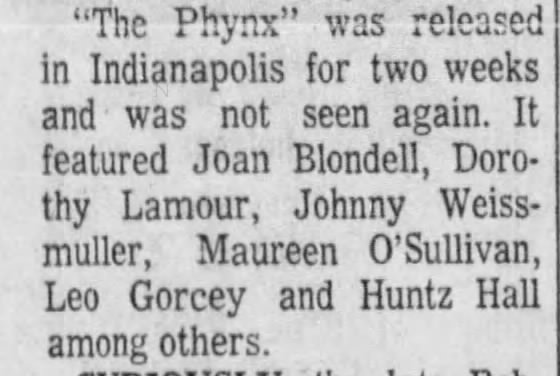
There was a small effort to promote The Phynx, although executives, who could watch dailies, rough cuts and previews, must have been aware the film was a turkey. My friend, David Grudt combed though newspaper archives and found the clips you see on this post, originally published in 1970 in the Indianapolis Star. The top clip promises a "world premiere" and mentions a "Rock and Roll Phynx contest." That must have been a big hit. (sarcasm intended) The second clip shows many of the guest stars and cameos in The Phynx. Poor Joe Louis gets his name misspelled.


So there was publicity for the film, an effort was made. It was all for naught. As then-UPI columnist Vernon notes in our final clip, "The Phynx was released in Indianapolis for two weeks and not seen again."


Despite its many faults, The Phynx, like any cult film, gets better the more you watch it. Despite being far more like Skidoo than Head, the film can bring the occasional smile.


NOTES: The best part of the film is when the has-been celebrities appear and we get to hear their banter. Some is witty. Pat O'Brien observes that if he had played the Gipper in Knute Rockne All-American, the 1940 classic, he'd be in Sacramento. That's a dated but funny gag as Ronald Reagan, who played The Gipper, was governor of California at the time. Reagan, of course, later became U.S. president. O'Brien played Rockne in the film. Another bittersweet funny gag is Joe Louis pointing out one advantage of being in Albania was there's no income tax. The joke has time-era relevance as Louis was hounded by tax authorities after his career for not paying taxes. Finally, maybe the best line is former Tarzan Johnny Weismuller turning to former Jane Maureen O'Sullivan, and saying, "Me Tarzan. You Jane." Despite the popularity of the quote, Weismuller never said that in a Tarzan film. The Phynx were played by A "Michael" Miller, Ray Chippeway, Dennis Larden, and Lonny Stevens. They are forgotten today. Only Larden had any marginal success singing, and it was before The Phynx. He was part of a group called Every Mother's Son that scored a hit with "Come on Down to My Boat." The group disbanded in 1968.


Saturday, May 27, 2023

Review: Warner Bros. 100 Years of Storytelling


Readers of the Plan9Crunch blog may have realized that TCM has of late been showing a lot of Warner Bros. films. It's because the iconic film studio is realizing its centennial.


On May 30, 2023, the volume Warner Bros. 100 Years of Storytelling (2023, Running Press, NYC), will be for sale. Written by Mark A. Viera, it's mostly a compendium of photos and awards Warner Bros. appropriately boasts of each year of the century. Although a Kindle version is available for reading on the go, this 360-page, exhaustively researched tome is at its heart a "coffee-table" book. It's best suited for interested parties to glance at the many illustrations, or for a film buff to sit in his or her easy chair and read a chapter on the 20s, 30s, 40s, 50s, 60s, 70s, and so on. 


Viera does a good, pithy job recapping the changes and evolving styles of the decades and how the studio reacted to the mores. I particularly liked his essay on the '70s, described as "The Era of the Auteur,." It talks of the young directors, inspired and emboldened to explore through film sexuality, race relations, politics and other controversial issues.


Although it's brief, TCM's Ben Mankiewicz provides an interesting forward in which he discusses being regarded as part of "Hollywood royalty" by virtue of his name. He notes that long ago, beginning in the pre-code era, Warner Bros, explored controversial topics, such as the plight of veterans in the film "Gold Diggers of 1933," and prison conditions in the film "I am a Fugitive From a Chain Gang." 


The book is moderately pricey but worth a buy, particularly for film buffs. You can leaf through it for hours, enjoying Viera's recaps, the photos of the films produced, and the Oscars tally sheets for each year.


-- Doug Gibson

Sunday, October 30, 2022

Doctor X a wonderful choice for a gripping, grisly pre-code scare film


---

Review by Doug Gibson


As it's almost Halloween, I want to pitch a pre-code thriller that's perfect for the spooky season, or any time of the year when you want some great vintage horror.


"Doctor X," 1932, Warner Brothers/First National, is a gem. One of famed Hungarian director Michael Curtiz' three '30s horror films -- the others are "Mystery of the Wax Museum" and "The Walking Dead" -- it's a two-tone color tale of grisly sadistic murders roiling a city. Through investigation, police believe that the murders are occuring at or near the home of a prominent scientist, played by Lionel Atwill. His daughter is played by Fay Wray.


Lee Tracy steals the movie playing a part he excelled at, that of a rogue reporter with questionable scruples but an overdose of aw-shucks charm that allows him to survive uncomfortable situations. Eager to scoop his press competitors on the murders, he hucksters and charms into Atwill's home. After meeting his daughter played by Wray, he has two motivations: getting the story on the murders, and romancing the beautiful daughter.


This is a very pre-code film. It's grisly at times. And the climac is gripping as Atwill gathers all the researchers in his home/laboratory to try to discover the mass murderer. I'll only tease readers with the phrase ... "SYNTHETIC FLESH."


Despite the gory goings-ons, there is also a maid, played by Leila Bennett, a popular comic actress of the time, who provides some light moments which do not clash with the serious story. I highly recommend readers purchase a beautiful recent Blu-Ray release. The film was a big hit in Depression-era 1932, grossing almost $600,000 against a budget of $224,000. That is akin to spending roughly $4.852 million today and getting a return of just under $13 million.


--


Below are newspaper clippings from the time "Doctor X" was released. They were gathered by my friend David Grudt, a film and media history buff who lives in Long Beach, Calif. I particularly appreciate David unearthing the film review below from the Hollywood Citizen News, Thursday, June 2, 1932. Then there's a blurb from Monday, Oct. 24, 1932, where "Doctor X" played on a double bill at the Fox La Brea Theater with the Marx Brothers comedy "Horsefeathers"! Finally, there is an ad for "Doctor X" from Saturday, Sept. 24, 1932, at two theaters. The 25-cent price is about $5.50 today.


---


Thursday, September 16, 2021

Barbara Payton: A Life in Pictures charts the rise and fall of a Hollywood star


The late actress Barbara Payton was beautiful, and she possessed screen presence. Her most notable film is "Kiss Tomorrow Goodbye," with James Cagney. 

Both Universal and particularly Warner Bros., prepped her with the anticipation for stardom. Ultimately, her story was tragic. She died mostly forgotten in the late 1960s, depressed; her body broken by alcoholism, and other abusive behaviors.

Her biographer, John O'Dowd, has published an amazing work. "Barbara Payton: A Life in Pictures," BearManor Media, 2018, Albany, Ga. (Amazon link is here). Through an introduction and afterword, with 34 chapters in between, it provides arcs of both her 39 years of life and her tenure as an entertainer. (Below, is a picture of Payton radiating girl-next-door beauty).

The book charts her biography, a girl from flyover country who attracted attention from the entertainment industry once she arrived in Hollywood with her husband. Universal soon beckoned and she starred in some now-forgotten shorts with a singing cowboy. She also made the publicity rounds.

The family photos from the '30s and '40s are extremely interesting and it's a credit to O'Dowd that he tracked them down. The author admits in the introduction that his goal is to convey that his subject Payton -- who was trashed repeatedly during her life and beyond -- was a "kind and empathetic" person. He notes that her decline and eventual fall into a personal hell was likely the result of a lack of awareness of the gravity of her situations. 

Universal dropped her, largely due to rumors of an affair with superstar Bob Hope. Reading the book, one can't ignore the irony of a woman (Payton) being harshly sanctioned for an affair, but the more powerful man involved, Hope, skating through it unscathed. 

Her end at Universal started a trajectory of a few years where Payton hopscotched between bigger studios (Warner Bros and semi-big RKO) to work, sometimes loaned out, at lower-tier studios (Eagle-Lion, Jack Broder, Lippert, Allied Artists). (Below is a scene of Barbara with Kiss Tomorrow Goodbye" star Cagney).


Payton's co-stars in films included Cagney, Gregory Peck, Lloyd Bridges, Guy Madison, Raymond Burr, Lon Chaney Jr., Steve Cochran, and even Sonny Tufts! She starred in one film that has a small cult following, "Bride of the Gorilla," with Burr and Chaney Jr.

The photos in the book provide a glossy history of Hollywood in that era. The glamorous photos, the publicity campaigns, the stars gathering at the hot spots with photographers, the scandal sheets of that era, which Barbara was in a lot, unwillingly, and unfortunately, later more willingly. The courtroom shots, the pictures at Barbara's house when she was wealthy. Accounts of her relationships with actors Franchet Tone and Tom Neal are covered via photos, as well as the aftermath of Tone's savage beating by Neal.

With her career damaged in Hollywood, Payton went to England to star in a couple of Hammer films. The pictures are poignant, because they show a time and place where Payton was treated as a major star -- for the last time. I wondered while leafing through the London photos, the stills from films, publicity shots, Payton interacting with Londoners, if perhaps she should have stayed there to pursue more work. But she was in a bad relationship with the toxic, violent Neal, and he soon joined her across the Atlantic. They returned home.

By this time, the bad press, and cruel taunting from most Hollywood press icons, kept her away from the big studios. She was with the usually unemployed Neal in a couple of films. Also, the book highlights an unsuccessful stage tour with Neal of "The Postman Always Rings Twice."

(Below is a photo of Barbara, with actor Paul Langton, in the final film she made, "Murder is My Beat," directed by low-budget auteur Edgar Ulmer.)


Neal eventually left. That was no loss but by the latter '50s, Payton's personal and professional setbacks were heavy. She lost custody of her son, John Lee Payton. She lost her home. She entered the scandal sheets again due to a bad check charge. 

In the later '50s it might be charitable to call her life bohemian, but desperately trying to stay afloat is more apt. It's claimed she lived in the same poverty apartment as cult figure Vampira. She was married for a while to a much younger man and lived a rustic life with her spouse in Mexico.

There are candid photos in the book that, as O'Dowd notes, capture tension, weariness, disappointment, pain in Payton's face. You can see her shock in the late '50s, when she calls a news conference to announce a comeback, and is derided by press hounds who bothered to come.

It underscores what O'Dowd mentions about an over-optimism, a desire to believe good in others, that provided a lack of awareness to Barbara of how her own dysfunctional behavior damaged her. Also, recollections in the book (and there are many) hint of a deep pride, or even a desire to punish herself, that prevented her from accepting or taking advantage of the few offers of help she received late in life. She was exploited a lot, including in a dreadful, exploitative "autobiography" of her life in 1963. O'Dowd's book appropriately includes this event. Included is a haunting photo of a stoned, eyes wide and glazed Barbara, dressed scantily, looking about 50 years old. It is shocking, and heart-wrenching.

(Below is a photo that reminds how beautiful Payton was in her heyday. The photos other than the cover were provided by author O'Dowd).


O'Dowd's 560-page book takes the reader through the very rough 1960s' life she endured. She died in 1967, in her parents' home. Pictures cannot accurately describe the hell the subject endured. For more details, one can read O'Dowd's excellent biography of Payton, "Kiss Tomorrow Goodbye," (Bearmanor Media). (Amazon link here) My Plan9Crunch review of it is here. Two Plan9Crunch interviews with O'Dowd regarding "Kiss Tomorrow Goodbye" are here and here.

O'Dowd's strength as a writer and an art compiler is that he makes you care about the subject. He gets beyond the surface news reporting and uncovers the layers that makes a human being. He has spoken to so many family members, friends, lovers, acquaintances, colleagues, and media about Payton. It's a Herculean task and it provides readers the opportunity to care about the subject, to grieve for her failings and dysfunctional, dangerous life.

O'Dowd is currently working with a screenwriter to bring Payton's life story to the screen, in theaters, TV, streaming. My preference would be a Netflix-type streaming series but a two-hour movie would be a treat as well. Getting to a film takes a long time but I suspect Payton's compelling life eventually becomes one. 

-- Review by Doug Gibson


Wednesday, March 29, 2017

Teenagers from Outer Space -- wooden-acted cult manna


By Steve D. Stones

If it wasn’t for the wooden acting and poor production values, the 1959 sci-fi film "Teenagers From Outer Space" could pass with flying colors as a well-made, entertaining piece of celluloid. The film was distributed by Warner Brothers, which seems a bit odd, considering most low budget sci-fi films of the 50s era could never get a major studio like Warner Brothers to fund or distribute their product. The film couldn’t be placed in the Ed Wood School of bad acting and film making because, from a technical stand-point, its cinematography is well done, and the actors seem to take their dialogue very seriously. Many have suggested that this film could be a blueprint for the Terminator films, since the plot is one long chase sequence.

A group of teenage aliens led by actor King Moody land their spaceship somewhere in the Hollywood hills to place a gargon creature from their planet to harvest for food. Gargons have to be raised a safe distance from their planet. The gargon showed on screen is nothing more than a lobster in a cage.

Gargons grow to a million times their original size. One teenager named Derek, played by David Love, insists that the gargon creatures not be placed on planet earth because he has found evidence of intelligent life in the form of a dog. The dog is blasted with a ray gun by Thor, one of the other teenage aliens. All the aliens in the ship wear overalls that look like an auto mechanic might be wearing.

Derek insists that gargons not be raised on earth as he threatens the rest of the alien crew with his ray gun. Derek escapes, and Thor is assigned to chase after him and bring him back to the ship. Derek finds his way to a Hollywood neighborhood where he lodges with an attractive young girl named Betty and her grandfather. Betty and her grandfather naively accept that Derek is dressed in a strange outfit, and carries no luggage with him.

The rest of the film is a long, drawn out chase between Thor and Derek. While hunting for Derek, Thor blasts a gas station attendant, a sexy girl in a swimming pool (what was he thinking?), a college professor and a couple of police detectives with a focusing disintegrator ray-gun. Thor stops at nothing to find Derek and bring him back to the spaceship. The ray gun shines a reflective ray as the actor points the front of it in direct sunlight.

In a clichéd subplot, Derek falls in love with Betty, played by Dawn Anderson. Eventually Derek has to tell Betty that he is not of this earth. She is not too concerned, and maintains her love for him. The two go scouting for Thor’s ray gun after he is thrown from a car in a chase.

As Derek and Betty search for the ray gun near Thor’s car crash, a giant rear projected lobster (i.e. a gargon) appears on screen to attack the couple. Derek conveniently finds Thor’s ray gun in a bush and blasts the rear projected lobster as it falls to the ground.

The entire film has a Leave It To Beaver, Ozzie and Harriet innocence to it that seems appropriate for the era. Some of the music used in the film can be heard in George Romero’s 1968 film – Night of The Living Dead, and Robert Clarke’s 1959 film – The Hideous Sun Demon. Director Tom Graeff cast himself as a newspaper reporter. Some accounts suggest that he cast David Love in the role of Derek because the two were gay lovers at the time. Neither of the two men went on to make a living in films in Hollywood. Scary Monsters Magazine #88 has devoted the issue to Teenagers From Outer Space, with interviews and articles about the film and surviving cast members and crew. The film is now in the public domain, and can be found in many DVD packs with other low-budget 1950s sci-fi titles. Happy Viewing.

Thursday, November 24, 2016

Sh! The Octopus - A Fun Lighthouse Mystery


By Steve D. Stones

This 1937 comedy-mystery feature produced by Warner Brothers is loosely based on a stage play known as The Gorilla, then later made as a 1930 talkie, and was then made into a comedy starring the Ritz brothers in 1939. In this version, an octopus is substituted for the gorilla role. The script has many miles on it from its various filmed versions. The film stars two great comedy veterans - Hugh Herbert and Allen Jenkins as bumbling police detectives. They provide great comic relief to the film.

A young artist named Paul Morgan, played by John Eldredge, purchases a secluded lighthouse so he can work in private on his marine paintings. Captain Cobb (Brandon Tynan) escorts Morgan into the lighthouse and tells him the place has not been occupied for over twenty years. Morgan finds evidence that this is not true. A soft, warm candle is on the table, indicating that someone has been there recently. A knock at the door reveals another local captain - Captain Hook, who is the only other person with keys to the lighthouse.

Meanwhile two police detectives, Kelly (Hugh Herbert ) and Dempsey (Allen Jenkins)  are traveling on the mainland by car in the pouring rain when a tire blows out. They stop to change the tire and are confronted by a screaming attractive woman named Vesta Vernoff (Marcia Ralston) soaked by the rain. Just before the tire blows out, a radio report in the car tells of an octopus sinking a ship. Vernoff tells of seeing her stepfather's corpse at the lighthouse and of an octopus that lives in the bottom of the lighthouse.

When Vernoff and detectives Kelly and Dempsey arrive at the lighthouse, a hanging corpse is discovered at the top of the lighthouse dripping blood on the table below. Kelly and Dempsey try to investigate, but discover that the stairs of the lighthouse have been removed. A secret panel opens in the wall, and the detectives find some stairs that lead to the hanging corpse. The corpse turns out to be a stuffed dummy with a bottle of ketchup dripping on the table below.

I won't spoil any more of the plot, but some of the fun elements of this film are of scenes of octopus tentacles reaching out from behind doors and a curtain. Somehow the octopus manages to get out of the water below the lighthouse and make it to the main level to reach out behind the doors and curtains to scare the main characters.

Another fun sequence shows a pair of Detective Kelly's shoes hopping around, which is later revealed to be toads inside the shoes. A turtle with a lighted candle on its back burns the seat of Kelly's pants as he is sitting in a chair. Kelly's scuba outfit fills up with water in another hilarious scene as Dempsey and Morgan try to deflate all the water out of the suit.

In March of 2008, Turner Classic Movies played this film on a double-feature with another octopus film - It Came From Beneath The Sea (1955). For further information about Sh! The Octopus, refer to Gary and Susan Svehla's entertaining book - Guilty Pleasures of The Horror Film, published by Midnight Marquee Press, Inc. in 1996.  Happy viewing.


Sunday, January 31, 2016

'A Soldier's Plaything' was a Harry Langdon feature in 1930


By Doug Gibson

One problem that film comic Harry Langdon had, throughout his entire sound career, was that his big-budget films with major studios bombed. The failure of the films were not Langdon’s fault, he performed well in all of them. And the films have gained in critical popularity in the 70 to 80 years after their release. Obviously, that’s little comfort to Langdon, who died 69 years ago. The one-time Sennett/First National silent star enjoyed his best success in the sound era as a comic lead in Hal Roach, Educational and Columbia shorts, and a few acting gigs in low-budget B films. Perhaps the best of these is “Misbehaving Husbands,” from Monogram. Nevertheless, his three A films, “A Soldier’s Plaything,” “Hallelujah, I’m a Bum,” and “Zenobia,” with Oliver Hardy, were all flops.

The film I’m reviewing today is “A Soldier’s Plaything,” from 1930, produced by Warner Brothers. It’s one of those very early talkies that blends comic routines with musical numbers. The film involves Harry (Tim) and co-star Ben Lyons (Georgie) as U.S. soldiers in Germany during the occupation after World War I. Georgie is the lady’s man who falls for a sexy German girl/woman Gretchen, (Lotti Loder). Harry has some excellent scenes, where he plays the “little elf” character he honed as a silent star very well. He also gets to sing a song, and does so very well. He’s not the focus of the film but he’s the funniest one in it. He easily outperforms -- in comedy -- a burly, yelling Noah Berry as Captain Plover, who constantly makes Harry and Ben shovel manure; that’s a running joke in the movie.

Ben’s Georgie, Harry’s soldier pal, is carrying a secret that harms his romance with Gretchen. He thinks he killed a violent gambler/gangster back home in the USA. That’s why he joined Tim as a WW1 recruit. Naturally, this causes some harm to his relationship with the German beauty. Worried that he’ll be arrested, he tells her he’ll come back and get her. Gretchen, who wants to go to the states with him immediately, is naturally skeptical. It looks like their romance is kaput, until an abrupt ending wraps up the plot neatly.

“Abrupt” is an excellent word to apply to this Michael Curtiz-directed film. It’s only 56 or 57 minutes, and is over before you know it. There seems to have been extreme editing in the film. Example: like old silent films, titles, rather than scenes, are used to move action along. Also, when Georgie’s major dilemma with Gretchen is resolved (he discovers the man he thought he killed is a fellow soldier) there’s no reconciliation scene with his girl. She’s just with him, all happy, in the next scene. According to movie books, there is a 73-minute version of this film (now lost) that played in Europe. It’d be nice if it was found one day.

According to genre books, Lotti Loder was a European beauty that Warner Brothers was planning to groom for stardom. It’s clear though, that by the finished release cut, studio execs had abandoned those plans during filming. Although beautiful, she does not have screen presence and seems just another supporting player in the film. There is one memorable -- pre-code -- scene of her with Lyons by a creek where she shows off a pair of very attractive legs, however. According to film books, she only made a few more films before leaving the industry.

Harry Langdon, as mentioned, is the best part of this film. He’s funny and demonstrates good comic timing. The film, due to editing, is a B film that cost A money. Depression-era audiences had other films with more depth to spend money on. Curtiz uses an interesting double-exposure technique when portraying life in the USA from persons describing it in Germany. I recommend this film, particularly if you are a Langdon fan and for those interested in the evolution of the earliest sound films. Watch Langdon sing in this film below!

Monday, April 13, 2015

Big Hearted Herbert is Guy Kibbee at his most grouchy


By Doug Gibson

"Big Hearted Herbert," 1934 black and white, directed by William Keighly, produced by Warner Brothers and released by Warner Brothers The Vitaphone Corp., 59 minutes. Starring Guy Kibbee as Herbert Kalness, Aline MacMahon as Elizabeth Kalness, Patricia Ellis as Alice Kalness and Phillip Reed as Andrew Goodrich. Schlock-meter rating: 6.5 out of 10,

I love Guy Kibbee movies; the man was made to play the middle-aged business man of the 1930s with a lot of bluster in sight and tenderness hidden; he stars in the only surviving film version of Sinclair Lewis’ homage to the conformist businessman, “Babbitt.” Often playing his wife in his Warner Brothers/Vitaphone films of the 1930s is Aline MacMahon,a  tall, angular actress who seems to get more attractive as the film goes on; she was often the ying to Kibbee’s yang.

“Big Hearted Herbert,” which I first watched thanks to Turner Classic Movies, is not the best programmer that Kibbee made with MacMahon, but it’s a perfect example of the domestic comedies that Kibbee could so effortlessly perform 80 years ago. He stars as Herbert Kalness, grouchy, long-winded successful plumbing supplies business who grouses constantly to his wife, Elizabeth, played by MacMahon, and three kids, Alice, Robert and Junior. Herbert practically worships a dour family photo of his late father that hangs, saint like, in the family home.

It’s obvious Elizabeth loves Herbert, because she has the patience of a saint with her husband, who is so worn out and stressed from hard work and success that he constantly erupts into self-pitying rants at the dinner table about the laziness of his kids, the ungratefulness of the family, the uselessness of a college education and social airs, the importance of hard work and plain living, and so on; he just snaps at everybody. Kibbee is a little more crabby than fussy in this film; he’s rarely been this ill-tempered, but his screen presence, which is geared toward audiences softening at his round countenance, makes it hard to hate him.

Herbert, though, really becomes a burden to his family when he loudly asserts to Junior that he will not go to college, but rather enter the family business and work 10 hours a day like Herbert did. He also erupts at the announcement that daughter Alice is engaged to college man (Harvard no less!) Andrew Goodrich, future lawyer. 

At a dinner with his future in laws, Herbert puts his grouch-mode into overdose, insulting and upsetting everyone. 
At this point, MacMahon’s wife Elizabeth has had enough and arranges a come-uppence for her crabby husband. That occurs when Herbert arranges a dinner party with the family with some of prized business customers. The final act of the film is the most amusing as MacMahon shines as much as, if even more, than Kibbee, who has quite a transformation from the constant grouch character he’s played the first two acts. What happens is that wife Alice arranges the dinner to be as old-fashioned and rustic as Herbert claims his own past life was.

But it’s all in fun, and this is at heart a pleasant, light-hearted domestic comedy; despite Kibbee’s there never any real suspense that things won’t turn out OK in the end.

Today, most remember Kibbee as Governor "Hoppy" in Frank Capra's "Mr. Smith Goes to Washington," but some of his best work includes the aforementioned "Babbitt" and the comedic satire "The Dark Horse,' where he plays a simpleton recruited for higher office, pre-dating Peter Sellers in "Being There" by more than 40 years. You can watch a great 3 minute trailer of Big Hearted Herbert at http://www.tcm.com/mediaroom/video/139082/Big-Hearted-Herbert-Original-Trailer-.html