Translate

Sunday, July 24, 2022

The Mad Monster -- George Zucco is a brooding genius maniac


The Mad Monster, 77 minutes, Producers Releasing Corporation, B&W. Directed by Sam Newfield. Starring George Zucco as Dr. Lorenzo Cameron, Johnny Downs as Tom Gregory, Anne Nagel as Lenora Cameron, Glenn Strange as Petro/the monster, and Sarah Padden as the grandmother. Schlock-meter rating: 5.5 stars out of 10.


By Doug Gibson

The first time I watched this vintage PRC cheapie, I trashed it and compared it to later dogs like Beast of Yucca Flats and The Creeping Terror. However, during my second viewing I warmed a little to the film. It is, as one reviewer has said, so bad it fascinates. I agree. The plot: Mad scientist Lorenzo Cameron (Zucco), rebuffed by his peers, injects wolf blood into a simpleminded handyman (Strange) turning him into a well-dressed dog/wolf man. Ostensibly, the crazy doc plans to create warriors to defeat the Nazis and other enemies with his injections, but he eventually uses the monster to kill his enemies. The plot, which is recycled pulp, includes a backwoods country swamp setting, a beautiful daughter, her reporter boyfriend, and the cops.


The bottom of the barrel budget hampers Mad Monster, but there are scenes of high camp that are bizarre: The opening sequence involves the mad Zucco injecting Petro in the laboratory with blood from a snarling creature in a cage. During the scene, the doctor hallucinates a debate with his scientist colleagues (who appear as misty personages). I guess low-budget director Newfield was trying to show Zucco is mad, but it seems like he's on an LSD trip. Also, some filter is used to make the country swamp seem dank and foggy, but it just looks like the air is filled with cheesecloth.


The film lags often and should have been trimmed to an hour. There are several scenes where actors, who have nothing to do, sit and wait for the camera to stop rolling. Despite the budget and bad script, Zucco, a veteran of low-grade horrors, does a capable job. PRC starlet Nagel is pretty, and has a voice that is a dead ringer for Judy Garland. Unfortunately her reporter/boyfriend Gregory has a squeaky voice. Strange, who later would play the Frankenstein monster in a few films, is terrible. As the dim-witted Petro, he's a fourth-rate imitation of Lon Chaney Jr's Lenny in Of Mice and Men. In fact, he seems to have a far better personality as the monster. In a small role, Padden is creepy as a cackling backwoods grandma. The film ends, as was often the style 60 years ago, with the young lovers embracing in front of a burning house. It's worth a rental if you like C and B movies from the 30s and 40s.

Tuesday, July 5, 2022

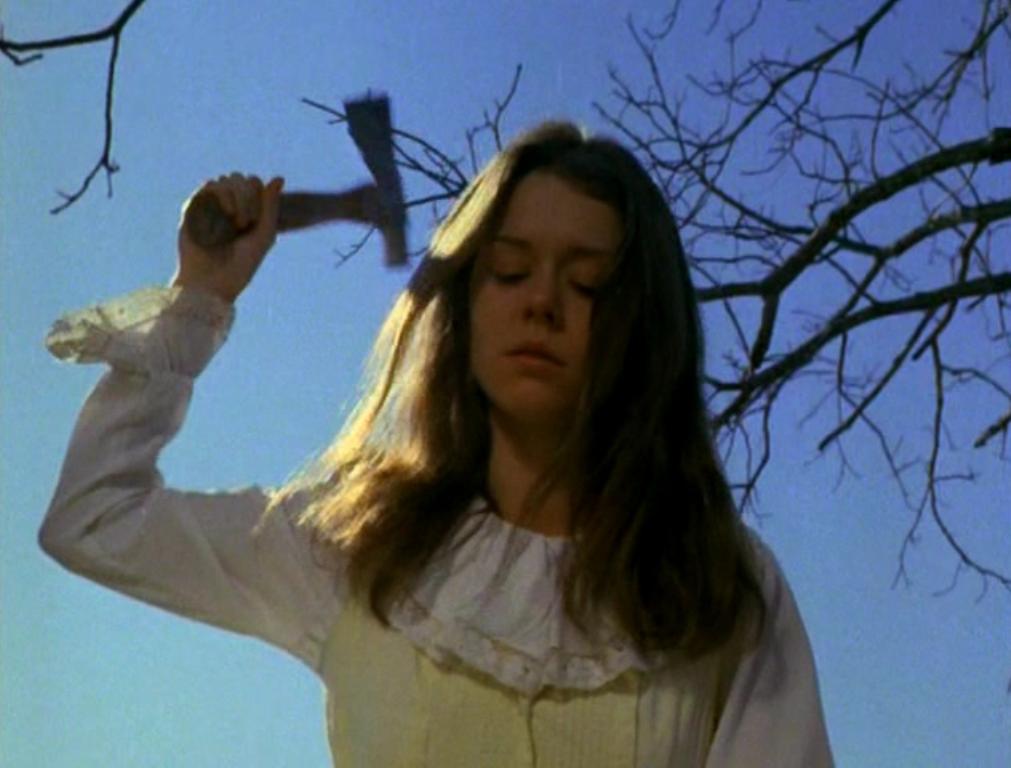
Axe -- its spare bleak terrain and characters heighten suspense, terror


Axe, a very low-budget North Carolina regional film, was shot in 1974 by a 20-something filmmaker, Frederick R. Friedel. The budget was only slightly more than $20,000.  Harry Novak, who ran Boxoffice International Pictures, Inc., a now-cultish mostly grindhouse distributor, picked it up from Friedel, along with another micro-budget Friedel film, Kidnapped Coed.

I haven't seen the latter film but I always wanted to see Axe, mainly thanks to a creepy trailer Novak put together. (You can see the trailer at the IMDB link to Axe above) I saw ads for the video/DVD when Something Weird was pitching it, but never bit. A key reason was despite several exceptions, Novak-released films generally seemed to be wanna-be porn that skirted the gray area between X and XXX.

Axe popped up on YouTube recently and I decided to finally check it out. I had recently learned that it was one of the "video nasties" that England banned for a while long ago. 

Axe kind of blew me away. It's only slightly longer than an hour, and it's no Novak-type sex film. It's an intense revenge film where the spare, bleak settings, buildings and emotionally spare characters create both a suspenseful and ultimately terrifying film. Novak, who was trying hard to stay in business in the mid to late '70s, was wise to pick up Axe. I hope it made a few bucks.

The film involves three criminals. Two are sadistic psychopaths. One is a weak man who goes along with the murdering and robbing. After killing one man and causing his terrified male lover to leap to his death, they take off for the country in search of plunder. In a small convenience store on the road, the two sadists casually terrorize and sexually humiliate the lone female employee. It's uncomfortable and gradually more frightening to watch. People shouldn't be allowed to terrorize innocents like this. They do in life, though. It's a harsh reality.

The trio eventually stop at a large house off the road, very southern style, wih a long front porch. Inside is a grandfather, who is paralyzed and cannot speak. He is tended to by granddaughter Lisa (Leslie Lee), a pretty girl/woman with an age difficult to ascertain. She is quiet, emotionless and solemn, speaking rarely and without emotion. She could have medical issues except in her bedroom there is art of girls laughing and smiling. They even look like Lisa. It's clear something traumatic has changed  Lisa.


She is a stoic and does not emote when two of the criminals very soon become threatening to her and her granddad. The third, weaker criminal, develops a crush on Lisa. Director Friedel has set up an odd kidnapping situation where the "hostages" barely acknowledge their captors. When a police vehicle stops by looking for the criminals, Lisa blandly acquises with the kidnappers' ponderous threats not to tell. 

The contrast to the terror victims experiences in the two previous scenes, a double murder, and a robbery, to what's occurring in this remote southern house, is striking. Stoicism without fear is being exhibited by Lisa. The criminals are too crudely dumb to be concerned.

That night, one of the psychopaths enters Lisa's girlish bedroom with an intent to rape her. But Lisa has a straight razor in bed with her. The criminal dies a graphic, painful, bloody death. Lisa, exerting tremendous strength, cleans up and tries to hide the body. 

This is an intense film. We know there are flaws. We don't have a backstory as to how Lisa became an emotionless, almost robotic character. We don't know what spurs the fire inside her to fight back. But what Roger Ebert said in his review of Last House on the Left applies also to Axe, which at heart is a less explicit version of Last House ... Ebert said he was describing what occurs in this intense film, not trying to deconstruct it. It may be unpleasant. It may be horrific. But the story is lean and mean and told effectively. The music works in Axe, as well. It's haunting, with a kind of hopeless melody.

The scenery, the house, bedrooms, living room, kitchen, the shabby store where the clerk is terrified, all are "characters" that contribute to this grim tale of revenge. The scenes of Lisa feeding her disabled grandfather, without emotion, while evil hovers around her, are at first disconcerting but later forbidding. It becomes so clear that these criminals are way in over their heads with this 100-pound protagonist.

Axe eventually has garnered a very small cult. Severin Films has released a Blu Ray of it and Kidnapped Coed, which is a film I'll also see once I buy the Blu-Ray. The Blue-Ray includes a blending of both films that Friedel released 30 years later, called Bloody Brothers.

I urge readers to see Axe. I want to know what you think. It grabs me with its spare, devoid of emotion crude justice. It's only about 66 minutes. Edited for the times, of course, it would have been a superb idea for Monogram or PRC 80 years ago. You can watch Axe (for now) here. Also see a South Carolina 1974 release ad under its original title, Lisa, Lisa (below).

-- Doug Gibson


Sunday, June 12, 2022

House of Ygor novel keeps that Universal horrors feel within its pages


Review by Doug Gibson


The actor Bela Lugosi created the iconic character, Ygor, in the Universal horror film "Son of Frankenstein." Lugosi's creation -- who hadn't even been in the two previous Frankenstein films -- upstaged Boris Karloff's monster in the 1939 film. The devious, grotesquely-bent-at-the-neck survivor of a hanging produced dread, fear and pathos for audiences. Ygor was in "The Ghost of Frankenstein" and then his brain was in the monster's body in "Frankenstein Meets the Wolfman." In that film Lugosi portrayed the monster.


But if Ygor fails to appear in the Frankenstein saga until film number three, it's fair to wonder where this deviously charismatic fiend came from. Author Brad Braddock, who penned an entertaining prequel to another iconic Lugosi film, "White Zombie," has provided genre readers, as well as fans of gothic horror, an explanation as to what exactly Ygor was doing prior to his activities in "Son of Frankenstein." 


In "House of Ygor,"' Arcane Shadows Press, 2022, Ygor is a shepherd, living a hermit-like life outside the village of Frankenstein, trying to live down his past adventures with Doctor Frankenstein. Unfortunately, someone is stealing bodies, and the one-armed Inspector Krogh, who retains some sympathy for Ygor, warns him he is considered a suspect.


Ygor is discovered hiding by two villagers. They try to kill him and he kills one to escape. He heads to the ruined castle where monsters were created and makes a surprising discovery. He is then captured and eventually tried and hanged. Just before slipping into unconsciousness, Ygor sees his beloved sheep slaughtered by the village elders. Inspector Krogh is sickened and disgusted with the savagery of his fellow townsman.


I will not mention more of the plot because I don't want to deprive readers of enjoying the overall tale. This is a thoroughly first-rate Universal horror "variation" (to use the new preferred term for sequels and prequels of classic works). Braddock is a talented storyteller. He possesses a scholar's knowledge of the Universal horrors, the characters, the monsters, the locations, the lands, the traditions. He comprehends the overwhelming guilt, despair, malice, cruelty, fear, terror and injustice that creates such horrors.


"House of Ygor" may be a deliberate title because like those two lean Universal films, "House of Frankenstein" and "House of Dracula," there are multiple monsters, and -- like "House of Frankenstein" -- divergent plot lines, though in "House of Ygor" both occur at the same time. There is another iconic Universal monster who appears in the book, and his search for relief is related. And even more genre characters greet readers.


Braddock's novel is fast-paced, with 36 generally short chapters spread over almost 200 pages. This is a plus as it keeps the narrative moving quickly, which is essential to maintain suspense. Often the chapters move from the Ygor narrative to the other tale. Besides the village of Frankenstein and the desolate castle, passages take readers through deep caves, gypsy camps, a boat on the sea, dark streets in London, and the decayed Castle Carew in England, which really exists.


The terror of the village elders who are picked off one by one for death delight the hardened, unfeeling Ygor, who is obsessed with revenge. Braddock also conveys well his friendship with the Frankenstein monster, which often is displayed more through eye contact and hand signals than spoken word.


An appropriate quick summary of "House of Ygor" is that besides being a good read, it keeps that familiar vintage Universal horrors feel within its pages. There is one more additional treat: an introduction by genre writer Frank Dello Stritto, which is filled with indispensible observations on the Universal films.


Saturday, May 28, 2022

The Monstrous Dr. Crimen blends Phantom of the Opera, Frankenstein, etc


Review by Steve D. Stones


This Mexican film, The Monstrous Dr. Crimen, set in the Balkans in the 1950s, is an interesting combination of the original 1925 Phantom of The Opera with Lon Chaney, Frankenstein (1931) with Boris Karloff and House of Wax (1953) with Vincent Price. The film was made the same year as House of Wax in 1953 but not released until 1955. The film is also known as other titles of The Revived Monster, Monster and The Resurrected Monster.


Nora, played by Miroslava Stern, is a bored newspaper journalist looking for an exciting story to publish. She feels her newspaper has become too routine and passe for readers. She tells her editor, Mr. Gherasimos (Fernando Wagner) in a local cafe that her life has become boring and stupid. She wants some excitement in her life.


Gherasimos suggests to Nora that she respond to a lonely hearts classified advertisement in the newspaper of a wealthy man looking to meet a young woman. He feels this might be the opportunity she needs to write an exciting story. Nora accepts the editor's suggestion and meets a man dressed in a dark cape at a boat loading dock at 9 pm that evening. The man's face is covered in sunglasses and a black scarf as he approaches Nora. A white rose that Nora wears on her coat is quite the contrast to the man's dark appearance as she approaches him.


After establishing a trust in the dark dressed man, Nora agrees to return to his home to be put to a test. The couple drive to a cemetery. Nora becomes frightened at the dark and foggy cemetery. The dark man assures her that his house is just past the cemetery. He tells Nora that his house is where dead people live. The couple walk slowly through the cemetery.


Nora observes many life size wax figures of female models in the house, which further adds to her nervousness. All the mirrors in the house are covered. The dark dressed man reveals his name to be Herrmann Ling (Jose Maria Linares-Rivas) – a plastic surgeon who not only sculpts wax figures but also conducts experiments in his basement laboratory. Ling plays the piano for Nora as a skull sits on top of the piano. Ling's assistant Mischa (Alberto Mariscal) tells Nora that Herrmann Ling creates wax figures for nothing more than a hobby.


Nora becomes anxious to see Ling's face, but he fears her rejection. Ling claims he hides behind his disguise because of the hatred and rejection of mankind towards him. He removes the sunglasses and scarf from his face as Nora faints. His face is elongated and distorted with deep scars. Nora insists that she is not frightened by his appearance, and kisses Ling. This causes Ling to be so happy with joy that he removes all the coverings of the mirrors in the mansion.


The next day, Nora reports to Gerasimos in the cafe about her meeting with Herrmann Ling. Ling is hiding nearby behind a partition in the cafe and listening to their conversation. He feels betrayed by Nora reporting their meeting to Gerasimos. This causes Ling to be angry with rage, so he revives a corpse of a handsome young man in his laboratory to meet with Nora so that he can have her murdered.


The cemetery sequences in this film are every bit as creepy and atmospheric as any seen in classic Universal Studios monster movies from the 1930s and 40s. The Monstrous Dr. Crimen is often said to be the film that laid the foundation for many other south-of-the border Mexican horror films that followed in the 1950s. The mask unveiling scene does not pack the same punch as the unmasking scene of Lon Chaney in The Phantom of The Opera (1925), but it still sends chills up the viewer's spine. Ling's grotesque face repels the viewer with fright.


Sinister Cinema in Medford, Oregon sells The Monstrous Dr. Crimen on their Drive-In Double Feature #156 with Daughter of Horror (1955 – AKA Dementia). The Drive-In Double Feature DVD contains trailers and classic drive-in movie intermission clips between the two films. This drive-in double feature is a great treasure to have for any fan of rare, obscure horror films. Happy Viewing.