Translate

Sunday, August 28, 2022

Andy Milligan's 'Blood' is grindhouse auteur's monsterama


---

Review by Doug Gibson

Stephen King, in his book Danse Macabre, trashed grindhouse filmmaker Andy Milligan. Writing of his film, "The Ghastly Ones," King said something about it being the result of morons with cameras. 

King's comments lend credence to the maxim that even one of our greatest writers can be a total ass when pontificating on other subjects. Crude "The Ghastly Ones" may be, but Milligan cobbled it together on a budget of roughly $10,000, perhaps a little bit more. He also created something unique, with his signature stamp of family dysfunction leading to chaotic, deadly horror.

Ironically, Stephen King later directed a film, "Maximum Overdrive." King later accurately labeled it "a moron movie." It cost $9 million and was a derivative mess. (I wasted $5 or so watching it in a theater). Since it grossed $7.5 million, King's film ended up losing -- on a conservative guess -- about $10 million.

"The Ghastly Ones" made likely a tidy fortune for Milligan's tight-fisted producer, William Mishkin. It played drive ins and grindhouses for years. It's probable Milligan saw none of those profits. I've read rumors that Mishkin gave Milligan about $20,000 to make a film, and Milligan only spent half so he would see a healthy paycheck for himself.

With this preamble over, this post is a review of the 1974 Andy Milligan film, "Blood." For a long time it was hard to find, and then a murky, ragged 57-minute or so print was located. You can see it on YouTube. Tubi has a ragged 69-minute version. There's a complete, roughly 73-minute Blu-Ray version of the film on Severin's Andy Milligan "Dungeon" box set. 

Milligan was ending his association with Mishkin around the time of "Blood." It was funded by backers of "The Texas Chainsaw Massacre" and even "Deep Throat!" The budget is significantly bigger than for a film like "The Ghastly Ones." I'd say, maybe $30,000 was provided. Even so, "Blood" was not a high-priority project. It was meant to be a co-feature to a film called "Legacy of Satan," -- also on Tubi -- helmed by "Deep Throat" director Gerard Damiano.

Like most Milligan films, "Blood" improves upon repeat viewings. It's a Universal Studios-style monsterama, with "Day of the Triffids" thrown in. There's this wildly imaginative plot, with an added spice of deep family dysfunctions and secrets, with rage directed at sleazy lawyers, nosy real estate agents, and the requisite old crone, who haunts a creepy cemetery. 

Imagine if Andy Milligan had directed Universal's "House of Dracula." It might have resembled this: Lawrence Orlovsky (Allan Berendt) rents a house in 19th century (Staten Island?). He lives with his wife, Regina (Hope Stansbury). Weird experiments are going on in the house. Also residing are research associates, Carrie, her husband Orlando, and Carlotta. Orlovsky is overseeing a host of dangerous plants, who have already mutilated the servants. Orlando is legless; Carrie has a rapidly deteriorating infection on her leg, and Carlotta has become a disabled, moronic hulk due to blood being taken from her to supply the plants. The house furniture and fixtures resemble the 1970s but that is pure Milligan.

The plants are designed to keep Regina healthy. As it turns out, she's a vampire, and needs the sustenance. One of the few terrifying moments is where we discover what Regina looks like prior to a plant infusion. After the plant treatment, she has a dark, pale beauty, but she's obviously mad as a hatter. Also, we learn that Lawrence is really the son of the Wolf Man, Lawrence Talbot. This is likely the only film in which the daughter of Dracula is married to the son of the Wolf Man. And yes, the son also suffers from dad's curse.

It's apparent very soon that there's no love between these two. He stoically endures her. She pleads for affection, but is obviously too insane to provide affection. Hope Stansbury, involved in several Milligan productions, is at her best in "Blood." She is a whiny, bitchy, angry, jealous killer, unable to feel any emotion that fails to feed her need for blood. Berendt, who only made one film, is good as the harried Wolf Man, who eventually allows his romantic eye to wander to the comely secretary of his crooked lawyer. The actor sort of resembles "Puddy" in the series "Seinfeld."

Typical Milliganisms include Carrie's long-lost brother, a globe-trotting sailor, surprising her with a visit. Their joyful greeting soon includes passionate kissing and caresses, insinuations of past incest. He's very concerned with Carrie's limp and wounded leg. Before he can leave, Regina, unbeknownst to Carrie, coaxes him downstairs on an errand, and kills him. Regina also kills the nosy real estate agent, the hag at the cemetery, and even a quivering defenseless mouse (I hope that scene was not real.) Her lycanthropic husband is also after the corrupt lawyer, who cheated him of much of his estate. His vampire wife, for her part, is lusting for revenge on the comely secretary of the lawyer, who has turned hubby's Wolf Man heart. And the plants are getting bigger, bolder and more deadly.

It's all very much in the Milligan style, with cramped settings, lots of arguments, and long talky scenes punctuated with bursts of horror and violence. There's a short but pretty good end-scene battle royale, and a witty final "bookend" scene.

If your a Milligan fan you'll enjoy "Blood" more each time you view it. If this is your introduction to Milligan, you may be pleasantly surprised, but I'd recommend watching a few of his earlier films to better get more flavor of this "gutter" auteur.

Sunday, August 7, 2022

John Carradine makes Cain's Cutthroats a western worth a look


---

Review by Doug Gibson

"Caine's Cutthroats" is a 1970 revenge western that was originally titled "Caine's Way" (more on that later). It's a very low-budget western with ambitous pretensions. It wants to be deep, and explore how unwarranted suffering and grief can be contaminated into a never-ending desire to torture and kill; and how the desire for revenge can return a good man to his once-evil self. If the producers had just kept a simple plot simple, you might see "Caine's Cutthroats" on western cable channels today instead of the same tired fuzzy print that has made the rounds through a VHS release, various appearances on out-of-print multi-western DVD collections, and current appearances on Tubi, YouTube and Daily Motion.


The plot: "Caine's Cutthroats" are former Confederate soldiers who committed crimes against Union forces. It's long after the Civil War, and they are out of prison. They have resumed criminal activities, stealing a Union military payroll and slaughtering several soldiers. They visit the home of their past gang leader, Justice Cain (Scott Brady), who has renounced his past and lives with his son and new wife, an African-American woman who once served as a slave maid in his household. Cain rebuffs his returning crew and they turn on him, raping his wife and killing her and Cain's young son. They shoot Cain, torch his property and leave him for dead.


There's one main reason to see this film (and another smaller one). The main reason is the introduction of the character, Preacher Simms, played by the great John Carradine. The self-described preacher discovers Cain, nurses him back to health and buries his wife and child. Preacher Simms loves to quote Bible scripture -- often as wry commentary on events he witnesses -- but he makes most of his money as a bounty hunter. He keeps the heads of the outlaws he kills pickled in a big barrel. He collects bounties by delivering the heads to law enforcement. As Cain heals, Simms learns that the Cain's Cutthroats gang members carry healthy bounty rewards. Preacher and Cain join to hunt the 'Cutthroats; Preacher for the money, Cain for revenge.

At this point in his career, Carradine was usually a one- or two-day payday for low-budget films. But he has a substantial role in this film, and I think this may be his best performance in a low-budget film in the early '70s. He just chews up the scenery, quoting Bible scriptures  shows great comic timing, and really seems to be enjoying himself. As he tells Cain, "... I sort of mix vocations, a shepherd of the flock, a hunter of men. ..."


Brady, once a major star and still getting some A-film roles in 1970, seemed to enjoy paydays in low-budget films. He's adequate as Cain, a man who has lost everything and can't control his thirst for vengeance. Although initially the sympathetic victim, he reverts to his former heartless, criminal, sadistic tendencies. 

The simple plot has promise but the execution fails. The film, shot in Kanab, Utah, and Yucca Valley's PioneerTown in California, is very low-budget. It's directed by Kent Osborne, who is slightly less talented than Al Adamson. Both Brady and Carradine, and Robert Dix -- who plays Cain's former second in command -- worked for Adamson. With one exception, the actors who portray the 'Cutthroats are very mediocre. They seem incapable of doing anything other than whooping and hollering, and laughing at inflicting pain. The violence is poorly portrayed, with fake blood, and the scenes are shot crudely and unconvincingly. The scant budget, and 85-minute running time, doesn't provide nuance for the adversaries, nor does it provide sympathy for the protagonist Cain, who shows his rage in explosions of anger, rather than as a slowly-simmering-to-boiling cauldron.


The one positive performance from the 'Cutthroats comes from Darwin Joston, as Billy Joe, a psychopathic former soldier with serious mother issues. Joston went on to star in bigger films, including "Wild at Heart," "The Fog," and "Assault From Precinct 13,"

Now, here's the second cult reason to view "Cain's Cutthroats." There is a small but substantial role by Ed Wood actor -- and his friend -- Valda Hansen. She plays"Zelda,' who is either a barfly or prostitute who cavorts romantically with Billy Joe in a "saloon." (The low budget prevents viewers from really seeing a realistic-looking saloon.) Valda's acting is very strong. She portrays a boisterous woman who really enjoys heavy flirting with the outlaw. A second scene, inside a room where the two prepare to have sex, ends with a partially nude Zelda being strangled to death by the psychopath. He can't engage in sex due to his mother issues, and an angry Zelda insults him, triggering the homicidal rage.

Viewers need to note that the second scene, the murder -- with Hansen's character being strangled -- is missing from both YouTube and Daily Motion versions, as well as DVDs that include "Cain's Cutthroats" with other westerns. The version currently on Tubi has the film with both scenes. Other than the obscure VHS release, that may be the only complete "Cain's Cutthroats" out there. 

Another actor, Adair Jameson, is effective in a small role as Rita, a former mistress of one of the killers, who joins Cain and Preacher after her boyfriend is killed. She engages in a romance with Cain that would have helped him. However, Cain is too consumed with anger to accept her offer of love. After a particularly sadistic killing of one of the murderers, both Rita and Preacher Simms abandon Cain, leaving him for good. The final scene provides a sort of morality tale that is intended to show a broken Cain that cannot achieve peace, even at the end of his vengeance quest.

Jameson has a nude bathing scene that is not cut from any prints. She is probably best known for her tiny role in the Don Knotts comedy, "The Ghost and Mr. Chicken," where she plays an attractive bank employee, Eileen, whose fully-filled sweater is complimented by her boss, played by James Millhollin. Jameson was married to B-film actor Myron Healey ("The Unearthly").

The "spaghetti westerns" were done a lot better than this California/Utah sadistic 'oater. It boasts some original songs, which seem out of place with the grim story. Mentioned earlier is that the film was released as "Caine's Way." It was about 10 minutes longer and apparently included documentary-like footage of modern-day criminal biking gangs committing mayhem. It would be interesting to see that print. In the unlikely event a nice Blu-Ray print is ever provided for this film, I hope the "Caine's Way"footage is an extra, if it still exists.


In an interview with Cult Movies Magazine published after her death, Valda Hansen expressed a lot of enthusiasm for "Cain's Cutthroats," expressing high hopes and later disappointment that it did not get more exposure. It's one of the few films where Hansen received considerable film time, and she shows she possesses acting skills, as she also does in another '70s low-budget film, "Outlaw Riders."

As you can see from the theater ads interspersed in this review, it did get many bookings. With a bigger budget, less sadism, a bigger star, and Carradine, it might be a favorite today seen on TCM, etc. As it is, it's a mediocre, small-budget revenge western with a very small cult that's due to Carradine's truly bizarre performance, and his comic timing. Despite its shortcomings, I have developed a fondness for the film, and watch it every couple of years. I own a VHS copy.


Sunday, July 24, 2022

The Mad Monster -- George Zucco is a brooding genius maniac


The Mad Monster, 77 minutes, Producers Releasing Corporation, B&W. Directed by Sam Newfield. Starring George Zucco as Dr. Lorenzo Cameron, Johnny Downs as Tom Gregory, Anne Nagel as Lenora Cameron, Glenn Strange as Petro/the monster, and Sarah Padden as the grandmother. Schlock-meter rating: 5.5 stars out of 10.


By Doug Gibson

The first time I watched this vintage PRC cheapie, I trashed it and compared it to later dogs like Beast of Yucca Flats and The Creeping Terror. However, during my second viewing I warmed a little to the film. It is, as one reviewer has said, so bad it fascinates. I agree. The plot: Mad scientist Lorenzo Cameron (Zucco), rebuffed by his peers, injects wolf blood into a simpleminded handyman (Strange) turning him into a well-dressed dog/wolf man. Ostensibly, the crazy doc plans to create warriors to defeat the Nazis and other enemies with his injections, but he eventually uses the monster to kill his enemies. The plot, which is recycled pulp, includes a backwoods country swamp setting, a beautiful daughter, her reporter boyfriend, and the cops.


The bottom of the barrel budget hampers Mad Monster, but there are scenes of high camp that are bizarre: The opening sequence involves the mad Zucco injecting Petro in the laboratory with blood from a snarling creature in a cage. During the scene, the doctor hallucinates a debate with his scientist colleagues (who appear as misty personages). I guess low-budget director Newfield was trying to show Zucco is mad, but it seems like he's on an LSD trip. Also, some filter is used to make the country swamp seem dank and foggy, but it just looks like the air is filled with cheesecloth.


The film lags often and should have been trimmed to an hour. There are several scenes where actors, who have nothing to do, sit and wait for the camera to stop rolling. Despite the budget and bad script, Zucco, a veteran of low-grade horrors, does a capable job. PRC starlet Nagel is pretty, and has a voice that is a dead ringer for Judy Garland. Unfortunately her reporter/boyfriend Gregory has a squeaky voice. Strange, who later would play the Frankenstein monster in a few films, is terrible. As the dim-witted Petro, he's a fourth-rate imitation of Lon Chaney Jr's Lenny in Of Mice and Men. In fact, he seems to have a far better personality as the monster. In a small role, Padden is creepy as a cackling backwoods grandma. The film ends, as was often the style 60 years ago, with the young lovers embracing in front of a burning house. It's worth a rental if you like C and B movies from the 30s and 40s.

Tuesday, July 5, 2022

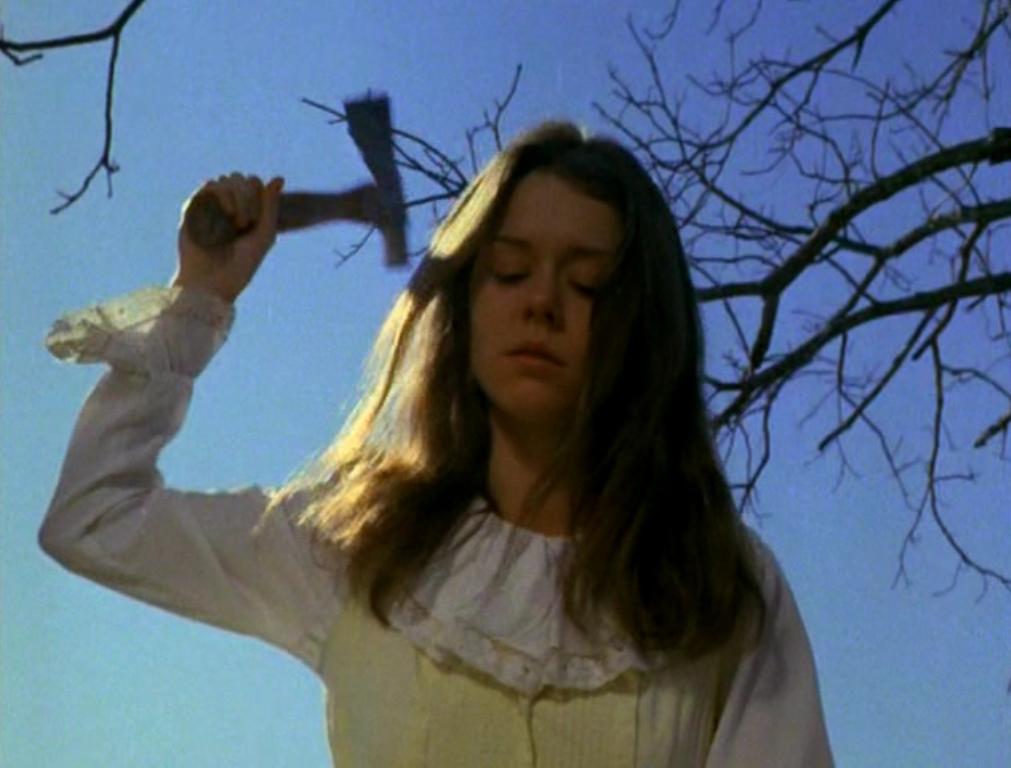
Axe -- its spare bleak terrain and characters heighten suspense, terror


Axe, a very low-budget North Carolina regional film, was shot in 1974 by a 20-something filmmaker, Frederick R. Friedel. The budget was only slightly more than $20,000.  Harry Novak, who ran Boxoffice International Pictures, Inc., a now-cultish mostly grindhouse distributor, picked it up from Friedel, along with another micro-budget Friedel film, Kidnapped Coed.

I haven't seen the latter film but I always wanted to see Axe, mainly thanks to a creepy trailer Novak put together. (You can see the trailer at the IMDB link to Axe above) I saw ads for the video/DVD when Something Weird was pitching it, but never bit. A key reason was despite several exceptions, Novak-released films generally seemed to be wanna-be porn that skirted the gray area between X and XXX.

Axe popped up on YouTube recently and I decided to finally check it out. I had recently learned that it was one of the "video nasties" that England banned for a while long ago. 

Axe kind of blew me away. It's only slightly longer than an hour, and it's no Novak-type sex film. It's an intense revenge film where the spare, bleak settings, buildings and emotionally spare characters create both a suspenseful and ultimately terrifying film. Novak, who was trying hard to stay in business in the mid to late '70s, was wise to pick up Axe. I hope it made a few bucks.

The film involves three criminals. Two are sadistic psychopaths. One is a weak man who goes along with the murdering and robbing. After killing one man and causing his terrified male lover to leap to his death, they take off for the country in search of plunder. In a small convenience store on the road, the two sadists casually terrorize and sexually humiliate the lone female employee. It's uncomfortable and gradually more frightening to watch. People shouldn't be allowed to terrorize innocents like this. They do in life, though. It's a harsh reality.

The trio eventually stop at a large house off the road, very southern style, wih a long front porch. Inside is a grandfather, who is paralyzed and cannot speak. He is tended to by granddaughter Lisa (Leslie Lee), a pretty girl/woman with an age difficult to ascertain. She is quiet, emotionless and solemn, speaking rarely and without emotion. She could have medical issues except in her bedroom there is art of girls laughing and smiling. They even look like Lisa. It's clear something traumatic has changed  Lisa.


She is a stoic and does not emote when two of the criminals very soon become threatening to her and her granddad. The third, weaker criminal, develops a crush on Lisa. Director Friedel has set up an odd kidnapping situation where the "hostages" barely acknowledge their captors. When a police vehicle stops by looking for the criminals, Lisa blandly acquises with the kidnappers' ponderous threats not to tell. 

The contrast to the terror victims experiences in the two previous scenes, a double murder, and a robbery, to what's occurring in this remote southern house, is striking. Stoicism without fear is being exhibited by Lisa. The criminals are too crudely dumb to be concerned.

That night, one of the psychopaths enters Lisa's girlish bedroom with an intent to rape her. But Lisa has a straight razor in bed with her. The criminal dies a graphic, painful, bloody death. Lisa, exerting tremendous strength, cleans up and tries to hide the body. 

This is an intense film. We know there are flaws. We don't have a backstory as to how Lisa became an emotionless, almost robotic character. We don't know what spurs the fire inside her to fight back. But what Roger Ebert said in his review of Last House on the Left applies also to Axe, which at heart is a less explicit version of Last House ... Ebert said he was describing what occurs in this intense film, not trying to deconstruct it. It may be unpleasant. It may be horrific. But the story is lean and mean and told effectively. The music works in Axe, as well. It's haunting, with a kind of hopeless melody.

The scenery, the house, bedrooms, living room, kitchen, the shabby store where the clerk is terrified, all are "characters" that contribute to this grim tale of revenge. The scenes of Lisa feeding her disabled grandfather, without emotion, while evil hovers around her, are at first disconcerting but later forbidding. It becomes so clear that these criminals are way in over their heads with this 100-pound protagonist.

Axe eventually has garnered a very small cult. Severin Films has released a Blu Ray of it and Kidnapped Coed, which is a film I'll also see once I buy the Blu-Ray. The Blue-Ray includes a blending of both films that Friedel released 30 years later, called Bloody Brothers.

I urge readers to see Axe. I want to know what you think. It grabs me with its spare, devoid of emotion crude justice. It's only about 66 minutes. Edited for the times, of course, it would have been a superb idea for Monogram or PRC 80 years ago. You can watch Axe (for now) here. Also see a South Carolina 1974 release ad under its original title, Lisa, Lisa (below).

-- Doug Gibson