Translate

Sunday, February 13, 2022

Future Stooge Joe DeRita in Wedlock Deadlock, a Columbia comedy short from 1947


Review by Doug Gibson

There's a scene in the Columbia comedy short, "Wedlock Deadlock," that contains the kind of studio in-humor that makes me love these semi-vintage comedies. Star Joe DeRita, frustrated beyond sensible patience by obnoxious, cloddish in laws who won't leave, is holding a book titled "Nearly Perfect Murders." The author's name is Elwood Ullman.


The scores of thousands of movie-goers who saw this short for the next few years in various theaters likely had no idea who Ullman was. He was the screenwriter for "Wedlock Deadlock." It was an inside joke for the Columbia team, likely hatched from director Edward Bernds, who directed many above-par Columbia shorts for Hugh McCollum's department. 

You can watch "Wedlock Deadlock" here, via YouTube. Greg Hilbrich, who runs the absolutely essential The Columbia Short Department website, showed me links to all four Columbia comedies DeRita starred in during the second half of the 1940s. "Wedlock Deadlock" was my favorite; all are more or less remakes of previous Columbia shorts for other stars. DeRita with a full head of hair kind of resembles Lou Costello a little. But he lacks Costello's wit, although he's' not bad in physical comedy. He was mostly cast as a harried husband. (More on The Columbia Shorts Department at the end of this post)

In "Wedding Wedlock," shlubbish DeRita is "Eddie,' improbably maried to gorgeous blonde, Betty, played by Christine McIntyre (probably the most iconic Columbia female star; she was in dozens of shorts but is best known for her supporting work with the Three Stooges). The pair are in their new home, all lovey-dovey, when ... her family arrives uninvited.

They are mother-in-law, Lydia, sister-in-law Hortense, and brother-in-law Chester. They are rude, pathologically insensitive freeloaders who take over the house, to Eddie's outrage and Betty's mild protests. There are slapstick comedy scenes. DeRita serves dinner and is not able to get a bite. Another scene involves the trio rearranging the furniture and a fight over a radio in the home. Eddie's eventually ready to go after the in-laws with a meat cleaver but  relents after Betty's pleas for patience. Nevertheless, the in-laws take over the bedroom, forcing the newlyweds to sleep on chairs and tables in the living room. More slapstick ensues as DeRita's makeshift bed collapses.

Eventually, Eddie arranges to have his friend, Dick, and his wife Ruby, come visit the house. The goal is to give the rude Lydia, Hortense and Chester a taste of their own medicine. The final few minutes of the short is very funny. I don't want to give the ending away but I will mention that Dorothy Granger, who plays Ruby, more or less steals the film with her enthusiastic, manic, funny performance. I am aware of Granger, who included Columbia in her roughly 250-film career of minor roles, uncredited bit parts and TV roles. She really steals the show from DeRita, who grumbles more than he fights. Also, McIntyre, who has a history of playing -- energetically -- a heroine, a villain, and a comic in many Columbia shorts, is also quite passive in this short.

The slapstick comedy fell a little to DeRita, but more so to comedy shorts veterans Esther Howard (Lydia), Patsy Moran (Hortense) and Charles Williams (Chester). They are obnoxious but do an adequate job carrying physical comedy. William Newall, as Dick, also is adequate. As mentioned, though, Granger's Ruby is the best slapstick comic presence in this short. 

However, the "ironic tag" ending, that Columbia occasionally used, allows both DeRita and McIntye to show a bit more passion, Columbia "O'Oucho" style, at the very end.

I don't know how ubiquitos "Wedlock Deadlock" was in theaters. Below in old newspaper clippings from The Anniston (Ala) Star (Dec. 21, 1947) you see it mentioned as a short with George O'Brien's "Wings Over Wyoming," and there's a paragraph noting that "J DeRita" is the star. Below the Star is a Feb. 24, 1949, Statesville (Tex) Daily-Record clip showing the film as the comedy short with Johnny Mack Brown's "The Fighting Ranger." That bill also includes a supporting feature and a cartoon.


According to Wikipedia, DeRita was not happy with his Columbia shorts. Maybe that's why only four were produced. The former burlesque and Los Angeles stage star doesn't project great screen presence. He does do physical comedy fairly well. Two other shorts, "Slappily Married," and "The Good Bad Egg,' show off his skills. But I prefer him in an understated, suffering "everyman" role like "Wedlock Deadlock."

I really appreciate all Hilbrich has done gathering and preserving the entire Columbia shorts output. Without genre experts like him we would miss a lot of the great shorts. 

Afternote: I recently acquired copies of nearly two dozen non-Three Stooges Columbia comedy shorts. Greg Hilbrich, who manages the invaluable website The Columbia Shorts Department offers many of the comedy shorts, including titles other than Columbia, for sale via DVD and digital download.Sales of these non-Stooges shorts provided the opportunity to view vintage comedy shorts that are out of circulation.  

Saturday, January 22, 2022

Mesa of Lost Women is kitsch, but it has 'Tarantella'!


By Steve D. Stones 


Just how bad is Mesa of Lost Women? Well, I may be the wrong person to answer this question, since I’m a peddler of bad cinema. Even by my standards, Mesa of Lost Women is pretty bad. 


With two directors at the helm, Mesa should have turned out so much better. The growing cult surrounding the film may be a result of many principle players of the film having ties to Ed Wood. For example, Lyle Talbot, star of Wood’s Jail Bait, Glen or Glenda and Plan 9 From Outer Space, narrates the film. The annoying music score by Hoyt Curtin is used in both Mesa and Jail Bait. The lovely Dolores Fuller and Mona McKinnon star as spider girls. 


However, this film is much more difficult to watch than any Ed Wood film, which is saying a lot. Another cult aspect of the film has to do with the casting of George Barrows as a sanitarium nurse. Barrows is the actor who put on a gorilla suit and scuba helmet to star as Ro-Man in the infamous Robot Monster. Barrows went on to play another gorilla named Anatole in Hillbillies In A Haunted House. 


Jackie Coogan, who went on to star as Uncle Fester in The Adams Family television show, plays Dr. Arana. Arana conducts experiments in a secret laboratory in the Muerto Desert on beautiful women and spiders. Dr. Leland Masterson, the worst actor in the film, is invited to Arana’s lab to witness some of Arana’s experiments and findings. Arana explains to Masterson that he can inject beautiful women with a growth hormone from spiders, which makes the women become indestructible. Masterson accuses Arana of being mad, so Arana injects him with the growth hormone, which causes him to go insane. 


Somehow Masterson escapes Arana’s lab, ends up in a Mexican insane asylum and then escapes from the asylum in less than ten seconds of screen time. He then makes an appearance at a local Mexican cantina where he becomes infatuated with a pretty blonde, played by Mary Hill. The blonde is getting married later that evening to her much older fiancé. The two sit at a cantina table as Masterson joins them. Masterson’s nurse, played by George Barrows, then joins them at the table in an attempt to take Masterson back to the local sanitarium. 


(Mesa of Lost Woman usually played -- often in the southern United States -- on double bills as the second feature. Below are a couple of old newspaper clips of it in release. It served as a double feature to Barbara Payton in Bad Blonde in a drive in at the Wichita Daily Times, in Wichita, Texas. Note that in one clip, from the Greenville Daily Democrat in Mississippi, it is referred to as Lost Women. That was during its later re-release. In that clip Barbara Payton is not only mistakenly touted as a star in the film, her last name is misspelled. Above is an example of Mesa of Lost Women actually headlining at a southern states drive in in Lubbock Texas' Morning Avalanche.)


One of Dr. Arana’s spider girls named Tarantella, played by the beautiful Tandra Quinn, performs a very bizarre dance in front of the patrons in the cantina. In a fit of rage, Masterson kills Tarantella with a gunshot, and then takes the bride, her husband and Barrows hostage.


I could go on and on with the plot of Mesa of Lost Women, but you get the point in just how bad it is. It should also be noted that Howco Productions, that produced Mesa of Lost Women, also produced Ed Wood’s Jail Bait. This may be the reason why the Hoyt Curtain score is used in both films, and why many of the same actors are used. 


If Ed Wood had directed this film, I feel it would have turned out much better, which may not be saying much. At least the bad elements of an Ed Wood film are funny, campy and enjoyable to watch. The bad elements of Mesa of Lost Women could never rise to Ed Wood’s level of “bad cinema” excellence.


Saturday, January 8, 2022

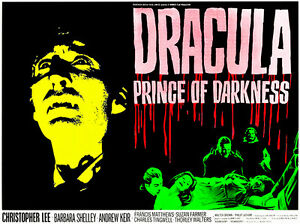
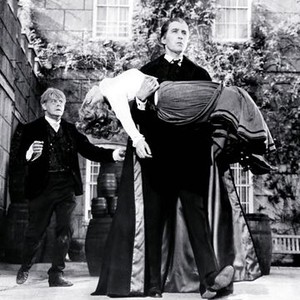
Dracula: Prince of Darkness -- Lee and Shelley shine in Hammer horror


Dracula: Prince of Darkness, 1966, 80 minutes, Hammer, Color. Directed by Terence Fisher. Starring Christopher Lee as Dracula, Barbara Shelley as Helen Kent, Andrew Keir as Father Sandor, Francis Matthews as Charles Kent, Suzan Farmer as Diana Kent, Charles ÿBudÿ Tingwell as Alan Kent, Thorley Waters as Ludwig, Philip Latham as Klove and John Maxim as the coach driver. Schlock-Meter rating: 9 stars out of 10.

This is a magnificent horror film. Two English couples are vacationing in Eastern Europe. They are warned by a priest (Keir, who is great) to stay away from Carlsbad, and above all, an unmarked castle. Of course, they ignore the priest's advice and enter the castle. There, with the help of an evil assistant (Latham), Count Dracula (Lee) is resurrected from dust and the night turns to terror for the couples.

The acting is superb, and director Fisher's economical pacing prevents the film from dragging and maintains suspense. Keir, as Father Sandor, is a great vampire hunter, and carries much of the film with his commanding presence. Barbara Shelley as the ill-fated Helen Kent, undergoes an effective transition within the film. The first half of the film she's a repressed, shrewish early-middle-aged wife. However, after falling prey to Dracula's curse, Shelley becomes a beautiful, passionate woman with full cleavage. She literally looks 15 years younger and deserves credit for pulling off the transformation. Waters as Ludwig, an imbecile who helps Dracula, is a capable Renfield clone, and Latham is sinister and eerie as Dracula's living servant Klove.


The film opens with a final shot from Hammer's classic The Horror of Dracula, where Peter Cushing destroys Lee's Dracula. It was the third Hammer Dracula film, but Lee's second playing the man with a cape. Lee produces scares, despite never uttering a word in the film. He is sinister, yet commanding. Not human, he prefers to communicate with snarls and shrieks of rage or triumph. I won't give away the entire ending, but Dracula meets his fate in a rather unusual manner.

One minor quibble: I wish the Hammer films were shot in black and white rather than color. I understand that it worked well in the 1960s, but today the Hammer films are a bit dated because of the color. They would appear fresher if black and white. The forest settings appear realistic and the castle is suitably creepy. It's a must-rent cult film. Better yet, buy it for your collection.

-- Doug Gibson

Saturday, December 25, 2021

Godzilla 2000, a review


Godzilla 2000, 2000, about 90 minutes, color, Toho films, Japan Distributed in the U.S. by Columbia Tristar. Directed by Takao Okawara. Starring Kitagawa Tsutomo, Hiroshi Abe, Takehiro Murata, Mayu Suzuki and Shiro Sano. Rated PG. Rating on a scale of 10: 8. (Reviewed in 2009)

When I was a child, I saw a lot of Saturday matinee thrillers. I remember really enjoying reissues of the Marx Brothers' Go West and The Seventh Voyage of Sinbad. But I never saw a Godzilla film. I didn't lose any sleep over it as a child, but, when Toho's latest Godzilla flick, Godzilla 2000, opened in August (2000), I persuaded my skeptical wife to catch a matinee at one of those new mega-cinema mall (this place was showing over 30 films). 

So we settled down with some popcorn, and I put my feet up in the nearly empty theater and waited for some bad dubbing, some fairly cheesy monsters and Godzilla's distinct Japanese shriek. And that's exactly what I got. 

Godzilla is cheesy and at times ridiculous, but still, it's a lot of fun. It doesn't try to take itself seriously, and as a result, provides great Saturday matinee popcorn-gobbling fun. When it comes out in video, it's a must for cult fans to rent this film, microwave the popcorn, and catch it late night on the tube. 

Here's the plot: The Godzilla Prediction Network (I'm not making that name up) is in a race with Japan's Crisis Control Intelligence Agency to find Godzilla, who occasionally rampages the countryside. The Prediction wants to contain Godzilla and study the creature. The Crisis Control bureaucrats, led by one of the most stone-faced actors in film history, want to kill Japan's most famous beast. In between there's a nosy newspaper reporter trying to get the perfect photo of Godzilla. Somewhere in the middle of all this, a huge rock is lifted from the bottom of the sea to sunlight, thereby resurrecting a huge alien monster. 

Guess who gets the fight it? There are many moments of camp in this monster-fest. Besides the ridiculous dubbing and sometimes-poor Toho effects, the scene where the woman reporter is chewed out by her editor is fun to watch. It seems she was too close to the Godzilla, and the radiation wipes out a good print! The final, dubbed line in the film is a howler, and I won't give it away. 

There's a lot of action, and a lot of Godzilla in Godzilla 2000, and that makes it a winner and a must-see for cult film lovers. As mentioned, after it leaves theaters, it's best seen late at night, with beer or pop and a lot of popcorn. You'll laugh a lot, but you'll also enjoy the story, and the energetic rubber monsters flailing away. After watching this film, I'm sure Toho will bring back the big guy for a sequel every few years. 

Editor's note: In the decade-plus after this film Toho and America made some impressive big-budget Godzilla/King Kong films.

-- Doug Gibson