Translate

Showing posts with label Edward Bernds. Show all posts

Sunday, February 13, 2022

Future Stooge Joe DeRita in Wedlock Deadlock, a Columbia comedy short from 1947


Review by Doug Gibson

There's a scene in the Columbia comedy short, "Wedlock Deadlock," that contains the kind of studio in-humor that makes me love these semi-vintage comedies. Star Joe DeRita, frustrated beyond sensible patience by obnoxious, cloddish in laws who won't leave, is holding a book titled "Nearly Perfect Murders." The author's name is Elwood Ullman.


The scores of thousands of movie-goers who saw this short for the next few years in various theaters likely had no idea who Ullman was. He was the screenwriter for "Wedlock Deadlock." It was an inside joke for the Columbia team, likely hatched from director Edward Bernds, who directed many above-par Columbia shorts for Hugh McCollum's department. 

You can watch "Wedlock Deadlock" here, via YouTube. Greg Hilbrich, who runs the absolutely essential The Columbia Short Department website, showed me links to all four Columbia comedies DeRita starred in during the second half of the 1940s. "Wedlock Deadlock" was my favorite; all are more or less remakes of previous Columbia shorts for other stars. DeRita with a full head of hair kind of resembles Lou Costello a little. But he lacks Costello's wit, although he's' not bad in physical comedy. He was mostly cast as a harried husband. (More on The Columbia Shorts Department at the end of this post)

In "Wedding Wedlock," shlubbish DeRita is "Eddie,' improbably maried to gorgeous blonde, Betty, played by Christine McIntyre (probably the most iconic Columbia female star; she was in dozens of shorts but is best known for her supporting work with the Three Stooges). The pair are in their new home, all lovey-dovey, when ... her family arrives uninvited.

They are mother-in-law, Lydia, sister-in-law Hortense, and brother-in-law Chester. They are rude, pathologically insensitive freeloaders who take over the house, to Eddie's outrage and Betty's mild protests. There are slapstick comedy scenes. DeRita serves dinner and is not able to get a bite. Another scene involves the trio rearranging the furniture and a fight over a radio in the home. Eddie's eventually ready to go after the in-laws with a meat cleaver but  relents after Betty's pleas for patience. Nevertheless, the in-laws take over the bedroom, forcing the newlyweds to sleep on chairs and tables in the living room. More slapstick ensues as DeRita's makeshift bed collapses.

Eventually, Eddie arranges to have his friend, Dick, and his wife Ruby, come visit the house. The goal is to give the rude Lydia, Hortense and Chester a taste of their own medicine. The final few minutes of the short is very funny. I don't want to give the ending away but I will mention that Dorothy Granger, who plays Ruby, more or less steals the film with her enthusiastic, manic, funny performance. I am aware of Granger, who included Columbia in her roughly 250-film career of minor roles, uncredited bit parts and TV roles. She really steals the show from DeRita, who grumbles more than he fights. Also, McIntyre, who has a history of playing -- energetically -- a heroine, a villain, and a comic in many Columbia shorts, is also quite passive in this short.

The slapstick comedy fell a little to DeRita, but more so to comedy shorts veterans Esther Howard (Lydia), Patsy Moran (Hortense) and Charles Williams (Chester). They are obnoxious but do an adequate job carrying physical comedy. William Newall, as Dick, also is adequate. As mentioned, though, Granger's Ruby is the best slapstick comic presence in this short. 

However, the "ironic tag" ending, that Columbia occasionally used, allows both DeRita and McIntye to show a bit more passion, Columbia "O'Oucho" style, at the very end.

I don't know how ubiquitos "Wedlock Deadlock" was in theaters. Below in old newspaper clippings from The Anniston (Ala) Star (Dec. 21, 1947) you see it mentioned as a short with George O'Brien's "Wings Over Wyoming," and there's a paragraph noting that "J DeRita" is the star. Below the Star is a Feb. 24, 1949, Statesville (Tex) Daily-Record clip showing the film as the comedy short with Johnny Mack Brown's "The Fighting Ranger." That bill also includes a supporting feature and a cartoon.


According to Wikipedia, DeRita was not happy with his Columbia shorts. Maybe that's why only four were produced. The former burlesque and Los Angeles stage star doesn't project great screen presence. He does do physical comedy fairly well. Two other shorts, "Slappily Married," and "The Good Bad Egg,' show off his skills. But I prefer him in an understated, suffering "everyman" role like "Wedlock Deadlock."

I really appreciate all Hilbrich has done gathering and preserving the entire Columbia shorts output. Without genre experts like him we would miss a lot of the great shorts. 

Afternote: I recently acquired copies of nearly two dozen non-Three Stooges Columbia comedy shorts. Greg Hilbrich, who manages the invaluable website The Columbia Shorts Department offers many of the comedy shorts, including titles other than Columbia, for sale via DVD and digital download.Sales of these non-Stooges shorts provided the opportunity to view vintage comedy shorts that are out of circulation.  

Friday, February 5, 2016

Edward Bernds' memoir is a history of early Hollywood sound films


By Doug Gibson

I've long wanted to read Edward Bernds's memoir, "Mr. Bernds Goes to Hollywood: My Early Life and Career in Sound Recording at Columbia with Frank Capra and Others." But it's pricey. Just to buy it in Kindle is $40-plus dollars; out of print dead-tree copies go around $50 and more.

But I found it, in the library at Weber State University in Ogden, Utah, where this blog calls home. Who wouldn't want to read about Edward Bernds' career as main sound man for such great Capra films as "Lady For A Day," "It Happened One Night," "You Can't Take It With You" and more? And Bernds was also on the set doing sound for Howard Hawks, Leo McCarey, Gregory LaCava, and more. In the studio system of the 1930s, it wasn't all A production assignments. Bernds was assigned to dozens of low-budget western oaters, many starring Charles Starrett. He also did sound for screen tests and the low-budget near low-on-the-Columbia-totem-pole comedy shorts. In fact, Bernds was on the set when a trio of performers, Moe, Curly and Larry, starred in a musical novelty short called "Women Haters." Of course, they became the Three Stooges and Bernds was around doing sound for many of the comedy, Stooges, Andy Clyde and others.

Bernds was born in Chicago in 1905. He loved the new medium radio and by the time he was 20 he worked at a Chicago station. When his girlfriend, Bathsheba, moved to Los Angeles, Bernds eventually followed her there and the pair were married. They returned to Chicago briefly but a job offer came from southern California as a sound technician. Bernds' tales of the early days of sound films is fascinating. He describes the gradual sophistication of studios' sound systems. Early synchronized sound involved filming in a confined space, that limited the freedom of the camera. That may be why so many early sound films look stagy.

Bernds worked briefly at United Artists but moved to Columbia. It was considered a lesser studio but it was a smart move for Bernds. He describes how he was noticed by Capra, an exceptional director who was able to place actors in plots and situations and elicit performances that made audiences care about their fate. Capra noted Bernds' talent, and he became his preferred sound technician.

It was a fortunate partnership. Bernds was an observer of film, a frustrated wannabe screenwriter and director who compensated that desire by writing short stories for the 1930s literary magazine "Rob Wagner's Script." Bernds recalls taking his published stories to Columbia's crusty boss, Harry Cohn, who always asked Bernds to send a screenplay. As Bernds notes, at that point in his life he lacked the confidence to write a screenplay.

As mentioned, Bernds kept notes and along with his memories they provide a detailed look at early sound Hollywood that is a treasure for film buffs. We get peeks into the characters and actions of stars such as Clark Gable, Barbara Stanwyck, Claudette Colbert, Jimmy Stewart, Loretta Young, Leslie Howard Jean Arthur, The Stooges, of course, and many more.

Trust me when I say the life of a working-class, integral member of a film crew, the sound technician, is an interesting topic, particularly one toling 80-plus years ago. Bernds captures the times, the down of the Great Depression, the hope that Franklin Delano Roosevelt offered. We walk streets in 1930s southern California with Bernds and we vicariously relive Bernds' memories of his favorite mode of transportation, the cross-country train.

Bernds learned both diplomacy and when to assert himself on a set. As he recalls, Capra was open to suggestions, but a director such as LaCava would fire a subordinate for unsolicited information.

The details of filmmaking, beyond just sound technology, are fascinating in Bernds' memoir. He takes us across the Atlantic to shoot a film in England, to New York and New Jersey for shoots, to ranches in southern California, to the rickety Columbia stages used for the comedy shorts, and much more. We get glimpses of the dangers, and sometimes tragedies, that resulted in filming in an era before modern special effects.

Through the 1930s, Bernds and his wife raised a family and saw his paycheck grow with Columbia. But he harbored a major ambition, to be a director. And that is the theme of "Mr. Bernds Goes to Hollywood," it's one film professional's journey to finally becoming a director. The book opens with Bernds' relating Cohn's bewilderment that his efficient sound man wanted to chuck that for directing. It ends with Bernds' move to directing with the shorts department under the guidance of producer Hugh McCollum. The memoir barely covers the directing years, but any genre fan is well aware of the dozens of Columbia comedy shorts Bernds directed, and the features work he got, usually "Blondie" films.

Bernds never became an A director. He didn't have the opportunity to do Capra-esque films. He left Columbia when McCollum was fired and a previous western feature with The Stooges he made, "Gold Raiders," got terrible reviews and that hurt his career (I have seen the film and enjoy it). But he was hired at Allied Artists for a while and was busy directing for more than a decade, including the later Bowery Boys films, a couple of late Stooges features and some genuine cult science fiction films, including "Queen of Outer Space" and "World Without End."

He died in 2000, a year after his memoir was published. A couple of interesting points: Although he has great respect for Capra, he notes several recollected events that are distinctly different from what Capra writes in his autobiography. This is important because Capra, who had feuded with Harry Langdon in the 1920s, was harsh to Langdon in his memoirs, claiming things about him that have been debunked since.

Also, there is a bittersweet recollection of Bernds, and his writing pal Edward Ullman, visiting his old work office at Columbia in the late 1960s on business. The pair of film veterans were condescended to and lectured on comedy by a youngster less than half their age. At that point, Bernds decided he was content with his two film industry pensions.

I urge fans of the Columbia comedy shorts to read this book. They will gain a better appreciation of one of the best shorts directors. His later years are highlighted with an epilogue interview of Bernds by Leonard Maltin and Joseph McBride. Bernds offers interesting tidbits, some delightfully gossipy. McCollum, Bernds reveals, was smitten with the beautiful comedy shorts supporting player Christin McIntire, although he says it may have been platonic.

Those wishing a more detailed look at Bernds' work with Columbia comedy shorts must read the book by Ed Watz and Ted Okuda, "The Columbia Comedy Shorts, reviewed here.

Wednesday, August 21, 2013

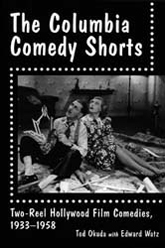
Book on Columbia comedy shorts offers a fascinating glimpse of two-reeler history


                                      By Doug Gibson

The Columbia Comedy Shorts, Ted Okuda and Ed Watz’s interesting history — courtesy of McFarland Press — of the 25 years of two-reel comedies the studio generated is fascinating reading if your a genre buff, and interesting even to the fan whose knowledge of Columbia shorts is limited to the several score shorts that starred the Three Stooges. Reading the book, I was amazed at the depth of the comic talent that Jules White grabbed for Columbia over three decades. I was aware of the Stooges, of course, and the former big-name silent stars who worked with Columbia — Harry Langdon, Buster Keaton, Charley Chase, Andy Clyde — but I’d wager very few know of Vera Vague, or Sterling Holloway, or Billie Burke, or Maxie Rosenbloom and Max Baer, or Hugh Herbert, Walter Catlett, Collins & Kennedy, Harry Von Zell, and solo efforts from future Stooges Shemp Howard and Joe Besser, and even Bert Wheeler, plus Wally Brown. All, and more, were under contract with Columbia shorts. (Vague, by the way, garnered two Academy Award nominations, note the authors.)

Okuda and Watz wrote this valuable reference guide before the era of broadband Internet, and YouTube, and Google archives. At that time, only the Stooges were easily available to watch. Others required 16-millimeter film purchases. That’s changed. I can go to YouTube and watch the Columbia shorts of Langdon, Keaton, Clyde, Shemp, Chase, and even catch one of the obscure comedies of Baer and Rosenbloom, which were not available to the authors. In fact, most of Columbia’s other stars failed to catch on in the TV era for two reasons: one, they didn’t have the sheer volume of episodes of the Stooges; and two, nor did they have the fan base. This bears explaining — as enjoyable as the Columbia efforts of Langdon, Chase, Keaton, etc., are, the shorts are not these comics’ best works. Columbia, which under Jules White, stressed loud gags and action, defined the Stooges; many of the others had to adapt to Columbia.

This is not a criticism of Jules White, who seemed an amazing man, with tremendous energy and a desire to grab as many comics as he could while at the helm of the two-reeler section of the studio. From reading this book, which benefits from extensive interviews with Jules White, director Edward Bernds and feature player in many shorts, Emile Sitka, it’s apparent that the executives' disinterest in the shorts department — so long as it was making money — allowed tremendous autonomy for White. According to the book, salaries for the stars ranged from $500 an episode to $1,000 (for Keaton), to $1,250 (for Langdon) and to $2,500 an episode for each of the Stooges.

While most of the shorts were heavy on slapstick, White, and also producer Hugh McCollum, sometimes offered more subtle humor, such as Sterling Holloway, popular in the late 40s and 50s. Also, director Bernds was able to complete some shorts that provided more humor than just slapstick. His Stooges’ short, “Micro-phonies,” (watch below) remains my favorite for just that reason, including the opportunity to hear the beautiful voice of Columbia’s most famous comedy shorts woman, Christine McIntyre, who has achieved iconic status as a Stooge player.

As mentioned, while the Stooges were honed on Columbia’s fast-paced, loud action templates that sometimes ended abruptly, it frequently led to lesser efforts from the other stars. However, as the authors note, by the latter 1930s, Langdon, Chase, and many others were looking for work, and in no position to turn down the above-average paydays. Jules White clearly admired the players he offered starring roles for in the shorts, and it’s a pleasure for genre fans to watch Langdon and others provide laughs in that later era. And, it’s important to remember, the Columbia shorts were wildly popular. Even a sub-par Langdon effort, such as “A Blitz on the Fritz,” was a huge hit for movie-goers watching these shorts prior to the main films. The Stooges were so popular that Columbia used the popularity to boost their feature films, the authors note.

“The Columbia Comedy Shorts: Two-Reel Hollywood Film Comedies, 1933-1958” provide the ingredients that made the shorts. There are short profiles of the directors, Jules White, his brother Jack White (Preston Black), as well as Bernds, Charley Chase, Del Lord, and the unfortunate Harry Edwards, who appears to have been everyone’s least favorite, except for a loyal Harry Langdon. Not surprisingly, the authors note that Edwards was eased out after Langdon’s death in late 1944. Information is included on the writers, how the films were shot, including sound effects, previews, casting, budgets, stunts ... and injuries, pay scale, etc. There are even script samples. Readers may be surprised at how closely the Stooges, for example, followed scripts. The comedy chaos can lead to an assumption that much of the action was ad-libbed, but not really.

All of the shorts produced are provided at least a paragraph of information, and the authors are careful to note where scenes from other shorts were used; a practice that occurred often in the more lean-budget 1950s. For example: Although Christine McIntyre had left Columbia by the mid-1950s, footage of her was used in later “new” shorts.

There are short biographies of professionals involved in Columbia productions. I haven’t mentioned Vernon Dent, a mainstay throughout the Columbia shorts era. Always a featured player, his talent was equal to the stars. Reading Dent’s short biography, I wanted to learn more. It's great to learn that there is now full-length biography of this comedy pioneer, "Vernon Dent: Stooge Heavy ...,” from BearManorMedia. The versatile McIntyre, in so many of the Columbia shorts, would be an interesting biography, in my opinion. Edward Bernds penned an autobiography, “Mr. Bernds Goes to Hollywood,” which I have read.

Okuda and Watz have compiled a valuable, interesting film history tool, with fantastic nuggets of information. It’s as valuable today as it was in 1986, when first released. Now that many of these shorts can be viewed at home, the book is a handy resource. You can buy the book here.

Monday, April 8, 2013

'Gold Raiders' - obscure but notable as the 3 Stooges first feature


By Doug Gibson


"The Gold Raiders," 1951, B&W, 56 minutes, directed by Edward Bernds, starring George O'Brien as "George O'Brien," The Three Stooges, Moe Howard, Larry Fine and Shemp Howard, Lyle Talbot as Taggert, Sheila Ryan as Laura Mason and Clem Bevans as Doc Mason.

This "oater" is a curio, mainly because it features the Three Stooges in supporting roles. The very short B-film stars silent and early talkie cowboy film star George O'Brien as a lawman turned insurance man hired by mining companies to get their gold safely to the bank. Crime boss Lyle Talbot wants to steal the gold. He tries to get information on where the gold is being taken from a drunken old doctor (Bevans) who, with his stooped figure and drawling voice, is made for westerns.

The Three Stooges play bumbling peddlers who ally with O'Brien to keep the gold safe. Gold Raiders is an OK film. It's nothing special from the hundreds of other "oaters" made in Hollywood but an aging O'Brien does an OK job shooting and fighting. Talbot, who starred in Ed Wood films, is a good villain and the Stooges are funny.

Director Bernds, who helmed many Stooge shorts, a few with the trio's beautiful blonde co-star Christine McIntyre, and later some features, told Cult Movies Magazine that Moe Howard was envious of Abbott and Costello and wanted to get into features. The result was Gold Raiders, an almost forgotten film today that was meant more as a comeback vehicle for O'Brien. Bernds recalled that the film was trashed by critics but, in my opinion, it really isn't too bad. Its main handicap is an abysmally low budget. It was shot in five days and looks it. One unintentionally funny scene includes a close-range shootout in a cramped saloon where almost no one seems to get shot. The film is also unique in that it may be the only western ever made where an insurance man is a two-fisted, gunslinging hero! It's a fun film and it's interesting and not unpleasant to see see the Stooges as comedy relief is a western action film.

According to Bernds, the film idea was hatched because Moe was envious of the success of the comedy team of Abbott & Costello. Despite the obscurity of Gold Raiders, the Stooges later made several features where they were the stars, including The Three Stooges Meet Hercules, Snow White and the Three Stooges and The Outlaws is Coming. Truth is, though, I enjoy the lean and mean Gold Raiders more than any of the later bigger-budget efforts. The Stooges are more effective as comedy relief, rather than the main components of a film

Notes: The makeup for Gold Raiders was done by Ed Wood regular Harry Thomas. Gold Raiders was released by United Artists but plans for a sequel with the Stooges and O'Brien were abandoned. The film was released to TV several years later and then sat for decades forgotten until 2006 when Warner Brothers released it on DVD. It can be bought via amazon.com


Thursday, February 2, 2012

The Three Stooges in an old oater! Gold Raiders


By Doug Gibson

"The Gold Raiders," 1951, B&W, 56 minutes, directed by Edward Bernds, starring George O'Brien as "George O'Brien," The Three Stooges, Moe Howard, Larry Fine and Shemp Howard, Lyle Talbot as Taggert, Sheila Ryan as Laura Mason and Clem Bevans as Doc Mason.

This "oater" is a curio, mainly because it features the Three Stooges in supporting roles. The very short B-film stars silent and early talkie cowboy film star George O'Brien as a lawman turned insurance man hired by mining companies to get their gold safely to the bank. Crime boss Lyle Talbot wants to steal the gold. He tries to get information on where the gold is being taken from a drunken old doctor (Bevans) who, with his stooped figure and drawling voice, is made for westerns.

The Three Stooges play bumbling peddlers who ally with O'Brien to keep the gold safe. Gold Raiders is an OK film. It's nothing special from the hundreds of other "oaters" made in Hollywood but an aging O'Brien does an OK job shooting and fighting. Talbot, who starred in Ed Wood films, is a good villain and the Stooges are funny.

Director Bernds, who helmed many Stooge shorts and later some features, told Cult Movies Magazine that Moe Howard was envious of Abbott and Costello and wanted to get into features. The result was Gold Raiders, an almost forgotten film today that was meant more as a comeback vehicle for O'Brien. Bernds recalled that the film was trashed by critics but, in my opinion, it really isn't too bad. Its main handicap is an abysmally low budget. It was shot in five days and looks it. One unintentionally funny scene includes a close-range shootout in a cramped saloon where almost no one seems to get shot. The film is also unique in that it may be the only western ever made where an insurance man is a two-fisted, gunslinging hero!

Despite the obscurity of Gold Raiders, the Stooges later made several features where they were the stars, including The Three Stooges Meet Hercules, Snow White and the Three Stooges and The Outlaws is Coming. Truth is, though, I enjoy the lean and mean Gold Raiders more than any of the later bigger-budget efforts. The Stooges are more effective as comedy relief, rather than the main components of a film

Notes: The makeup for Gold Raiders was done by Ed Wood regular Harry Thomas. Gold Raiders was released by United Artists but plans for a sequel with the Stooges and O'Brien were abandoned. The film was released to TV several years later and then sat for decades forgotten until 2006 when Warner Brothers released it on DVD. It can be bought via amazon.com


Thursday, July 1, 2010

The Gold Raiders: The Stooges Go West!


By Doug Gibson

"The Gold Raiders," 1951, B&W, 56 minutes, directed by Edward Bernds, starring George O'Brien as "George O'Brien," The Three Stooges, Moe Howard, Larry Fine and Shemp Howard, Lyle Talbot as Taggert, Sheila Ryan as Laura Mason and Clem Bevans as Doc Mason.

This "oater" is a curio, mainly because it features the Three Stooges in supporting roles. The very short B-film stars silent and early talkie cowboy film star George O'Brien as a lawman turned insurance man hired by mining companies to get their gold safely to the bank. Crime boss Lyle Talbot wants to steal the gold. He tries to get information on where the gold is being taken from a drunken old doctor (Bevans) who, with his stooped figure and drawling voice, is made for westerns.

The Three Stooges play bumbling peddlers who ally with O'Brien to keep the gold safe. Gold Raiders is an OK film. It's nothing special from the hundreds of other "oaters" made in Hollywood but an aging O'Brien does an OK job shooting and fighting. Talbot, who starred in Ed Wood films, is a good villain and the Stooges are funny.

Director Bernds, who helmed many Stooge shorts and later some features, told Cult Movies Magazine that Moe Howard was envious of Abbott and Costello and wanted to get into features. The result was Gold Raiders, an almost forgotten film today that was meant more as a comeback vehicle for O'Brien. Bernds recalled that the film was trashed by critics but, in my opinion, it really isn't too bad. Its main handicap is an abysmally low budget. It was shot in five days and looks it. One unintentionally funny scene includes a close-range shootout in a cramped saloon where almost no one seems to get shot. The film is also unique in that it may be the only western ever made where an insurance man is a two-fisted, gunslinging hero!

Despite the obscurity of Gold Raiders, the Stooges later made several features where they were the stars, including The Three Stooges Meet Hercules, Snow White and the Three Stooges and The Outlaws is Coming. Truth is, though, I enjoy the lean and mean Gold Raiders more than any of the later bigger-budget efforts. The Stooges are more effective as comedy relief, rather than the main components of a film

Notes: The makeup for Gold Raiders was done by Ed Wood regular Harry Thomas. Gold Raiders was released by United Artists but plans for a sequel with the Stooges and O'Brien were abandoned. The film was released to TV several years later and then sat for decades forgotten until 2006 when Warner Brothers released it on DVD. It can be bought via amazon.com