Translate

Showing posts with label Jules White. Show all posts

Wednesday, April 22, 2020

Joe Besser in Fraidy Cat stars in vintage Columbia comedy short


Review by Doug Gibson

The old comedian Joe Besser is  best known as the funny man who replaced Shemp Howard as the third Stooge in the late-middle 1950s. The Stooges needed a third to finish up their quarter-century contract with Columbia. The shorts with Besser are not the best of the Stooges, but other considerations, including smaller budgets and an inability of Besser to bond with the mannerisms and acting of Moe Howard and Larry Fine, hampered the productions. After the Columbia contract, the two main Stooges decided to make movies with Joe DeRita, another old comedy man.

However, on his own Besser made 10 comedies as a solo Columbia comedy star. I acquired "Fraidy Cat," a 1951 short, because I wanted to see how Besser worked as the star. Besser shone as a man/child type, this older middle-aged comic who chattered and snarked like a six or seven year old, bumbling and surviving his way through comic disasters.

In "Fraidy Cat," Besser is teamed in comedy with a radio personality of the time named Jim Hawthorne. Nevertheless, Besser is the main comedy star of the team, with Hawthorne as more straight man. In what is a remake of a Three Stooges short called "Dizzy Detectives," Joe and Jim are hapless detectives with a boss (Tom Kennedy) who threatens the duo with job dismissal if they don't catch a gang of thieves that uses a gorilla to rob shops. They take vigil at an antique shop where comic mayhem ensues. I enjoyed a slapstick bit early in the short in which an angry Kennedy pounds a desk, smashing some edible nuts. Hawthorne would support Besser in three Columbia shorts. (See the pair below in this still from the short, Besser at right)


If one wants to see Besser doing the fussy man/child act at his best, catch some old Abbott and Costello TV shows, where he play, in over the top but funny style, the childish "Stinky," who snarks and slaps often at Lou Costello in skits. Dressed as a detective in "Fraidy Cat,", Besser does a lot of that, takes a few lumps but always seems to come ahead, and get the bad guys, with the luck of providence. A typical Besser joke in the short, uttered in childish talk, is him insisting the criminal plot is an "inside job" because it's "not outside."

Jules White directs with his usual constant mayhem slapstick ... a lot of heads are cracked on the noggin. Besser may not be everyone's cup of Joe but he does possess strong comic timing, even in these later, cheaper-produced Columbia shorts. I mentioned Besser made 10 shorts with Columbia, but nearly half of them were remakes with a lot of stock footage. He actually remade "Fraidy Cat" as "Hook a Crook" in 1955, with few original scenes.

The print from The Columbia Shorts Department website is very clean and crisp and it's a strong introduction to Besser as a non-Stooges performer. Look to our site for future reviews of vintage Columbia comedy shorts.

----

Afternote: I recently acquired copies of nearly two dozen non-Three Stooges Columbia comedy shorts. Greg Hilbrich, who manages the invaluable website The Columbia Shorts Department offers many of the comedy shorts, including titles other than Columbia, for sale via DVD and digital download. A current sale of non-Stooges shorts provided the opportunity to view vintage comedy shorts that are out of circulation. 

Monday, September 3, 2018

Book reviews Andy Clyde Columbia comedy shorts


Review by Doug Gibson

Vintage comedy star Andy Clyde enjoyed a long career. He gained prominence in the silent era and was still making audiences laugh in the 1960s as a character on TV series (including The Real McCoys) and a memorable guest spot as an impoverished maker-of-berries-for women's-hats in The Andy Griffith Show.

It's interesting that his longest running gig, 22 years, is either forgotten by most or woefully under-represented for those interested. That's his 1934 to 1956 tenure making comedy shorts with Columbia studios. Clyde made almost 80 shorts, nearly all of which still exist, as prints or negatives stored at The Library of Congress. His iconic persona and talents, old man with spectacles, a walrus mustache, along with an alarmed comedy double-take that few peers can match, were honed to perfection during his Columbia years.

As James L. Neibaur, author of The Andy Clyde Columbia Comedies, McFarland (2018) (800-253-2187), notes, for a while in the 1930s the Andy Clyde comedy shorts were more popular than The Three Stooges shorts for Columbia. Even after The Stooges grabbed the top comedy shorts spot as money-makers for the studio, Clyde's shorts never relinquished its strong second place.

The Scotland-born Clyde (1892-1967) who migrated to the U.S. in 1912, showed enough talent to grab the attention of Mack Sennett, who liked his versatility and slapstick skills. Late in his silents career, Clyde used makeup, including facial stubble, to make him appear and old man, although he was still in his 30s. As talkies took over, he used this persona for Educational Pictures shorts, initially with Sennett.


Clyde was a natural fit for Jules White, who oversaw Columbia's still-new comedy shorts department. With directors such as White, Charley Chase, and Del Lord, Clyde made his best shorts in the years before World War II, when, as Neibaur notes, budgets were higher for the Columbia shorts. Some of the best include Love Comes to Mooneyville, 1936, and Stuck in the Sticks, 1937, in which Clyde and actor Robert McKenzie have slapstick competitions to win the hand of Esther Howard, who had strong chemistry with Clyde.

Clyde's old-man looked allowed him to be able to play a wide range of characters, from a backwoods man to a professional man, such as a doctor in the very funny Old Sawbones, 1935, in which he competes with a veterinarian to become county physician. Comedy shorts regulars of the period that co-starred with Clyde include Vivien Oakland, Shemp Howard, Vernon Dent, Barbara Pepper, Bud Jamison, Betty Blythe, Minerva Urecal, Charley Rogers, Christine McIntyre ... and more.

Jules White was an effective director for Clyde notes Neibaur. White possessed the ability to create so much slapstick, even violent, in such a short time that the audience ended up enjoying the film even if the humor was scarce. Clyde's acting skills lent polish to White's craft due to Clyde's skills at slapstick. Clyde also worked well with directors Charley Chase and Edward Bernds, both of whom favored humor a little more subtle than White.

One of my favorite lower-budget shorts from the 1940s is Andy Plays Hookey, (1946), a remake of W.C. Fields' movie "Man on the Flying Trapeze," where Andy is a henpecked man who after a day of trying to see the fights eventually asserts himself and achieves respect in his home and work. Watch it below.


As Neibaur mentions, Andy Plays Hookey, which was directed by Bernds, was also a remake of a Sennett-directed short, Too Many Highballs, starring Lloyd Hamilton in a role Fields was supposed to have starred in. So, there are three films on the subject, the first being the Hamilton-starred one.Andy Played Hookey, Neibaur writes, manages to compact much of "... Flying Trapeze" in a two-reel film, while ... Highballs was much more streamlined, he adds.

Here's two parts of another, 1937 Clyde Columbia short, Lodge Night, via YouTube.


Clyde was well-liked at Columbia and known as a team player who would work with anyone, including Harry Edwards, a one-time feature director whose skills had eroded. Neibaur notes that a few of Clyde's Edwards shorts are damaged by poor directing, such as lingering far too long on a scene.

Clyde was married to the former Elsie Tarron, and had a son named John. He loved being a father and it was a crushing blow when John died in 1944 at age nine of meningitis. Clyde learned what parents who lose children know -- that life goes on. After a short break, he resumed the Columbia shorts as well as outside work, including roles in western films, such as The Hopalong Cassidy series.

By the 1950s, Columbia's comedies were a shell of what they had once been. Budgets were at a minimum, and most of the films were remakes of earlier films using stock footage of the previous films. Neibaur notes that Clyde usually only worked for a day on these shorts, a few scenes to set up any new actors in the remake. In fact, one of Clyde's final films is 90 percent old material.

Even in the 1930s, a Columbia short was finished in five days. By the mid '50s, with one-day shoots for a couple of recycled shorts a year, Clyde made the decision to leave Columbia after 22 years. The popularity of television offered him lucrative roles that time with the shorts was likely cutting into.

He remained a successful working actor until his death, with a large TV resume. He died of a heart attack in his sleep.

When the Columbia shorts were syndicated in the 1950s, a healthy number of those chosen were Clyde's, and they played often. Of course, with the exception of the Three Stooges, none of Columbia shorts are aired commercially today. Thanks to streaming sites such as YouTube, you can find several to watch. Greg Hilbrich, with his The Columbia Shorts Department website (an invaluable tool), has posted Clyde and other Columbia stars on his site's YouTube pages.

Still's, there's not enough of the shorts available for viewing to whet this fan's appetite after reading Neibaur's comprehensive assessments of all the shorts. Let's hope that Andy Clyde's Columbia output one day receives a quality DVD release, maybe 24 shorts, with cleaned up commentary, perhaps from Neibaur, Hilbrich, or Ted Okuda and Ed Watz, who wrote the indispensable The Columbia Comedy Shorts.


Monday, November 20, 2017

Bert Wheeler in the short Innocently Guilty


It's time for another installment in our occasional series of those old-time Columbia comedy shorts that are not well known (think all of them save the Three Stooges.) Today we recall "Innocently Guilty," a 1951 two-reeler that starred Bert Wheeler. Above is a still from the climax of the short. Yes, Bert was hiding in a baby carriage.

Some information about Bert Wheeler. He was a big name in the 1920s on the vaudeville stage and achieved even more fame on the big screen as the boyish half of Wheeler and Woolsey. They made a slew of wonderful comedy films for several years that made a lot of money. After Robert Woolsey died Wheeler's screen career faded and although a working actor, he was struggling to earn a living by 1950, working in summer stock, etc.

As Ed Watz and Ted Okuda note in their book, "The Columbia Comedy Shorts," the head man at Columbia's comedy shorts, Jules White liked to sign former comedy names to two-picture deals, with an option for more if the shorts caught the public's fancy. White, who directed "Innocently Guilty," is quoted in the book as saying, "I gave him (Wheeler) a job at a time nobody else wanted him." Wheeler only made two shorts for Columbia. The second, in 1951, is called "The Awful Sleuth." (I have not seen that one.) "Innocently Guilty" is mediocre, although Wheeler acts well in it. The fault lies in a mediocre script and director White, who often equated humiliation and violence with humor. Only the Three Stooges were consistently able to take such direction and turn it into quality humor.

The short, which Okuda and Watz note had already been filmed twice with Andy Clyde as "It Always Happens" (1935) and "His Tale is Told," (1944) is remade with Wheeler as Hodkinson G. Pogglebrewer, tractor salesman, leaving his happy home to pitch tractors in the big city to Mr. Bass (the perennial Vernon Dent). Old Hodkinson has an appealing wife, Helen, played by another Columbia perennial supporting player, Christine McIntyre. Unfortunately, the script calls for Hodkinson to have a pathologically suspicious sister-in-law, Marge (Margie Listz), used by White for slapstick physical humor.

Once in the big city Hodkinson helps a sexy woman, Fifi (Nanette Bordeaux)  in the hotel, in her room, with an innocent task. Unfortunately, his crazy sister in law has dragged his wife to spy on him. Catching hubby looking compromised with another woman, she plans to divorce him but quickly changes her mind. All seems OK except that the next day, Hodkinson, to get a sale, pretends to be a ladies man to Bass. He even lies about what happened with Fifi. Bass admits to Hodkinson that he's so jealous of perceived male attention to his wife he'd commit violence if confronted with it.

You guessed it folks, Fifi is Mr.  Bass' wife. And with the imagination of Jules White, Fifi, sans outer clothing, Mr. Bass, and Hodkinson all end up in a car together. Fifi gets back to her room undetected, followed for some reason by Hodkinson, and then followed by pathological Margie and Helen, and finally by Bass, now prepared to kill Hodkinson.

None of this is terribly funny. The short ends inconclusively, with Bass shooting at the fleeing, dressed-as-a-baby Hodkinson. White was known for ending shorts with the stars running away, the conflict unresolved.

So why did I still enjoy the short? It's a part of history, a starring big-screen role for Wheeler late in his career. And Bert Wheeler is indeed good in the short. Even a decade-plus after the glory days, he retains the boyish, aw-shucks, optimistic charm that he had with RKO in the 1930s. He's likable. He's just shoved into an awful script and a poor choice for a director.

It's' also fun to see veterans McIntrye and Dent in any Columbia short, although this is far from their best work. Dent, in particular, is far too passive in his opening scene to be accepted later as a husband jealous enough to kill. Both Dent and Liszt take their knocks more than once as foils for physical humor. Early in the film water from a store awning knocks Liszt for a loop, and of course actors take tumbles in the bathroom scene. It's also nice to see silent star Heinie Conklin in a small supporting role as the janitor.

I was able to see this film thanks to Greg Hilbrich, who runs The Columbia Shorts Department website, which is just full of information all things Columbia comedy shorts. The short is posted on Hilbrich's Facebook wall. It's come to my attention he soon plans to post it on The Shorts Department YouTube page and once that occurs, I will embed the short here.


Saturday, September 2, 2017

Vera Vague: Doctor, Feel My Pulse is vintage Columbia comedy


Review by Doug Gibson

As part of our infrequent, but consistent series that highlight the "other stars" of the Columbia comedy shorts, we bring you Barbara Jo Allen, otherwise more famously known as Vera Vague. Between 1944 and 1952 Vague made a couple of shorts a year for Jules White's comedy shorts team at Columbia.

"Doctor, Feel My Pulse," is arguably her best short say experts (I've only seen this one), although it isn't one of two later shorts that were actually nominated for short-subject Academy Awards. Allen, a very attractive brunette, created a shrill, spinster character on the radio in the late 1930s. As she moved to film, taking the stage name "Vera Vague,'' her beauty forced producers to make her more of a high-spirited, sometimes neurotic "best friend" and "flirt" in feature films.


White's hiring of her to do Columbia shorts made her the rare female comic lead for a shorts series. As Ted Okuda and Ed Watz note in their book "The Columbia Comedy Shorts," her work suffered due to mediocre scripts and White's tendency toward more violent, male-oriented humor. However, the authors note that "Doctor, Feel My Pulse" is arguably Vague's best short. I've watched it three times and I agree it's a funny, entertaining farce.

Vera Vague, named as such, is a real estate agent, recently married to an attractive husband. Irving, (George Lewis) who tries his best to get a kiss from his wife. The problem is, Vera's a hypochondriac. She even gets the sneezes when she's talking on the phone. While in her office, she mistakes red ink for throat spray, with the resulting "Jules White"-type humor.

Eventually Vera makes her way to a doctor. On the way she develops an eye tic which makes the men she passes on the street into the office think she's coming on to them. It's an amusing, low-key humor scene. There's also a funny passage with comedy veteran Bud Jamison. Eventually, Vera mistakes a loony patient (Jack Norton) for the real doctor, and follows him home to receive some unorthodox treatment.


The real doctor and Vera's husband Irving arrive and discover the chaos. They decide to "teach Vera a lesson." Vera is told she has little time to live. Worse, Irving and Vera's pretty friend Sandra (played by the iconic Christine McIntyre) pretend that they are in love and plan to marry after Vera dies, enjoying her money in the process. Irving and Sandra have quite a kiss, although Vera gets the last kiss with Irving.

I won't give away the final scene but Vague really carries the short, particularly at the end where she effectively ends the two-reeler, taking charge of the action in a manner that would make "Lucy Ricardo" proud. In fact, throughout the short I kept thinking that Vague resembles a lesser version of Lucille Ball. She has that combination of zaniness and demanding total respect despite the absurdity she finds herself in.

In all Vague made 16 two-reel shorts for Columbia. During the filming of "Strife of the Party," (`1944) Vague refused to ever work with director Harry Edwards again. Sadly, the once highly regarded Edwards was battling alcoholism and would eventually be let go. Since Edwards was part of Hugh McCollum's Columbia team, Vague just moved permanently to White's unit. Her two Oscar-nominated shorts are "The Jury Goes Round 'N' Round" (1945) and "Hiss and Yell" (1946). "Doctor, Feel My Pulse" is a remake of "Calling All Doctors," (1937), with Charley Chase. Heine Conklin and Ann Doran join Jamison as uncredited actors in the short.

We're able to see this short via YouTube thanks to Greg Hilbrich, who runs the Columbia Shorts Departments website and has uploaded many Columbia shorts to YouTube via his page "The Shorts Department. We interviewed Greg recently.

Friday, November 18, 2016

The Glove Slingers' Fresh as a Freshman -- a Columbia comedy short


By Doug Gibson

It's been several months since we posted a review of one of the lesser (read non-Three Stooges) Columbia comedy shorts, so let's continue this infrequent series with the 1941 short, "Fresh as a Freshman," (watch it above courtesy of The Columbia Shorts Department).

"Fresh as a Freshman" was part of The Glove Slingers series of comedy shorts. It followed the life of young boxer Terry Kelly, played by David Durand in this offering, but there were three Terrys in the series. As Ed Watz and Ted Okuda note in their book The Columbia Comedy Shorts, the Glove Slingers were a sequential series, rare for the Columbia shorts.

But this presented some problems with finding a theme for the series. Initially, Terry is a boxer, but then he goes off to college, with romance, songs and dance and the inevitable fistfight climax. "Fresh as a Freshman," directed by Jules White, is moderately entertaining but encompasses the series' failure to latch on to a regular theme. There's Terry, his ma, his buffoonish but warm-hearted manager and trainer duo, a girl (Pamela Blake) Terry gets a crush on, college life, an oafish former boyfriend, and another cute girl (Dona Drake) who does a singing act in the middle of the 18 minute short.

That's a lot of fish on the fire and the oafish slapstick of Terry's boxing world uneasily cohabits with the college life and fraternity dances.

The plot: Terry, on his way to school, takes a picture for ma. The previous failed picture of a beautiful coed meshes with Terry's dime slot picture. He falls in love with her and improbably meets her fixing her car. Even more improbably he mistakes this beautiful woman in mechanic's garb for a guy.

Anyway, they're a couple at college but the ex-boyfriend recruits the aforementioned singer to pretend to be Terry's paramour, thereby alienating his current girlfriend. Terry's ma and boxing team come up to college for a mixer and all is eventually resolved with Terry punching the oaf and kissing his girl.

I've omitted the constant slapstick, usually involving the trainer and manager or the ex-boyfriend. There's some racist humor early and Jules White's penchant for violent humor gets in. In an early scene, Terry kicks his newfound love in the butt when she loses a car part. He doesn't know it's her then but it's still cringe worthy.

I love the Columbia comedy shorts. Watch this just to learn a bit more about the comedy shorts that shared screen time with the Stooges. The Glove Slingers only lasted for 12 episodes and "Fresh as a Freshman" underscores why its time was limited. There were too many tools in the box for the Glove Slingers to maintain the interest necessary to have a long run.


Wednesday, April 22, 2015

Talking Three Stooges and more: An interview with the creator of Columbia Shorts Department website


When it comes to history on the 25 years that the Columbia comedy shorts were a staple in movie theaters, there was the book, "The Columbia Comedy Shorts," by Ted Okuda and Ed Watz, that has been like a bible for us genre fans. However, one individual has taken it a step further into the digital age.

Greg Hilbrich is the creator of the website The Columbia Shorts Department. It is an always-growing "information-heavy site dedicated to the vintage theatrical short subjects of Columbia Pictures." The website is frankly, priceless, and we are indebted to Hilbrich's hard work and scholarship. Once I discovered the site, I knew we had to interview him for Plan9Crunch, and we have a treasure trove of information ahead of us. It's a long interview, but full of fascinating information, but still not nearly as much information as The Columbia Shorts Department website contains.

Enjoy the interview!

-- Doug Gibson

Plan9Crunch: How did you become interested enough in the Columbia comedy shorts to start a website on its history?

Hilbrich:  Here's the short answer.

It all began with the Three Stooges. I was fortunate enough to grow up in the pre-cable/satellite days when weekends on local television were made for old Bowery Boys and Abbott and Costello comedies, Frankenstein, Dracula and The Wolfman films and an occasional Ma and Pa Kettle or a Sherlock Holmes feature. The real fun for me was the after-school programming, shows like Gilligan's Island and The Munsters and old theatrical shorts like Popeye, Woody Woodpecker, The Little Rascals and The Three Stooges. During one of these television viewings of a Stooges short, my dad told me about how, as a kid growing up in the late 1930s and early 1940s, he rarely saw a Stooges short in the theater. Instead, he rattled off the names of comedians he remembered seeing ... Andy Clyde, El Brendel, Hugh Herbert and Buster Keaton. He told me how he recognized Jules White's name (on the Stooges shorts) and that he was the same guy who made the films of the comedians he named, (and) told me that they had the same sound effects. His little discussion on these "other films" ended with the question "How come they don't ever show those guys on TV anymore?" (He recalled seeing the Andy Clyde and Buster Keaton Columbia shorts on WGN Channel 9 out of Chicago in the early 1960s, tied into the same hour-long program with the Stooge comedies).

I asked a few more questions about his movie-going experiences, where I learned that most of what I watched, the old Popeye and Tom and Jerry cartoons were made to be seen in a theater too. I had always noticed the studio logos at the beginning of them, but never quite made the connection at that age. So I went to the library and began my research. Being such a Stooges fan, I found myself checking out books like MOE HOWARD AND THE THREE STOOGES and THE THREE STOOGES SCRAPBOOK. In these books I would find the names of a few of the guys my dad had mentioned, El Brendel and Andy Clyde, in the select filmographies. I also discovered that there were short comedies starring all three of the actors who were more popular for replacing Curly as "third Stooge." So my interest in theatrical short-subjects began ... one thing led to another and that's when I found the book THE GREAT MOVIE SHORTS by Leonard Maltin, a book chock-full of the information I was seeking out, but (still) I couldn't find a single one of these films to view.

Then it happened. ... I discovered THE book ... my "bible" of sorts, THE COLUMBIA COMEDY SHORTS by Ted Okuda and Ed Watz. This book was even more chock-full of the information I sought as it was a complete list of every two-reel comedy Columbia produced, 526 of them, between 1933-1958 (The book only concerned itself with those shorts produced in Hollywood by both Jules White and Hugh McCollum. Columbia actually produced/released thousands of one- and two-reel subjects ranging from animated cartoons to sports reels to sing-a-long subjects). There was information on the people in front of and behind the scenes, release dates, actual quotes from folks who appeared in the films and more, But even with this wealth of information provided by Okuda and Watz, one thing that was apparent to the question "How can I get to see some of these things?" ... was that there simply was no easy way. So I started to look into other areas of opportunity such as private 16mm film collectors, mom-and-pop home video companies, and Hollywood collector shows.

Unfortunately, being new to this, I didn't turn anything up right away. My dad died in 1992, so he never got to see any of the films he had me searching for, but shortly after his passing, they seemed to start pouring in, Andy Clyde and El Brendel being the first official non-Stooge Columbia shorts I got to see.

I like to think that my dad had a lot to do with that.

So as I gathered up more shorts for my collection, I also gathered up more bits and pieces of info that THE COLUMBIA COMEDY SHORTS book had omitted; not on purpose, just over time, more information became available. So, with the blessings of Ted Okuda and Ed Watz, my site became a somewhat unofficial and very expanded follow up to their book.


Plan9Crunch: How would you describe your site to a casual web surfer whose knowledge on the subject ends with the Three Stooges?

Hilbrich:  As far as the comedy shorts go,  I often describe a non-Stooge Columbia short as being a Three Stooges film without the Three Stooges. I describe them that way because the same folks behind the Stooge films are behind these other shorts. Easily recognizable are the names of directors, writers, co-stars, gags, plots and sound effects, even the style of the opening titles are all very familiar, giving off a sense of déjà vu even to the casual Stooges viewer. Columbia was the king of the two-reel comedy short. The unit stayed in business until the late 1950s, and the shorts stayed in regular theatrical circulation a good 10 years after Columbia closed the doors on its short subjects division. There was a reason why, and although the 190 shorts starring The Three Stooges were the studio’s number-one two-reeler draw, there were another 336 two-reelers that helped keep the unit in business. So my site explores those other films, all by series. Originally, the site was going to focus only on the two-reel comedies, but I decided to make the site a much wider world when it comes to the shorts that feature the words "Columbia Pictures Presents." I offer information (when available) on every single Columbia short either produced by the studio or produced by other production companies and released through Columbia. Being that there are thousands of titles, my site might be a bit much for the casual web surfer -- it's very info-heavy -- and it could easily scare someone off. It's also a work-in-progress, and I am doing my best to make it user friendly.

Plan9Crunch: Obviously, the Three Stooges have became iconic and are still played today on TV. What separates their long-term appeal from other stars, such as Buster Keaton or Harry Langdon, whose Columbia shorts are appreciated only by a few genre fans?

Hilbrich: The Stooges are far different from Langdon or Keaton, or most of the other comics who appear in these two-reelers, but the shorts of Langdon and Keaton, and many others, were just as popular when originally released.

As I mentioned earlier, not all of the shorts ran in certain areas of the country. I've looked through old newspaper archives, for instance, and in the area my dad grew up in and rarely saw an "Also included, a Three Stooges comedy" in the movie advertisements local theaters ran. I did find a lot of Andy Clyde, El Brendel, Harry Langdon Columbia's advertised, even some simple "Added-Columbia Comedy" blurbs with no description of what the short was. It was definitely television that helped spark the Stooges' popularity (not saying they weren't already a hit).

Because of the Stooges' television success, Columbia’s Screen Gems released to TV a package of some 200 non-Stooge titles. Their selections of titles are somewhat baffling, not every single short in a series was offered. Using the Stooges' success, these films were marketed as sure-fire ratings winners. They weren't, and disappeared from TV a short time after their initial release (maybe turning up as fillers after a movie or during a rain delay of a ball game). I think the reason for this was that they simply weren't the Stooges. They usually ran in a time slot shared by other shows popular with the after-school crowd; combined into an hour-long block of maybe, for instance, a Bugs Bunny cartoon, a Popeye cartoon, and a Glove Slingers short. ... "Glove Slingers? Where are the Stooges?" some kid who just rushed home from school to catch them might ask. Now, as for Andy Clyde and Buster Keaton, I believe because they were still in the public eye, their shorts remained in the rotation (at least at WGN they did). Other stations, such as one in Cincinnati, rotated through the entire package of non-Stooge shorts.

Another reason that these films in their post-theatrical run maybe fizzled out was that there just weren't enough of them to sustain a series of sorts. There were 190 Stooges shorts to cycle through as a daily program, and only 10 Keaton shorts. In some other cases, a series with Polly Moran (that was included in this non-Stooge deal) only contained 2 titles. Yet despite their TV revival failure, a lot of the shorts (many unobtainable today, like Harry Mimmo’s DOWN THE HATCH) were reissued theatrically in the early 1960s.

Plan9Crunch: I have read Okuda and Watz' book, "The Columbia Comedy Shorts," and I'd wager the casual reader would be shocked to discover how many Columbia comedy shorts stars there were. Who are some of your favorites among the many, including Hugh Herbert, Charley Chase, Monty Collins, El Brendel, Vera Vague, Sterling Holloway, Schilling and Lane, Baer and Rosenbloom, Shemp Howard, Joe Besser ... and so many more?

Hilbrich: I was one of those who was shocked to see how many comics Columbia starred in two-reelers. My favorite of these others are Andy Clyde, followed by El Brendel. Hugh Herbert’s films are fun when he's paired with Dudley Dickerson, but I like them all; even the worst of the shorts have a moment or two, well, maybe not KIDS WILL BE KIDS (1954), Jules White’s answer to the then-popular theatrical reissues of Hal Roach’s Our Gang (The Little Rascals) comedies.

Plan9Crunch: What can we do to get more of these other Columbia shorts into public consumption? I love Harry Langdon and have managed to see most of his Columbia shorts via YouTube, and I bought the DVD release of Keaton's shorts. But it's a tough task finding these non-Stooges shorts, and recently I've noticed Langdon shorts being taken down from You Tube by Sony for copyright reasons!!?? I would hope Sony would release Langdon's Columbia shorts, but that seems like a fantasy wish.

Hilbrich:  I hope that because Sony is pulling some of the shorts that were posted on You Tube that it's a sign that these little films could be coming to the On Demand DVD service (or maybe even TCM) in the near future. A while back, an online petition was formed to get the Columbia Charley Chase shorts onto DVD -- that finally happened (the set was almost sidelined by the poor reception the Keaton set received). The Chase shorts were made available through the Sony On Demand dvd-r service. A bonus included the Chase-directed Columbia short A NAG IN THE BAD with comics Smith and Dale. Perhaps a petition would help see at least some other shorts in the future.

The two-reelers have crept their way onto DVD. A beautiful restoration of MIDNIGHT BLUNDERS with Tom Kennedy and Monty Collins appears on a set of Columbia horror films, PHONY CRONIES with El Brendel appears on one of the budget Stooges DVD sets, and Andy Clyde’s HOT PAPRIKA appears as an extra on a Hammer Studios pirate-themed set. All but two solo Stooges' Columbia shorts are available on in the Ultimate Stooges DVD set, included are a couple of Andy Clyde and Glove Slingers shorts that co-star Shemp Howard (as well as the Shemp Howard-El Brendel team up PICK A PECK OF PLUMBERS).  The two titles missing are NOT GUILTY ENOUGH (Andy Clyde with Shemp Howard) and a early Joe Besser short produced by Ben Blake called CUCKOORANCHO. I highly recommend this Ultimate Stooges set.


Plan9Crunch: What's the most fulfilling aspect of your Columbia blog for you? Is it tracking down the shorts posters, bio info on the stars, or finding new locations or websites where many of the shorts exist, or something else?

Hilbrich: I love researching this subject, collecting lobby cards and one-sheets for these little two-reelers is fun, but the most fulfilling thing about collecting information about these mostly forgotten films has been helping family members of those who either appear on screen or were behind the scenes during the production actually get to see the films. Harry von Zell's daughter, for example, had no idea that her father ever appeared in his own two-reel comedy series and was floored by what she saw when I sent her some of the films I have in my collection. Why she didn't know he appeared in two-reelers was answered by the fact that he just never mentioned it. Another person who comes to mind is the son of Stooges writer Searle Kramer. He knew his dad worked on Stooges shorts (some of their best, I feel), but had no info or had ever seen the other Columbia films his dad wrote or co-wrote, and I helped him obtain copies of several.

Plan9Crunch: I've noticed there are lost Columbia shorts. Do you think it's more that they haven't been properly looked for or that they are really lost?

Hilbrich: I think it's a mixed bag. I know of a few titles that no material exist on, but I think for the most part, they're out there. I know of a few one-of-a kind prints in private collectors hands, and I know of a few that have been publicly screened that I'd love to get copies of (Harry Mimmo's DOWN THE HATCH in 3D and ROOTIN TOOTIN TENDERFEET, a Max Baer and Maxie Rosenbloom short that was a reworking of Laurel and Hardy's WAY OUT WEST). Probably not the best shorts, but it's nice to know that they're out there, especially with the recent discovery of HELLO POP, a Ted Healy short featuring Moe, Larry and Curly that was made at MGM, that was once on top of the "lost pile," so there's hope.

On a personal note, I finally tracked down a print of MITT ME TONIGHT, the fifth short in the Glove Slingers series. It was part of the Screen Gems' TV package for syndication, but it's been a tough one for me to track down. There were 12 Glove Slingers shorts produced, and I believe only the first 8 titles were in the TV package. A "Holy Grail" of sorts is the last of the Glove Slingers series, HIS GIRL’S WORST FRIEND, as it features my pal Parry Hall's father, Eddie Hall.

Plan9Crunch: There were scores of supporting players in the Columbia shorts, Vernon Dent, Christine McIntire, Dick Curtis ... Who are some of your favorite supporting players?

Hilbrich: I am a big fan of Vernon Dent. Christine McIntyre always stands out, but my favorite is Emil Sitka. That man could have had his own series. His on-screen antics are often funnier than the star player's, to which a comparison to James Finlayson of the Laurel and Hardy subjects was always made by my dad whenever Sitka was on screen. He's always a focal point, no matter how large or small his role is. He's terrific in Billie Burke’s BILLIE GETS HER MAN (1948)  and in the role as Hugh Herbert's uncle in HOT HEIR (1947), a role he would improve upon in its remake, GENTS IN A JAM (1952) with The Three Stooges. And then there's his role as the preacher in BRIDELESS GROOM. Can you imagine one of the other supporting players, such as Vernon Dent or Dick Wessel in that role? Neither can I.

Plan9Crunch: The Columbia shorts had a certain slapstick style, influenced by Jules White and made very popular by the Three Stooges. What impact, in your opinion, did Columbia's more physical style of comedy have on the success, or lack of success, stars such as Keaton, Langdon, Chase and others had. Also, did Columbia leave the lasting impression on comedy shorts, in the same manner that, for example, Glenn Strange's Frankenstein Monster is more iconic than Boris Karloff's monster?

Hilbrich: It's funny that you bring up the Frankenstein comparison, as I associate Glenn Strange with that role over Boris Karloff, too.

Columbia cornered the market on 15-20 minute slapstick comedies with their unique, mostly overly violent tones. But the Stooges' style of slapstick comedy in these Columbia shorts is really different and the boys take it up a notch, even when compared to a short like TRAINING FOR TROUBLE with Gus Schilling and Richard Lane that recycles the same or very similar plot line and gags. There is a smoother flow to the Stooge films, and there is a flat-out attraction to their characterization of human beings. In a Stooges short, Moe, in retaliation will pick up a shovel and swing it into Larry's face as a form of punishment, with a CLANG sound effect. In an El Brendel two-reeler, El might pick up that same prop shovel to begin to throw it over his shoulder, and with that same sound effect of a CLANG, he clips Tom Kennedy in the head. It's an accident that is forgiven, leaving El to be happy. Moe wasn't on the other end of that shovel.

The moments of slapstick throughout these shorts are all very similar, vases get broken over people's heads, monsters or goons chase people through hallways, gun fire blows hats off heads, but it's all a little different than how those same situations appear in the shorts of the Three Stooges. The cartoon violence that is softened by those sound effects mentioned earlier are handled very well in the Stooge shorts, and for that reason the sound effects work better with them. The Jules White approach to the violent style of slapstick does outshine other studios' short-subjects of the era just because that style is much more outlandish in approach and execution.

As for the success or lack of success this style of comedy had on others like Charley Chase or Harry Langdon, I don't think it was lost in first release. If you look through older reviews in trade magazines, audiences ate it up; the shorts were popular, even shorts that we might look at today as being just so-so. Keaton’s Columbia shorts are looked at today as being awful. I really don't think they are as bad as the shorts he made at Educational, and they are definitely 10 times better than the stuff he did for MGM in the early 1930s. Are they as good as his early 1920s output, no, they aren’t. The style is very much off from what viewers today are used to seeing when compared to his silents , and the use of stunt doubles or rear-screen projection can be jarring, but audiences of the day welcomed his films, and I don't think they compared something like THE GENERAL to his Columbia short MOOCHING THROUGH GEORGIA. He was a familiar face from the past once again bringing laughs to the screen.

If anything, it was the release of the films to television that spawned a lack of success; again going back to what I mentioned earlier, the films were broadcast during a time slot children were used to seeing the Stooges in. And the Stooges had more childlike appeal, with Curly’s mannerisms. A good example of a Columbia shorts series being a close second to the Stooges in appeal to both theatrical audiences and younger television viewers later are those starring Andy Clyde. His "old man" character is the draw, a likable goof that wanders into slapstick situations but never comes off as too stupid to sympathize with (as Laurel and Hardy do (to me at least) in their later films for Fox.

Slapstick was the focus of 90 percent of Columbia's two-reel comedies, especially those directed by Jules White. Ed Bernds' approach at directing the shorts sometimes allow an actual story line to develop and conclude in the brief 16-18 minutes with outlandish bits of slapstick peppered throughout. A Jules White short might end on a sight gag with no conclusion to the story line, and some vote that the Stooges shorts at his helm are much more cruel, even with the sound effects softening the violence. TV stations took notice, and some of the gags, for either sensitive material that was a product of the times or extreme amounts of violence, cartoonish or not, were either cut by Screen Gems themselves or by in-house television station editors.

The most violent scene in Columbia shorts history was not even a product of Jules White, but instead by director Del Lord in THEY STOOGE TO CONGA (1943) with The Three Stooges. It's the now-famous climbing spike gag, in which Curly drives a spike into Moe's eye. It's been reported that Screen Gems did not include this short in its rotation of Stooge comedies for syndication, but that is not true. Now whether or not stations chose not to use this short in their lineup  or have their in-house editors remove the climbing spike clip, I'll never know. I'm sure a little of both happened, but I own a Screen Gems print of this title, climbing spike gag and all intact.  But even with some of these shorts slightly edited for violent content, we'll never really know how many kids busted each other's skulls open with a hammer or cut off one another's noses with a pair of scissors, but I think it's pretty safe to say that very few kids were sent to the ER for 32 stitches because one of their pals playing Moe ran a hacksaw across their heads.

Plan9Crunch: What future plans do you have for the site? Any chance of a convention with a full slate of shorts with those players we can't access on TV today?

Hilbrich: The site is still, and will most likely always be, a work-in-progress since I am always updating it with new or expanded information that I continue to find daily, which I couldn't do by myself, so I do feature a page of acknowledgement to all of those who have helped me out. One of the biggest challenges for me is finding information on the less-popular one-reel subjects, especially those from the early 1930s. I've managed to gather up titles, but I'm still working on production credits and the synopsis. There are a few other things in the works, like a media player and gallery for photos of the one-sheets, lobby cards and other bits of related material. There are also some other pages to the site that I am working on, pages with mini-bios for the writers, directors and other behind-the-scenes folks.

The site is also on the way to becoming a dot com site, so you won't have to type in a thousand-letter web address. I'd love to do a screening of the shorts, maybe one day that will happen, but I don't have anything planned.


Wednesday, August 21, 2013

Book on Columbia comedy shorts offers a fascinating glimpse of two-reeler history


                                      By Doug Gibson

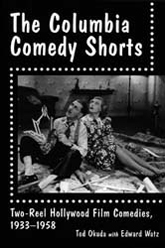
The Columbia Comedy Shorts, Ted Okuda and Ed Watz’s interesting history — courtesy of McFarland Press — of the 25 years of two-reel comedies the studio generated is fascinating reading if your a genre buff, and interesting even to the fan whose knowledge of Columbia shorts is limited to the several score shorts that starred the Three Stooges. Reading the book, I was amazed at the depth of the comic talent that Jules White grabbed for Columbia over three decades. I was aware of the Stooges, of course, and the former big-name silent stars who worked with Columbia — Harry Langdon, Buster Keaton, Charley Chase, Andy Clyde — but I’d wager very few know of Vera Vague, or Sterling Holloway, or Billie Burke, or Maxie Rosenbloom and Max Baer, or Hugh Herbert, Walter Catlett, Collins & Kennedy, Harry Von Zell, and solo efforts from future Stooges Shemp Howard and Joe Besser, and even Bert Wheeler, plus Wally Brown. All, and more, were under contract with Columbia shorts. (Vague, by the way, garnered two Academy Award nominations, note the authors.)

Okuda and Watz wrote this valuable reference guide before the era of broadband Internet, and YouTube, and Google archives. At that time, only the Stooges were easily available to watch. Others required 16-millimeter film purchases. That’s changed. I can go to YouTube and watch the Columbia shorts of Langdon, Keaton, Clyde, Shemp, Chase, and even catch one of the obscure comedies of Baer and Rosenbloom, which were not available to the authors. In fact, most of Columbia’s other stars failed to catch on in the TV era for two reasons: one, they didn’t have the sheer volume of episodes of the Stooges; and two, nor did they have the fan base. This bears explaining — as enjoyable as the Columbia efforts of Langdon, Chase, Keaton, etc., are, the shorts are not these comics’ best works. Columbia, which under Jules White, stressed loud gags and action, defined the Stooges; many of the others had to adapt to Columbia.

This is not a criticism of Jules White, who seemed an amazing man, with tremendous energy and a desire to grab as many comics as he could while at the helm of the two-reeler section of the studio. From reading this book, which benefits from extensive interviews with Jules White, director Edward Bernds and feature player in many shorts, Emile Sitka, it’s apparent that the executives' disinterest in the shorts department — so long as it was making money — allowed tremendous autonomy for White. According to the book, salaries for the stars ranged from $500 an episode to $1,000 (for Keaton), to $1,250 (for Langdon) and to $2,500 an episode for each of the Stooges.

While most of the shorts were heavy on slapstick, White, and also producer Hugh McCollum, sometimes offered more subtle humor, such as Sterling Holloway, popular in the late 40s and 50s. Also, director Bernds was able to complete some shorts that provided more humor than just slapstick. His Stooges’ short, “Micro-phonies,” (watch below) remains my favorite for just that reason, including the opportunity to hear the beautiful voice of Columbia’s most famous comedy shorts woman, Christine McIntyre, who has achieved iconic status as a Stooge player.

As mentioned, while the Stooges were honed on Columbia’s fast-paced, loud action templates that sometimes ended abruptly, it frequently led to lesser efforts from the other stars. However, as the authors note, by the latter 1930s, Langdon, Chase, and many others were looking for work, and in no position to turn down the above-average paydays. Jules White clearly admired the players he offered starring roles for in the shorts, and it’s a pleasure for genre fans to watch Langdon and others provide laughs in that later era. And, it’s important to remember, the Columbia shorts were wildly popular. Even a sub-par Langdon effort, such as “A Blitz on the Fritz,” was a huge hit for movie-goers watching these shorts prior to the main films. The Stooges were so popular that Columbia used the popularity to boost their feature films, the authors note.

“The Columbia Comedy Shorts: Two-Reel Hollywood Film Comedies, 1933-1958” provide the ingredients that made the shorts. There are short profiles of the directors, Jules White, his brother Jack White (Preston Black), as well as Bernds, Charley Chase, Del Lord, and the unfortunate Harry Edwards, who appears to have been everyone’s least favorite, except for a loyal Harry Langdon. Not surprisingly, the authors note that Edwards was eased out after Langdon’s death in late 1944. Information is included on the writers, how the films were shot, including sound effects, previews, casting, budgets, stunts ... and injuries, pay scale, etc. There are even script samples. Readers may be surprised at how closely the Stooges, for example, followed scripts. The comedy chaos can lead to an assumption that much of the action was ad-libbed, but not really.

All of the shorts produced are provided at least a paragraph of information, and the authors are careful to note where scenes from other shorts were used; a practice that occurred often in the more lean-budget 1950s. For example: Although Christine McIntyre had left Columbia by the mid-1950s, footage of her was used in later “new” shorts.

There are short biographies of professionals involved in Columbia productions. I haven’t mentioned Vernon Dent, a mainstay throughout the Columbia shorts era. Always a featured player, his talent was equal to the stars. Reading Dent’s short biography, I wanted to learn more. It's great to learn that there is now full-length biography of this comedy pioneer, "Vernon Dent: Stooge Heavy ...,” from BearManorMedia. The versatile McIntyre, in so many of the Columbia shorts, would be an interesting biography, in my opinion. Edward Bernds penned an autobiography, “Mr. Bernds Goes to Hollywood,” which I have read.

Okuda and Watz have compiled a valuable, interesting film history tool, with fantastic nuggets of information. It’s as valuable today as it was in 1986, when first released. Now that many of these shorts can be viewed at home, the book is a handy resource. You can buy the book here.