Showing posts with label Christine McIntyre. Show all posts
Thursday, November 4, 2021
Harry Langdon, Una Merkel a comedy pair in 'To Heir is Human'
By Doug Gibson"To Heir is Human" (imdb page is here) is one of comic legend Harry Langdon's more energetic late comedy shorts for Columbia, which featured other comic stars besides the Three Stooges. Released in early 1944, it stars Harry as window washer Harry Fenner, who is improbably located by telephone book deliverer Una, played by Una Merkel. It seems a sinister looking fellow asked Una to find Harry and deliver him to a forbidding domain where he'll inherit a fortune.The man, A Raven Sparrow, will give Una $1,000 to find Harry. Una drags a semi-reluctant Harry to the house, where naturally, a trio comprised of relatives and a thuggish handyman want to knock off Harry -- and Una -- and get all the inherited cash for themselves.
Although he's looking very old -- Langdon would die in December 1944 -- Harry is in excellent form the low-budget short, produced in Hugh McCollum's wing of Columbia's shorts studio. "The Elf" is in form in a few scenes, particularly during his initial refusal of Una's efforts to locate him, and more prominently in a later scene with his Vampish "kissing cousin," Velma, played by Christine McIntyre, who later gained iconic status as a Three Stooges regular. Langdon is hilarious with his mild surprise and resistance as Velma, one of the baddies, tries to provide him poisoned drinks. A Raven Sparrow, by the way, is played by Lew Kelly, who looked like a creepy cross between an aged Boris Karloff and John Carradine. The handyman is played by Bud Gribbon. His best scene is where he lowers a noose over Harry's head, who mistakes it for a tie. There are effective scenes in the house, particularly a room with an electric. Both A. Sparrow Raven and Una receive unpleasant but funny jolts as a result.
Now, I have not mentioned Una Merkel's contribution yet, because I've been saving it for her own paragraph or too. She absolutely marvelous in her role as dogged working girl Una. Merkel, who later gained a measure of consistent fame, had enjoyed a measure of stardom in the 1930s. However, by 1943 she was in a slump, and doing low-budget shorts. Nevertheless, her career slump doesn't show in this film.
Merkel has a tremendous eye for comedy, particularly slapstick, and she shows a lot of that in the film. She's literally manhandled in this film, getting thrown out of offices, having telephone directories thrown at her, being pulled by a thug who wants to kill her, fainting, and being electrocuted. Nevertheless, she never stops protecting her charge Harry, even if her main motivation for the $1,000 is to improve her appearance. Una Merkel reminds me of a slightly more intelligent version of Patsy Kelley in her shorts with Thelma Todd. Her pairing with the lower key Langdon works well. ... By the way, frequent Langdon co-star Vernon Dent has a cameo as a board chairman of a business. The scene is while Una is chasing Harry, and Langdon is funny as he intrudes into the speech.
This is an obscure film. A Langdon fan and film collector originally provided me a copy of the film, Look for it at Turner Classic Movies on the odd chance it will get on as an "extra." It is now on YouTube, however. Watch it here.
Saturday, January 6, 2018
Pistol Packin' Nitwits -- Harry Langdon's last film
Review by Doug Gibson
I've probably seen "Pistol Packin' Nitwits" about 40 times; even though its circulation days are long over. With a YouTube dupe and my own duped DVD, courtesy of a kind fellow Harry Langdon fan, I have easy access to this Columbia comedy short via a DVD-R print.
There's pathos involved in my interest and fascination. It's sad but compelling. Harry died after completing the film. Although not the last released, this was the final film Harry made. According to his wife, Mabel Langdon, he came home feeling very ill after a day of shooting, citing in particular a soft shoe dance routine he did with co-star El Brendel. (The dance, by the way, is one of the highlights of the short). Watching the dance, you realize it's more or less the last work this comedy genius ever did.
Harry was 60 and there seemed to be a history in his family of dying relatively young. His doctor diagnosed a cerebral hemorrhage, and Harry unfortunately quickly declined, dying on Dec. 22, 1944. Besides Mabel, he was survived by his son, Harry Jr., who still lives and has enjoyed an excellent career as a photographer.
There's another reason I enjoy "Pistol Packin' Nitwits," even though it's far from Harry's best sound short, or even his best Columbia short. It's a wildly free-ranging film, a blunt spoof that's 90 percent western and 10 percent "old-time serial superhero with amazing powers."
The plot: In Hangman's Gulch, Nevada, the beautiful Queenie Lynch (Christine McIntyre) owns Queenie's Place," a saloon. Her future is threatened by thuggish and buffoonish Rawhide Pete (Dick Curtis) who owns the mortgage on the saloon and will foreclose if Queenie won't marry him by midnight. Queenie appeals to the handsome cowboy Jack (Brad King) to help her and he promises to have $2,500 by midnight.
Harry and "Professor" Brendel are grifter salesmen peddling fake cleaning fluid. With Pete as a volunteer, they mistakenly put real axle grease on his clothes and make a huge mess. This so amuses Queenie that she hires the hapless duo to "help run the place." Inside the saloon, Pete, when he isn't falling over and threatening Harry and El Brendel, tries to kill Jack with a gun. In the "superhero" spoof portion of the film, the bullets bounce of the chest of a smiling Jack. Harry and El Brendel think Pete was firing blanks but almost lose their lives learning that he is using real bullets.
The middle portion of the film has two shining moments; the aforementioned soft shoe dance of the comedy duo (see screen shot above) and a solo song, "Father, Dear Father," by McIntyre. She has a beautiful singing voice, as anyone who has seen the Three Stooges short, "Micro-phonies," already knows.
In between are the gag scenes, with El Brendel hitting the jackpot on a machine, Harry avoiding an unfunny stereotypical old cowboy, the duo trying to use a test-your-punching-strength machine to steal the mortgage from Pete, and Pete being generally buffoonish, at one time having a bumblebee fly into his collar.
IMDB incorrectly lists Edward Bernds as the director. It's actually Harry Edwards, a one-time major talent who had sunk to mediocrity by this time. While this is better than a host of Langdon 1940s Columbia efforts, it still suffers from poorly presented gags and editing is poor. An example is inclusion shots of Jack racing on his horse to get back to the saloon. They play to The William Tell Overture but the inserts last about one second and are place clumsily in the film. (Bernds has co-credit with Langdon for the story).
There's a showdown at the end with Jack, Pete, Harry, El Brendel and Queenie. I'll let readers watch the film and be surprised.
As mentioned, I have a fondness for the film. It's quirky and has some good song and dance routines. Harry is funny; El Brendel is less funny but some of the gags work, including the cleaning fluid demonstration and the efforts to rid Pete of the mortgage.
Langdon enjoyed the security of working at Columbia (he called them "O-Ouch-O" comedies). He was looking his age, though, and starting to get overshadowed in shorts by lesser talents, such as El Brendel and even Elsie Ames. On the other hand, he was working in B movies, as well as sometimes on the stage and writing. This was the happiest time of his life, with a comfortable home, a loving wife and a son growing up.
Both Edwards and El Brendel only lasted about a year with Columbia after "Pistol Packin' Nitwits." Although Curtis died at 49 in 1952 of pneumonia, he made about 250 films, and was active in Columbia shorts as well as early television. McIntyre (see below) had a long association with Columbia shorts, particularly with the Three Stooges. In fact, today she is iconic for her association with the trio as their co-star.
"Pistol Packin' Nitwits" was remade as "Out West," in 1947, with the Three Stooges as the stars. McIntyre reprises the role of the damsel in distress. "Out West" is directed by Bernds. The probable reason Bernds is listed as director in IMDB is because Columbia goofed in their release posters for "... Nitwits," listing Bernds as director. I must confess, of the pair, I prefer "Pistol Packin' Nitwits." Give it 17 minutes of your time, and watch Harry Langdon gamely finish the scenes and wrap his final film.
Monday, November 20, 2017
Bert Wheeler in the short Innocently Guilty
It's time for another installment in our occasional series of those old-time Columbia comedy shorts that are not well known (think all of them save the Three Stooges.) Today we recall "Innocently Guilty," a 1951 two-reeler that starred Bert Wheeler. Above is a still from the climax of the short. Yes, Bert was hiding in a baby carriage.
Some information about Bert Wheeler. He was a big name in the 1920s on the vaudeville stage and achieved even more fame on the big screen as the boyish half of Wheeler and Woolsey. They made a slew of wonderful comedy films for several years that made a lot of money. After Robert Woolsey died Wheeler's screen career faded and although a working actor, he was struggling to earn a living by 1950, working in summer stock, etc.
As Ed Watz and Ted Okuda note in their book, "The Columbia Comedy Shorts," the head man at Columbia's comedy shorts, Jules White liked to sign former comedy names to two-picture deals, with an option for more if the shorts caught the public's fancy. White, who directed "Innocently Guilty," is quoted in the book as saying, "I gave him (Wheeler) a job at a time nobody else wanted him." Wheeler only made two shorts for Columbia. The second, in 1951, is called "The Awful Sleuth." (I have not seen that one.) "Innocently Guilty" is mediocre, although Wheeler acts well in it. The fault lies in a mediocre script and director White, who often equated humiliation and violence with humor. Only the Three Stooges were consistently able to take such direction and turn it into quality humor.
The short, which Okuda and Watz note had already been filmed twice with Andy Clyde as "It Always Happens" (1935) and "His Tale is Told," (1944) is remade with Wheeler as Hodkinson G. Pogglebrewer, tractor salesman, leaving his happy home to pitch tractors in the big city to Mr. Bass (the perennial Vernon Dent). Old Hodkinson has an appealing wife, Helen, played by another Columbia perennial supporting player, Christine McIntyre. Unfortunately, the script calls for Hodkinson to have a pathologically suspicious sister-in-law, Marge (Margie Listz), used by White for slapstick physical humor.
Once in the big city Hodkinson helps a sexy woman, Fifi (Nanette Bordeaux) in the hotel, in her room, with an innocent task. Unfortunately, his crazy sister in law has dragged his wife to spy on him. Catching hubby looking compromised with another woman, she plans to divorce him but quickly changes her mind. All seems OK except that the next day, Hodkinson, to get a sale, pretends to be a ladies man to Bass. He even lies about what happened with Fifi. Bass admits to Hodkinson that he's so jealous of perceived male attention to his wife he'd commit violence if confronted with it.
You guessed it folks, Fifi is Mr. Bass' wife. And with the imagination of Jules White, Fifi, sans outer clothing, Mr. Bass, and Hodkinson all end up in a car together. Fifi gets back to her room undetected, followed for some reason by Hodkinson, and then followed by pathological Margie and Helen, and finally by Bass, now prepared to kill Hodkinson.
None of this is terribly funny. The short ends inconclusively, with Bass shooting at the fleeing, dressed-as-a-baby Hodkinson. White was known for ending shorts with the stars running away, the conflict unresolved.
So why did I still enjoy the short? It's a part of history, a starring big-screen role for Wheeler late in his career. And Bert Wheeler is indeed good in the short. Even a decade-plus after the glory days, he retains the boyish, aw-shucks, optimistic charm that he had with RKO in the 1930s. He's likable. He's just shoved into an awful script and a poor choice for a director.
It's' also fun to see veterans McIntrye and Dent in any Columbia short, although this is far from their best work. Dent, in particular, is far too passive in his opening scene to be accepted later as a husband jealous enough to kill. Both Dent and Liszt take their knocks more than once as foils for physical humor. Early in the film water from a store awning knocks Liszt for a loop, and of course actors take tumbles in the bathroom scene. It's also nice to see silent star Heinie Conklin in a small supporting role as the janitor.
I was able to see this film thanks to Greg Hilbrich, who runs The Columbia Shorts Department website, which is just full of information all things Columbia comedy shorts. The short is posted on Hilbrich's Facebook wall. It's come to my attention he soon plans to post it on The Shorts Department YouTube page and once that occurs, I will embed the short here.
Friday, May 13, 2016
Harry Langdon in 'To Heir is Human,' a Columbia comedy short
By Doug Gibson
"To Heir is Human" (imdb page is here) is one of comic legend Harry Langdon's more energetic late comedy shorts for Columbia, which featured other comic stars besides the Three Stooges. Released in early 1944, it stars Harry as window washer Harry Fenner, who is improbably located by telephone book deliverer Una, played by Una Merkel. It seems a sinister looking fellow asked Una to find Harry and deliver him to a forbidding domain where he'll inherit a fortune.The man, A Raven Sparrow, will give Una $1,000 to find Harry. Una drags a semi-reluctant Harry to the house, where naturally, a trio comprised of relatives and a thuggish handyman want to knock off Harry -- and Una -- and get all the inherited cash for themselves.
Although he's looking very old -- Langdon would die in December 1944 -- Harry is in excellent form the low-budget short, produced in Hugh McCollum's wing of Columbia's shorts studio. "The Elf" is in form in a few scenes, particularly during his initial refusal of Una's efforts to locate him, and more prominently in a later scene with his Vampish "kissing cousin," Velma, played by Christine McIntyre, who later gained iconic status as a Three Stooges regular. Langdon is hilarious with his mild surprise and resistance as Velma, one of the baddies, tries to provide him poisoned drinks. A Raven Sparrow, by the way, is played by Lew Kelly, who looked like a creepy cross between an aged Boris Karloff and John Carradine. The handyman is played by Bud Gribbon. His best scene is where he lowers a noose over Harry's head, who mistakes it for a tie. There are effective scenes in the house, particularly a room with an electric. Both A. Sparrow Raven and Una receive unpleasant but funny jolts as a result.
Now, I have not mentioned Una Merkel's contribution yet, because I've been saving it for her own paragraph or too. She absolutely marvelous in her role as dogged working girl Una. Merkel, who later gained a measure of consistent fame, had enjoyed a measure of stardom in the 1930s. However, by 1943 she was in a slump, and doing low-budget shorts. Nevertheless, her career slump doesn't show in this film.
Merkel has a tremendous eye for comedy, particularly slapstick, and she shows a lot of that in the film. She's literally manhandled in this film, getting thrown out of offices, having telephone directories thrown at her, being pulled by a thug who wants to kill her, fainting, and being electrocuted. Nevertheless, she never stops protecting her charge Harry, even if her main motivation for the $1,000 is to improve her appearance. Una Merkel reminds me of a slightly more intelligent version of Patsy Kelley in her shorts with Thelma Todd. Her pairing with the lower key Langdon works well. ... By the way, frequent Langdon co-star Vernon Dent has a cameo as a board chairman of a business. The scene is while Una is chasing Harry, and Langdon is funny as he intrudes into the speech.
This is an obscure film. A Langdon fan and film collector originally provided me a copy of the film, Look for it at Turner Classic Movies on the odd chance it will get on as an "extra." It is now on YouTube, however.
Sunday, January 24, 2016
Wife to Spare -- a Columbia comedy short with Andy Clyde
By Doug Gibson
Above you is a Columbia comedy short from 1947. It is obscure primarily because it's not one of The Three Stooges shorts. The wonderful trio has endured, and arguably is on TV somewhere daily. But there are many, many other Columbia comedy shorts, and they are gems. Stars include Buster Keaton, Charlie Chase, Harry Langdon, Hugh Herbert, Andy Clyde (of whom we will talk about in this post) and many more.
They merit appreciation today, and at Plan9Crunch we plan to highlight the non-Stooges Columbia shorts. There are a lot. We'll also make sure when we review a short, that our readers can watch it via YouTube, or other sources. That takes me to a wonderful film historian named Greg Hilbrich, who following the fantastic research of Ed Watz, Ted Okuda, Leonard Maltin and others, has created The Columbia Shorts Department website. It's a labor of love to pay homage to all the shorts that studio released over a quarter century. We interviewed Greg on his site recently and we reviewed Watz and Ted's book on the Columbia shorts as well.
What Mr. Hilbrich has done, as well as some others on YouTube (Johnny Flattire and Billie Towzer come to mind) is to upload many of the "lost" Columbia shorts on The Shorts Department YouTube page. Thanks to the Columbia Shorts Department, I have watched a 1947 Andy Clyde Columbia short, "Wife to Spare," several times in the last week. You can watch it too, it's at the top of this blog.
In what will be, as mentioned, and occasional series on Plan9Crunch, we'll make "Wife to Spare" the first Columbia short to be reviewed in 2016. (By the way, we have reviewed another a ways back, Harry Langdon in "To Heir is Human."
---
Wife to Spare, 1947, Columbia comedy short, black and white, about 16 minutes, 25 seconds, directed by Edward Bernds, starring Andy Clyde, Christine McIntyre, Lucile Brown, Dick Wessel, Vera Lewis, Murray Alper, Emile Sitka and Heine Conklin.
---
What's best about this late 1940s offering is the cast. It's stellar. Besides Clyde as the fussy businessman married to beautiful Brown, and forced to live with a ne-er-do-well brother in law (Wessel) and a mother in law from hell (Lewis) you have Columbia second player stars Sitka and McIntyre in supporting roles. Finally, Conklin, a name from the comedy silents, has a small role as a janitor. It's retro movie magic, and although the tight budget and hurried script is evident, the manpower of talent, as well as above-average direction of Bernds, make this an enjoyable 1,000 seconds and I'm sure pleased theater audiences.
Clyde made hundreds of Columbia shorts. By this time he had long shaved his beard, kept the mustache and was able to play a fussy, yet determined city man, trying to solve others mistakes, get out of his own jam, and have a peaceful life with his wife and no mother in law. The plot has him trying to get his layabout brother in law (Wessel) out of a $500 jam due to activities with a sexy gold-digger, played by a very attractive McIntyre, who literally lets her hair down, chewing up the scenery as a schemer who moves to frame Clyde once she realizes he has more cash.
In a funny scene, McIntyre maneuvers Clyde into compromising photos and audio while her co-swindler husband, Alper, gathers the "evidence." Things appear bleak for Clyde; the swindlers are demanding $5,000, his wife has overheard him talking to McIntyre, and his mother in law hires a lawyer (Sitka) to have her daughter divorce Andy.
As with most of the films, before budgets were really slashed in the 1950s, there's a lot of plot for two reels. Enough of the jokes work to leave you with a smile. These actors stayed busy. Clyde had overall 390 acting roles, says IMDB, McIntyre 130, most with Columbia shorts. Wessel 301!
I'd like to focus on two "Wife to Spare" Columbia shorts regulars. McIntyre is best known as a classy co-star to the Stooges, with her hair up and manners impeccable. Like Dent and Sitka, she's achieved iconic status as a Stooges' foil. In "Wife to Spare,' she has a more prurient sexual appeal, with her hair down and trying to sweet talk Clyde with a fake southern accent (her name is Honey Jackson). The other occasional Columbia player is Wessel. He hasn't gained iconic status and while he had his moments in other shorts, he's the weak link in "Wife to Spare." His idea of comedy is to laugh hysterically (maniacally) every time Andy bumps his head or walks into something.
The opening scene sets the pace for a slightly above average short, with Clyde dressed in woman's clothes, forced to clothes model for the women in his household. Watch it above and come back to Plan9Crunch for another Columbia shorts review in the near future.
Wednesday, August 21, 2013
Book on Columbia comedy shorts offers a fascinating glimpse of two-reeler history
By Doug Gibson
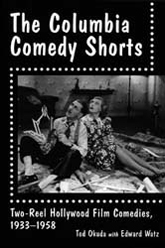
The Columbia Comedy Shorts, Ted Okuda and Ed Watz’s interesting history — courtesy of McFarland Press — of the 25 years of two-reel comedies the studio generated is fascinating reading if your a genre buff, and interesting even to the fan whose knowledge of Columbia shorts is limited to the several score shorts that starred the Three Stooges. Reading the book, I was amazed at the depth of the comic talent that Jules White grabbed for Columbia over three decades. I was aware of the Stooges, of course, and the former big-name silent stars who worked with Columbia — Harry Langdon, Buster Keaton, Charley Chase, Andy Clyde — but I’d wager very few know of Vera Vague, or Sterling Holloway, or Billie Burke, or Maxie Rosenbloom and Max Baer, or Hugh Herbert, Walter Catlett, Collins & Kennedy, Harry Von Zell, and solo efforts from future Stooges Shemp Howard and Joe Besser, and even Bert Wheeler, plus Wally Brown. All, and more, were under contract with Columbia shorts. (Vague, by the way, garnered two Academy Award nominations, note the authors.)
Okuda and Watz wrote this valuable reference guide before the era of broadband Internet, and YouTube, and Google archives. At that time, only the Stooges were easily available to watch. Others required 16-millimeter film purchases. That’s changed. I can go to YouTube and watch the Columbia shorts of Langdon, Keaton, Clyde, Shemp, Chase, and even catch one of the obscure comedies of Baer and Rosenbloom, which were not available to the authors. In fact, most of Columbia’s other stars failed to catch on in the TV era for two reasons: one, they didn’t have the sheer volume of episodes of the Stooges; and two, nor did they have the fan base. This bears explaining — as enjoyable as the Columbia efforts of Langdon, Chase, Keaton, etc., are, the shorts are not these comics’ best works. Columbia, which under Jules White, stressed loud gags and action, defined the Stooges; many of the others had to adapt to Columbia.
This is not a criticism of Jules White, who seemed an amazing man, with tremendous energy and a desire to grab as many comics as he could while at the helm of the two-reeler section of the studio. From reading this book, which benefits from extensive interviews with Jules White, director Edward Bernds and feature player in many shorts, Emile Sitka, it’s apparent that the executives' disinterest in the shorts department — so long as it was making money — allowed tremendous autonomy for White. According to the book, salaries for the stars ranged from $500 an episode to $1,000 (for Keaton), to $1,250 (for Langdon) and to $2,500 an episode for each of the Stooges.
While most of the shorts were heavy on slapstick, White, and also producer Hugh McCollum, sometimes offered more subtle humor, such as Sterling Holloway, popular in the late 40s and 50s. Also, director Bernds was able to complete some shorts that provided more humor than just slapstick. His Stooges’ short, “Micro-phonies,” (watch below) remains my favorite for just that reason, including the opportunity to hear the beautiful voice of Columbia’s most famous comedy shorts woman, Christine McIntyre, who has achieved iconic status as a Stooge player.
As mentioned, while the Stooges were honed on Columbia’s fast-paced, loud action templates that sometimes ended abruptly, it frequently led to lesser efforts from the other stars. However, as the authors note, by the latter 1930s, Langdon, Chase, and many others were looking for work, and in no position to turn down the above-average paydays. Jules White clearly admired the players he offered starring roles for in the shorts, and it’s a pleasure for genre fans to watch Langdon and others provide laughs in that later era. And, it’s important to remember, the Columbia shorts were wildly popular. Even a sub-par Langdon effort, such as “A Blitz on the Fritz,” was a huge hit for movie-goers watching these shorts prior to the main films. The Stooges were so popular that Columbia used the popularity to boost their feature films, the authors note.
“The Columbia Comedy Shorts: Two-Reel Hollywood Film Comedies, 1933-1958” provide the ingredients that made the shorts. There are short profiles of the directors, Jules White, his brother Jack White (Preston Black), as well as Bernds, Charley Chase, Del Lord, and the unfortunate Harry Edwards, who appears to have been everyone’s least favorite, except for a loyal Harry Langdon. Not surprisingly, the authors note that Edwards was eased out after Langdon’s death in late 1944. Information is included on the writers, how the films were shot, including sound effects, previews, casting, budgets, stunts ... and injuries, pay scale, etc. There are even script samples. Readers may be surprised at how closely the Stooges, for example, followed scripts. The comedy chaos can lead to an assumption that much of the action was ad-libbed, but not really.
All of the shorts produced are provided at least a paragraph of information, and the authors are careful to note where scenes from other shorts were used; a practice that occurred often in the more lean-budget 1950s. For example: Although Christine McIntyre had left Columbia by the mid-1950s, footage of her was used in later “new” shorts.
There are short biographies of professionals involved in Columbia productions. I haven’t mentioned Vernon Dent, a mainstay throughout the Columbia shorts era. Always a featured player, his talent was equal to the stars. Reading Dent’s short biography, I wanted to learn more. It's great to learn that there is now full-length biography of this comedy pioneer, "Vernon Dent: Stooge Heavy ...,” from BearManorMedia. The versatile McIntyre, in so many of the Columbia shorts, would be an interesting biography, in my opinion. Edward Bernds penned an autobiography, “Mr. Bernds Goes to Hollywood,” which I have read.
Okuda and Watz have compiled a valuable, interesting film history tool, with fantastic nuggets of information. It’s as valuable today as it was in 1986, when first released. Now that many of these shorts can be viewed at home, the book is a handy resource. You can buy the book here.
Thursday, June 13, 2013
A Harry Langdon talkie short -- 'To Heir is Human'
By Doug Gibson
"To Heir is Human" (imdb page is here) is one of comic legend Harry Langdon's more energetic late comedy shorts for Columbia, which featured other comic stars besides the Three Stooges. Released in early 1944, it stars Harry as window washer Harry Fenner, who is improbably located by telephone book deliverer Una, played by Una Merkel. It seems a sinister looking fellow asked Una to find Harry and deliver him to a forbidding domain where he'll inherit a fortune.The man, A Raven Sparrow, will give Una $1,000 to find Harry. Una drags a semi-reluctant Harry to the house, where naturally, a trio comprised of relatives and a thuggish handyman want to knock off Harry -- and Una -- and get all the inherited cash for themselves.
Although he's looking very old -- Langdon would die in December 1944 -- Harry is in excellent form the low-budget short, produced in Hugh McCollum's wing of Columbia's shorts studio. "The Elf" is in form in a few scenes, particularly during his initial refusal of Una's efforts to locate him, and more prominently in a later scene with his Vampish "kissing cousin," Velma, played by Christine McIntyre, who later gained iconic status as a Three Stooges regular. Langdon is hilarious with his mild surprise and resistance as Velma, one of the baddies, tries to provide him poisoned drinks. A Raven Sparrow, by the way, is played by Lew Kelly, who looked like a creepy cross between an aged Boris Karloff and John Carradine. The handyman is played by Bud Gribbon. His best scene is where he lowers a noose over Harry's head, who mistakes it for a tie. There are effective scenes in the house, particularly a room with an electric. Both A. Sparrow Raven and Una receive unpleasant but funny jolts as a result.
Now, I have not mentioned Una Merkel's contribution yet, because I've been saving it for her own paragraph or too. She absolutely marvelous in her role as dogged working girl Una. Merkel, who later gained a measure of consistent fame, had enjoyed a measure of stardom in the 1930s. However, by 1943 she was in a slump, and doing low-budget shorts. Nevertheless, her career slump doesn't show in this film.
Merkel has a tremendous eye for comedy, particularly slapstick, and she shows a lot of that in the film. She's literally manhandled in this film, getting thrown out of offices, having telephone directories thrown at her, being pulled by a thug who wants to kill her, fainting, and being electrocuted. Nevertheless, she never stops protecting her charge Harry, even if her main motivation for the $1,000 is to improve her appearance. Una Merkel reminds me of a slightly more intelligent version of Patsy Kelley in her shorts with Thelma Todd. Her pairing with the lower key Langdon works well. ... By the way, frequent Langdon co-star Vernon Dent has a cameo as a board chairman of a business. The scene is while Una is chasing Harry, and Langdon is funny as he intrudes into the speech.
This is an obscure film. A Langdon fan and film collector originally provided me a copy of the film, Look for it at Turner Classic Movies on the odd chance it will get on as an "extra." It is now on YouTube, however. Watch it here.
Monday, April 8, 2013
'Gold Raiders' - obscure but notable as the 3 Stooges first feature


By Doug Gibson
"The Gold Raiders," 1951, B&W, 56 minutes, directed by Edward Bernds, starring George O'Brien as "George O'Brien," The Three Stooges, Moe Howard, Larry Fine and Shemp Howard, Lyle Talbot as Taggert, Sheila Ryan as Laura Mason and Clem Bevans as Doc Mason.
This "oater" is a curio, mainly because it features the Three Stooges in supporting roles. The very short B-film stars silent and early talkie cowboy film star George O'Brien as a lawman turned insurance man hired by mining companies to get their gold safely to the bank. Crime boss Lyle Talbot wants to steal the gold. He tries to get information on where the gold is being taken from a drunken old doctor (Bevans) who, with his stooped figure and drawling voice, is made for westerns.
The Three Stooges play bumbling peddlers who ally with O'Brien to keep the gold safe. Gold Raiders is an OK film. It's nothing special from the hundreds of other "oaters" made in Hollywood but an aging O'Brien does an OK job shooting and fighting. Talbot, who starred in Ed Wood films, is a good villain and the Stooges are funny.
Director Bernds, who helmed many Stooge shorts, a few with the trio's beautiful blonde co-star Christine McIntyre, and later some features, told Cult Movies Magazine that Moe Howard was envious of Abbott and Costello and wanted to get into features. The result was Gold Raiders, an almost forgotten film today that was meant more as a comeback vehicle for O'Brien. Bernds recalled that the film was trashed by critics but, in my opinion, it really isn't too bad. Its main handicap is an abysmally low budget. It was shot in five days and looks it. One unintentionally funny scene includes a close-range shootout in a cramped saloon where almost no one seems to get shot. The film is also unique in that it may be the only western ever made where an insurance man is a two-fisted, gunslinging hero! It's a fun film and it's interesting and not unpleasant to see see the Stooges as comedy relief is a western action film.
According to Bernds, the film idea was hatched because Moe was envious of the success of the comedy team of Abbott & Costello. Despite the obscurity of Gold Raiders, the Stooges later made several features where they were the stars, including The Three Stooges Meet Hercules, Snow White and the Three Stooges and The Outlaws is Coming. Truth is, though, I enjoy the lean and mean Gold Raiders more than any of the later bigger-budget efforts. The Stooges are more effective as comedy relief, rather than the main components of a film
Notes: The makeup for Gold Raiders was done by Ed Wood regular Harry Thomas. Gold Raiders was released by United Artists but plans for a sequel with the Stooges and O'Brien were abandoned. The film was released to TV several years later and then sat for decades forgotten until 2006 when Warner Brothers released it on DVD. It can be bought via amazon.com
Subscribe to:
Posts (Atom)