Translate

Wednesday, August 27, 2014

Three of Bela Lugosi's best Monogram cheapie thrillers

In the early 1940s, Bela Lugosi signed a deal to star in several Monogram low-budget horror flicks (a couple were comedy/thrillers with the East Side Kids). It was a decision that allowed Lugosi to be the top actor on the set, an occurrence diminishing at Universal Studios. The films are mediocre save Lugosi's usual excellent performance. Unlike Boris Karloff, for example, Lugosi never phoned in performances in low-budget films. We've reviewed most of the Monogram films at Plan9Crunch, but I want to give capsule salutes to three of my favorites.

Doug Gibson


BOWERY AT MIDNIGHT, 1942:

Although the competition is fierce, this is likely the most kitschy delight when it comes to chaos and convolution. Lugosi plays a man cursed with three personalities: college professor, kindly operator of skid row soup kitchen and ruthless criminal. My favorite Lugosi scene: When the master criminal, reacting to a low level crook's joy at being part of a big robbery, casually tosses the crook off a multi-story roof, thereby creating the disruption necessary for he crime. Review here.


THE APE MAN, 1943:

Often derided as a "worst film," it isn't. Lugosi goes way beyond what's just to give some dignity to this film as a mad scientist who turns himself into part ape and has to kill to get a spinal fluid that might cure him. Wallace Fox and Louise Currie are also excellent co-stars who play journalists who foil his plans. See this film. Our review is here.


THE INVISIBLE GHOST, 1941:

Lugosi's first Monogram has a convoluted plot but benefits from above-average direction from Joseph H. Lewis. Lugosi plays a kindly man whose wife deserted him. Unbelievably, she still lives on the grounds and he goes quite mad when he catches glimpses of her. The deaths lead to the execution of one innocent man whose brother (same actor) comes to the house to seek justice. Lugosi's hypnotic walk when under the murder spell of his wife is campy but the actor also brings pathos to it. Former silent star Betty Compson plays Lugosi's estranged, insane wife.

Wednesday, August 20, 2014

Six Jerry Warren classics on DVD from VCI Entertainment!


By Steve D. Stones

If you thought Ed Wood made ridiculously bad films, it’s likely you’ve never sat through a Jerry Warren Z-movie bomb. VCI Entertainment and Kit Parker Films teamed up in 2013 to release six Warren classics on two DVDs. Each DVD has three films with trailers, deleted scenes and interviews with cast members – such as Katherine Victor and Geraldine Brianne Murphy – the women who wore the Yeti costume in Man Beast (1956).

Volume One contains The Wild World of Bat Woman (aka She Was A Hippie Vampire - 1966), Curse of The Stone Hand (1964), and Man Beast (1956). Volume Two contains Attack of The Mayan Mummy (1964), Creature of The Walking Dead (1965) and House of Black Death (1965) – starring horror icons Lon Chaney and John Carradine.

Three of the films on both volumes are chopped up Mexican imports that Warren cut then added scenes with padded, long dialog and boring voice-over narration. The added scenes combined with the existing Mexican footage are confusing and do not add much to the finished product. Attack of The Mayan Mummy, Curse of The Stone Hand and Creature of The Walking Dead are all examples of this.  Creature of The Waking Dead is the most watchable of the three, but may still test your movie watching attention span.

Warren makes better films when he does not rely on cutting existing footage from imports. Man Beast is a good example of this. The film has a simple, easy to follow plot concerning an expedition that sets out to find the existence of Yeti creatures in the Himalayan Mountains. The film may look cheap, but at least it does not confuse the viewer, as his chopped up Mexican imports do. It may be his best film ever.

I’m hopeful that VCI Entertainment and Kit Parker Films will release a third volume on DVD of Warren’s films that includes three more of his beloved drive-in fodder  classics– such as The Incredible Petrified World, Teenage Zombies and Invasion of The Animal People. Let’s keep our fingers crossed.  Happy viewing. 

Monday, August 18, 2014

Cult movies writer Frank Dello Stritto's memoir published in Standard-Examiner newspaper


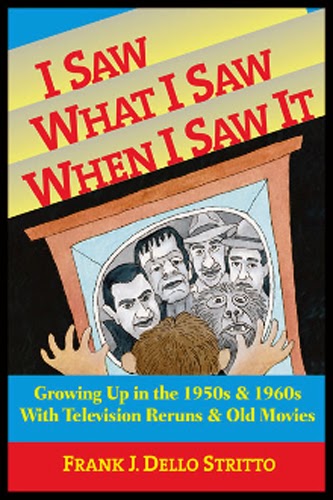
On Aug. 17, 2014, my review of Frank J. Dello Stritto's memoir, "I Saw What I Saw When I Saw It: Growing Up in the 1950s & 1960s With Televison Reruns & Old Movies," (2014, Cult Movies Press) was published in the Standard-Examiner newspaper. Here is the beginning:

The term "monster boomer has been used by author Frank J. Dello Stritto to describe himself and it is an apt definition. He's one of those born in the decade after World War II, and a significant portion of his taste in popular culture was shaped by television and movies, and the shows and films most likely to be enjoyed by a boy growing up in New Jersey in a traditional two-parent family.

To read the rest of the review, please go here.

To read an interview I conducted with the author, go to this earlier Plan9Crunch post.

To purchase Frank's memoir, please go to this site.

-- Doug Gibson


Wednesday, August 13, 2014

Rat Pfink a Boo Boo: Steckler's oddly titled superhero masterpiece


By Steve D. Stones

Low budget director Ray Dennis Steckler is best known for creating the first so-called “monster musical” – The Incredibly Strange Creatures Who Stopped Living & Became Mixed Up Zombies (AKA Teenage Psycho Meets Bloody Mary). Like most of Steckler’s films, he cast his wife Carolyn Brandt in a leading role in Rat Pfink A Boo Boo (AKA The Adventures of Rat Pfink A Boo Boo).

As campy as the title may be, the person who created the opening titles for the film forgot to put a letter N and D after the letter A so that the title would read: Rat Pfink And Boo Boo. To further complicate matters, a letter P was placed in front of the word Fink, likely to not confuse the Rat Fink character in this film with the famous Rat Fink character created by Ed “Big Daddy” Roth in the 1960s. Confused yet? Perhaps this was Steckler’s way of avoiding copyright infringements?

A group of hoodlums is constantly harassing Ceebee Beaumont by calling her on the telephone. Ceebee is the beautiful girlfriend of rising rock singer and teenage heartthrob Lonnie Lord, played by Vin Saxon (AKA Ron Haydock). The group follows and kidnaps Ceebee, played by Steckler’s wife at the time – Carolyn Brandt, and demands a ransom of $50,000.00 from Lonnie.

Lonnie and his gardener, played by Titus Moede, thrust into action by dressing up in costumes similar to Batman & Robin, but instead they wear ski masks. They call themselves Rat Pfink & Boo Boo, in case you haven’t guessed by now. The two catch up with the hoodlums and save the day by rescuing the girl and avoiding a confrontation with a giant ape named Kogar.

Various interesting scenes in the film use colored filters over the black and white photography, such as an opening night sequence in blue of the hoodlums attacking a young woman to steal her purse. Other scenes use a red filter over the black and white.

The DVD and video print of Rat Pfink A Boo Boo, sold by Sinister Cinema in Medford, Oregon has a short introduction by director Steckler. Steckler’s films have gained a strong following in recent years, and have even been featured on Turner Classic Movies, a cable network that screens classic films.

Steckler spent the last few years of his life living in Las Vegas running a video store. He passed away in January of 2009. May his films live on forever for cult movie fans to enjoy for many generations to come!