Translate

Showing posts with label memoirs. Show all posts

Saturday, April 30, 2016

Beth Porter's memoir Walking On My Hands a fascinating account of an entertainer's life

Review and interview by Doug Gibson

Beth Porter has had a fascinating career, able to share the evolution of entertainment and cultural shifts covering more than 50 years. Whether on stage, film, television and behind the scenes, she's had a successful tenure in the industry. Her memoir, Walking On My Hands is an intensely personal, honest autobiographical account of her life, the personal and the professional. It kept me reading way past my sleeping hours.

For cult movies fans, Beth is also known as the star of Andy Milligan's now lost "The Naked Witch." In her memoir she describes the kindness of her relationship with the late director, who was a colleague of her's in those day, directing, acting, and auditioning. She also had a role in Woody Allen's Love and Death. That's how I first became acquainted with her work. She also was in the 1974 film version of The Great Gatsby.

Below is my Amazon review of Beth's memoir, as well as an interview with her. The New York native lives in London today.

---

A FASCINATING MEMOIR FROM A GIFTED STORYTELLER

I love this memoir. It's a ride through the cultural life of the past several decades. To take a short detour, I first became a fan of Beth Porter when, while watching "Love and Death" for the 100th time, I suddenly realized that "Anna" looked a heck of a lot like the star of a lost Andy Milligan film called "The Naked Witch." Sure enough, the same actress. A check of her IMDB page showed a long, distinguished career in the arts and I often thought of trying to reach her, and ask her about Milligan. I'm going on 10 years as one of those "no hopers" who are fans of Andy, and still doing very well.

Thanks to Facebook and a Milligan page, I learned that Beth Porter was working on a memoir and recently I was able to read it. It's a fascinating read. Besides her career, she opens up about her family, her love life, her politics, life in the film and stage world of 1960s New York City, and a successful career with the BBC, from acting to behind the camera. And she talks about traveling the world, a lot of Europe, in acting groups. She's a big part of the famous La MaMa Troupe. She recounts being on the West End. There are too many anecdotes to provide justice, but what can you say about an actress who a critic opined performed like Mae West thinking of a sex change? Or Beth hollering to Maggie Smith at a fat farm if it was her eyelashes that were fat? Or meeting Albert Finney and watching "Murder on the Orient Express" being filmed?

As for Milligan, Beth provides a softer, more endearing recollection of the gutter auteur. She recalls him as a serious, thoughtful actor and director who was using the soft-core era of the mid 60s to make more serious, almost low-budget Orson Welles types of films. She mentions that "Orphans of the Storm" serves as an inspiration for "The Naked Witch." What a pity this film is lost. For many of us, it's our "London After Midnight." Beth recalls doing Othello with Milligan, auditioning with him, and even stayed in his Staten Island home. She mentions the Caffe Cino era and Neal Flanagan and Johnny Dodd are among those in the pages. 

I could go on, but read the book. It may take a while but it's never dull and the author's talents and enthusiasm for life and all the change ups it throws us are on every paragraph. Frankly, this memoir could easily fit into a syllabus on contemporary entertainment in the latter decades of the 20th century.

----

For $2.99 on Amazon Kindle, "Walking On My Hands" is a great bargain. What fascinated me so much about the books is the time capsule glimpses into certain eras of entertainment, places and culture. We can read about the world of independent film and acting troupes 50 years ago, but nothing is better than actually conversing and learning from someone who lived those times.
---

Here's my interview with Beth Porter:

La Mama: What impact has that had on women's drama and comedy 50 years later?
PORTER: This is very difficult for me to answer because my relationship with theatre has changed so drastically, not least because I've lived abroad for so many decades. From my perspective I think there are more opportunities for women in show biz genres of all disciplines. But still not nearly enough. I've spoken about this through-out the book, actually. Do you have recollections of Shirley Stoler, cult actress and Caffe Cino actor, as well as La Mama?
PORTER: I must have met her, but by the time she'd returned from Tom O'Horgan's La MaMa mini-tour abroad in 1966, I was becoming part of what would soon become The La MaMa Troupe. Of course I saw her in some of her films and thought her a powerful if unpolished actress. Did you ever meet Hope Stansbury, who wrote the Milligan-directed "Vapors," was a waitress at Caffe Cino, and starred in several Milligan films?
PORTER: Yes, though we were never friends. I thought her appearance was striking! There are a couple of funny stories about her which were being circulated at the time. The first involves another person, whose name I've forgotten, but who was a tall, thin man who always wore his hair very long. The line was: Who's that over there? The answer was: Well, it's either [the man's name] going, or Hope Stansbury coming!
The other story involves Hope riding the subway on a particularly stifling NYC summer day. She looks up to see a man standing in front of her wearing a long raincoat which he opens to reveal he's naked, his penis staring her in the face. She says to the man, "Oh, yes, it is terribly hot, isn't it?" And that, Doug, is how legends are born! And on The Naked Witch, what's it like performing in your first film, the feelings, emotions. How did Milligan help or hinder?
PORTER: As you've read in my book, it wasn't my first film, but it was the first film in which I had the starring role. I was excited -- in my naivety -- that it would be the basis of my ambitions. Andy was primarily concerned with the many behind-camera roles he took. As I've written, he was always kind to me. You had mentioned you are in The Filthy Five. Were you paid for it? Do you recall those films, seeing them in theaters?
PORTER: Well, I'm not even sure it was The Filthy Five, as I've written. I can't remember anything about getting paid, which doesn't mean I wasn't. Money has never been important to me. I never went to see any of Andy's films - except for The Naked Temptress in London, as I've written about in my book. Judging from my own work with Andy, I didn't think any of the actors was anything special - including me. And some of them were just plain bad! Besides Neal Flanagan, who were some Caffe Cino, troupe, Milligan actors that made an impact on you?
PORTER: My off-off-Broadway memories are dominated by its atmosphere rather than any specific actors. To be honest, compared with some of the acting both off-Broadway and on B'way at the time, off-off-B'way performers weren't that accompished. Two who were: Seth Allen, despite his emotional problems, was capable of extraordinary theatrical electricity. Warren Finnerty of The Living Theatre especially in The Brig has also stayed with me over all these years. Joe Papp's Public Shakespeare Theatre showcased scores of fine actors. Ruby Dee and Ossie Davis, and Robert Hooks [of The Negro Ensemble Company], were all committed to black performance, and proved how short-sighted it was of off-off-Broadway writers not to provide more roles for their talents.

Here are some recollections of Milligan from Beth's memoir:

"Andy and I became very close friends. ... I can only speak about my own relationship, which was always based on kindness." ... 

"Andy was never a conventionally good-looking man, his Irish features just awry. It gave an unexpected sadness to the twinkle in his smile. His intellect transcended much of the pettiness rife among insecure and unsuccessful actors. I found his analyses of classic drama informed and cogent. ... He also had an extensive knowledge of films, and at some point in his life had learned how to hand-make clothing." ...

"After Othello, Andy and I stayed in touch and one day he asked me to help him audition with a scene from Desire Under the Elms. ... I was so flattered that Andy had thought of me, and the scene he's chosen was one of Eugene O'Neil's most heart-rending." ...

"Andy proved a perceptive director, and I truly learned a lot from working with him. ... When the audition results were announced they wanted me but not Andy. He must have been devastated, but congratulated me warmly and hoped we'd be able to work together again. ..."

(ME IN CAPS) THEY DID WORK TOGETHER AGAIN IN THE NAKED WITCH. AS PORTER SAYS IN HER MEMOIR, IT WAS "at the time called nudie films ... but were in only tangential ways related to the soft-porn of recent years, and in no way even close to the hard-core images freely available online today." 

"... What Andy originally wanted to achieve was a low-rent version of the Orson Welles repertory company, crafting scripts far outside the usual prurient fare. ..."

MILLIGAN'S THE NAKED WITCH IS A VERY SMALL PART OF A MEMOIR THAT COVERS A LONG, INTERESTING LIFE IN THE ENTERTAINMENT WORLD. TO READ MORE, I RECOMMEND BUYING "WALKING ON MY HANDS,"

Thanks very much to Beth Porter for sharing her life with readers and providing Plan9Crunch the opportunity to review her book and interview her.

Tuesday, April 28, 2015

'Monster boomer' grows up with Frankenstein's Monster, Dracula, ...


By Doug Gibson

(A longer version of this review was published by the Standard-Examiner newspaper (here). 

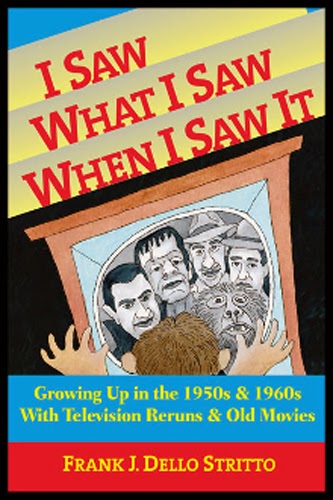
In his memoir, “I Saw What I Saw When I Saw It: Growing Up in the 1950s & 1960s with Television Reruns and Old Movies,” (Cult Movies Press, 2014) "monster boomer" Frank Dello Stritto describes a world in which youngsters carved imagination from technology far before the computer age. On the TV set, for a while a luxury for a 1950s family, the author and his siblings were introduced to vampires, monsters, atomic supermen, Superman himself, space heroes, Abbott & Costello, and the old, already-creaky Universal horrors of the ’30s and ’40s. Rocky Jones, Space Ranger, joined Superman as his first TV heroes, the “Little Rascals” was an early favorite, and the culture was reflected as the television dictated; crimes occurred in the chilly downtown city, situation comedies in the warm residential neighborhoods.

The first sentence of Dello Stritto’s title is from the Abbott & Costello film, “Abbott & Costello Meet Frankenstein,” a film the author believes played a huge role in shaping the boomers’ fondness for the old monsters created by Universal studios. In the comedy, the pair engage in adventures with Dracula, as portrayed by Bela Lugosi, the wolf man, as portrayed by Lon Chaney Jr., and a Frankenstein monster that resembles in features Boris Karloff’s iconic character. Youngsters such as Dello Stritto, wowed by the film, are responsible for the long-lasting perception of these monsters’ visages appearing as they did in the old movies. In the 1950s, these Universal films, as well as similar offerings from studios big and small, were gradually fed to television to air on ”Shock Theater,” or “Creature Feature,” on afternoons or evenings. The Universal films were even reissued to 1950s theaters, competing on screen with the nuclear-age and space monsters.

As Dello Stritto notes in the book, the later outer space monster movies scared him more than the old Universal monster flicks. Nevertheless, the old monsters made a larger impression on the youth. One suspects that more than Abbott & Costello moved the author’s heart to favor the old monsters. For one thing, the old monster films were more difficult to track down. The Draculas, Frankensteins, wolf men, mummies, and so on appeared on TV sporadically, sometimes too late for the youngster Frank to watch. Other times his mother might say no or his father would veto a film Frank had his heart set on due to a football game or these dreaded words, “what else is on.” Dad was master of the TV.

Today one can chart the evolution of the Universal horrors from the first film of a series to the last. Dello Stritto saw them when he could, and never -- the first time -- in the appropriate order. Later, as a young adult, Dello Stritto would haunt New York City and other locations to find revival theaters that played films such as “Dr. Jekyll & Mr. Hyde,” “The Old Dark House,” and “Mark of the Vampire.”

But the adult Dello Stritto took his interest much farther, working his way through old public records to unearth treasures about Bela Lugosi, who is clearly his favorite subject. The young adult even wrote a biography of Lugosi 40 years ago, but discarded it after learning more intensive biographies of the subject were forthcoming.

Besides the movies and TV shows, life several decades ago is captured in the memoir. From the early days of TV, to tenement life sans showers or baths, to a world where the new TV was never switched off, to the Cold War and arms race with the Soviet Union, to the boxing bouts between Muhammad Ali and Sonny Liston, to dad losing his steady job and having to work on the docks, the author captures a life that shaped him into the man he is today.


“I Saw What I Saw When I Saw It” provides the answers to the life that shaped Mr. Dello Stritto into being such an authority on Lugosi and the horror/thriller cinema genre.

To read a Plan9Crunch interview with Dello Stritto, go here.

Monday, August 18, 2014

Cult movies writer Frank Dello Stritto's memoir published in Standard-Examiner newspaper


On Aug. 17, 2014, my review of Frank J. Dello Stritto's memoir, "I Saw What I Saw When I Saw It: Growing Up in the 1950s & 1960s With Televison Reruns & Old Movies," (2014, Cult Movies Press) was published in the Standard-Examiner newspaper. Here is the beginning:

The term "monster boomer has been used by author Frank J. Dello Stritto to describe himself and it is an apt definition. He's one of those born in the decade after World War II, and a significant portion of his taste in popular culture was shaped by television and movies, and the shows and films most likely to be enjoyed by a boy growing up in New Jersey in a traditional two-parent family.

To read the rest of the review, please go here.

To read an interview I conducted with the author, go to this earlier Plan9Crunch post.

To purchase Frank's memoir, please go to this site.

-- Doug Gibson


Wednesday, August 6, 2014

An interview with cult films author, essayist Frank J. Dello Stritto


Today's blog post is an interview with cult films scholar Frank J. Dello Stritto. For at least two generations, Dello Stritto has published many essays -- in publications such as Photon, Cult Movies Magazine and Scarlett -- on the monster boomer films that defined childhood for so many fans on the cult films genre today. Dello Stritto is also an expert on the life of the best screen vampire, Bela Lugosi. He is the author of a collection of essays, "A Curious Volume of Forgotten Lore," and co-author, with Andi Brooks, of "Vampire Over London: Bela Lugosi in Britain," which deals with Lugosi's last major stint as Count Dracula on the stage. This interview accompanies a review of Dello Stritto's new memoir, "I Saw What I Saw When I Saw It: Growing Up in the 1950s & 1960s with Television Reruns and Old Movies," published by Cult Movies Press, who also are the publishers of his other books.
-- Doug Gibson

1) You mention that the classic Universal horrors that you love so much do not scare you. Why is that so, in your opinion?

Dello Stritto: If I had seen "Dracula" at age 4 or 6, it might have scared me, esspecially if I saw it in a dark theatre. I did not see Universal horrors until my late pre-teens/early teens, and on television. Too old for the kind of visceral fear that I felt seeing "War of the Worlds" (at age 3, in a theatre).

"Scary" was never a factor in my watching the Universal horrors. I sensed early on that I was watching a mythology unfold, that I was discovering sagas that thrived just before my birth. I discovered a lot of multi-film series on afternoon television--the Johnny Weissmuller Tarzans, the Basil Rathbone Sherlock Holmes. But the Universal Horrors were true sagas, continuing stories across many films. They captivated, and I had to see them all.

2) Do you think children today are capable of the same type of fear that you got from War of the Worlds and Flash Gordon as a young child? Or has current technological advances, in real life and film, dulled our senses or imagination?

Dello Stritto: Technology has nothing to do with it. Babies still cry, and children are still afraid of the dark. The first fears --loss of parent, loss of home, loss of safety -- are as potent as ever. A movie that taps those fears, or taps memories of them, can still get to viewers, young and old. 

I don't think the Universal Horrors tap those fear, though. At least not for me. They tapped a curiosity about a fantastic past that I found irresistible. 

3) You wrote a memoir on your love of cult films and cult TV and your efforts to learn more about these youthful attractions as an adult. What is the spell that these films have over baby boomers that produce the scholarship, magazines, as well as kitsch that is published today?

Dello Stritto: I don't think anyone really sheds what fascinated them in their youth. Rather like the power that first loves hold over some of us. For some reason, my generation hangs on to the entertainments of their youth longer and more strongly then most. Maybe because we were raised in an era of affluence, but raised by parents who were children of depression and war. Possessions were few and dear to them, and became many and just as dear to us.

I am not boasting or confessing, but television was my best and most reliable friend when I was young. It was a good friend -- it never let me down, and though life took me in many directions, I never forgot my debt to it. 

Do people -- young or otherwise -- need myths? If so, I found mine in the films and TV that I write about.

4) What is a chief difference between Bela Lugosi and Boris Karloff in their legacy today. Most people I talk to say that while Karloff made more money than Lugosi, the latter easily outshines him in leaving a legacy in the genre. If you agree, why?

Dello Stritto: Their legacy is their films. Karloff made better career choices, had better luck, and so made more good movies, gave more solid performances. I doubt his Frankenstein's Monster will ever be equaled. 

Lugosi's output is erratic, but at his best, no one can match him. His characters seem almost otherworldly. An almost obligatory scene in his movies has other characters discussing how other he is. Odd, but real -- believable perhaps because Lugosi made them real and unearthly at the same time. Karloff's characters move us because we can relate to them. Lugosi's great performances make us step back in awe.

I can count those great performances on my fingers. Most of Lugosi's films are pretty bad. He shares some of the blame, but I wish that he had had better luck and better sense so that we could have many more fine performances.

Karloff's legacy rests on a fine body of work; Lugosi's rests on a unique persona that shined all too rarely.

5) I'm about 10 to 15 years younger than you. I can recall scrambling to watch an old Universal horror late at night but by adulthood, I had VHS to see films in order. Do you feel watching these series films in scattershot order as you grew to young adulthood provided a unique perspective in appreciating them, or was a barrier to fully appreciating the films?

Dello Stritto: Before home video, I watched only the movies that television and theatres let me see. So, I saw the Universal Horrors in no particular order, at odd times, and at irregular frequencies. Three years separate my first and second viewings of "Son of Frankenstein," whereas I first saw "Bride of Frankenstein" three times on the same day. Watching the movies like that forced the viewer to piece them together for himself, and so required some thought and imagination -- especially since the continuity between them is not always so good.

But I don't think that helps the appreciation of the films. Who would suggest that a miniseries' episodes should be watched in random order, or that a novel should be read out of sequence?

The scholarship on old movies can be divided into pre- and post-home video, and the post-home video age definitely has the advantage. In film books written in the 1960s and 1970s, the authors--certainly knowledgable--often get the details wrong, because they are doing a lot from memory. Once we could play and replay a movie while we wrote about it, the quality of the books went way up.

Future generations will never know the world that I knew -- only seeing what a small handful of TV stations choose to let us see. Straddling both worlds may give me a different perspective, but I don't think it gives me any advantage. Unless, you consider the thrill of opening the Sunday newspaper to the week's TV listings, and seeing that a long-awaited film is at last going to air.  

6) Expound the shared experience of, as a young adult, heading to NYC to travel to a film festival or theater and see an old genre film that hadn't been in circulation for decades. Was there an electricity in the audience?

Dello Stritto: I usually watched old movies on TV alone. As more and more old movies appeared, I knew that I was not alone--that other people somewhere out there were watching them too. So, when an old horror popped up at the revival theatres, people like me usually showed up, and made great audiences. All of us had been waiting years to see these movies, and you felt the excitement. I remember the audiences, around 1970, for single, separate  showings of "Mystery of the Wax Museum" and "The Old Dark House" -- both at Lincoln Center in New York. Both are lighthearted horrors, and the audience laughed at the fun parts, and watched in awe at the horror parts. Their electricity was palpable.

Some other long-missing horrors--like "Dr. Jekyll & Mr. Hyde," "Freaks," and "The Most Dangerous Game"-- turned up at revival theatres that played them continuously for maybe a week. That diluted the audiences, but they were still appreciative.

I must say that I hesitate to go to the rare horror revivals in theatres today. There is always someone is the audience, or some group,  who come only to laugh at and mock the film. They ruin the experience for everyone else. That didn't happen in the 1970s, when we were so glad that a missing horror had at last turned up. 

7) Do you feel that the old scary movies, comedies, serials, etc., that you saw as a child enhanced your imagination as a youngster?

Dello Stritto: Yes. At their best, they really exercised my sense of wonder and awe: the dead could rise, men could turn into animals, animals into men, weird creatures lived just over the horizon, and scientists pursed crazy quests. I thought about my own crazy quests.

I would add to the horror films, the fantastic TV that I watched. "One Step Beyond" and "The Twilight Zone" often had ordinary people facing extraordinary challenges or choices. Very easy to empathize with them. Hard not to, in fact. "Thriller" -- when it dealt with the supernatural -- had great ghost stories and witches' tales. A "Thriller" episode, "The Hungry Glass," is for me still the scariest hour in television history. After it ends, a viewer has to ponder how vulnerable we are to forces utterly beyond our control

Personally, I liked science fiction movies, but never dreamed of travelling to other planets or travelling through time. I would much rather have met a mad doctor or a werewolf.

8) You talk about efforts to gather original information about Bela Lugosi and you and Andi Brooks basically destroyed a negative myth with your "Vampire Over London - Bela Lugosi in Britain." As a film historian, what's it feel like to unearth a nugget, or hug chunk, of information that has not surfaced in scholarship yet?

Dello Stritto: Take a great historical figure -- Washington or Lincoln, Napoleon or Caesar -- and imagine that somehow historians had overlooked a year in his life. That's the thrill that Andi and I felt when we started getting into Lugosi's 8 months in Britain in 1951. The Lugosi biographies at the time basically said that he went to England in 1951, did not do much and came home months later. I knew that could not be true, because Lugosi spent money freely. He could not live months without some income. So, when Andi and I joined forces, we set out to document what he had done.

We envisioned a magazine article, but we kept finding people that worked with, or knew Lugosi while we was in Britain. We still are--we are now preparing an updated edition of "Vampire Over London - Bela Lugosi in Britain," which will include new reminisces that we have uncovered.

So, what began as an article grew into a book. What began as a documentation project took on a theme: the great man's last hurrah, last grasp at a comeback. Researching the book -- as we started finding so much information -- was a great adventure.
  
9) As a youngster, you saw many trailers for films that you did not see for many more years. "The Fly" comes to mind. How often did a film that you waited to see for years meet the expectations of the trailer?

Dello Stritto: Honestly, the raw fear that I felt watching some coming attractions has rarely been matched. The trailer for "The Fly" and for "Horror of Dracula" really terrified me. I guess I saw the movies themselves 10 years later. Of course, by then, I was older, had read a lot about them, and seen a lot of movies with pretty strong stuff. So, the films did not scare me at all. I won't say that I was letdown, but the "experience" did not match the coming attractions.

In 1958, my older brother stayed up late to watch "Frankenstein Meets The Wolf Man" on "Shock Theatre." He told me all about the next day, and that was my real introduction to Universal Horrors. I wanted to see all these monsters. I had to wait 6 years before the movie came to TV when I could see it. Yes--I was disappointed, but how can any movie live up to 6 years--almost half my life--of adolescent imagination?  I like the movie alot now, but that first viewing was a letdown.

10) Did the kids of the 1950s project a fear of World War III in some of the films in the theaters? Or were the films just scary on their own without the news headlines?

Dello Stritto: My generation grew up knowing that the world could destroy itself, and we lived through the Cuban Missile Crisis, which brought us to the very brink. The brinksmanship lasted about a week or so, and I remember a constant sense of dread. Real pending doom.

Still, I never walked into a movie theatre fearing WWIII, but often enough I walked out that way. There were schlocky movies like "Day the World Ended" and "World Without End" that had humans turned to monsters by radioactivity. "Radioactivity" was a really scary prospect for kids watching movies, since it made a lot of monsters. There were classy movies like "Fail Safe" which captured some of the feel of the Cuban Missile Crisis.

WWIII and the apocalypse was the specialty of "The Twilight Zone." Some of its best episodes have ordinary people dealing with the coming war, or its aftermath. There is an episode called "The Shelter" which was really scary, even though all its characters are just simple people living in a suburb. A lot of these episodes aired before the Missile Crisis. So, for kids like me, our "background" for what was happening came from "The Twilight Zone."

So, I don't think my generation projected a fear of WWIII on the movies and TV. Exactly the opposite -- the movies and TV exploited the themes. We learned about how WWIII might play out from them.

Finally, it still astounds me that you prefer the 1938 A Christmas Carol to the 1951 version.

Dello Stritto: I get that a lot. Those who like one version cannot fathom those who like the other. Young people do not appreciate that for a long time, those were the only two versions available. Now, there are many fine "Christmas Carol" movies out there, but a generation ago it was 1938 vs 1951. We can debate that -- but what's the point, no minds will be changed. You like one or the other, or wonder why anyone likes either.

I try not to say what I think are the "greatest films" or the "best films." I prefer to say what are my favorite films are. The 1938 "Christmas Carol" is one of my favorites. I've seen it dozen of times, and will probably see dozens of times in the years to come. I just can't say that about the 1951 version.