Translate

Tuesday, October 7, 2014

The Raven: Bela Lugosi at his most maniacal evil


                                                                  By Doug Gibson

Simply put, "The Raven" (1935) is a masterpiece. And credit for its perfection belongs to star Bela Lugosi, who is magnificent as the brilliant, deranged, courtly and insane Dr. Richard Vollin, who is so obsessed with Edgar Allan Poe that he has built real Poe-inspired torture devices in his dungeon.

"The Raven" is almost as good as "The Black Cat" that starred Lugosi and Boris Karloff, but it lacks the subtle sadism and velvet touch that director Edgar Ulmer gave to the other "Poe tale."

Lugosi's Vollin is implored upon to save the life of a beautiful dancer, Jean Thatcher, Irene Ware. Once he restores her to health, he fall in lust with her and wants her for himself. Rebuffed by Thatcher's father, Samuel Hinds, he hatches a plan to invite the dancer, her father, her fiance, and others to be tortured and murdered. In his feverish mind, Vollin believes that by killing, he can be released from his Poe obsessions, that to torture will relieve his torture.

Vollin's unwilling helper is Edmond Bateman, (Karloff) a murderer on the lam who bewails his ugly face. He begs Vollin to bring beauty to his countenance. Instead, Vollin makes him uglier and then promises to fix his ugliness after he kills his guests.

Lugosi is just brilliant. He's gentlemanly and manic, polite and cruel,  courteous and a raving lunatic. The short, 61-minute film is tightly directed by Lew Landers. It is an example of Universal's consistent fiscal cruelty to Lugosi that he received only half as much as Karloff earned, although Lugosi's Vollin is the real star, the real villain.

In this film, Lugosi proved that he could play the essential mad scientist, obsessed, insane, unfeeling, sadistic, perverted and, of course, brutal and murderous. In fact, Lugosi and Karloff play almost the same type of roles they would play in The Body Snatchers a decade later, with Karloff the weaker one in The Raven.

This is a film that should not be missed by any horror film fan. Its history is interesting; early reviews were appropriately positive, but then the Breen-era morals kicked in and there was a flurry of bad reviews decrying the sadism of the film. As a result, its profit was lower than expected and the film would damage the pocketbooks of Karloff and particularly Lugosi as it prompted the British horror ban on the latter half of the 1930s.

Fortunately, the film's excellence survived the prissy reviews and it's appropriately regarded as a classic and a Lugosi film with Karloff as a secondary character. The trailer is below:

Monday, October 6, 2014

The Mummy's Hand: The first Kharis tale from Universal


By Doug Gibson

My son and I have spent the past two weekends watching Universal's four "Kharis the mummy" movies. They are lean, competent films that seem to be over just as they've begun. By 1940, most Universal horrors were of the B-production and indeed "The Mummy's Hand" is budgeted at $80,000, about a third of what "Dracula" cost in 1931.

Despite the low budgets, the Universal films are generally far better than efforts from low-budget studios such as Monogram or PRC. The reason is due to discipline; more disciplined scripts, more disciplined directors, more disciplined acting (In a PRC or Monogram film, generally only 1, 2, or three actors were really talented; At Universal, most of the cast was. Also, Universal had access to its wonderful back lot and stock footage from earlier horror efforts.

Directed by Christy Cabanne, a silent films veteran, "The Mummy's Hand" is generally considered the best of the four films. I agree but I think all are entertaining. What perhaps sets apart "The Mummy's Hand" is the very strong cast. Dick Foran, Peggy Moran, Wallace Ford, Charles Trowbridge, Tom Tyler, and particularly George Zucco are in top form. The actors also don't take themselves too seriously. There are interludes of light comedy in the films which prevents the tension from going stale.

The plot: There's a prologue where we learn about Kharis being punished for trying to resurrect the Princess Ananka's tomb, in which he's mummified alive and left with life-sustaining "tanna" leaves. This is related to Dr. Andoheb (Zucco) who is tasked by a mentor to protect Ananka's tomb. Foran is Steve Banning, recently fired archaeologist stranded in Cairo with a sidekick, Babe Jenson, Ford. They discover a partial ancient vase which another expert, Dr. Petrie (Trowbridge) believes provides directions to Ananka's tomb. Using his influence and spies, Andoheb tries to stop them (he even breaks the vase) but Banner and company get funding from an eccentric American showman, the Great Solvani (Cecil Kelloway). His daughter, Marta Solvani (Moran) is upset with Banner and Jenson for getting the cash from her dad and even pulls a gun on them, but she is eventually won over and Foran and Moran become the love interest in the film.

The expedition heads off to the tombs with natives worried about the curse of Ananka's tomb. They have reason to worry as they are being tailed by Andoheb and his spy. Once Kharis is discovered in the tomb meant for Ananka (she was moved secretly, as the prologue notes), Andoheb revives the mummy (Tyler) with tanna leavesand the death toll starts to mount.

Tom Tyler, a western star, only played the mummy once. It was soon turned over to Universal's new horror star, Lon Chaney Jr., but some argue that Tyler is better than Chaney. In my opinion, Chaney's mummy has more personality but Tyler's is more sinister looking, particularly with the black holes that serves as his eyes. They are creepy.

Foran and Moran have chemistry and Ford, as he often did, provides a satisfying blend of whimsy and drama. Zucco is magnificent as the cold, calculating Andoheb. He doesn't get nearly enough praise for his mad scientist roles, often overshadowed by Boris Karloff and Bela Lugosi. The script falters a tad at the end by having Andoheb get the hots for Marta. That's out of character and unbelievable but it was a regular plot twist in the Kharis movies.

The only Universal Kharis film not set in the USA, "The Mummy's Hand" is well worth an hour-plus. It's a fine example of the efficient, low-budget horrors that Universal provided in the 1940s.

Saturday, October 4, 2014

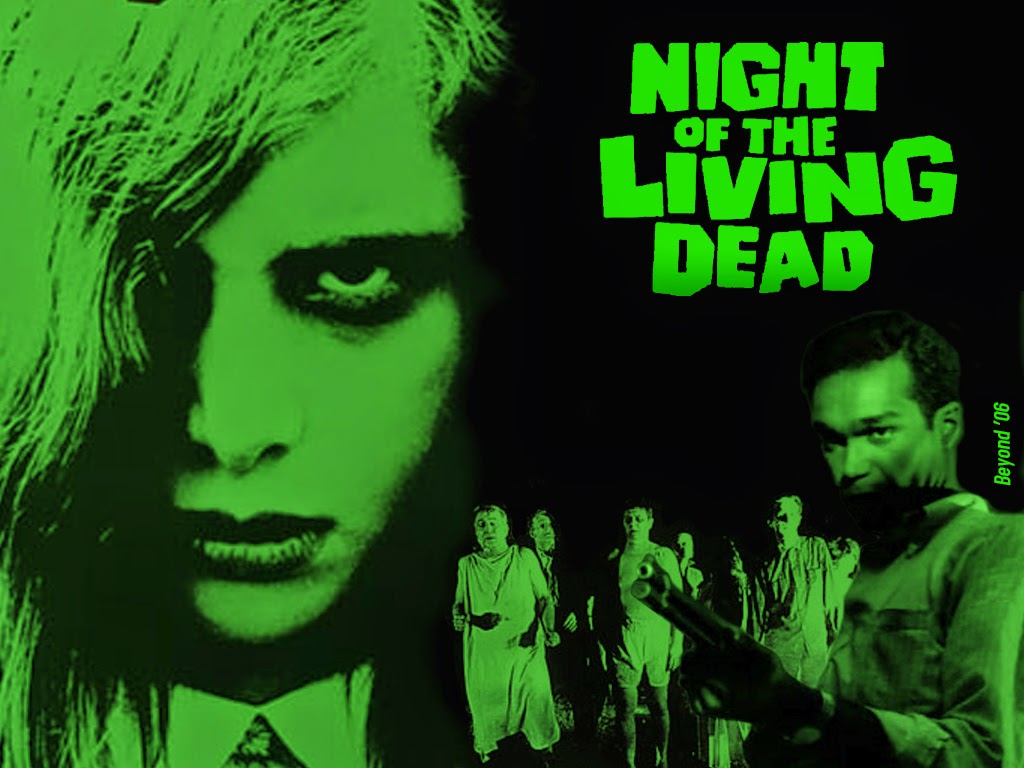
Night of The Living Dead (1968) – The Godfather of Zombie Movies


By Steve D. Stones

There’s no question that director George A. Romero is the Godfather of the zombie movie. His Night of The Living Dead (1968) is the standard to which all following zombie movies are measured. Prior to this landmark black and white film, the zombie was portrayed as a figure created through voodoo ritual. This zombie was a slow moving, brain dead person moving in a sort of somnambulistic trace. 

Romero changed this stereotype. In Romero’s world, zombies are vicious creatures who were once our friends, neighbors and loved ones, and they eat the flesh of the victims they attack. This was a big change from the voodoo zombie seen in Jacques Tourneur’s “ I Walked with a Zombie (1943).”
Watch closely, and you will see a film steeped in political and social commentary, and one which makes a statement about the breakdown of the family unit. The hero is a young African American man named Ben – played by stage actor Duane Jones. To cast a black man as the lead role and hero was risky business in the 1960s following a decade of racial tension, riots and Dr. Martin Luther King’s march on Birmingham.

The story may be familiar to you by now. Night of The Living Dead concerns a group of terrified individuals who have trapped themselves in a Pennsylvania farmhouse to protect themselves from hungry zombies. As the group fights desperately to survive the attack of zombies outside the house, the real struggle is between two men – Ben (Duane Jones) and Harry Cooper – played by Karl Hardman. Both are desperate to have complete control over the situation. The two continually argue with each other through the entire film.

Cooper’s wife and child and a young couple have barricaded themselves in the basement. Ben insists that everyone come upstairs and protect the ground level of the house. Cooper rejects this request, and a conflict between the two men occurs. Both men think they have the best plan for protecting the entire group, but as we see in the end – the zombies eventually break into the house, and only Ben is able to race downstairs and barricade himself in the basement for protection.

Ben survives the attack, but is mistaken for a zombie as a posse approaches the house and kills him. His body is thrown on a pile of dead zombies and burned at the end of the film. No heroes prevail in Romero’s zombie world.

The opening sequence of Barbara (Judith O’Dea) and Johnny (Russell Streiner) driving through an empty Pennsylvania cemetery covered with fallen leaves is one of the most effective scenes in horror cinema. Without showing a single zombie in the opening, the viewer immediately knows something dramatic and intense is about to happen. From the moment Johnny is attacked by a zombie wandering through the cemetery, the film never lets up on the zombie assault.

Shot on a shoestring budget by a group of Pennsylvania filmmakers working in television and commercials, the group formed the production name Image Ten based on the ten investors who put up the money and worked on the film. For further information on Night of The Living Dead, see Danny Peary’s “Cult Movies volume one” and Joe Kane’s excellent book “Night of The Living Dead – Behind The Scenes of The Most Terrifying Zombie Movie Ever.”

A remake was made in 1990 and 2006. The 2006 remake is a 3-D movie that comes with 3-D glasses if you buy the DVD.  Avoid the 30th Anniversary print with new scenes added. Romero had nothing to do with this version, and if you see it – you’ll understand why. The new scenes add nothing to the original film, and do not blend well with the original print.  Also avoid the computer colorized print that was released on VHS in the 1980s. The zombies are portrayed in a ridiculous green color that is laughable.

Don’t miss Romero’s excellent 1978 follow up – Dawn of The Dead. This sequel steps up the graphic horror and violence about ten notches and is in color. Happy viewing. 

Thursday, October 2, 2014

We love our Johnny Sokko! Another Giant Robot Voyage Into Space post

 By Doug Gibson

Voyage Into Space is an absolutely bizarre 1970 or so Japanese monster-rama that involves a young boy, Johnny Sokko, having control over a crime-fighting, flying Giant Robot. Sokko and Giant Robot work for the Unicorns, a UN-type spy ring trying to save the world from the extraterrestrial evil, Guillotine, his various sidekicks, including "Spider" and Dr. Botanus. The "army" of Guillotine is "the Gargoyle Gang," a group of military types who resemble Nazis.

This is a weird movie but unbelievably entertaining for young kids and nostalgic adults who recall seeing it when they were young kids. I saw this film when I was 7, 8 or 9 and we used to talk about it on the playground in school. It stars no one you ever heard of, the special effects are pretty bad, the acting terrible, the dubbing weak, but it's strangely cool. There's a 1960s' counterculture aura to this film. Several of the baddies dress like they stepped out of a Roger Vadim film. Guillotine raises a whole host of monsters and some are pretty interesting. One is a giant plant; another is a giant eyeball (I kid you not).

But still, this film, released by American Independent Films to TV only, is woefully cheap. The battling monsters don't match up to the same size in close ups and far-away shots. In one scene, Johnny Sokko and a Unicorn agent wash up on the beach with their clothes fully dry and pressed and their hair neat. Johnny Sokko's dubbed voice sounds a little like Bea Arthur of The Golden Girls. The Giant Robot hero is very cool, though, and the film's theme song is catchy. My four year old son, who like his dad loves the film, hums the theme song daily.

Here's the big secret to Voyage Into Space. It's actually about four episodes, including the first and last, culled from a 30 or so-episode series from the late 60s called Johnny Sokko and His Flying Robot. That show also aired on TV, including on long-forgotten Channel 52 in Southern California when I was a kid. You can catch Johnny Sokko episodes today on http://www.hulu.com/ For more than a generation, you couldn't find Voyage Into Space on VHS or DVD. I spent decades wondering what had happened to my favorite Japanese color monster film. Finally, last year Sinister Cinema http://www.sinistercinema.com/ started selling the film. Since that occurred the floodgates have opened and Voyage Into Space, a public domain film, has many sellers. And it's all over YouTube as well.

It's a great film, particularly if you have a fondness for the Japanese monster genre, and your kids will love it. And let's face, it has one of the coolest opening music. Watch it.