Translate

Wednesday, February 5, 2014

A Soldier's Plaything, an early Harry Langdon talkie


By Doug Gibson

One problem that film comic Harry Langdon had, throughout his entire sound career, was that his big-budget films with major studios bombed. The failure of the films were not Langdon’s fault, he performed well in all of them. And the films have gained in critical popularity in the 70 to 80 years after their release. Obviously, that’s little comfort to Langdon, who died 69 years ago. The one-time Sennett/First National silent star enjoyed his best success in the sound era as a comic lead in Hal Roach, Educational and Columbia shorts, and a few acting gigs in low-budget B films. Perhaps the best of these is “Misbehaving Husbands,” from Monogram. Nevertheless, his three A films, “A Soldier’s Plaything,” “Hallelujah, I’m a Bum,” and “Zenobia,” with Oliver Hardy, were all flops.

The film I’m reviewing today is “A Soldier’s Plaything,” from 1930, produced by Warner Brothers. It’s one of those very early talkies that blends comic routines with musical numbers. The film involves Harry (Tim) and co-star Ben Lyons (Georgie) as U.S. soldiers in Germany during the occupation after World War I. Georgie is the lady’s man who falls for a sexy German girl/woman Gretchen, (Lotti Loder). Harry has some excellent scenes, where he plays the “little elf” character he honed as a silent star very well. He also gets to sing a song, and does so very well. He’s not the focus of the film but he’s the funniest one in it. He easily outperforms -- in comedy -- a burly, yelling Noah Berry as Captain Plover, who constantly makes Harry and Ben shovel manure; that’s a running joke in the movie.

Ben’s Georgie, Harry’s soldier pal, is carrying a secret that harms his romance with Gretchen. He thinks he killed a violent gambler/gangster back home in the USA. That’s why he joined Tim as a WW1 recruit. Naturally, this causes some harm to his relationship with the German beauty. Worried that he’ll be arrested, he tells her he’ll come back and get her. Gretchen, who wants to go to the states with him immediately, is naturally skeptical. It looks like their romance is kaput, until an abrupt ending wraps up the plot neatly.

“Abrupt” is an excellent word to apply to this Michael Curtiz-directed film. It’s only 56 or 57 minutes, and is over before you know it. There seems to have been extreme editing in the film. Example: like old silent films, titles, rather than scenes, are used to move action along. Also, when Georgie’s major dilemma with Gretchen is resolved (he discovers the man he thought he killed is a fellow soldier) there’s no reconciliation scene with his girl. She’s just with him, all happy, in the next scene. According to movie books, there is a 73-minute version of this film (now lost) that played in Europe. It’d be nice if it was found one day.

According to genre books, Lotti Loder was a European beauty that Warner Brothers was planning to groom for stardom. It’s clear though, that by the finished release cut, studio execs had abandoned those plans during filming. Although beautiful, she does not have screen presence and seems just another supporting player in the film. There is one memorable -- pre-code -- scene of her with Lyons by a creek where she shows off a pair of very attractive legs, however. According to film books, she only made a few more films before leaving the industry.

Harry Langdon, as mentioned, is the best part of this film. He’s funny and demonstrates good comic timing. The film, due to editing, is a B film that cost A money. Depression-era audiences had other films with more depth to spend money on. Curtiz uses an interesting double-exposure technique when portraying life in the USA from persons describing it in Germany. I recommend this film, particularly if you are a Langdon fan and for those interested in the evolution of the earliest sound films. Watch Langdon sing in this film below!

Thursday, January 30, 2014

‘Dracula’: Was the Count resigned to his death?

By Doug Gibson

 
I absolutely love Bela Lugosi’s portrayal of Count Dracula in the 1931 classic. He is pure aristocratic evil, able to put on a facade of gallantry yet betray it in mere seconds with a deadly glare at Van Helsing. Also, even in fine attire, in his own domain, in a dungeon, with rats, bugs, whey-faced brides or a cringing, spider-eating Renfield, he conveys malicious evil deeper than the filth around him. In that deepest part of his existence, his dead heart rots darker.

Why, though, did Lugosi’s Count Dracula ditch his Romanian, Hungarian playfields, where he had his pick of the scared villagers, and easy escape to his coffins filled with native soil, and go to alien England, with a mere few coffins and shovelfuls of native soil? Why choose such a conflicted, weak minion as the anonymous, unloved Renfield as his companion? And why set up shop, in Carfax Abbey, so close to such a deadly rival as Dr. Van Helsing? Why seek the virginal, well-protected Mina, the intended of the feckless Jonathan Harker, but whose back is closely watched by Van Helsing?
I’ve watched Lugosi play Dracula many times. I can knock away the silly claims that Dracula is a stagy film, or slow. Every frame is necessary — with the possible exception of the asylum employees played for laughs — to establish and maintain Lugosi’s Count’s sinister, evil, egotistical persona. But recently, I’ve added this interpretation. Did Count Dracula move to London, with its unknown attractions and more dangerous temptations, with the intention of ending his long, endless existence?
Dracula is a slave to his passion, his thirst for blood. It cannot be satiated, whether the victim is a mere flower girl or society belle Lucy. He knows well he cannot resist tasting his pretty neighbor Mina. He cannot even haul up stakes and flee after Van Helsing exposes him with the mirror parlor trick. In fact, Dracula, although nearly claiming Mina’s life due to his blunt force of personality, is merely pitiable at his end. He lies in his coffin, chased into the bowels of Carfax Abbey after being betrayed by the ill-fated Renfield, and submits to an anticlimactic, off-screen death at the hands of the vampire hunter Van Helsing.
Was the Count so vain as to think that no harm could come to him in his coffin filled with native soil in the basement of a rotting abbey? Van Helsing didn’t even have to break a lock to stab the Count in the heart. I think not. I hypothesize that Dracula himself was tired of living for centuries, that he chose his trip to London, a land of new blood and unseen dangers, as a deliberate step to the end of his existence. Although the script allows no confirmation, I think Lugosi’s Dracula must have known that he was to be the neighbor of his most feared enemy, Van Helsing.
Of course Dracula tried to prevent his death. His natural greed and cold evil did not dissipate in his last adventure, and he nearly succeeded — for a brief moment — in vanquishing Van Helsing. He allowed nature, his generations-old greed and lust for blood, to be his undoing.
The strongest evidence for Dracula’s death wish is found early in Dracula’s journey to London when he encounters Mina, her dad, Lucy, and Jonathan at the opera house. He says, wistfully, “To die, to be really dead, that must be glorious!” Mina Seward replies, “Why, Count Dracula!” and Dracula adds, “There are far worse things awaiting man than death.”
Dracula fights, he makes an effort to save himself, but he will not move from his final home. As a result, he is vanquished, but it is an honorable end for the old fiend.
Horror movie expert Frank J. Dello Stritto, who along with other experts have mulled over Dracula’s motives in his final days, opines that the slow, thousands year-plus lives of Dracula is conveyed by Lugosi’s mannerisms. Dello Stritto says, “He (Lugosi) put into his performance a lot of subtle touches to make Dracula seem from another world: the odd pace of his speech, the use of his cape, his very slow movements compared to the other cast members’ … A lot of actors who play Dracula are ordinary men trying to appear extraordinary, and not quite succeeding. Lugosi’s character is like Dracula himself — an extraordinary being trying to appear ordinary, and again not quite succeeding.”
I once wrote this of Dracula, and I stand by it. “I have seen “Dracula” scores of times, and Lugosi is the key to the film. He is a tall, courtly, menacing figure who promises a fate worse than death. And that is the appeal of these early horror films compared to the sadistic gore-fests of today — a fate worse than death awaits the vampire’s victims. That fate is conveyed to perfection in the scene where Lugosi’s vampire murders actor Dwight Frye’s cringing, pathetic, mad disciple Renfield. Dracula’s exterior is charming. But his filthy interior attracts darkness, fog, storm, chill winds, rodents, flies, spiders, blood and undeath.”
Dracula was a slave of his filthy existence. Pleasure had long been usurped by bloodlust. It was a tremendous feat for the Count to keep it up for centuries. But he was tired, and chose London for his grand finale. He became, finally, really dead.
If you have not seen Bela Lugosi’s Dracula, do yourself a favor and watch it. It can be accessed, in parts, via YouTube (here) or for pay at Amazon OnDemand.
(This essay originally appeared at StandardBlogs)

Monday, January 27, 2014

The Devil Bat is Lugosi's finest poverty row offering


The Devil Bat
The Devil Bat, 1941, Producers Releasing Corporation, directed by Jean Yarbrough. Starring Bela Lugosi, Suzaane Kaaren, Dave O’Brien, Guy Usher, Hal Price. Sixty-nine minutes. Schlock-Meter Rating: *********1/2 stars out of 10 stars. Note: Also sold on some video labels as Killer Bats.

By Doug Gibson
---
Okay, I know that the plot of Devil Bat is silly. I know the budget is a $1.89. I know the special effects are ridiculous with rubber bats swooping down to victims’ necks. I’m aware that many critics, including John Stanley (whom I respect) consider Devil Bat an example of Lugosi’s slow side to oblivion, and Ed Wood movies.

Nevertheless, I love this film. It is a great cult movie because it has heart. Lugosi -- and the rest of the cast -- take their job seriously. They take a sow’s ear and turn it into a silk purse. The plot is as follows: A seemingly kindly scientist (Lugosi) has toiled his entire life for a perfume company. The scientist’s discoveries had made millions for the firm’s family, but he remains a salaried employee. For that he is bitter and angry, and has harvested killer bats that will attack the scent of a perfume. Of course, Lugosi gives the perfume to the rich family members, and murders occur. By the end, nosy reporters and cops uncover Lugosi’s crime and he is killed at the end. Of course, as was PRC’s and other minor 40s film companies’ wont, there is also a love story mixed in this thriller.

Bela Lugosi’s greatest talent was providing an excellent performance no matter the subject matter. His performance as a brooding scientist, bitter, angry, feeling underappreciated, is a masterpiece. There is a scene at the beginning of Devil Bat where the family members of the firm -- who really seem to love the scientist -- throw him an appreciation testimonial and provide him with a $25,000 gift. Lugosi’s scientist is all decorum in this scene, and it’s chilling when he’s alone and the mad, angry, bitter murderer is revealed. It’s an effective contrast, which I don’t think other 40 chiller stars George Zucco or John Carradine could have pulled off.

By all means, rent Devil Bat (I recommend you buy it) and lose yourself in a great actor making the most of a simple story. Lugosi on screen can hypnotize a viewer. One ignores the plot flaws and poor special effects and appreciates a master actor in a great performance.

Friday, January 24, 2014

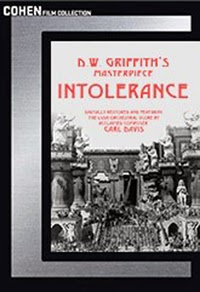
Intolerance – An Epic Masterpiece of the Silent Era


By Steve D. Stones

The folks at Cohen Media Group have released a beautiful digitally restored DVD and Blu-Ray print of D.W. Griffith’s 1916 silent epic “Intolerance.”  The DVD comes with a booklet of information about the making of “Intolerance.” The film is the first in Hollywood history to be called “epic” and innovative because of its use of enormous sets, elaborate costumes and thousands of extras in crowd scenes - despite the fact that no script had been written for the film.

“Intolerance” opens with a recurring image of a mother rocking a cradle, played by Griffith regular Lillian Gish. Four stories are woven together from different times in history - Biblical Judea, Medieval Paris, Ancient Babylon and early 20th century America. Two of the stories – The Mother & The Law (the early 20th century America story) and the fall of Ancient Babylon can be seen as separate films on a second disc that comes with the DVD, which is how director Griffith originally intended the four films to be seen.

The Mother & The Law story deals with the injustice a poverty stricken young mother goes through when a group of self-righteous society women take her baby away because they feel she is unfit to care for the child. The Biblical Judea story tells of Christ’s struggles with the Pharisees, and ultimately his crucifixion. Medieval Paris tells of Charles IX of France influence of his mother, Marguerite of Medici, to issue a decree against the Huguenots, which results in the events of the St. Bartholomew’s Day Massacre on the 24th of August 1572. The Ancient Babylon story is of the High Priest of Bel who convinces the Persian King Cyrus to destroy and conquer Prince Belshazzar in 539 BC.

In January to April of 1916, Griffith filmed the fall of Ancient Babylon scenes, which are the most famous and legendary of the film. With this story, he had built the largest, most spectacular sets ever made in motion picture history up to that time. The interior shots of Ancient Babylon are a truly breathtaking sight. The great Babylon set became legend in Hollywood, and a replica was made near the Dolby Theatre as a backdrop for the annual Academy Awards.

Still dealing with his critics after the release of “Birth of A Nation” (1915), Griffith’s “Intolerance” also had its share of critics. Griffith’s depiction of undraped women in Ancient Babylon times outraged some critics and movie-goers. Some even suggested that the Mother & The Law story was an attempt to show how the wealthy and powerful try to impose rigid standards of morality on the poor class.

Upon its initial release, movie-goers flocked to see “Intolerance” in 1916. However, after just a few short weeks, attendance started to drop. Considered a “box office failure” at the time, the film suffered mostly from the huge expenses lost from promoting the film. Today, it is regarded as one of the most important films in early Hollywood history, if not the most important.

A number of worn out, public domain prints can be found for sale of "Intolerance" in the movie marketplace. Avoid these prints at all costs. It is worth the extra money for the serious film collector to invest in this print put out by Cohen Media Group. Happy Viewing!