Translate

Showing posts with label Stan Laurel. Show all posts

Sunday, September 17, 2023

Zenobia a comedy that matched Oliver Hardy and ... Harry Langdon


By Doug Gibson

"Zenobia," a 1939 Hal Roach comedy feature is an charming film, albeit one that failed to attract audiences. It's mostly forgotten today, except for routine once-a-year airings on Turner Classic Movies. (It did, however, recently get a Blu-Ray release.) The film, from Hal Roach, pairs rotund Oliver Hardy with silent- and early-talkies era comedian Harry Langdon. This was because Hardy's iconic partner, Stan Laurel, was engaged in a contract dispute with Roach. Langdon, a close friend of both Laurel and Hardy, stepped in to film "Zenobia," with no real intention of taking Stan Laurel's place, although there was talk of a second Hardy/Langdon feature, that ended after "Zenobia" failed at the box office. Laurel eventually returned to Hal Roach, but soon after the pair left for good, moving to 20th Century Fox.

But let's talk about "Zenobia." It takes place in Carterville, Mississippi, in the post-Civil War deep South, although to be honest the residents there appear to have been spared the recent horrors of war. Hardy plays -- way out of character -- Dr. Henry Tibbett, a mild-mannered country doctor whose finances are a bit shaky because long ago he decided not to use his medical skills to get wealthy. Nevertheless, he lives in a rented mansion with Mrs. Tibbett (Billie Burke), his daughter Mary (Jean Parker) and their three servants, Zero (Stepin Fetchit) Dehlia (Hattie McDaniel) and their child Zeke (Phillip Hurlic). Daughter Mary is engaged to marry a rich young man, Jeff Carter, played by James Ellison. Jeff's snobbish mother, Mrs. Carter (Alice Brady) loathes the match is working to get back with a former girlfriend, Virginia, played by June Lang.
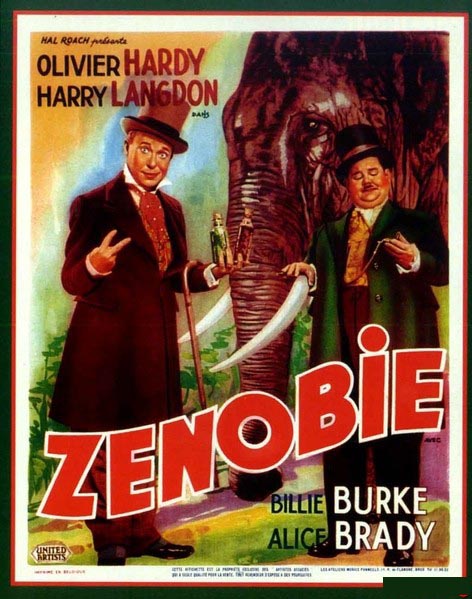


Despite this subplot, this is a gentle film, and no matter how dastardly the machination of Mrs. Carter and Virginia to dash Jeff and Mary's love, there's never any danger of the pair being split up. All ends well and even mean Mrs. Carter apologizes at the end. What's most interesting is that Burke -- who was Glinda the Good Witch in Wizard of Oz -- provides most of the comedy, and not Hardy. Burke proves herself adept at comedy, playing a scatterbrained but quick-witted, and loyal spouse to Hardy's gentle, good-natured Dr. Tibbetts.

This domestic set up is damaged by the performance of Fetch-it as the servant, Zero, who perpetuates a racist stereotype that unfortunately was a part of Hollywood in that era. "Zero" mumbles, whines, cowers and cringes throughout the film. However, the contrast between his performance and that of McDaniel is interesting. McDaniel, who won an Oscar as Mammy in Gone With the Wind, delivers a strong performance, in which she never surrenders her dignity or self-respect.

Now, time to mention the main plot and Harry Langdon's excellent contribution to "Zenobia." Langdon plays Professor McCrackle, a traveling tonic salesman who also has an elephant, named "Zenobia," who travels with him. One day, when Zenobia is feeling poorly, McCrackle begs Dr. Tibbetts to treat his elephant. Because he's such a nice man, Tibbetts treats Zenobia. His treatment works so well that the elephant becomes enamored of the doctor and won't leave him alone, following poor Hardy's doctor and occasionally picking him up. Upset that he's no longer number one with his elephant, Langdon's McCrackle is convinced, with some help by the scheming Mrs. Carter, to file an alienation of affection lawsuit against Dr. Tibbetts.

It's an amusing plot, and Langdon is excellent in scenes with Hardy. He's too good a comedian and actor to try to imitate Laurel. Instead, Langdon utilizes his understated comedic talents and blend of timidity, deadpan blank face and "Little Elf" voice to generate a fair share of laughs. His best scenes with Hardy are when Zenobia is being treated by the doctor, as well as his efforts to keep the elephant away from Hardy's Tibbetts. In the final courtroom scene, which is the strongest point of the film, Langdon is hilarious as he is constantly interrupted while trying to testify using a memorized script.

So why did the film fail? It cost $637,000 and grossed only $351,000 worldwide, according to the Langdon biography "Little Elf. " It's not Langdon's fault. One reason may be that audiences were so used to Laurel and Hardy comedies that they couldn't accept Oliver Hardy in a role that was mostly non-comedy. In fact, when he's treating Zenobia is the closest he gets to traditional "Hardy comedy" and audiences probably wanted more. Also, while Burke is very good in comedy, and witty, it must have seemed strange to audiences to see her, and not Oliver Hardy, getting the laughs. Another reason may be that there is very little drama in this comedy. As mean as Mrs. Carter, Virginia, and others are, you don't really feel that there's any tension in the film. The New York Times described Zenobia as "Gone With the Wind" as devised by Hal Roach, and there's truth to that. Carterville seems like somewhere in NeverLand, an alternative multiverse. Finally the biggest reason Zenobia failed so badly was that the public didn't want to see Hardy with anyone else other than Stan Laurel.


The New York Times also gave props to Langdon, writing (from Wikipedia) "...Harry Langdon has adopted the partnership prerequistes formerly reserved for Stan Laurel...Harry Langdon's pale and beautifuly [sic?] blank countenance...has probably already excited the professional jealousy of Mr. Laurel..."

However, Langdon never intended to attempt to supplant Laurel, a man who went out of his way to help Langdon through tough stretches in the 1930s, and is due a lot of credit for providing momentum that insured the last several years of Langdon's career was fairly busy, and prosperous. Scenes in the otherwise excellent film, "Stan and Ollie," that purport to show that Hardy was upset at Laurel for briefly leaving Hal Roach and saddling him with Langdon are fictional.

Zenobia is worth watching, and I'm glad it's frequently on TCM, as it provides both a glimpse at the versitility of Oliver Hardy and the comic talents of Harry Langdon. 

Saturday, February 9, 2019

Stan and Ollie a soul-inspiring tribute to Laurel and Hardy

Review by Doug Gibson

I wasn’t going to post a review of Stan and Ollie, the recently released film on the comedy team Laurel and Hardy, but two weeks after I saw it, it still resonates with me. It’s a wonderful, soul-inspiring film of the love and respect the two comic geniuses had for each other, and exemplifies their efforts and dedication to prevail over tough professional odds and poor health.


The film starts with the pair at the height of their fame, making “Way Out West” in the late 1930s and then segues to 1953 in England, and the aging pair’s last tour together. It starts as a disaster, but rallies to success after both subject themselves to a physically grueling publicity campaign. Both harbor a hope, based on flimsy promises, that a film version of Robin Hood awaits them afterward.


The secrets to the film’s success are the stars: Steve Coogan as Stan Laurel and John C. Reilly as Oliver “Babe” Hardy. They are perfect. These are not imitators; they have captured the spirits of the comic legends. After a few minutes you feel you are watching Laurel and Hardy. The classic routines seem as well done as the originals. Coogan has received BAFTA recognition. Reilly, who I think captures Hardy even a tad more than Coogan captures Laurel, deserved an Oscar nomination he did not get.


A couple of scenes help to capture the poignancy of this film. Reilly’s Hardy, desperate to buy his soon-arriving wife a nice jewelry gift, bets on a longshot horse in a shoot-the-moon ploy to gain the money. He rushes to a newsstand for the results. His face falls with dejection as he learns the horse lost. Totally dejected, he spots a group of young fans staring at him. He breaks into character, delighting the fans with his iconic antics.


In another scene, Coogan’s Laurel, is sitting in the office of the producer who had claimed he would fund the Robin Hood film. He’s been rebuffed repeatedly but soldiers on, hoping to achieve a goal he knows in his heart is likely hopeless. The producer disrespects him, keeping him waiting for hours, and eventually sends him a flunky to tell him the deal’s off. Despite his despair while waiting, Laurel still has the moxie and enthusiasm to do skits for a cold secretary who doesn’t appreciate the efforts.


Director John S. Baird creates effectively the London of the early 1950s. It’s a great period piece and one appreciates the stark contrasts between the early, cheap digs and theaters of the tour compared to grandeur of the London hotel and West End theater later in the tour. Shirley Henderson (Moaning Myrtle of Harry Potter films), as Hardy’s wife Lucille Hardy, and Nina Arianda, as Laurel's wife, Ida Kitaeva Laurel, are both very good in their roles. They share tender scenes with their husbands that show the love and support in the marriages. Rufus Jones is also strong as the supportive, but also flaky and kind of weaselly, producer of the stage tour.


Of course, the bond between the comics as portrayed by Coogan and Reilly seals the deal for this film. I won’t give too much away but Laurel and Hardy fans will shed a tear near the end as the comics gamely try to make it through the grueling tour. Some historical license is taken; a decision by Hardy to act with another partner many years ago supposedly causes Laurel lingering resentment. That resentment didn’t actually happen, but, hey, dramas need conflict, and this apocryphal bit doesn’t wound the film. Danny Huston and Richard Cant have small roles as Hal Roach and comic Harry Langdon, who made the aforementioned film, Zenobia, with Hardy.

This is a beautiful memoir of two iconic stars, with wonderful performances and recreations of classic acts. I’m so happy it’s an unexpected hit in England and even here. Laurel and Hardy more than deserve it. Memo to the BBC: make a similar film about then-faded star Bela Lugosi's final tour of Dracula earlier in the 1950s, which also occurred in England. There's already a fascinating book on it.

Sunday, July 15, 2018

Laurel and Hardy very funny in Our Wife


Review by Doug Gibson

I recently watched "Our Wife," a very funny Stan Laurel and Oliver Hardy short from 1931. Produced by Hal Roach Studios, the plot involves rotund Ollie wanting to marry his equally rotund sweetheart, Dulcy, (played by Babe London). Unfortunately, Dulcy's dad, played by comedy short legend James Finlayson, absolutely forbids his dumpling to marry Hardy. So, with the help of mild-mannered Stan, the comedy pair ineptly plan to spring Dulcy from her home and elope.

This is my second-favorite Laurel and Hardy short. Only "The Music Box" is better. The comic timing is superb and the cast is an iconic dream. Besides Ollie, Stan and Finlayson, the minister who married Ollie and Dulcy is played by cross-eyed silent and early sound comic Ben Turpin. Turpin, born in 1869, was a genuine pioneer of the comedy silent era. One of his early, early films, 1909's "Ben Gets a Duck and is Ducked," filmed in Chicago, had him going into a public duck pond. He was arrested by police officers not amused at the film company's permit-less filming efforts!

The best scene in "Our Wife" involves Ollie, Dulcy and Stan trying to fit into an impossibly tiny getaway car, procured by the hapless Stan. The film is easy to find as part of collections offered via amazon, etc. It also pops up on Turner Classic Movies once in a while. But, thanks to YouTube, you can watch the film above. More info is here.


Wednesday, March 4, 2015

Zenobia: Hal Roach comedy feature that matched Oliver Hardy and Harry Langdon


By Doug Gibson

"Zenobia," a 1939 Hal Roach comedy feature is an charming film, albeit one that failed to attract audiences. It's mostly forgotten today, except for routine once-a-year airings on Turner Classic Movies. The film, from Hal Roach, pairs rotund Oliver Hardy with silent- and early-talkies era comedian Harry Langdon. This was because Hardy's iconic partner, Stan Laurel, was engaged in a contract dispute with Roach. Langdon, a close friend of both Laurel and Hardy, stepped in to film "Zenobia," with no real intention of taking Stan Laurel's place, although there was talk of a second Hardy/Langdon feature, that ended after "Zenobia" failed at the box office. Laurel eventually returned to Hal Roach, but soon after the pair left for good, moving to 20th Century Fox.

But let's talk about "Zenobia." It takes place in Carterville, Mississippi, in the post-Civil War deep South, although to be honest the residents there appear to have been spared the recent horrors of war. Hardy plays -- way out of character -- Dr. Henry Tibbett, a mild-mannered country doctor whose finances are a bit shaky because long ago he decided not to use his medical skills to get wealthy. Nevertheless, he lives in a rented mansion with Mrs. Tibbett (Billie Burke), his daughter Mary (Jean Parker) and their three servants, Zero (Stepin Fetchit) Dehlia (Hattie McDaniel) and their child Zeke (Phillip Hurlic). Daughter Mary is engaged to marry a rich young man, Jeff Carter, played by James Ellison. Jeff's snobbish mother, Mrs. Carter (Alice Brady) loathes the match is working to get back with a former girlfriend, Virginia, played by June Lang.

Despite this subplot, this is a gentle film, and no matter how dastardly the machination of Mrs. Carter and Virginia to dash Jeff and Mary's love, there's never any danger of the pair being split up. All ends well and even mean Mrs. Carter apologizes at the end. What's most interesting is that Burke -- who was Glinda the Good Witch in Wizard of Oz -- provides most of the comedy, and not Hardy. Burke proves herself adept at comedy, playing a scatterbrained but quick-witted, and loyal spouse to Hardy's gentle, good-natured Dr. Tibbetts. (watch a scene of Burke's wit above)

This domestic set up is damaged by the performance of Fetch-it as the servant, Zero, who perpetuates a racist stereotype that unfortunately was a part of Hollywood in that era. "Zero" mumbles, whines, cowers and cringes throughout the film. However, the contrast between his performance and that of McDaniel is interesting. McDaniel, who won an Oscar as Mammy in Gone With the Wind, delivers a strong performance, in which she never surrenders her dignity or self-respect.

Now, time to mention the main plot and Harry Langdon's excellent contribution to "Zenobia." Langdon plays Professor McCrackle, a traveling tonic salesman who also has an elephant, named "Zenobia," who travels with him. One day, when Zenobia is feeling poorly, McCrackle begs Dr. Tibbetts to treat his elephant. Because he's such a nice man, Tibbetts treats Zenobia. His treatment works so well that the elephant becomes enamored of the doctor and won't leave him alone, following poor Hardy's doctor and occasionally picking him up. Upset that he's no longer number one with his elephant, Langdon's McCrackle is convinced, with some help by the scheming Mrs. Carter, to file an alienation of affection lawsuit against Dr. Tibbetts.

It's an amusing plot, and Langdon is excellent in scenes with Hardy. He's too good a comedian and actor to try to imitate Laurel. Instead, Langdon utilizes his understated comedic talents and blend of timidity, deadpan blank face and "Little Elf" voice to generate a fair share of laughs. His best scenes with Hardy are when Zenobia is being treated by the doctor, as well as his efforts to keep the elephant away from Hardy's Tibbetts. In the final courtroom scene, which is the strongest point of the film, Langdon is hilarious as he is constantly interrupted while trying to testify using a memorized script.

So why did the film fail? It cost $637,000 and grossed only $351,000 worldwide, according to the Langdon biography "Little Elf. " It's not Langdon's fault. One reason may be that audiences were so used to Laurel and Hardy comedies that they couldn't accept Oliver Hardy in a role that was mostly non-comedy. In fact, when he's treating Zenobia is the closest he gets to traditional "Hardy comedy" and audiences probably wanted more. Also, while Burke is very good in comedy, and witty, it must have seemed strange to audiences to see her, and not Oliver Hardy, getting the laughs. Another reason may be that there is very little drama in this comedy. As mean as Mrs. Carter, Virginia, and others are, you don't really feel that there's any tension in the film. The New York Times described Zenobia as "Gone With the Wind" as devised by Hal Roach, and there's truth to that. Carterville seems like somewhere in NeverLand, an alternative multiverse. Finally the biggest reason Zenobia failed so badly was that the public didn't want to see Hardy with anyone else other than Stan Laurel.

The New York Times also gave props to Langdon, writing (from Wikipedia) "...Harry Langdon has adopted the partnership prerequistes formerly reserved for Stan Laurel...Harry Langdon's pale and beautifuly [sic?] blank countenance...has probably already excited the professional jealousy of Mr. Laurel..."

However, Langdon never intended to attempt to supplant Laurel, a man who went out of his way to help Langdon through tough stretches in the 1930s, and is due a lot of credit for providing momentum that insured the last several years of Langdon's career was fairly busy, and prosperous.

Zenobia is worth watching, and I'm glad it's frequently on TCM, as it provides both a glimpse at the versitility of Oliver Hardy and the comic talents of Harry Langdon. Watch it above via YouTube.

Friday, February 13, 2015

Laurel and Hardy in the 1940s film 'The Big Noise'


The Big Noise

by Doug Gibson

"The Big Noise," a 1944 Laurel and Hardy feature from Twentieth Century Fox, directed by Malcolm St. Claire, is generally panned by Laurel and Hardy enthusiasts. In fact, it was listed as one of the "50 worst films" in the Medved brothers book that was popular 30 years ago.

But that's all nonsense. "The Big Noise" is not a great film but it's a passable way to spend 74 minutes with a classic comedy team. It's certainly not among Laurel and Hardy's best films. To see those, buy the Hal Roach feature "Sons of the Desert" and the Roach short "The Music Box." But in "The Big Noise," the boys' genius still works at times.

The plot involves Stan and Ollie as bumbling janitors working in a private detective's office. A scientist named Alva Hartley (Arthur Space) calls the agency asking for detectives to guard his bomb, called the Big Noise. The bomb is so powerful it can win World War II for the allies (how prophetic!). L and H want to be detectives, so they pose as such and take on the assignment.

Next door to the Hartley live a pack of criminals, who want to steal the bomb and sell it to the Nazis. Somehow a pretty young lady (Doris Merrick) is also there (she's innocent of the plot) and Hartley takes a small fancy to her.

Eventually Laurel and Hardy take off with the bomb with the crooks in hot pursuit. Incredibly, the whole shebang ends in the ocean!

This is just an OK film. L and H fans will be more tolerant. Those unaccustomed to the pair should watch a better entry. The boys were starting to age in 1944 and the physical hijinks suffered. There are funny scenes, though, of L and H trying to relax in a bedroom with beds that come out of the walls and tables that rise out of the floor. A scene where the pair eats food in pill form is flat and unfunny, though.

One scene that works is the pair trying to sleep in a Pullman train compartment. Another unfunny part of the film is an annoying brat in the Hartley house who plays pranks. He's played by child star Robert Blake, who later gained fame as an actor and then earned notoriety after being accused of murdering his wife (he was acquitted).

Also, Veda Ann Borg overacts as a chunky matron who has eyes for Ollie. One trivia bit in the film is that Stan, on his accordion, played the popular song "Maisey Doats." According to the film's press book, the pair deliberately cut back on wasteful gags to help with the WWII effort.

To sum up, it's an OK way to kill 74 minutes and should be watched by completists, but there are better L and Hardy outings. Again, though, it's not as bad as one might think.

Friday, May 17, 2013

Laurel and Hardy at their best in 1931 short 'Our Wife'

I recently watched "Our Wife," a very funny Stan Laurel and Oliver Hardy short from 1931. Produced by Hal Roach Studios, the plot involves rotund Ollie wanting to marry his equally rotund sweetheart, Dulcy, (played by Babe London). Unfortunately, Dulcy's dad, played by comedy short legend James Finlayson, absolutely forbids his dumpling to marry Hardy. So, with the help of mild-mannered Stan, the comedy pair ineptly plan to spring Dulcy from her home and elope.

This is my second-favorite Laurel and Hardy short. Only "The Music Box" is better. The comic timing is superb and the cast is an iconic dream. Besides Ollie, Stan and Finlayson, the minister who married Ollie and Dulcy is played by cross-eyed silent and early sound comic Ben Turpin. Turpin, born in 1869, was a genuine pioneer of the comedy silent era. One of his early, early films, 1909's "Ben Gets a Duck and is Ducked," filmed in Chicago, had him going into a public duck pond. He was arrested by police officers not amused at the film company's permit-less filming efforts!

The best scene in "Our Wife" involves Ollie, Dulcy and Stan trying to fit into an impossibly tiny getaway car, procured by the hapless Stan. The film is easy to find as part of collections offered via amazon, etc. It also pops up on Turner Classic Movies once in a while. But, thanks to YouTube, you can watch the film above. More info is here.

-- Doug Gibson

Sunday, October 7, 2012

Laurel and Hardy's The Big Noise -- not as bad as you think


The Big Noise

by Doug Gibson

"The Big Noise," a 1944 Laurel and Hardy feature from Twentieth Century Fox, directed by Malcolm St. Claire, is generally panned by Laurel and Hardy enthusiasts. In fact, it was listed as one of the "50 worst films" in the Medved brothers book that was popular 30 years ago. But that's all nonsense. "The Big Noise" is not a great film but it's a passable way to spend 74 minutes with a classic comedy team. It's certainly not among Laurel & Hardy's best films. To see those, buy the Hal Roach feature "Sons of the Desert" and the Roach short "The Music Box." But in "The Big Noise," the boys' genius still works at times.

The plot involves Stan and Ollie as bumbling janitors working in a private detective's office. A scientist named Alva Hartley (Arthur Space) calls the agency asking for detectives to guard his bomb, called the Big Noise. The bomb is so powerful it can win World War II for the allies (how prophetic!). L&H want to be detectives, so they pose as such and take on the assignment. Next door to the Hartley live a pack of criminals, who want to steal the bomb and sell it to the Nazis. Somehow a pretty young lady (Doris Merrick) is also there (she's innocent of the plot) and Hartley takes a small fancy to her.

Eventually Laurel and Hardy take off with the bomb with the crooks in hot pursuit. Incredibly, the whole shebang ends in the ocean!

This is just an OK film. L&H fans will be more tolerant. Those unaccustomed to the pair should watch a better entry. The boys were starting to age in 1944 and the physical hijinks suffered. There are funny scenes, though, of L&H trying to relax in a bedroom with beds that come out of the walls and tables that rise out of the floor. A scene where the pair eats food in pill form is flat and unfunny, though.

One scene that works is the pair trying to sleep in a Pullman train compartment. Another unfunny part of the film is an annoying brat in the Hartley house who plays pranks. He's played by child star Robert Blake, who later gained fame as an actor and then earned notoriety after being accused of murdering his wife (he was acquitted). Also, Veda Ann Borg overacts as a chunky matron who has eyes for Ollie. One trivia bit in the film is that Stan, on his accordion, played the popular song "Maisey Doats." According to the film's press book, the pair deliberately cut back on wasteful gags to help with the WWII effort.

To sum up, it's an OK way to kill 74 minutes and should be watched by completists, but there are better L&H outings. Again, though, it's not as bad as you might think.

Wednesday, June 23, 2010

Laurel and Hardy in The Big Noise


The Big Noise
by Doug Gibson

"The Big Noise," a 1944 Laurel & Hardy feature from Twentieth Century Fox, directed by Malcolm St. Claire, is generally panned by Laurel and Hardy enthusiasts. In fact, it was listed as one of the "50 worst films" in the Medved brothers book that was popular 30 years ago. But that's all nonsense. "The Big Noise" is not a great film but it's a passable way to spend 74 minutes with a classic comedy team. It's certainly not among Laurel & Hardy's best films. To see those, buy the Hal Roach feature "Sons of the Desert" and the Roach short "The Music Box." But in "The Big Noise," the boys' genius still works at times.

The plot involves Stan and Ollie as bumbling janitors working in a private detective's office. A scientist named Alva Hartley (Arthur Space) calls the agency asking for detectives to guard his bomb, called the Big Noise. The bomb is so powerful it can win World War II for the allies (how prophetic!). L & H want to be detectives, so they pose as such and take on the assignment. Next door to the Hartley live a pack of criminals, who want to steal the bomb and sell it to the Nazis. Somehow a pretty young lady (Doris Merrick) is also there (she's innocent of the plot) and Hartley takes a small fancy to her.

Eventually Laurel and Hardy take off with the bomb with the crooks in hot pursuit. Incredibly, the whole shebang ends in the ocean!

This is just an OK film. L&H fans will be more tolerant. Those unaccustomed to the pair should watch a better entry. The boys were starting to age in 1944 and the physical hijinks suffered. There are funny scenes, though, of L&H trying to relax in a bedroom with beds that come out of the walls and tables that rise out of the floor. A scene where the pair eats food in pill form is flat and unfunny, though.

One scene that works is the pair trying to sleep in a Pullman train compartment. Another unfunny part of the film is an annoying brat in the Hartley house who plays pranks. He's played by child star Robert Blake, who later gained fame as an actor and then earned notoriety after being accused of murdering his wife (he was acquitted). Also, Veda Ann Borg overacts as a chunky matron who has eyes for Ollie. One trivia bit in the film is that Stan, on his accordion, played the popular song "Maisey Doats." According to the film's press book, the pair deliberately cut back on wasteful gags to help with the WWII effort.

To sum up, it's an OK way to kill 74 minutes and should be watched by completists, but there are better L&H outings. Again, though, it's not as bad as you might think.