Translate

Showing posts with label 1940s films. Show all posts

Monday, September 7, 2026

The Spider Woman Strikes Back not a bad late Universal horror


I've been watching the free Internet Universal Monsters Channel of late (Xfinity 4135) and in between some dull and boring 21st century horror flicks, the UMC shows a healthy selection of the vintage Universal horror movies. Universal's run peaked in the mid '40s and the films essentially were better produced and written "poverty-row" horror types. They were on their last legs.


A lot of these mid '40s films are on the UMC. I had never seen 1946's The Spider Woman Strikes Back. But I'm a fan of Gale Sondergaard, who was pretty good in a couple of Universal Sherlock Holmes films. This film is 59 minutes and I wasn't expecting much. It's a slight film with a kind of "let's-wrap-things-up-quickly finale." However, it was a pleasant surprise: a not bad film with a good plot, fine acting and a generally creepy, suspenseful pace. And it also has the disfigured Rondo Hatton, Universal's dying horror star of the mid '40s. (Hatton suffered from acromegaly). 


The plot: Sondergaard is Zenobia Dollard, a reclusive blind woman living in a mansion. Hatton is her scary looking mute servant, Mario. Starlet Brenda Joyce (also Jane in the Tarzan movies) is hired as Zenobia's assistant. Zenobia's had other assistants who have mysteriously left service. Although Mario takes some getting used to, things start well between the trio. But Joyce, (whose character is named Jean Kingsley) begins to have excessive fatigue, and sleeps too much.


What's happening is Zenobia (who is not blind) is siphoning blood out of Jean nightly, with Mario as her assistant. She feeds the blood to toxic plants, which eventually pollutes the milk. Cows are dying. Area residents get ill. The community is in an uproar wondering why this is happening. I don't want to give away the final reel. Other characters include Jean's boyfriend, Kirby Grant (Hal Wentley), who does some sleuthing for his beloved. Along with other townspeople, they begin to tighten the noose on Zenobia and Mario.


Sondergaard is excellent in the film, with a chilly politeness and solicitude that is increasingly sinister. Hatton was a poor actor, but in this film, he seems to show -- in his own way -- sympathy for Jean. He doesn't want her to die like the other assistants.


Sondergaard had previously played The Spider Woman in a Sherlock Holmes Universal mystery, matching wits with Basil Rathbone. Obviously, producers played on that in The Spider Woman Strikes Back. But they are not the same character, and there are few spiders in the film. The sharp dialogue and pacing provide tension, particularly when Jean is in the large mansion, at the mercy of Xenobia and Mario.


The film plays like a longer version of a superb TV show along the lines of Thriller, Night Gallery, Alfred Hitchcock Presents, or The Twilight Zone. It's largely ignored now although there was a recent Blu Ray release. It must have pleased viewers as a B feature in the late 40s.


Universal was soon to end their horror production. It became Universal International and made a string of flops until Abbott and Costello Meet Frankenstein became a bit hit. As mentioned, the Universal B horrors are tighter and more disciplined than Poverty-Row films. But it's the chaotic, slapdash scripts of films such as The Corpse Vanishes or The Ape Man that make these cheapie films more popular today; not to mention the iconic Bela Lugosi starring in many.


But give The Spider Woman Strikes Back a viewing. I'll wager you'll enjoy it. You can watch the Universal Monster Channel here.


-- Doug Gibson

Wednesday, February 5, 2025

Peter Lorre's The Face Behind the Mask has a finale that punches viewers in the gut


Review by Doug Gibson

"The Face Behind the Mask," 1941, may be Peter Lorre's most understated masterpiece. He's superb as kind, pacifistic immigrant Janos Szabo, who is disfigured in a fire. His appearance kills his career as a watchmaker, so he embarks on crime and is very successful, buying a mask to alleviate his appearance.

One day he meets a beautiful blind working woman, played by Evelyn Keyes, and they fall in love. Szabo leaves his crime gang, but they won't let him go. The final 20 minutes or so of this film has the impact of a punch in the gut. Ironically, I learned on TCM's commentary that Lorre hated the film.


Lorre signature menace is excellently portrayed here, despite his then-slight figure. He’s initially an idealistic immigrant from Hungary, eager and optimistic. It’s powerful to witness his despair and loss of idealism that turns him into a reluctant crime leader.

Above and below are 1941 newspaper clippings on the film, from the Long Beach (Calif.) Press-Telegram, the Oakland (Calif.) Post Inquirer, and the Daily Times-Advocate, from Escondido, Calif. Plan9Crunch thanks David Grudt, of Long Beach, Calif., for unearthing these gems.


Wednesday, June 19, 2024

Valley of the Zombies: Republic does poverty-row horror


This 1946 Republic Pictures poverty-row horror film is a lean and mean 56-minute programmer. Ian Keith is a mostly forgotten actor today, but he was one of the finalists to play Dracula in 1931. In Valley of the Zombies, he plays a vampire-like character who forces a doctor to help him murder and get the blood he needs. Keith is creepy in the role and the film is a great, spooky hour to kill.


Keith also was considered for the role of Dracula in Abbott and Costello Meet Frankenstein, so he lost out to Bela Lugosi twice. Republic was known mainly for low-budget westerns and better-than-average serials. This film, very cheaply done, is kind of a mix with sparse sets similar to an ‘oater and enough shocks and surprises for a few serial short episodes.


Robert Livingston and Adrian Booth are mediocre as the man and woman romantic heroes, but it really doesn’t matter. The action moves so fast and there’s a really exciting climatic scene. It's odd that Keith is billed fourth in the credits. He's the reason to view this film. You can watch this film via YouTube here and of late this film has actually received a Blu-Ray release. If not above $20, it’s worth a buy.


-- Doug Gibson


Saturday, January 7, 2023

Hitler's Madman a film that rallied Allied audiences in 1943


I love old newspaper clippings, and again kudos to my friend, David Grudt, of Long Beach, Calif., for locating several clips for the John Carradine-starring "Hitler's Madman," 1943, which detailed the assassination of Nazi sadist/mass murderer Reinhard Heydrich, and the subsequent mass retaliation murder within the Czech town of Lidice. The above review was penned by The New York Daily News Wanda Hale, who was a founder of the New York Film Critics Association. Hale spent roughly 40 years reviewing films for the Daily News, retiring in the early 1970s.


"Hitler's Madman" (see a newspaper-published still below) was filmed as a poverty-row effort by Producers Releasing Corporation, but had enough mojo to garner a planned release by a bigger poverty-row producer, Republic Pictures. However, its fortunes leaped when the head honchos at major-studio MGM were impressed enough to take over final production. MGM also added a few scenes, one where Carradine's Heydrich is inspecting young Czech teen girls for use in a forced brothel. One of the teens in that scene is a very young, just-under-contract Ava Gardner.


Carradine is great in this role. You really hate him in a role in which he is playing the personifaction of pure evil. The details within the tale of Heydrich's assassination and the massacre of Lidice are liberally fictionalized, but it's excellent patriotic somber entertainment for wartime morale. Two lovers are reunited, one working as an agent against the Nazis. He recruits his lover and tries to persuade others to rebel. Townspeople are split between secret rebels, those who loathe the Nazis but discourage rebellion and a few Nazi-favoring quislings who include the mayor. The Nazis' main use for Lidice is to harvest male soldiers to die at the front and force women into brothels for Nazi soldiers. After Heydrich casually murders townspeople blocking his roadwayway during a town event, a plot develops against his life. He is ambushed and badly wounded.


Heydrich dies a slow agonizing death. Before he dies, he is visited by Heinrich Himmler, who clearly is more or less unconcerned, and offers bland platitudes about dying for Germany. Before his death, Heydrich, unable to deal with his mortality and in agony, refuses to die for Hitler and says that the war is probably lost for the Nazis. In his report to Hitler, Himmler assures the fuhrer that Heydrich died praising the Third Reich. It's a very strong scene, underscoring the banality of death and its ultimate insignificance for the evil.


Himmler orders the town destroyed and many of its males killed. The famous poem, The Murder of Lidice, bookends the film. It is recited at the beginning and the end. The film ends very strongly with the ghosts of the Lidice massacre walking through the streets, murdered in body but not conquered in spirit.


I imagine this film inspired a lot of audiences during World War II. It is very well made. Besides Carradine, stars include Alan Curtis and Patricia Morison, and Ralph Morgan. It is directed by future A-director Douglas Sirk. It was Sirk's first film after he escaped from Nazi Germany.


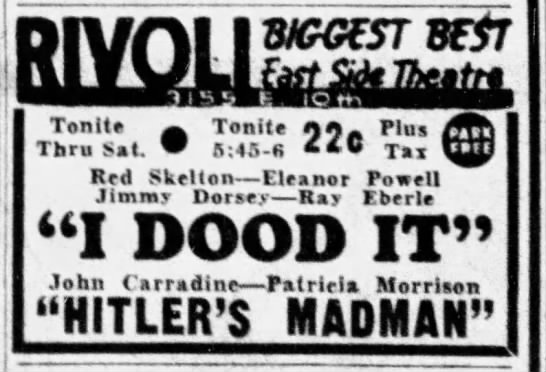
Before are a couple of more newspaper ads from 1943. I confess I was amused that the very serious, somber "Hitler's Madman" was paired in a double-feature with the Red Skelton comedy, "I Dood It." I guess audiences came to laugh and cry.


-- Doug Gibson